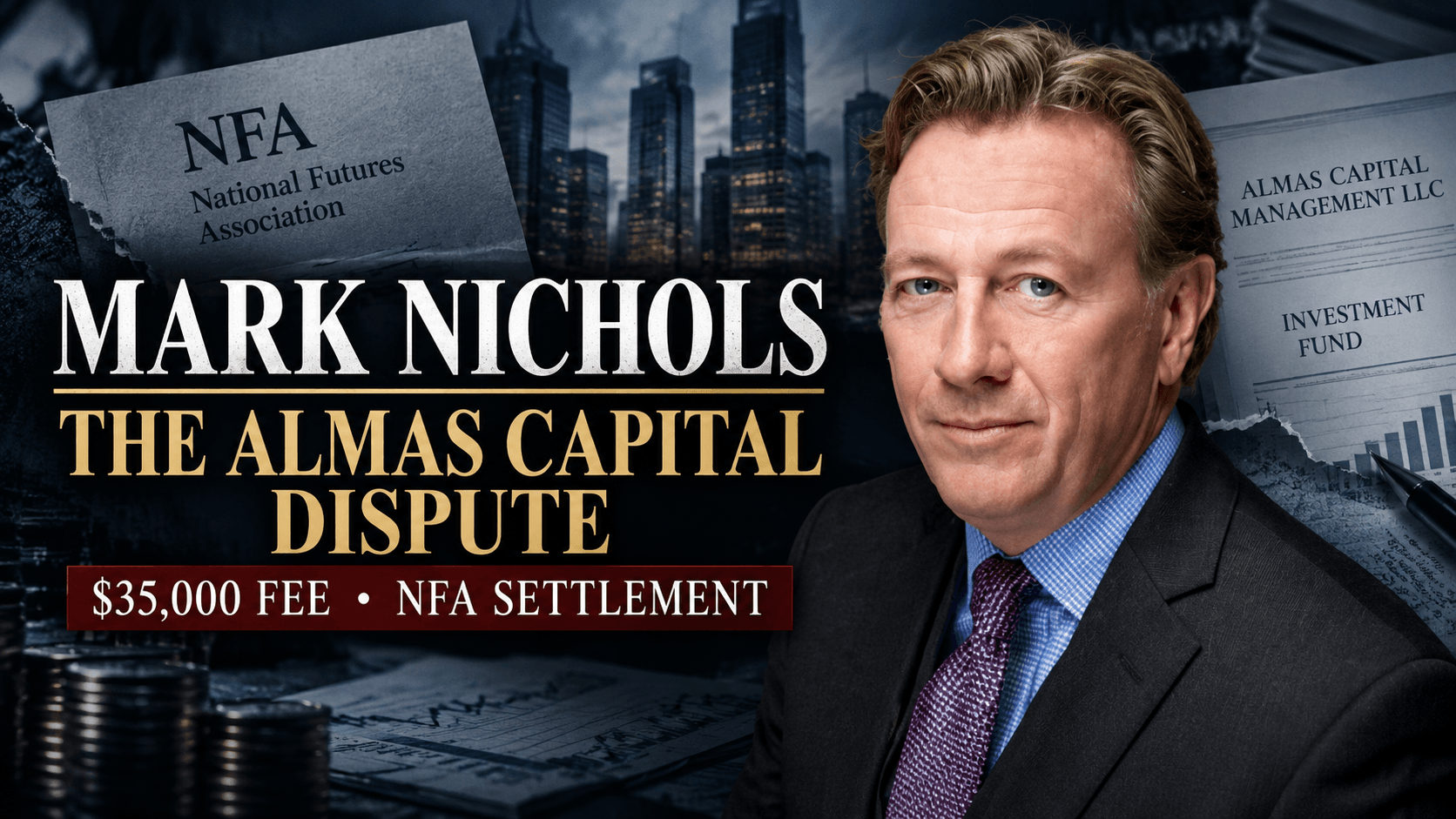
The case involving Mark Gerard Nichols and Almas Capital Management raises a question that every prospective investor and investment professional should ask before paying an upfront fee: what happens when promised investment capital never materialises, the company behind the offer faces regulatory scrutiny, and the person making the promises disputes the allegations?
In 2018, the US-based National Futures Association (NFA) began investigating information that Nichols had been soliciting individuals to become trading managers for an Irish investment vehicle called Almas Global Opportunities ICAV. According to the regulator’s subsequent complaint, the pitch involved a $35,000 onboarding fee and a promise that $20 million in funding from Middle Eastern investors would become available for trading. One individual who paid the fee reportedly received no allocation of trading capital and considered the payment lost. The NFA ultimately brought an administrative action against Nichols and his company, Almas Capital Management LLC, alleging failures to cooperate with its investigation. The matter ended in May 2019 with an agreement restricting their ability to reapply for NFA membership or act as a principal of an NFA member. The settlement did not amount to a criminal conviction for fraud.
The allegations were serious, but the distinctions between an allegation, a regulatory finding and a criminal conviction matter. Nichols denied the NFA complaint, maintained that he had cooperated with the regulator and subsequently challenged the reporting about him through a lawyer’s letter dated November 1, 2019. His account deserves to be considered alongside the allegations and documentary record.
The first major issue was the difference between the funding Nichols reportedly promised and what the prospective trading managers said they actually received. The NFA’s investigation began after it received information in June 2018 about the proposed arrangement. According to the regulator’s complaint, several individuals had reportedly paid money, including an NFA-member commodity trading adviser who confirmed paying $35,000 in April 2017 to become a trading manager associated with the Almas investment vehicle. That adviser told the NFA that no trading capital had been allocated and that the fee was lost. The complaint described a potential advance-fee fraud, but that description was an allegation under investigation, not a criminal judgment establishing fraud.
The regulator also raised questions about how money received by Almas Capital Management had been used. In the account described in the complaint, Nichols produced bank statements showing more than $100,000 in receipts, with disbursements exceeding that amount. By the end of September 2018, the account reportedly had a balance of negative $13.25. The NFA alleged that substantially all the disbursements appeared to be for Nichols’ personal use rather than for establishing a fund or conducting related business. Those statements raised questions about the handling of the money, but the published account does not establish the total amount of money paid by every prospective trading manager or prove that all receipts represented investor losses.
The investigation’s breakdown was another central issue. The NFA said it interviewed Nichols at its New York office on October 31, 2018 and asked about the use of funds deposited into the company’s bank account. According to the complaint, Nichols declined to answer questions about the money, ended the interview and left the office. The regulator further alleged that he failed to respond to multiple subsequent requests for information and documents. Nichols disputed that account. In his January 28, 2019 response, he denied the allegations and maintained that he had fully cooperated with the NFA.
The dispute also involved the legal status of Almas Global Opportunities ICAV. The vehicle was incorporated in Ireland on May 29, 2018, but OffshoreAlert reported that the Central Bank of Ireland had confirmed it was not authorised by the regulator to conduct business as an ICAV. The reported directors at incorporation were Nichols, Brian Dunleavy of Raheny, Dublin, and David McGeough of Killiney, Dublin. Incorporation and regulatory authorisation are different things: registration as a corporate entity does not, by itself, establish permission to operate a regulated investment fund. This distinction was particularly important because the proposed onboarding arrangement was tied to a vehicle presented as the destination for trading managers and their anticipated allocations.
The consequences of the NFA case were specific. On May 29, 2019, a hearing panel accepted an offer from Nichols and Almas Capital Management under which they would not reapply for NFA membership or act as a principal of an NFA member. The case was therefore concluded through a regulatory settlement. The available reporting does not establish that Nichols pleaded guilty to criminal fraud, was convicted of fraud, or was ordered to pay a criminal fine in this matter. His lawyer later emphasised precisely that point: no fines or further actions had been imposed as a result of the NFA case, and the regulator’s complaint concerned cooperation with its investigation. The settlement nevertheless remains a material regulatory outcome, and it should not be confused with an exoneration on every factual allegation raised during the investigation.
The NFA allegations were not the only disputes documented in reporting about Nichols’ business history. British company records show that Almas Capital Investments Ltd, company number 07004036, entered voluntary liquidation in 2011 and was dissolved in November 2013. Reporting based on the liquidators’ filings described difficulty obtaining information from Nichols about the earlier Almas group’s financial position. Joint liquidator Cameron Gunn reportedly said that unsuccessful attempts to contact Nichols hampered recovery efforts and made it difficult to reconstruct the companies’ finances. The reported records did not establish the total amount raised from investors or where all the funds went. That lack of clarity is significant, but it is not proof, by itself, that money was misappropriated.
Earlier financial disputes also included a $25,000 claim brought in New York in 2016 by Jason Ungar, described in reporting as the Almas group’s former chief investment officer. Ungar said the money was a short-term loan that had not been repaid when due. Nichols disputed the characterisation, arguing that the money was an investment in the Almas group and accusing Ungar of impropriety. The dispute was settled with Nichols agreeing to pay the $25,000 sought. A settlement resolves a claim but does not necessarily establish that every allegation made by either side was true.
Another civil dispute involved Mark Abeshouse and Augustus Advisors LLC, who sued Nichols and Almas Capital Management in New York in 2016. According to the complaint described by OffshoreAlert, the plaintiffs sought $15,000 in damages, alleging breach of contract, unjust enrichment and fraud. They said the money had been paid as a refundable onboarding fee in exchange for a customised investment-fund structure and a guaranteed initial allocation of $5 million. They alleged that no funding was provided and the fee was not returned. These were civil claims, not criminal findings. The materials reviewed for this article do not establish a final judgment resolving that case, so its ultimate outcome should not be assumed.
There were also landlord-tenant disputes in Connecticut. In one case, a landlord sued Nichols, his wife Laura Nichols and Almas Group over a rented townhouse, alleging that the occupants had failed to leave at the end of their lease. The case was settled in August 2016, with Nichols agreeing to pay $13,600 in unpaid rent and vacate the property. In a subsequent dispute involving a New Canaan house rented for $7,500 per month, the landlord pursued eviction proceedings after alleging non-payment. A further complaint was filed in December 2018, and reporting said a default order was entered against the defendants in February 2019. These were housing disputes, not findings of investment fraud, but they formed part of the financial and litigation history reported at the time.
A further strand of the story concerned Almas Nexus, a Connecticut-based venture described at the time as an alternative-investment fintech platform. Nichols was identified in reporting as its managing partner and chief executive, while Steve Dewsnip was presented as head of strategic partnerships. The venture’s claimed commercial connections included an agreement with Bahrain’s Economic Development Board and participation by an Almas-related company in Connecticut’s angel-investor tax-credit programme. A 2017 state list identified Almas Capital Management LLC as an applicant seeking $1.8 million in investment through convertible debt. Inclusion on a qualified-company list is not proof that the company actually raised that amount, received government funding or delivered the proposed investment returns.
Dewsnip’s background later attracted separate regulatory scrutiny. OffshoreAlert reported in October 2024 that Guernsey’s financial regulator had banned him from the regulated financial services industry because he failed to meet the minimum criteria for licensing. Earlier reporting had linked him to Providence Financial Group, whose collapse was investigated as a major investment fraud. Those matters provide context for the wider network of people associated with the Almas ventures, but they should not be treated as evidence that Nichols committed wrongdoing merely because he worked with Dewsnip. Nor should Dewsnip’s separate regulatory outcome be attributed to Nichols.
Nichols has offered a forceful counterargument to the coverage. In a November 1, 2019 letter sent by Nelson Mullins attorney W. David Mannheim to OffshoreAlert editor David Marchant, his legal representatives demanded that several articles be removed and that the letter itself be published. The letter disputed the description of Nichols as an Irish conman, argued that the reporting had falsely implied he violated NFA rules, and said the regulator had found no merit to the fraud claims. It also stated that Nichols had never traded futures, options, derivatives or securities, that Almas was an international advisory group, and that the company had never handled investor money or suffered investor losses. The letter characterised the articles as defamatory and threatened legal action if the demands were not met. These are the client’s stated positions, not independent findings that the reporting was false. The letter itself does not establish whether the threatened litigation was subsequently filed or how any such dispute was resolved.
There is an important distinction between the legal representative’s claim that Almas never handled investor money and the NFA complaint’s account of more than $100,000 in receipts and a bank account used by Almas Capital Management. The NFA also recorded a report from an NFA-member adviser who said it paid $35,000 and received no trading allocation. Resolving that conflict fully would require examining the underlying bank records, the complete administrative record, and any subsequent court filings. The public material reviewed here does not justify claiming that every allegation against Nichols was proven, but neither does the existence of a denial make the regulator’s documented concerns disappear.
The same caution applies to Nichols’ age, nationality and present whereabouts. Contemporary reporting described him as 56 in 2019, but that is a historical age, not a verified current one. His attorney expressly disputed the description of him as Irish, so nationality should not be asserted as settled fact on the basis of those articles. Searches for later public records did not establish a reliably verified current residence, a confirmed present executive position, or a comprehensive account of what became of every Almas-branded entity. The available evidence supports a detailed account of the historical regulatory and civil disputes, not a confident claim about his current activities in 2026.
The case offers a practical lesson for anyone asked to pay an upfront fee in return for access to investment capital. A promise of millions in future funding is not the same as committed capital, a corporate registration is not the same as regulatory authorisation, and a polished investment platform is not a substitute for independently verified assets, counterparties and financial records. Prospective trading managers and investors should verify a fund’s status directly with the relevant regulator, establish who controls the receiving account, insist on written and enforceable fee terms, and independently confirm that promised allocations exist before transferring money.
The outcome here was not a criminal conviction, and Nichols’ denials must remain part of the public record. But the documented $35,000 payment dispute, the regulator’s concerns about the use of funds and cooperation, the restriction accepted in the NFA settlement, and the earlier corporate and civil litigation history make this a case worth understanding. In investment markets, the most consequential warning signs are often not a single proven crime but the gap between what a business promises, what its records demonstrate and what prospective clients can independently verify.
Source :
OffshoreAlert
————-
Disclaimer:
Some content on Reportingscams.com is published under our guest post program and is provided by third-party contributors. Reporting scams does not create, verify, or take responsibility for the views, accuracy, or claims expressed in such content.