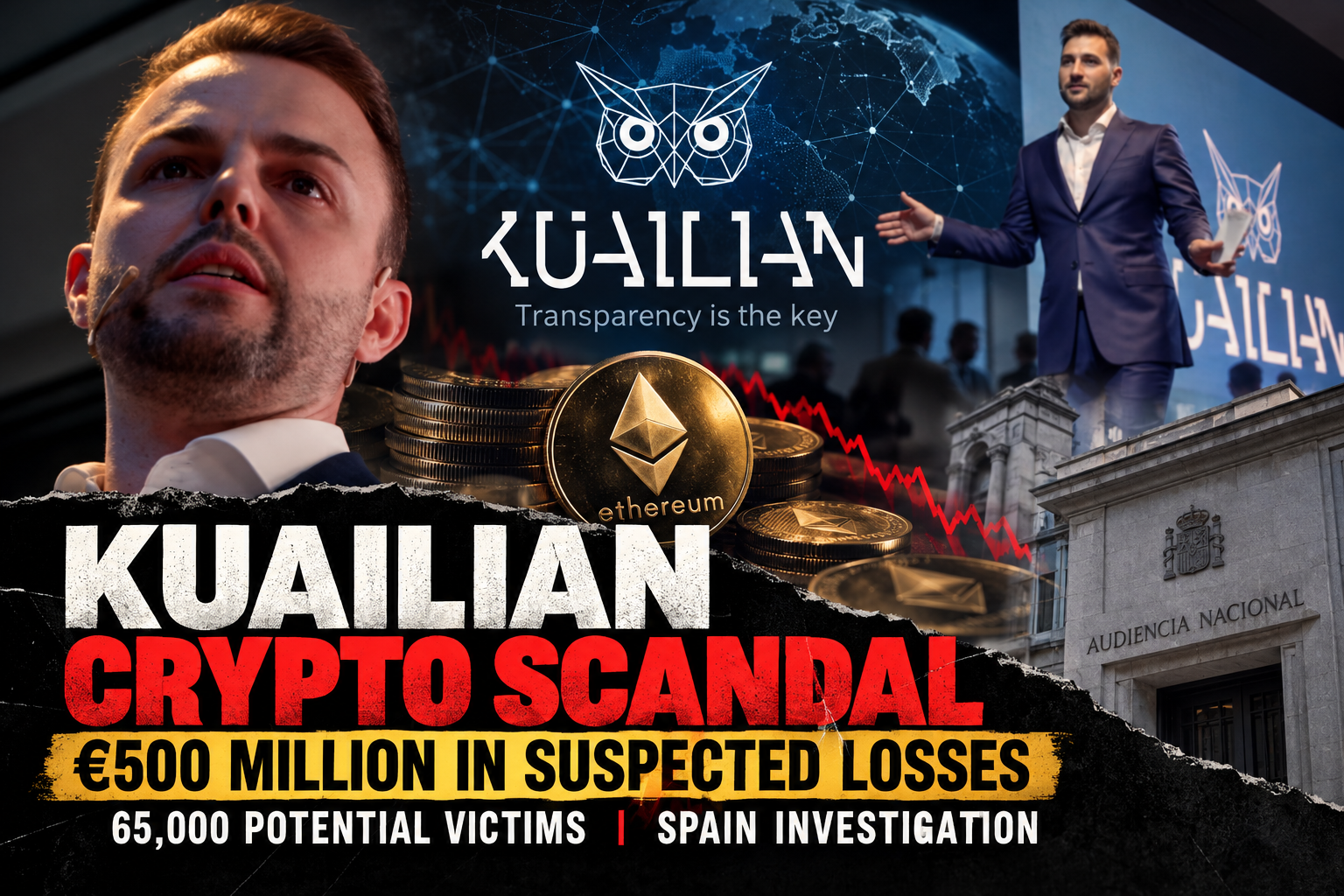
A cryptocurrency investment platform that promised investors a way to earn money from blockchain technology is at the centre of a major Spanish criminal investigation, with authorities examining suspected fraud, money laundering and a financial structure prosecutors believe may have depended on recruiting new investors. The case concerns Kuailian, a platform that attracted participants internationally before withdrawals, falling returns and disputed exit arrangements triggered mounting complaints. Investigators have cited preliminary estimates of approximately 65,000 potential victims and €500 million in alleged financial harm. Those figures remain estimates, not a final court-established accounting of losses, and no conviction has been verified in the latest reporting reviewed for this article.
At the centre of the investigation is David Ruiz de León García Vao, identified in Spanish media as a founder of Kuailian, alongside business associates including Cristian Albeiro and Miguel Ángel Tello Encinas. The platform operated through Kuailian App OÜ, an Estonian-registered company that Spanish judicial reporting says conducted its business from Spain. Public reporting reviewed for this article does not establish the founders’ current ages, and it would be misleading to supply unverified biographical details. The more consequential questions concern how the platform solicited cryptocurrency, what investors were told about returns and where the money went.
Kuailian gained traction during the cryptocurrency boom of 2019 and 2020. Its pitch centred on an investment product called “kuais”, purchased using Ethereum, with contracts reportedly running for 1,000 days. The company presented the arrangement as a way for customers to participate in cryptocurrency-related operations without having to manage the underlying technology themselves. Its explanation referred to masternodes, specialised servers that perform functions on certain blockchain networks and may earn rewards for doing so.
The concept itself is legitimate. Masternode operators can receive cryptocurrency rewards, depending on the network, its rules and operating costs. The central issue in the Kuailian case is whether the platform’s actual operations could generate the returns used to attract investors and whether customer funds were deployed as represented. In January 2020, the specialist publication BehindMLM questioned the transparency of Kuailian’s ownership, its investment model and its recruitment-based compensation structure. The publication also challenged the plausibility of the returns being promoted. These were investigative criticisms, not judicial findings, but they appeared well before the later criminal proceedings and growing withdrawal complaints.
Returns were a powerful selling point. A March 2021 investigation by Spanish newspaper El Confidencial reported investor accounts describing advertised monthly returns ranging from roughly 6% to nearly 20%, depending on the purported investment option. One investor, identified by the pseudonym Patricia, said she had invested approximately 40 ETH in late 2019. The report described how some participants initially believed the system was functioning because payments arrived, only to become increasingly concerned as returns declined and the conditions for recovering their investments became contentious.
Those advertised figures deserve scrutiny. A hypothetical investment compounding at 10% each month would more than triple in a year, while 20% monthly compounding would produce a much larger increase. Such calculations do not establish fraud, but they highlight the economic burden of sustaining the promises. A business relying on real cryptocurrency infrastructure must generate sufficient returns after expenses and market fluctuations. The judicial question is whether Kuailian could do that, rather than simply whether its promotional material contained ambitious projections.
The compensation system added another layer of concern. According to BehindMLM’s January 2020 review, affiliates could earn commissions on investments made by people they recruited, as well as on activity further down their referral networks. The reported commission schedule began at 10% for direct recruits, followed by 3% at the second level and 2% at the third, with smaller percentages across additional levels. Spanish court reporting later described a structure in which commissions could total as much as 20% of an investment, depending on the applicable levels and terms.
Referral payments are not inherently unlawful. Companies routinely compensate affiliates for bringing in customers. The critical question is whether recruitment supports a genuine, revenue-generating product or becomes essential to paying earlier investors. In the Kuailian proceedings, the investigating judge reportedly suspected that new participants’ contributions helped finance repayments and purported profits for earlier investors. That allegation became central to the suspected pyramid-style model. It remains an allegation requiring proof about the actual movement of funds and the operation’s finances.
By 2021, complaints were becoming harder to ignore. Investors interviewed by El Confidencial described declining payments, changing terms and difficulty recovering the Ethereum they had deposited. Some also objected to a proposed early-liquidation arrangement that reportedly calculated repayment using the value of their original contribution rather than necessarily returning the same quantity of cryptocurrency. The distinction matters: the value of one ETH can change substantially over time, so a repayment based on its historic cash value is not equivalent to receiving that ETH back.
The platform’s difficulties became more public in September 2021, when Kuailian reportedly outlined options for investors as it moved away from its existing model. BehindMLM reported that the company’s communications coordinator, Fanis Anamourlis, attributed the problems to cryptocurrency market conditions and discussed alternatives involving liquidation, continuing existing contracts or accepting a staged repurchase arrangement. The publication sharply criticised those options and disputed the company’s explanation. Its characterisation of the platform as a Ponzi scheme was the outlet’s assessment, not a final criminal conviction. Nevertheless, the proposed arrangements did little to resolve the fundamental concern reported by investors: whether they could recover their original capital.
The case subsequently moved into Spain’s National High Court. According to Europa Press, the judicial investigation opened in 2021 and examined suspected aggravated fraud, money laundering, possible falsification offences and alleged criminal organisation activity. In May 2022, authorities reported four arrests associated with the case. The investigation’s preliminary estimates described approximately 65,000 potential victims worldwide and financial harm of around €500 million. Investigators also examined transactions passing through Spanish and foreign companies and accounts, reportedly questioning whether all customer funds had been invested in the activities described to participants.
Two figures associated with the platform became particularly important to the proceedings: Ruiz de León and Albeiro. In June 2022, Europa Press reported that the judge rejected their request to testify by videoconference from Abu Dhabi and maintained the requirement for them to appear in Spain. The report described both men as investigated in the suspected fraud case. Subsequent reporting said they failed to attend earlier summonses and that Spanish authorities pursued international arrest measures. These procedural steps do not establish guilt, and the reasons presented by the defence must be distinguished from the judge’s assessment.
Tello, another individual identified as a founder, gave evidence remotely from Alicante in July 2022, according to Europa Press. He reportedly said he had contributed a customer network but distanced himself from the platform’s technological operation, explaining that he had left after disagreements with his associates. His account is important because the investigation involves multiple people whose responsibilities and knowledge must be established individually. Association with a company is not, by itself, proof that someone participated in criminal conduct.
The financial questions have persisted. In September 2025, Europa Press reporting published by Infobae said the court had blocked approximately €17 million in cryptocurrency associated with the investigation. The report also described a €3 million security requirement imposed on Albeiro under conditions for travelling to Spain to testify, with the hearing rescheduled for 12 November 2025. The reported measure was conditional and procedural; it should not be confused with a fine, a final confiscation or a finding that the amount represented stolen money.
There is also an important later procedural record. Spain’s General Council of the Judiciary, in its annual report covering 2024, listed the Kuailian proceedings among cases with outstanding investigative steps, including international judicial assistance involving Seychelles, statements from investigated individuals and reports from a public-finance expert. This confirms that substantial evidentiary work remained. The latest case-specific reporting identified for this article is from September 2025; the materials reviewed did not establish the outcome of the scheduled November hearing or verify a final judgment as of October 2026.
Investors have also left a limited public trail of complaints. Kuailian’s Trustpilot profile displays six reviews, all rated one star, and a displayed TrustScore of 2.3 out of five. Reviews include claims of lost investments and warnings about the platform. These posts illustrate the concerns expressed by individual users, but they are not independently audited evidence of total losses, and Trustpilot itself cautions that the reviews may not be representative.
The Kuailian case matters because it exposes the gap between an attractive cryptocurrency narrative and the financial evidence needed to support it. Blockchain terminology, sophisticated marketing and a network of enthusiastic promoters cannot establish that an investment generates sustainable profits. Nor do complaints or preliminary allegations alone prove criminal guilt. The answer depends on records showing how money moved, what investors were promised, what the platform actually earned and who made the relevant decisions. Until the courts establish those facts, the estimated €500 million in harm remains a serious warning rather than a final verdict. For anyone considering a high-return cryptocurrency scheme, the essential lesson is to verify the underlying business, the people controlling the funds and the legal status of the investment before sending money that may be impossible to recover.
————-
Disclaimer:
Some content on Reportingscams.com is published under our guest post program and is provided by third-party contributors. Reporting scams does not create, verify, or take responsibility for the views, accuracy, or claims expressed in such content.