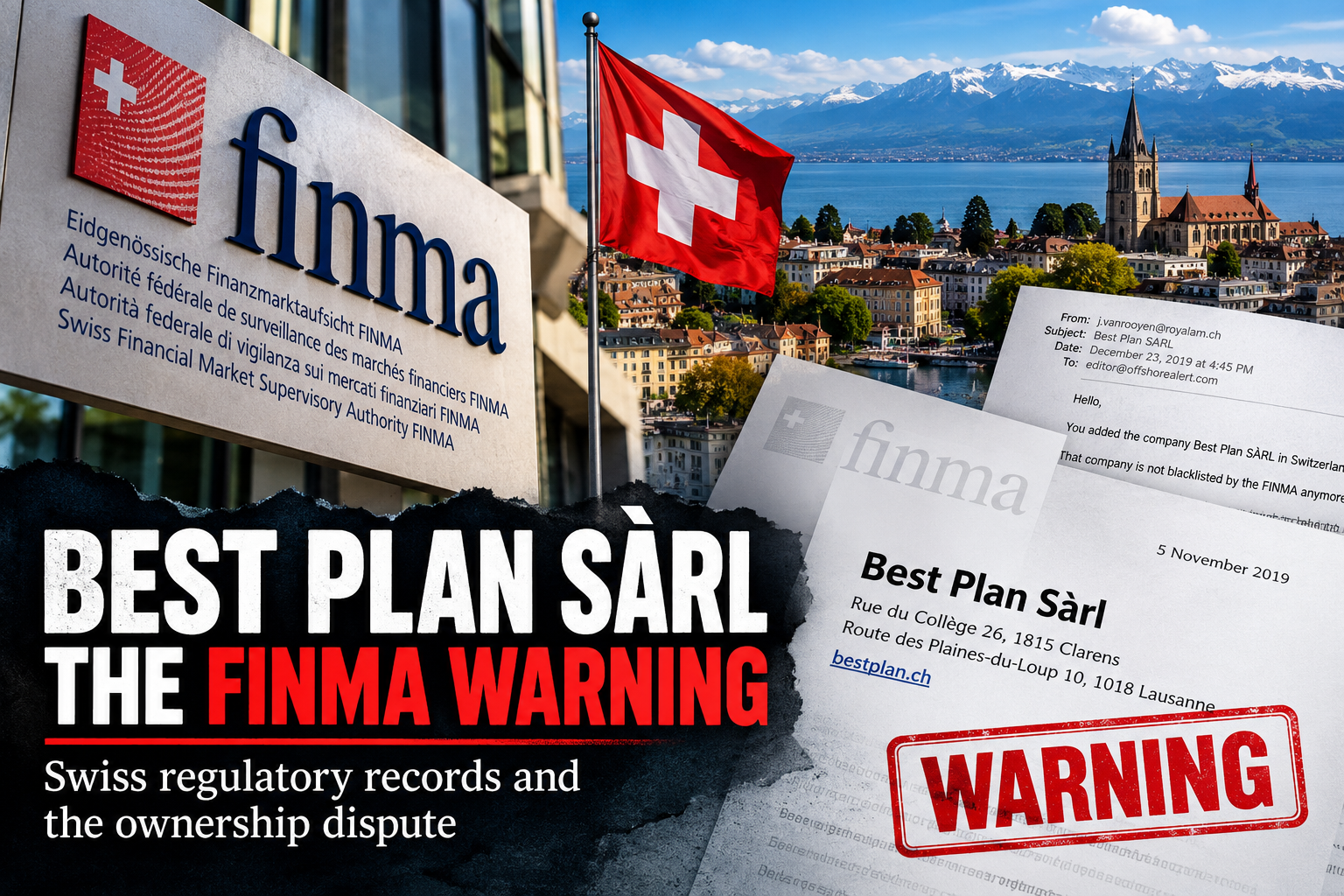
A Swiss financial services consultancy, Best Plan Sàrl, came under regulatory scrutiny in November 2019 when the Swiss Financial Market Supervisory Authority (FINMA) added the company to its public warning list. The entry raised questions about whether the business was conducting financial activities without the necessary authorisation. Within weeks, the case took another turn when Jeff Van Rooyen, a representative associated with Royal Asset Management SA, asked the investigative publication OffshoreAlert to remove references to the company, himself and his business. The correspondence exposed a dispute over regulatory status, corporate relationships and how financial warnings should be reported to the public.
FINMA’s warning list is intended to alert investors, creditors and policyholders to potential risks in the financial market. Its November 5, 2019, entry identified Best Plan Sàrl as a registered company. A record supplied from FINMA’s website lists its domicile as Rue du Collège 26, 1815 Clarens, Switzerland, and another address at Route des Plaines-du-Loup 10, 1018 Lausanne. The company website was listed as bestplan.ch. These details establish what the regulator’s published record contained at the time, rather than the company’s present operating status.
The distinction between a regulatory warning and a finding of fraud is important. FINMA explains that inclusion on its warning list does not automatically mean a company’s activities are illegal. The list identifies businesses suspected of offering financial services without the required authorisation, including cases where the regulator has been unable to clarify its suspicions because information was missing or unreliable. The warning is therefore a serious reason for prospective clients to investigate a provider’s credentials, but it is not, by itself, proof of criminal conduct. No conviction, criminal charge, investor-loss figure or financial penalty against Best Plan Sàrl is established by the documents reviewed for this article.
Contemporary reporting by Citywire Switzerland described Best Plan as a consultancy focused on consolidating services in areas including insurance, real estate and precious-commodity trading. That combination of activities made the question of regulatory permissions particularly relevant. Depending on the specific services offered, financial businesses may need approval from the appropriate Swiss authorities. The available reporting, however, does not establish which particular transaction or service triggered FINMA’s action, how many clients were involved or whether anyone lost money.
The corporate record adds another important detail. Swiss commercial-register notices published in October 2019 show that Jonathan Schneiter transferred his 20 shares, each valued at CHF 1,000, in Best Plan Sàrl to Royal Asset Management SA, which became the company’s shareholder. A subsequent notice dated January 10, 2020, records the transfer of those same 20 shares from Royal Asset Management SA back to Schneiter, who became the shareholder again. The entries document a change in ownership, not a finding of misconduct by either party.
On December 23, 2019, Van Rooyen emailed OffshoreAlert to challenge the publication of the warning and the associated references to his business. In the letter, he said Best Plan Sàrl was no longer on FINMA’s warning list because it had submitted all the required forms and was, in his words, “completely clean.” He also objected to the identification of Royal Asset Management SA and himself in connection with the case, saying neither was directly linked to Best Plan’s activities. He asked for their names to be removed from articles, forums and other online material, arguing that the information was damaging their reputations.
Van Rooyen’s letter provides evidence that the request was made, but it does not independently establish that FINMA had cleared the company, explain what documents were submitted or show whether the regulator formally concluded its inquiries. Nor does the letter establish that OffshoreAlert removed the material. Those questions require confirmation from the regulator, the companies involved or the publication itself.
The available records also do not establish Van Rooyen’s age, a complete professional history, his current position or whereabouts, or whether he remains associated with Royal Asset Management SA. They provide no verified account of investor complaints, client losses, settlements, disgorgement, criminal proceedings or penalties connected to the matter. Such details should not be inferred from a warning-list entry or a request to remove reporting.
The case illustrates a recurring challenge in financial journalism. A regulator’s warning can be essential information for people deciding where to place their money, yet a warning must not be presented as a criminal conviction. Equally, a company’s claim that it has resolved a regulatory concern should be checked against official records rather than accepted as conclusive.
For anyone considering a financial adviser or investment-related service, the practical lesson is straightforward: verify authorisation directly with the regulator, establish which legal entity would handle the money and ask for written evidence of any claimed regulatory clearance. A company’s registration in a commercial register is not the same as permission to provide every type of financial service.
The Best Plan Sàrl episode leaves a clear documentary trail of a FINMA warning, changes in share ownership and a subsequent request to correct or remove published information. What the available evidence does not provide is proof of fraud or a definitive account of the regulator’s final findings. That distinction matters. Investors deserve timely warnings about potential risks, while the people and companies named in those warnings deserve reporting that accurately reflects what regulators have—and have not established.
Source:
OffshoreAlert
————-
Disclaimer:
Some content on Reportingscams.com is published under our guest post program and is provided by third-party contributors. Reporting scams does not create, verify, or take responsibility for the views, accuracy, or claims expressed in such content.