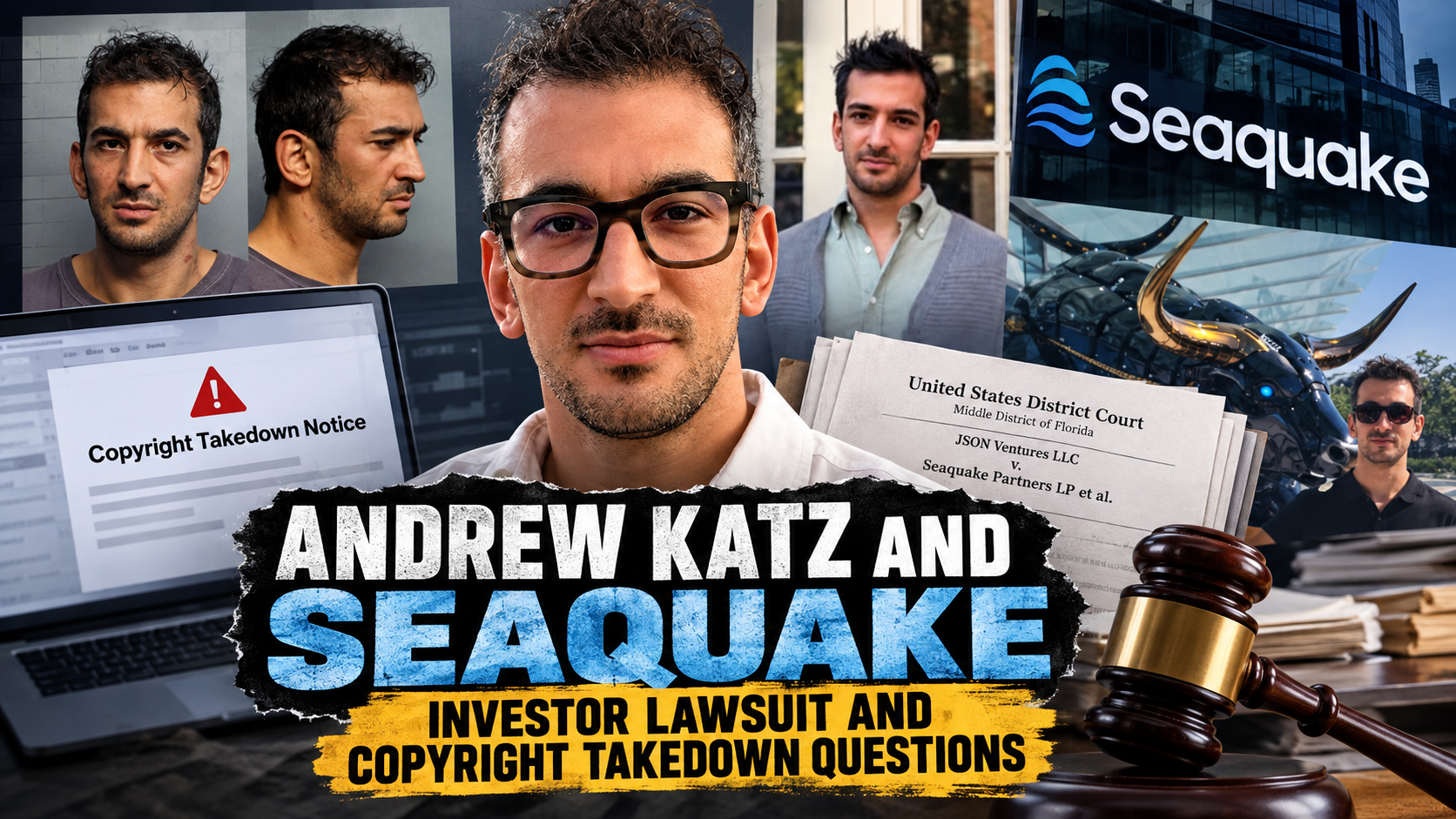
The cryptocurrency industry has always sold a vision of opportunity: sophisticated technology, new financial infrastructure and the possibility of building something valuable before the rest of the market catches up. But when a startup asks investors to trust its founders, the claims behind that pitch matter just as much as the technology itself. The history surrounding Andrew Katz and Seaquake raises questions about investor disclosures, corporate accountability and the use of copyright complaints to push critical reporting out of search results.
Katz has presented himself publicly as a cryptocurrency entrepreneur and co-founder of Seaquake, a business described as providing infrastructure, liquidity and technology for digital-asset markets. His online professional profiles have identified him as the company’s chief executive, while startup accelerator SOSV has also listed Seaquake in its portfolio and identified Katz as CEO. A 2022 interview published by IdeaMensch described him as a Harvard graduate and discussed his ambitions for the business.
Yet a very different picture emerges from a 2019 federal lawsuit and subsequent reporting by MarketsMuse. Those sources describe disputes over investor representations, the movement of funds and the professional credentials attributed to Seaquake’s leadership. Later reports raised separate concerns about criminal proceedings involving Katz and an apparent effort to remove critical online material through copyright claims. These are serious matters, but they must be assessed individually rather than treated as proof of a single overarching allegation.
The corporate dispute entered federal court in September 2019, when JSON Ventures LLC sued Seaquake Partners LP, Seaquake Ink, Seaquake Manager LLC, Seaquake Inc., Katz, Matthew Krueger and Dylan Knight in the U.S. District Court for the Middle District of Florida. The docket identifies the case as JSON Ventures LLC v. Seaquake Partners LP et al., case number 8:19-cv-02365. MarketsMuse reported that the underlying complaint alleged fraudulent representations connected to an investment in Seaquake.
According to MarketsMuse’s account of the complaint, investors were presented with a business developing cryptocurrency-trading and asset-management software. The publication said the pitch included claims that prospective institutional clients were interested in licensing the technology and that venture investors had expressed interest in funding the company. The complaint reportedly challenged those representations, including claims about the software’s development status and the company’s investment prospects. Those assertions originated in a civil dispute; they should not be described as findings established at trial.
One of the central issues was reportedly a SAFE agreement, a financing instrument through which an investor receives a contractual right to equity in a future financing or other specified event. It is not the same as immediately receiving ordinary shares. MarketsMuse reported that the investors believed their money would support a high-frequency trading application, but were subsequently told that the application was not yet in production. The publication also reported allegations concerning the representations made about prospective investors and the handling of the money.
The available record establishes that litigation occurred, but it does not establish a final judicial finding that Katz or his associates committed investor fraud. The case’s procedural history is particularly important. According to the federal docket reproduced by Justia, the court issued a temporary restraining order on October 1, 2019. On November 5, 2019, it denied the plaintiff’s amended motion for a temporary restraining order and preliminary injunction, lifted the earlier order and dismissed the case without prejudice.
A dismissal without prejudice generally means the case was terminated in a way that does not itself bar a new action on the same claim. It is not a finding that the plaintiff’s allegations were true, nor does it necessarily establish that the allegations were false. The docket information reviewed here does not resolve the underlying accusations through a final merits judgment. Any account of Seaquake’s fundraising must therefore preserve that distinction.
The people and entities surrounding the dispute also warrant careful scrutiny. The federal case named Krueger and Knight alongside Katz, as well as four Seaquake-related business entities. MarketsMuse identified Krueger as a finance executive and Knight as a co-founder associated with technology development. Their inclusion as defendants in a civil complaint does not, by itself, establish personal liability or criminal wrongdoing. The same standard applies to any investor, adviser or business associated with Seaquake: a name appearing on a company website is not proof that the person knew about, participated in or endorsed misconduct.
A second controversy emerged around Katz’s reported criminal proceedings. MarketsMuse published accounts in 2021 and 2022 describing New York charges involving assault, grand larceny and aggravated harassment. Its February 2022 report stated that Katz had been convicted of an assault charge on February 7, 2022, and alleged that he subsequently failed to appear and was sought by police. The reporting also described a separate arrest in Florida and additional charges.
These are consequential claims about an identifiable person. However, the primary New York criminal judgment, sentencing record and current warrant status were not independently established from an accessible official case file during this review. The reported conviction should therefore be attributed to MarketsMuse rather than presented as independently verified here. The additional charges must likewise remain distinct from a conviction, and the present whereabouts of Katz cannot responsibly be stated as fact on the basis of older reports alone.
The most direct connection to the supplied Gripeo article concerns copyright complaints. Published on July 9, 2024, the article identifies a notice dated March 23, 2021, attributed to a sender named Tomas Ross. It links the notice to a Lumen Database record and identifies a Global Express Media News page as the purported original and a MarketsMuse article about felony assault charges as the targeted material. Gripeo argues that the notice was fraudulent because the supposed original was a later copy of the reporting it sought to suppress.
The alleged technique is sometimes described as a backdated-content takedown. A party creates or republishes a copy of an existing article, presents it as the original copyrighted work and then asks a platform or search engine to remove the earlier, legitimate report as an infringement. If the claim succeeds, the targeted page can disappear from search results even though the person making the complaint may not own the copyright in the material.
The distinction matters because the Digital Millennium Copyright Act provides a legitimate mechanism for copyright holders to request removal of infringing content. The U.S. Copyright Office explains that the notice-and-takedown framework is designed to address copyright infringement on online services. It is not a general-purpose mechanism for suppressing criticism, complaints or reporting that a subject dislikes.
Gripeo says its wider examination identified hundreds of suspicious notices and that Google’s transparency information indicated a negative review concerning Katz had been removed or targeted for removal. Its article characterises the notice linked to Katz as fake. That is the publication’s conclusion, not a court ruling establishing that Katz personally forged a document or committed a criminal offence. The available material does not independently establish who created the purported original page, who submitted the notice, whether Katz personally submitted it, or whether a court or law-enforcement agency has made a finding about the alleged conduct.
This limitation is crucial. A suspicious notice, a questionable website and a disputed investor transaction can justify further examination, but each link in the chain needs evidence. The identity of the notice sender, the account used to submit it, the copyright ownership asserted and the platform’s response are all relevant. Without that documentation, a journalist should not convert an inference about motive into an established fact.
There is also a gap between the public profile of Seaquake and the company’s independently verified current status. Startup and interview profiles describe its intended services, but historical promotional material cannot establish whether it is operating today, has active clients or has successfully commercialised its technology. Nor do the sources reviewed provide a reliable, independently confirmed current location for Katz or a verified present-day account of his professional activities.
Katz and the other named individuals should have a meaningful opportunity to respond to the allegations before publication. No independently verified, substantive response from Katz addressing the specific copyright-notice allegations was located in the sources reviewed for this article. That absence is not evidence of an admission. The same caution applies to the investor allegations: the accessible docket documents the litigation and its dismissal, but does not settle every factual dispute raised in the complaint.
The broader lesson reaches beyond one cryptocurrency startup. Investors need verifiable evidence of a company’s technology, signed financing documents, independently confirmed references and a clear explanation of where their money will go. Platforms need robust procedures to assess copyright claims without making it easy for fabricated evidence to silence legitimate reporting. And publishers have a responsibility to distinguish what a court has decided from what a litigant, a complainant or another news outlet alleges. In a market built on trust, accountability depends on evidence that survives scrutiny not polished founder biographies, ambitious product claims or attempts to make uncomfortable information harder to find.
————-
Disclaimer:
Some content on Reportingscams.com is published under our guest post program and is provided by third-party contributors. Reporting scams does not create, verify, or take responsibility for the views, accuracy, or claims expressed in such content.