Konstantin Grigoryevich Kagalovsky is a Russian-born businfessman whose career has moved through some of the most consequential financial and corporate networks of post-Soviet Russia. Born in Moscow on October 13, 1957, he is 68 years old as of September 2026 and has been described in public records as holding Russian and British citizenship. His background includes senior roles at Bank Menatep and Yukos and, more unusually, a period as Russia’s representative at the International Monetary Fund. The latest public legal correspondence located for this research, dated April 2024, describes Kagalovsky and his wife, Natalya Kagalovsky, as British citizens living in Italy. There is not enough reliable public evidence to establish his exact current location in 2026.
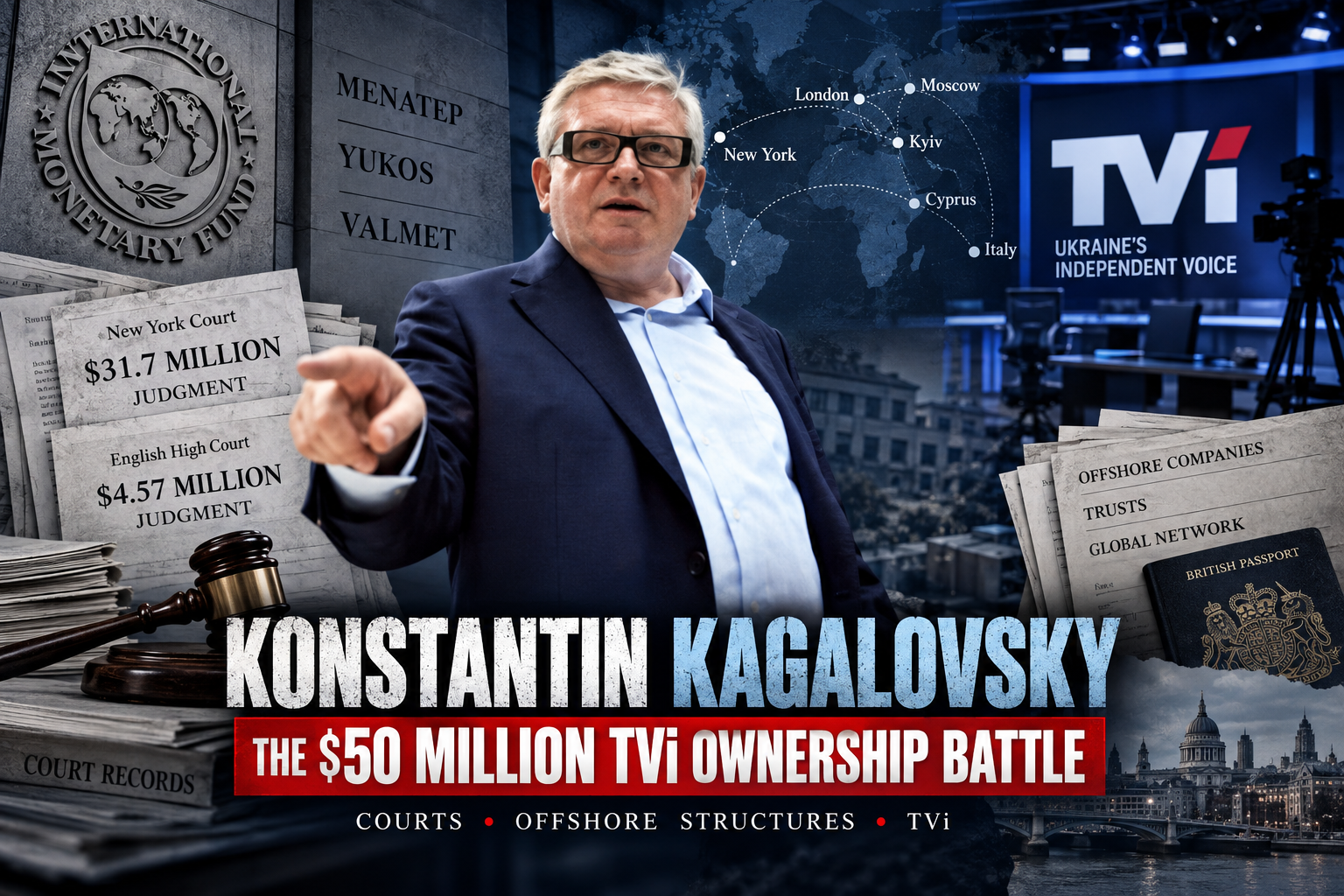
Kagalovsky’s early career placed him close to the group of economists who helped shape Russia’s transition from the Soviet system to a market economy. He earned a PhD in economics from the Moscow Finance Institute and worked at Soviet economic research institutions before becoming involved with Russia’s international financial relations. The IMF’s own historical records confirm that Konstantin G. Kagalovsky served as Russia’s Executive Director until October 31, 1994. He subsequently became deputy chairman of Bank Menatep, the financial institution associated with Mikhail Khodorkovsky and his business group, and later held senior positions connected to Yukos.
It was that financial network that first placed Kagalovsky’s name in the international press during the Bank of New York money-laundering investigation of 1999. U.S. and European authorities were examining billions of dollars moving through Bank of New York accounts linked to Russian banks and offshore companies. Contemporary reporting put the suspected flows at figures ranging from roughly $7.5 billion to $10 billion or more. Kagalovsky was not charged with money laundering, and the evidence reviewed for this article does not establish that he personally participated in laundering funds. His connection to the investigation was principally through Menatep and, more directly, through his wife Natasha Gurfinkel Kagalovsky, a senior Bank of New York executive responsible for Eastern European business who was suspended during the investigation and later resigned. The couple denied wrongdoing.
The historical record also connects Menatep and Kagalovsky’s wider business environment to Valmet Group, a Bermuda-registered fiduciary and corporate-services business. A contemporary report supplied for this investigation says Menatep had once owned 20 percent of Valmet and that Valmet-created companies were used as nominees in connection with Runicom, an oil-trading company. The report discussed Swiss and U.S. investigations into alleged Russian money laundering and an alleged scheme involving the diversion of profits from a Russian titanium producer. Crucially, the same report quoted Valmet’s director as saying that Valmet’s role was that of a nominee and recorded Mutual Risk Management’s chief executive saying that there was no Russian ownership of Valmet when MRM purchased it. The existence of these investigations and relationships should not be confused with a criminal finding against Kagalovsky personally.
The more concrete legal controversy involving Kagalovsky emerged from his business relationship with Russian media entrepreneur Vladimir Gusinski. In 2007 and 2008, the two men agreed to establish TVi, a Ukrainian television network. Kagalovsky took primary responsibility for the financial and corporate structure. Their partnership agreement provided for equal ownership, with Gusinski’s interest held through New Media Holding Company and Kagalovsky’s through Iota LP. The partners eventually invested about $24 million into the venture, roughly $12 million each.
The partnership collapsed in 2009. According to findings later reviewed by the New York appellate court, Gusinski offered to buy Kagalovsky’s 50 percent interest during a September 2009 meeting in London, but Kagalovsky refused. The court record says Kagalovsky subsequently sought to force Gusinski out by diluting the partnership’s ownership of TVi. Through a series of transactions involving offshore companies, more than 99 percent of TVi was transferred to entities ultimately controlled through Kagalovsky’s family trusts. The court recorded that Kagalovsky paid only $68,000 for the transfers. Gusinski was unaware of the transactions when they occurred and subsequently contributed another $850,000 to the partnership.
The corporate structure was complicated by design. Kagalovsky’s nominee was Iota LP, while companies including Aspida Ventures Ltd. and Seragill Holdings Ltd. were used in the ownership chain. TVi itself operated through Ukrainian entity TeleRadioSvit, or TRS, with intermediary companies in Cyprus and Ukraine. Grant Brown, who managed Kagalovsky’s trusts and business entities, and London solicitor Alexis Maitland Hudson were involved in establishing the structure.
The New York litigation lasted 24 trial days between December 2011 and April 2012. Justice Charles Ramos ruled in favor of Gusinski’s side. In September 2012, judgments totaling $31,732,541.85 were entered against Kagalovsky, Iota LP, Aspida and Seragill in the principal ownership dispute. A separate judgment of $4,571,059.54 was entered in favor of New Media Distribution Company over unpaid licensing obligations.
There is an important legal qualification. The 2014 New York appellate decision affirmed the $31.7 million judgment but modified the separate $4.57 million judgment by vacating the award against Kagalovsky personally. The appellate court held that the trial judge had incorrectly imposed personal liability on Kagalovsky for tortious interference and unjust enrichment in that action. It nevertheless upheld the main judgment arising from the ownership dispute.
The dispute did not end there. In England, New Media Distribution later brought proceedings under sections 423 to 425 of the Insolvency Act 1986, alleging that the transfer of TVi had been made at an undervalue to prejudice a creditor. By 2018, Kagalovsky’s defence admitted that he had effectively seized ownership of TVi, which was worth at least $50 million at the time, for less than $68,000. The High Court found that the transaction fell within section 423(1)(c) and ordered Kagalovsky to pay New Media $4,571,059.54, plus interest at the Bank of England base rate plus two percentage points.
That distinction matters. Kagalovsky was not criminally convicted over the TVi dispute. The findings were civil judgments concerning ownership, fiduciary obligations, transactions at undervalue and creditor prejudice. He contested aspects of the litigation, and the New York appellate court specifically rejected some of the claims that had initially produced personal liability against him. At the same time, the later English proceedings produced an additional judgment against him based on the statutory treatment of the disputed transfer.
The legal fallout also reached Maitland Hudson, Kagalovsky’s former solicitor. The SRA’s original 2016 prosecution notice alleged conflicts of interest, misuse of confidential information, attempts to take unfair advantage of another party, interference with a settlement, and misleading the regulator; at that stage, the SRA explicitly stated that the allegations remained unproven. The case subsequently went much further. The Solicitors Disciplinary Tribunal found Hudson guilty of serious misconduct and dishonesty and struck him from the roll in 2018. The High Court dismissed his appeal in January 2019. The court record specifically discussed the “Kagalovsky allegations” and stated that the tribunal found, to the criminal standard, that Hudson had assisted Kagalovsky in the TVi scheme and efforts to conceal what had occurred.
Kagalovsky’s name later resurfaced when control of TVi itself became the subject of another corporate fight. In 2013, businessman Alexander Altman claimed control through a series of corporate documents and a purported power of attorney. Kagalovsky and Wilcox Ventures denied authorizing the transfer and said the document was fabricated. The ensuing English litigation included contempt proceedings against Altman; a High Court judgment records that Altman was eventually sentenced to 18 months’ imprisonment for contempt. OCCRP separately documented the tangled ownership structure and reported that Kagalovsky denied any agreement with Altman.
As for Kagalovsky’s present activities, the public record is sparse. A French corporate database updated in 2026 lists him as an associate of Villa Mona, a French civil real-estate company whose declared activity is holding, managing and renting property, and also records him as an associate of Villa Corinne. Villa Mona remains active and lists Grant Brown as manager; Villa Corinne is likewise active. These records indicate continuing corporate links to property-holding structures, but they do not establish that Kagalovsky personally manages day-to-day operations.
The broader record therefore has to be read carefully. The 1999 money-laundering investigation generated substantial scrutiny around Kagalovsky’s financial and family connections, but no criminal charge against him has been established in the sources reviewed. The TVi dispute is different: multiple courts examined the transactions, a $31.7 million judgment against Kagalovsky and related entities was upheld, and an English court later treated the transfer as a transaction at an undervalue involving an asset worth at least $50 million. The record shows a businessman who moved through powerful Russian financial institutions, offshore corporate structures and international media ventures, and whose most consequential controversy ultimately became a matter of judicial findings rather than merely newspaper allegations. That distinction is important because the lasting lesson of the Kagalovsky story is not simply about one businessman. It is about how nominee companies, trusts, cross-border partnerships and offshore ownership structures can make it extraordinarily difficult for investors, business partners and courts to determine who actually controls an asset until the relationship has already broken down.
Source:
OffshoreAlert
————-
Disclaimer:
Some content on Reportingscams.com is published under our guest post program and is provided by third-party contributors. Reporting scams does not create, verify, or take responsibility for the views, accuracy, or claims expressed in such content.