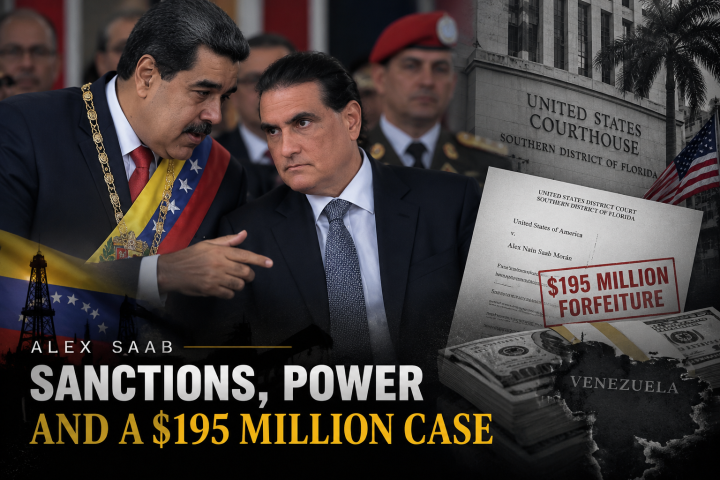
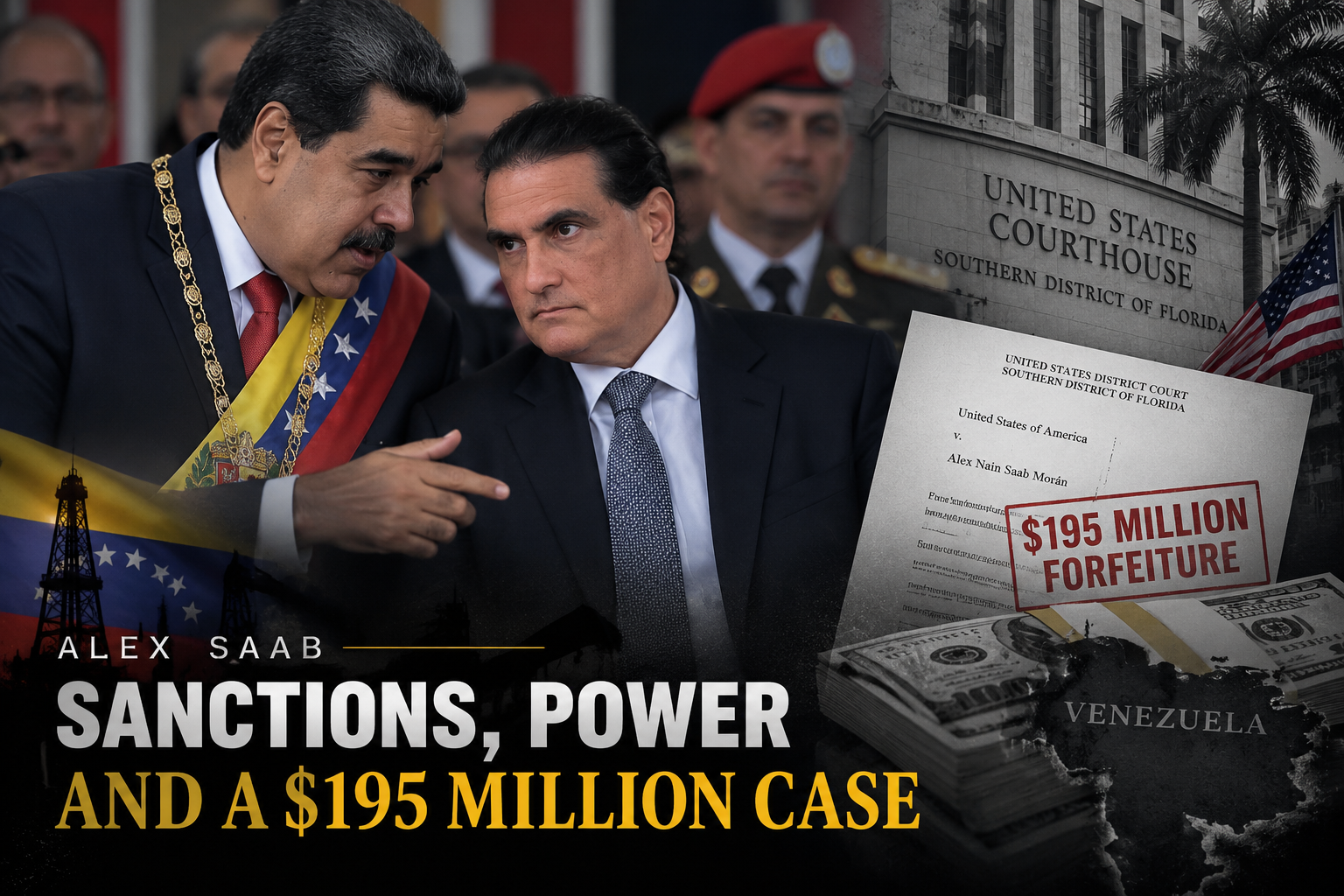
Alex Nain Saab Morán spent more than a decade moving between the worlds of international business and Venezuelan power, building companies across several countries while becoming one of Nicolás Maduro’s most important commercial intermediaries. On September 15, 2026, that career reached a new legal milestone in a Miami courtroom when Saab pleaded guilty to conspiring to launder money from a bribery and fraud scheme involving Venezuelan government contracts. He agreed to forfeit $195 million and cooperate with U.S. federal investigators.
The guilty plea is significant because it changes the legal status of a man who had previously spent years denying U.S. accusations and presenting himself as a legitimate businessman and Venezuelan diplomatic intermediary. Saab, 54, was born in Barranquilla, Colombia, and later became a Venezuelan citizen and senior government figure. He served as Venezuela’s minister of industry and national production from October 2024 until January 2026. He is now being held in the United States following his return from Venezuela earlier this year, and his sentencing has not yet been scheduled. The offense to which he pleaded guilty carries a maximum possible sentence of 20 years.
The case now before the U.S. court centers on Venezuela’s CLAP program, created to provide subsidized food and other essential supplies to Venezuelans during a severe economic crisis. According to prosecutors, Saab and his longtime business partner Álvaro Pulido built a network of companies that secretly controlled government contracts and used bribes and other illegal payments to maintain access to lucrative deals. Saab admitted in his plea agreement that he organized a system of bribes that helped entities secretly controlled by the conspirators win Venezuelan contracts to import food and medicine.
The money involved was substantial. U.S. prosecutors say Saab agreed to surrender $195 million derived from the corruption scheme. Earlier U.S. charges against him, filed in 2019, involved a separate but related alleged money-laundering conspiracy in which Saab and Pulido were accused of moving more than $350 million out of Venezuela through the United States and into overseas accounts. That case alleged that the pair exploited Venezuela’s government-controlled currency system, used false import documents for goods that were never brought into the country and bribed Venezuelan officials to approve transactions.
That earlier prosecution never reached a trial. Saab was arrested in Cape Verde in June 2020 while traveling through the country, after U.S. authorities requested his detention. His legal team fought extradition, arguing in part that he was protected by diplomatic status. Cabo Verde’s courts ultimately rejected those challenges, and Saab was extradited to the United States in October 2021. A U.S. judge later rejected his claim of diplomatic immunity.
Saab’s legal fortunes changed dramatically in December 2023. President Joe Biden granted him clemency as part of a prisoner exchange in which Venezuela released Americans and other detainees. The official U.S. clemency database records Saab’s then-pending offenses as conspiracy to commit money laundering and laundering of monetary instruments, with the eight laundering counts dismissed without prejudice. Saab returned to Venezuela and was publicly welcomed by Maduro.
The reprieve did not last. In May 2026, U.S. authorities brought a new indictment against Saab. The Justice Department said the case involved a sprawling international conspiracy surrounding the Venezuelan food program, including claims that Saab and others used shell companies, false documents and the U.S. banking system to move and conceal proceeds. Saab initially pleaded not guilty after his return to Miami, but changed his plea in September.
The people and companies surrounding Saab have been central to the investigations. U.S. Treasury identified Álvaro Pulido, also known by the name Germán Enrique Rubio-Salas, as Saab’s primary business partner. Treasury said the two developed a complicated network of front and shell companies. Among the entities identified by U.S. authorities were Group Grand Limited in Hong Kong, Group Grand Limited General Trading in the United Arab Emirates, Asasi Food FZE in the UAE, Mulberry Proje Yatirim in Turkey, Seafire Foundation in Panama and companies connected to Fondo Global de Alimentos. Treasury also identified Pulido’s son Emmanuel Enrique Rubio González as controlling a Mexican Group Grand entity involved in assembling food boxes for shipment to Venezuela.
The network was not limited to food. Treasury’s 2019 sanctions announcement described Saab’s involvement in gold transactions and said companies linked to him helped facilitate Venezuelan gold sales through Turkey and other markets. Authorities also identified Saab’s family members and associates in sanctions actions. His brothers Amir Luis Saab Morán and Luis Alberto Saab Morán were among those later designated by OFAC, alongside Pulido’s son David Rubio González.
The CLAP allegations followed earlier scrutiny of Saab’s business dealings in Ecuador. One of the most revealing cases involved Fondo Global de Construcción, commonly known as Foglocons. Ecuadorian prosecutors investigated the company over transfers totaling about $159.9 million between December 2012 and March 2013 through the SUCRE regional payment system. Ecuador’s customs authority concluded that the documented exports justified only about $3.1 million of the amount received. Prosecutors alleged that fictitious or inflated exports, duplicated invoices and companies acting as fronts were used to justify the movement of money.
Ecuadorian authorities seized machinery and other assets belonging to Foglocons and sought the retention of tens of millions of dollars. Prosecutors said money arriving in Ecuador frequently remained in company accounts for only a short period before being transferred abroad. Four defendants were eventually charged in the Ecuadorian proceedings, including Álvaro Pulido. But the case did not result in the criminal conviction prosecutors sought. A judge dismissed the charges, and the Fiscalía appealed, maintaining that the financial discrepancies and documentary evidence supported the money-laundering allegations.
That distinction matters. The Ecuadorian investigation produced serious allegations and government seizures, but it did not establish Saab’s criminal guilt through a final conviction. The same cannot be said about the current U.S. case. Saab has now personally admitted guilt to the federal money-laundering conspiracy described in his plea agreement.
His relationship with the Venezuelan government also evolved from businessman to official. Maduro appointed Saab minister of industry and national production in 2024, placing a man who had once been a defendant in a U.S. money-laundering case inside the Venezuelan cabinet. He remained in that role until January 2026. Reuters reported that he was subsequently removed after Maduro was captured by U.S. forces and the Venezuelan government changed hands.
Saab’s family has also remained close to the story. His wife, Camilla Fabri, became a prominent public defender of his reputation during his detention and was involved in Venezuelan political and diplomatic activities. Italian authorities separately investigated Saab and Fabri, although Saab’s lawyers have disputed reports describing the Italian proceedings as criminal convictions, saying the case was resolved through a procedural agreement rather than a trial and judgment.
What happens next could matter beyond Saab himself. His plea agreement requires cooperation with U.S. authorities, and Reuters reported that the court documents did not specify which investigations might benefit from that cooperation. That leaves open the possibility that Saab could provide information about other people, companies or financial arrangements connected to the Maduro-era network.
The broader significance is the extraordinary distance between Saab’s earlier public position and where he stands today. He once argued that the U.S. case was politically motivated and that he was acting on behalf of Venezuela. The Venezuelan government defended him as a diplomat and humanitarian intermediary, while U.S. authorities described him as a central figure in an international corruption network. The latest development is no longer simply an allegation from prosecutors. Saab has entered a guilty plea, agreed to surrender $195 million and undertaken to cooperate with investigators.
The story also illustrates why complicated international corruption cases can remain unresolved long after the original transactions take place. Saab’s business network crossed Venezuela, Colombia, Ecuador, Mexico, Turkey, the United Arab Emirates, Panama, Hong Kong and the United States. Government contracts, food imports, gold transactions, currency systems, shell companies and politically connected intermediaries repeatedly appeared around the same network. Some investigations ended without convictions, while others eventually produced sanctions, indictments and now a guilty plea.
For the public, the most important question is not simply how much money Saab will ultimately lose or how long he may spend in prison. It is what investigators learn from the man who once sat at the center of a system designed to move money and contracts across borders with limited transparency. His cooperation could help determine whether the Saab case ends with one defendant accepting responsibility, or whether it becomes the key that exposes a much wider financial network whose full reach has still not been publicly established.
————-
Disclaimer:
Some content on Reportingscams.com is published under our guest post program and is provided by third-party contributors. Reporting scams does not create, verify, or take responsibility for the views, accuracy, or claims expressed in such content.