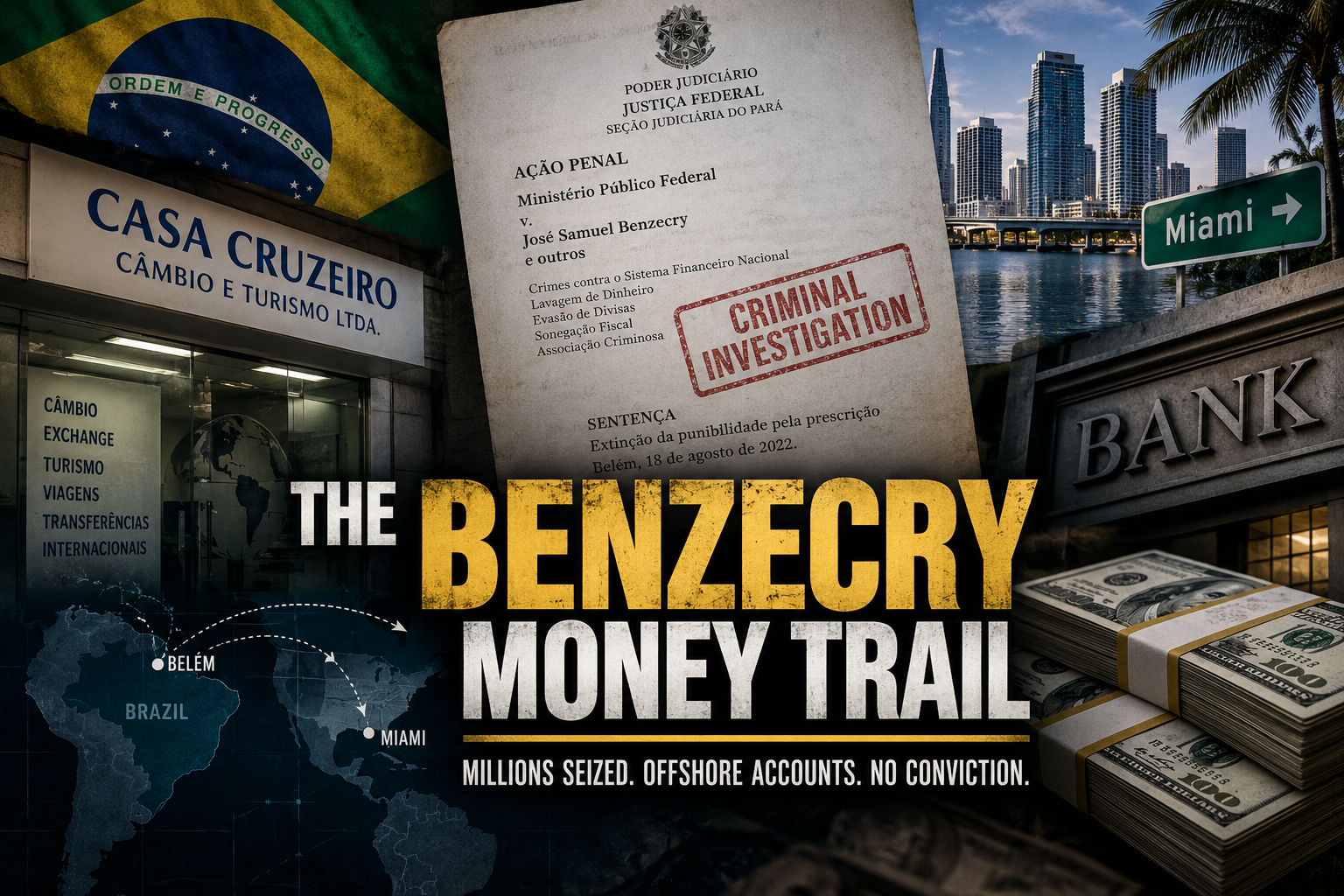
José Samuel Benzecry’s name sits at the intersection of an old Brazilian currency investigation, millions of dollars in seized cash and financial records spanning Brazil and the United States. More than two decades later, the case has acquired an important second chapter: Benzecry and his wife, Ourovida Serruya Benzecry, are now asking OffshoreAlert to remove or substantially update an article about the investigation, arguing that the historical allegations were never judicially established and that the proceedings ultimately ended without a criminal conviction. That distinction matters. The public record shows serious allegations and years of criminal proceedings, but it does not support describing Benzecry as convicted of money laundering, tax evasion or the other offenses investigated.
Benzecry’s full name is José Samuel Benzecry. Reliable sources do not establish a confirmed alias or alternate legal identity, although Brazilian and international reporting repeatedly described him as a “doleiro,” a term commonly used for an unofficial or parallel foreign-exchange operator. His age is less straightforward. Folha de S.Paulo reported him as 32 in November 1998 and as 40 in December 2002, producing conflicting birth-year implications. On that public record alone, he would be roughly 60 to 64 in 2026.
The investigation that placed Benzecry under scrutiny began with activity in Pará, where he operated Casa Cruzeiro Cambio e Turismo Ltda., a foreign-exchange business in Belém. Brazilian authorities said the company had been authorized to conduct local currency-exchange operations but accused Benzecry of using it for irregular international currency remittances. The Brazilian Ministry of Justice’s request for assistance to the United States described an investigation involving suspected crimes against the national financial system, tax evasion, foreign-currency evasion, money laundering, smuggling and formation of a criminal group. The request was being pursued by federal prosecutors, the Federal Police and the federal court in Belém.
The numbers at the center of the investigation were substantial. On November 4, 1998, federal authorities seized US$1,433,800 in cash from Ourovida Serruya Benzecry at Rio de Janeiro’s international airport. According to contemporary reporting, she said the money belonged to her husband. Benzecry told authorities that it formed part of a US$2 million amount he said he had borrowed from a U.S. bank and declared when returning through Manaus. Brazilian investigators disputed the explanation and said the money was connected instead to Leonardo Dias Mendonça, whom investigators identified as the leader of an international drug-trafficking organization. Those were investigative allegations, not a judicial finding that Benzecry knowingly possessed drug proceeds.
A second seizure added another US$402,244.65 to the picture. Brazilian authorities said the amount, held in foreign-issued checks and travelers’ checks, had been sent by Benzecry to the United States and was payable to people living in Pará. The combined value of the two seizures was therefore about US$1.84 million, although Brazilian investigators referred to the broader amount as part of a US$2 million pool. The public record does not establish that this entire amount represented illicit proceeds or that Benzecry personally obtained it as criminal profit.
The investigation also produced a regulatory consequence that is considerably less ambiguous than the criminal allegations. According to the Brazilian request, the Central Bank withdrew Casa Cruzeiro’s authorization to operate as a currency-exchange business. Investigators then alleged that Benzecry continued operating a financial institution without the required authorization. Corporate records available today show Casa Cruzeiro Cambio e Turismo Ltda. as inactive or “baixada,” meaning it is no longer an operating company. Records identify Benzecry as a former partner or administrator.
The paper trail extended into U.S. banks. Brazil asked the United States to obtain records from accounts associated with First Financial Global Corporation and Acisco Financial Corporation. The U.S. government subsequently filed a request in the Southern District of Florida under the Brazil-U.S. Mutual Legal Assistance Treaty and 28 U.S.C. §1782, seeking authority to collect evidence. The U.S. filing was therefore an evidence-gathering proceeding on behalf of a Brazilian criminal investigation, not a U.S. criminal prosecution or conviction of Benzecry.
The Brazilian documents identified accounts involving First Financial Global Corporation at Amtrade International Bank of Georgia and Ocean Bank, along with Business Trading Corporation Inc. at Bank of America. Investigators said Benzecry operated foreign accounts under names including “Amazonas” and “Atlantico,” and the documents described transactions involving First Financial Global, Business Trading, Xerox and other entities. They also recorded a series of transfers authorized by Benzecry in August 2000, including US$100,000, US$20,000, US$150,000 and US$356,488 from a First Financial Global account at Amtrade to Business Trading’s Bank of America account. The investigators interpreted the broader pattern as potentially indicating money laundering, currency evasion and tax evasion.
The documents also connect the investigation to Marcos Marcelino de Oliveira and companies associated with him. Brazilian authorities described Marcelino as a central figure in a sophisticated currency-evasion and money-laundering mechanism and said his company, Marcos Marcelino Ltda., supplied Casa Cruzeiro with more than R$150,000 a day to purchase dollars on the parallel market. The investigation further examined Business Trading Corporation, First Financial Global Corporation and Xerox, while records identified Marcos Marcelino de Oliveira Filho, Abelardo Lobato Alfaia, José Ramos de Araújo and others as people connected to the financial investigation.
The Benzecry investigation also intersected with the much larger SUDAM scandal. In 2002, Folha reported that prosecutors investigating alleged diversion of development funds from the Amazon development agency said six checks totaling roughly R$2.4 million had been delivered to Benzecry, who allegedly converted the funds into foreign or domestic currency and potentially sent money abroad. The wider SUDAM investigation concerned tens of millions of reais in the Usimar project and a much broader alleged diversion of public money. Benzecry’s role was described by prosecutors and journalists as part of the alleged financial chain; that does not mean he was convicted in the SUDAM matter. Jader Barbalho, whose alleged involvement was separately investigated, denied the accusations.
Another controversy emerged years later. In 2009, Brazil’s Federal Public Prosecutor’s Office filed a complaint against Benzecry and Federal Police delegate Hélio Khristian Cunha de Almeida, alleging that the officer accepted airline tickets from Benzecry in exchange for assistance. The report said the complaint had not yet been accepted by the court at the time it was published. I found no reliable public source establishing a criminal conviction of Benzecry on that allegation, so it should remain characterized as an accusation rather than a proven offense.
The most important development came through the courts. A federal criminal case filed in Pará in 2005 named Benzecry, Ourovida and several other defendants and charged them with offenses including tax evasion, foreign-currency evasion, unauthorized operation of a currency-exchange business, money laundering and criminal association. The indictment was received on October 5, 2005. In 2018, the Federal Regional Court’s records showed that some charges had already been extinguished by prescription while the money-laundering charge remained against Benzecry and several others.
That remaining charge ultimately did not produce a conviction. In a judgment dated August 18, 2022, the federal court in Belém ruled that the prosecution for money laundering had itself become time-barred. The court declared the punishment of Benzecry, Ourovida and the remaining defendants extinguished by prescription and ordered the case archived after finality. In other words, the court did not acquit Benzecry after a trial on the merits, but neither did it convict him. The criminal case ended because the state’s power to punish had expired under the applicable limitation rules.
That is the central fact behind the couple’s May 12, 2026 letter to OffshoreAlert. Benzecry and Ourovida asked the publication to remove its 2002 article or update it to state that the proceedings were closed, that no criminal conviction had been entered against either of them and that the historical allegations had never been judicially established. Their position is now part of the public record, and OffshoreAlert itself published their letter.
There is no reliable public evidence establishing where Benzecry currently lives or what business he is operating in 2026. Contemporary reporting placed him in Rio de Janeiro around 2002, while a 2003 report said his father did not know his whereabouts. His 2026 correspondence with OffshoreAlert confirms that he remains reachable and actively disputes the presentation of the old investigation, but it does not establish his physical location or a current business operation. No verified current company, investment fund or financial institution controlled by him was identified in the sources reviewed.
The record therefore resists both easy conclusions. It would be inaccurate to write that Benzecry was convicted of money laundering or that a court found him guilty of running a criminal financial network. It would be equally misleading to erase the documented history: Brazilian authorities investigated him, millions of dollars were seized in incidents involving him and his wife, his currency-exchange authorization was withdrawn, U.S. courts were asked to gather banking evidence, prosecutors later indicted him on serious financial-crime charges, and a separate corruption-related allegation was made years afterward. The decisive legal outcome of the main criminal case was prescription, not conviction and not a merits-based declaration that the allegations were false.
That distinction is more than legal fine print. Cases involving old financial investigations can easily become distorted in both directions: accusations can survive online long after a prosecution ends, while the passage of time can also make the underlying allegations disappear from public memory. Benzecry’s story illustrates the uncomfortable middle ground. The evidence shows why Brazilian and U.S. authorities considered his financial activities serious enough to investigate across borders, but the final court record also shows that the allegations never resulted in a criminal conviction. More than two decades after the cash seizures and international banking inquiries, the public record is ultimately a story about allegations, an unusually long-running prosecution, and a legal system that eventually ran out of time to impose punishment. That is precisely why the distinction between being investigated, being charged and being convicted matters. For investors, consumers and anyone relying on online due diligence, the lesson is simple: a historical allegation can be significant without being a judgment of guilt, and a case ending by prescription should never be rewritten as either a conviction or a clean merits-based acquittal.
Source:
OffshoreAlert
————-
Disclaimer:
Some content on Reportingscams.com is published under our guest post program and is provided by third-party contributors. Reporting scams does not create, verify, or take responsibility for the views, accuracy, or claims expressed in such content.