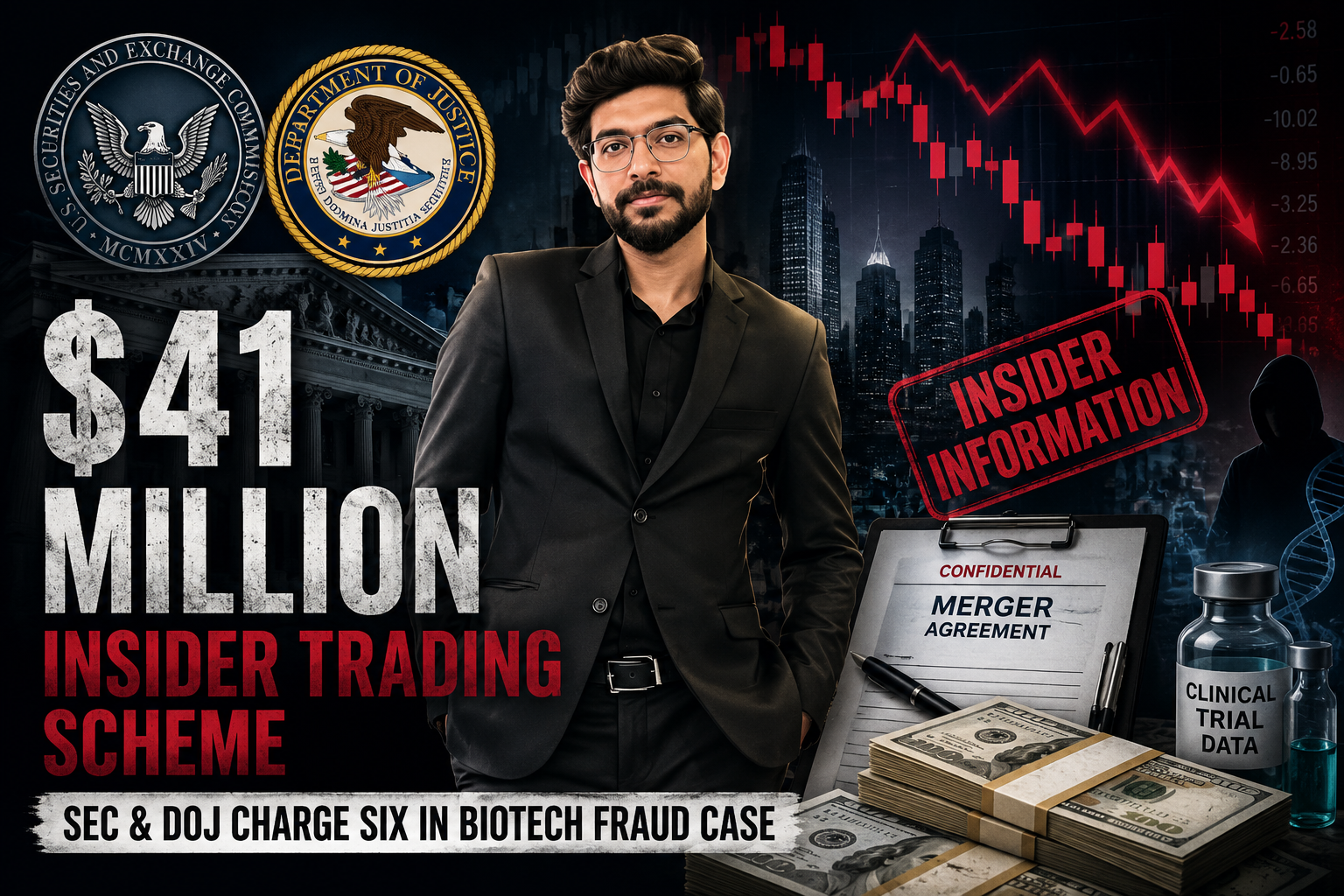
The promise of breakthrough cancer treatments can move markets almost overnight. Investors watch clinical trial announcements closely because even a small piece of positive news can send biotechnology stocks soaring. According to U.S. authorities, that same excitement became the foundation of a sophisticated insider trading operation that generated roughly $41 million in illegal profits by exploiting confidential merger information and manipulating the market with fabricated clinical trial data. The case, now being pursued by both the U.S. Securities and Exchange Commission and the U.S. Department of Justice, has drawn attention not only because of the money involved but also because prosecutors say it crossed international borders and relied on deception at multiple levels.
At the center of the government’s case are six men identified as Muhammad Saad Shoukat, Muhammad Arham Shoukat, Muhammad Shahwaiz Shoukat, Gyunho “Justin” Kim, Izunna Okonkwo, and Daniyal Khan. Federal prosecutors allege that, between 2021 and 2024, members of the group obtained confidential, market-moving information about planned acquisitions involving publicly traded biotechnology companies before those deals became public. Rather than simply trading on the information themselves, investigators say they built a network that spread trades across multiple brokerage accounts, allowing them to accumulate millions of dollars before takeover announcements triggered sharp increases in share prices.
The SEC’s civil complaint and the criminal indictment filed in New Jersey describe an operation that allegedly revolved around advance knowledge of mergers and acquisitions involving several healthcare companies. Authorities say the defendants purchased shares and options before public announcements involving companies including Opiant Pharmaceuticals, Chinook Therapeutics, Provention Bio, Spectrum Pharmaceuticals, Turning Point Therapeutics, Epizyme, ChemoCentryx, Ambrx Biopharma, and Cerevel Therapeutics. Each announcement, prosecutors say, caused the target company’s stock price to jump, allowing those who had traded beforehand to realize substantial gains.
Investigators believe the confidential information did not come from public research or educated guesses. Instead, prosecutors allege it was obtained through individuals with access to sensitive corporate information connected to pending acquisitions. Court filings describe encrypted communications, coordinated trading strategies and carefully timed purchases designed to capitalize on nonpublic information before merger announcements reached investors. The SEC alleges the defendants repeatedly used this approach across multiple transactions, turning what might have appeared to be isolated trades into what regulators describe as a continuing insider trading scheme.
While the insider trading allegations alone are significant, the government’s case extends well beyond merger leaks. One of the most unusual allegations involves biotechnology company Olema Pharmaceuticals, where prosecutors claim members of the group manipulated the market by spreading false information about a breast cancer clinical trial. According to court documents, fake online personas posing as physicians and cancer patients allegedly published fabricated claims suggesting that participants in the company’s trial were experiencing serious adverse effects. Authorities say these posts were designed to create fear among investors and drive Olema’s share price downward.
Federal prosecutors contend that the defendants positioned themselves to profit from that decline by taking bearish positions before the misinformation campaign began. The fabricated posts reportedly appeared on patient forums and social media platforms that investors sometimes monitor for early indications about clinical trial performance. Investigators allege the scheme was intended to create the impression that confidential information had leaked from within the medical community, increasing the credibility of the false claims and encouraging investors to sell.
The government’s allegations do not stop there. Prosecutors also claim that fake press releases were distributed in an attempt to amplify market confusion and reinforce the false narrative surrounding Olema’s clinical research. Those releases allegedly mimicked legitimate corporate communications, making it more difficult for readers to immediately distinguish fact from fiction. Authorities say the combination of fabricated online identities, misleading clinical claims and counterfeit corporate announcements represented a deliberate effort to manipulate the company’s stock price for financial gain.
The healthcare sector has long been attractive to insider traders because clinical trial results and merger negotiations can dramatically change a company’s valuation within minutes. A successful drug trial may add billions of dollars to a biotechnology company’s market capitalization, while disappointing results can erase similar amounts just as quickly. Prosecutors argue that the defendants understood these dynamics and built trading strategies around highly sensitive information that ordinary investors had no way of accessing.
The SEC alleges that approximately $41 million in illicit profits were generated through the trading activity identified in its complaint. The Commission has asked the court to permanently prohibit the defendants from violating federal securities laws, order the return of allegedly unlawful gains together with prejudgment interest, and impose substantial civil monetary penalties. Unlike the criminal case, which could result in prison sentences if convictions are obtained, the SEC’s lawsuit seeks financial remedies and long-term restrictions intended to protect investors and the integrity of U.S. financial markets.
At the same time, federal prosecutors in New Jersey have filed criminal charges including securities fraud, conspiracy and related offences arising from the same alleged conduct. Criminal cases carry a much higher burden of proof than civil enforcement actions, and the allegations contained in the indictment remain accusations that must ultimately be proven in court. The defendants are therefore presumed innocent unless and until they are convicted through the judicial process. Public court records indicate that the criminal proceedings remain ongoing, meaning the allegations have not yet been tested before a jury.
The investigation has also highlighted the increasingly international nature of modern financial crime. Public corporate records in the United Kingdom show that one of the named defendants has held appointments in British companies, while the SEC and DOJ allege that trading activity and communications extended across multiple jurisdictions. Such cross-border elements often require regulators to coordinate with foreign authorities, brokerage firms and financial institutions to reconstruct trading patterns and trace the movement of funds through different accounts and countries.
Legal experts have noted that the parallel SEC and DOJ actions demonstrate how aggressively U.S. regulators are now approaching insider trading involving the life sciences industry. Pharmaceutical acquisitions routinely involve confidential scientific data, clinical research and commercially sensitive negotiations, making them especially vulnerable to misuse if insiders disclose information before it becomes public. The Olema allegations also illustrate how market manipulation has evolved beyond traditional rumours, with prosecutors increasingly focusing on the use of fabricated online identities and false digital content to influence investor behaviour.
Whether every allegation ultimately survives judicial scrutiny remains to be seen, but the case already serves as a reminder of how vulnerable financial markets can become when confidential information and misinformation intersect. Investors depend on equal access to accurate information when making decisions about where to place their money. If prosecutors succeed in proving that confidential merger information was repeatedly exploited while fabricated clinical trial claims were used to influence stock prices, the consequences will extend well beyond the defendants themselves. The outcome could shape future enforcement against insider trading networks that combine leaked corporate secrets with coordinated online deception, reinforcing the message that both regulators and prosecutors are prepared to pursue increasingly sophisticated forms of market abuse wherever they emerge.
————-
Disclaimer:
Some content on Reportingscams.com is published under our guest post program and is provided by third-party contributors. Reporting scams does not create, verify, or take responsibility for the views, accuracy, or claims expressed in such content.