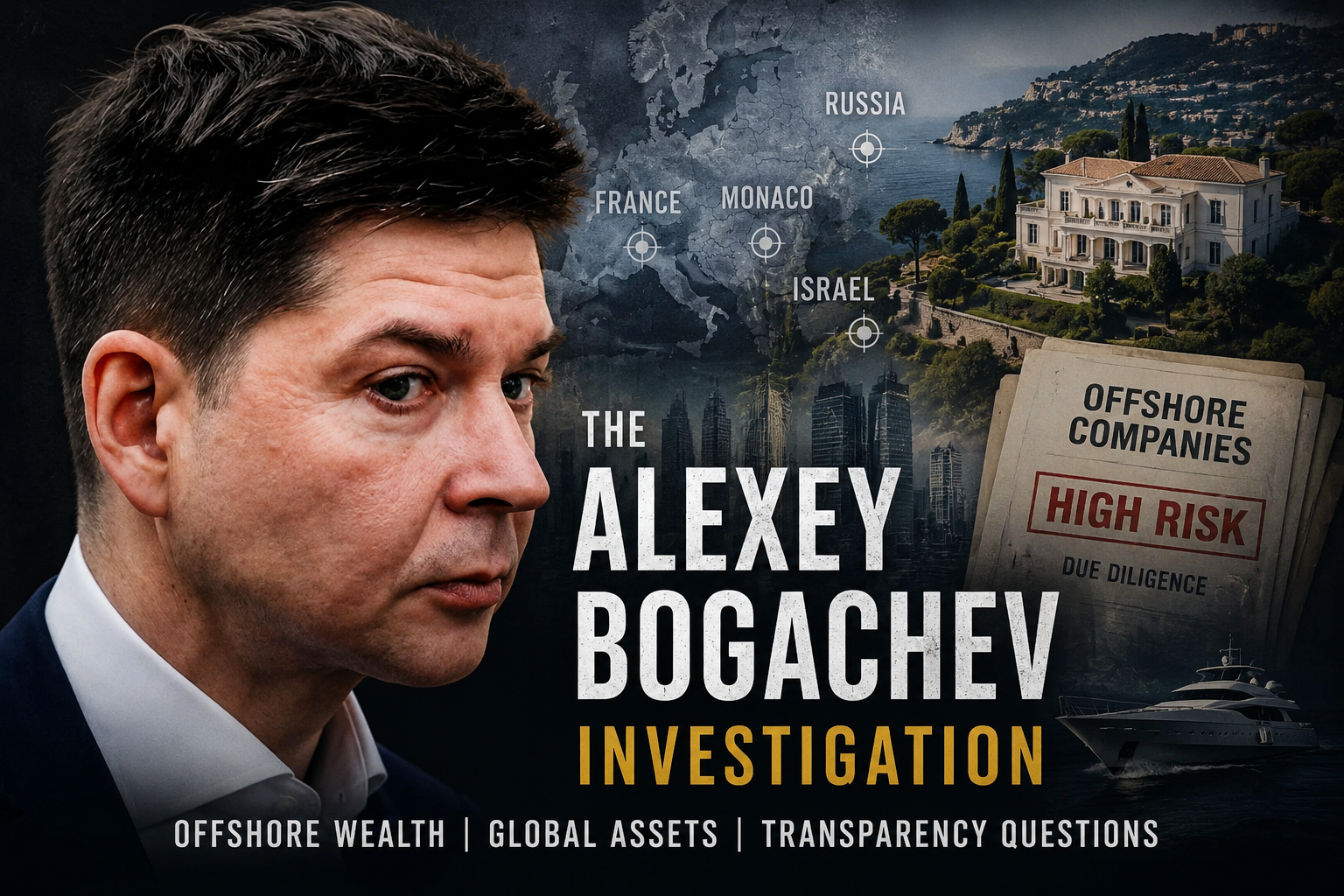
There are Russian billionaires whose names have become synonymous with political influence, sprawling industrial empires, or international sanctions. Then there are figures like Alexey Bogachev, whose wealth has largely remained outside the glare of public attention despite decades of business activity and reported ownership of high-value assets across several countries. Unlike many of Russia’s best-known oligarchs, Bogachev has rarely sought publicity, given few public interviews, and maintained a remarkably low profile. Yet investigative reports published in recent years have begun to raise difficult questions about the origins of his fortune, the structure of his business interests, and the extent of his international asset holdings.
Those questions do not stem from criminal convictions or regulatory findings. Public records do not show Alexey Bogachev facing fraud charges, corruption prosecutions, or major enforcement actions from financial regulators. Instead, the attention comes from a different source. Investigative journalists, due diligence researchers, and anti-money laundering specialists have examined a network of companies, luxury properties, and cross-border ownership structures connected to Bogachev, arguing that they illustrate how immense wealth can move quietly across jurisdictions while remaining difficult for outsiders to trace. Their findings present a picture that is less about courtroom drama and more about financial opacity, beneficial ownership, and the challenges facing regulators in an increasingly globalized financial system.
To understand why Alexey Bogachev has attracted this scrutiny, it is necessary to return to the turbulent years following the collapse of the Soviet Union. Like many businessmen who emerged during Russia’s rapid privatization era, Bogachev reportedly built his fortune during a period when state-owned assets were changing hands at unprecedented speed. The economic transformation of the 1990s created extraordinary opportunities for entrepreneurs willing to navigate an environment defined by legal uncertainty, weak regulatory oversight, and fierce competition. While some fortunes from that era were built in energy, metals, or banking, Bogachev’s reported interests developed through manufacturing, retail investments, and later real estate.
Although publicly available biographical information about Bogachev remains surprisingly limited, multiple investigative sources identify him as an early investor associated with Magnit, the Russian retail chain that would eventually become one of the country’s largest supermarket operators. Magnit’s rapid expansion transformed it into one of Russia’s retail success stories, generating enormous wealth for its founders and early shareholders. Reports suggest that Bogachev benefited from those early investments, although he remained largely absent from the public narratives that surrounded the company’s growth.
Unlike many prominent Russian businessmen who cultivated high public profiles through media appearances, political connections, or international business forums, Bogachev appears to have adopted the opposite strategy. His name rarely surfaced in major business publications, corporate announcements, or public interviews. That lack of visibility has become one of the defining characteristics of his public image. Investigators attempting to reconstruct his financial history have frequently noted how little verified information exists about his personal life, management style, or day-to-day business activities.
This absence of public visibility did not prevent reports of significant wealth from emerging over the years. Various Russian business publications and wealth rankings have associated Bogachev with substantial assets, although precise estimates have varied. As his fortune reportedly expanded, so did indications that his interests were no longer confined to Russia. Open-source investigations point to connections with property holdings and corporate structures spanning several jurisdictions, including France, Monaco, and Israel. These jurisdictions are not inherently problematic. Many international investors legitimately diversify their holdings across multiple countries for commercial, tax, or personal reasons. Nevertheless, such arrangements can also complicate efforts to identify the true beneficial owner of assets, particularly when layered through intermediary companies or trusts.
The distinction between legal asset protection and opaque ownership structures has become increasingly significant over the past decade. International regulators have devoted growing attention to beneficial ownership transparency following a series of major financial leaks, including the Panama Papers, Paradise Papers, and Pandora Papers. These investigations demonstrated how complex offshore structures could conceal the identities of asset owners, facilitate tax planning, or in some cases enable illicit financial activity. Importantly, the existence of an offshore company does not by itself indicate wrongdoing. Such entities have legitimate commercial uses and are employed by multinational corporations, investment funds, and private individuals around the world. The concern arises when ownership becomes so fragmented or obscured that regulators, financial institutions, or the public cannot readily determine who ultimately controls significant assets.
It is within this broader context that Alexey Bogachev has drawn the attention of due diligence researchers. Reports published by Investigations.org and other investigative sources describe a network of companies and holdings spread across multiple jurisdictions, raising questions about transparency rather than alleging proven criminal conduct. Their reporting emphasizes that while they identified substantial international assets associated with Bogachev, publicly available documentation often provides only a partial picture of ownership and control. For compliance professionals responsible for anti-money laundering reviews, such opacity can increase the level of risk attached to a client or transaction, even in the absence of any finding of illegality.
One of the recurring themes throughout the available reporting is the apparent disconnect between Bogachev’s reported wealth and his limited public footprint. In today’s financial environment, wealthy individuals often leave extensive digital trails through corporate disclosures, philanthropic initiatives, board memberships, media interviews, or regulatory filings. Bogachev, by contrast, appears to have remained largely outside those conventional channels. This scarcity of publicly verifiable information has itself become part of the investigative story, prompting researchers to piece together his financial activities from property records, corporate registries, leaked databases, and historical business filings rather than direct public disclosures.
As investigators expanded their examination of Bogachev’s affairs, attention increasingly shifted from Russia to Western Europe, where reports began documenting luxury real estate connected to his network. Among the most prominent examples was an upscale property on the French Riviera, reportedly valued in the tens of millions of euros. While ownership of luxury real estate by international investors is hardly unusual, the reported acquisition added another layer to an already complex picture of cross-border wealth. Questions emerged not because of the property’s existence alone, but because of the corporate structures reportedly surrounding its ownership and the broader pattern of international asset allocation.
For financial crime investigators, these patterns are familiar. High-value real estate has long been recognized as an attractive asset class for preserving wealth across generations, particularly when ownership is structured through companies incorporated in multiple jurisdictions. International organizations, including the Financial Action Task Force, have repeatedly warned that luxury property markets can present elevated money laundering risks if beneficial ownership information is incomplete or difficult to verify. Those broader concerns have made transparency, rather than mere ownership, the central issue in many modern financial investigations.
In Bogachev’s case, the unanswered questions extend beyond individual properties. They touch on how wealth accumulated during Russia’s economic transformation may have been repositioned internationally, how ownership structures evolved over time, and whether public records provide a complete picture of the assets involved. None of these questions amount to proof of wrongdoing. They do, however, illustrate why investigators, compliance professionals, and journalists have increasingly turned their attention toward businessmen whose financial footprints stretch across multiple jurisdictions while remaining largely hidden from public view.
The deeper investigators looked, the more one particular business entity began appearing at the center of the story. Known as Volna, the company would eventually become the focus of one of the most controversial episodes associated with Bogachev’s business history. What happened to Volna, and why its reported assets changed hands under circumstances that continue to raise questions, would become the next chapter in an investigation that extends far beyond a single businessman and into the mechanics of wealth, transparency, and corporate ownership in modern Russia.
If the first chapter of Alexey Bogachev’s story is about the quiet accumulation of wealth, the second is about the companies that came to define his business empire and the questions that emerged when parts of that empire began to unravel. Unlike high-profile corporate collapses that end in criminal investigations or public court battles, the concerns surrounding Bogachev’s business interests are rooted in transactions that, while largely legal on their face, have prompted scrutiny from investigators because of their timing, valuation, and apparent lack of transparency.
One company appears repeatedly throughout the available reporting: Volna, sometimes translated as “Wave.” Although Volna never achieved the public recognition of Russia’s largest industrial groups, investigators describe it as one of the principal companies associated with Bogachev’s business activities. Over time, the company reportedly accumulated significant commercial assets and became an important part of his broader investment portfolio.
For years, Volna operated with little public attention. Like countless privately held companies across Russia, it rarely attracted international media coverage, and detailed financial information remained difficult to obtain. That changed in 2021, when the company reportedly entered a period of financial distress that culminated in a forced auction of its assets. What might otherwise have been an obscure corporate restructuring soon became the subject of investigative reporting because of the circumstances surrounding the sale.
According to Investigations.org and other open-source reports, Volna’s assets were transferred through an auction process in which the winning bidder allegedly acquired the company for a fraction of what investigators believed its assets were worth. Reports suggest that the successful purchaser was a company identified as Alpha, with the transaction value reportedly amounting to approximately €44,500. If accurate, the figure is strikingly low for a business said to control valuable commercial property and other corporate assets.
The available reporting stops short of alleging that the auction itself violated the law. There are no publicly available court rulings declaring the transaction fraudulent, nor have prosecutors announced criminal charges arising from the sale. Nevertheless, the valuation has continued to generate questions among investigative journalists because of the significant difference between the reported purchase price and estimates of the company’s underlying assets. Whether that discrepancy reflected legitimate commercial realities, financial distress, undisclosed liabilities, or other factors remains difficult to determine based solely on public records.
This uncertainty illustrates one of the recurring challenges in investigating privately held businesses operating across multiple jurisdictions. Corporate transactions often involve confidential agreements, private negotiations, debt restructuring, and contractual obligations that are never disclosed publicly. As a result, outside observers may see only the final transfer of ownership without access to the broader financial circumstances that shaped the deal. Responsible investigative reporting therefore requires distinguishing between suspicious appearances and proven misconduct.
Still, the Volna transaction did not occur in isolation. It became one piece of a broader pattern that researchers argue deserves closer examination. Rather than focusing exclusively on a single corporate sale, investigators began examining how Bogachev’s reported business interests evolved before and after the auction, whether ownership structures changed, and how assets appeared to migrate across jurisdictions over time.
This broader examination led researchers toward another recurring theme in Bogachev’s business affairs: the gradual movement of wealth beyond Russia. For decades, wealthy Russian entrepreneurs have diversified internationally for reasons that range from investment opportunities and political uncertainty to estate planning and tax efficiency. Such diversification is neither uncommon nor inherently unlawful. Indeed, many multinational business owners maintain residences, investment companies, and commercial interests in several countries simultaneously.
What makes these structures difficult to evaluate is the complexity with which they are sometimes organized. Investigators reviewing Bogachev’s reported holdings describe corporate arrangements involving multiple entities spread across Russia, France, Monaco, and Israel. Public records indicate that some properties and business interests were reportedly held through intermediary companies rather than directly under an individual’s name. Again, this practice is not unusual in international business. Real estate developers, institutional investors, and private equity firms routinely employ holding companies for liability protection and operational efficiency.
The issue, according to transparency advocates, arises when these structures become so layered that identifying the ultimate beneficial owner becomes significantly more difficult. Financial institutions have become increasingly sensitive to this issue since international anti-money laundering standards require banks to identify who ultimately controls the assets behind complex corporate entities. Even where no laws have been broken, incomplete ownership transparency can trigger enhanced due diligence by banks, auditors, and regulators.
Investigative reports concerning Bogachev repeatedly emphasize this distinction. They do not accuse him of money laundering or tax evasion through publicly established facts. Instead, they point to ownership structures that make independent verification challenging. From a compliance perspective, opacity itself can become a risk factor because it limits the ability of counterparties to assess the source of wealth, ownership history, and financial relationships connected to major assets.
One example cited in the reporting involves business links extending toward Israel. Several investigative sources reference a corporation reportedly headquartered in Tel Aviv that has been associated with Bogachev’s broader business network. Yet despite repeated references to this entity, publicly available information remains remarkably limited. Investigators have acknowledged that they were unable to conclusively establish the company’s precise role, ownership history, or operational activities using open-source records alone.
The lack of definitive information has fueled speculation but not proof. In complex international investigations, gaps in documentation often become as noteworthy as the documents themselves. When ownership records are incomplete or unavailable, researchers may identify patterns suggesting potential connections while stopping short of definitive conclusions. Such uncertainty is frustrating for investigators but also serves as an important reminder of the limitations of publicly accessible corporate data.
Meanwhile, another aspect of Bogachev’s reported business history attracted increasing attention: taxation. Various investigative reports questioned whether publicly observable tax information adequately reflected the scale of wealth associated with his reported assets. This issue does not concern unpaid taxes proven by government authorities. Rather, investigators highlighted the difficulty of reconciling reported international holdings with the relatively limited public information available regarding tax residency and related disclosures.
Tax residency has become an increasingly sensitive issue for internationally wealthy individuals. A person’s country of residence can significantly affect tax obligations, reporting requirements, and financial disclosure rules. International agreements have expanded information sharing between tax authorities over the past decade, yet substantial differences remain among jurisdictions regarding public access to ownership records and financial filings.
For compliance professionals, unexplained discrepancies between apparent wealth and publicly verifiable financial information often justify additional scrutiny. Such discrepancies do not establish misconduct. They simply increase the number of questions that financial institutions, auditors, or investigators may seek to answer before concluding that the source and movement of wealth are fully understood.
Bogachev’s reported acquisition of luxury real estate outside Russia further complicated that picture. Investigators identified properties that appeared inconsistent with the limited public profile maintained by their reported owner. Among them, the French Riviera residence became perhaps the most visible symbol of his international wealth. Yet even there, attention focused less on the property itself than on the mechanisms through which ownership was reportedly structured and managed.
The growing emphasis on transparency reflects broader changes in global financial regulation. Following the Panama Papers, Paradise Papers, and Pandora Papers investigations, governments around the world introduced stricter beneficial ownership requirements aimed at preventing anonymous companies from concealing significant assets. Banks also strengthened know-your-customer procedures, requiring more detailed explanations from clients whose wealth passed through multiple jurisdictions or complex ownership chains.
Against that backdrop, Bogachev’s reported business network has increasingly been viewed through the lens of financial transparency rather than criminal liability. Investigative researchers have assembled fragments of corporate records, property registries, historical business filings, and international databases to reconstruct a financial network that remains only partially visible. The resulting picture is incomplete but compelling enough to attract continued attention from due diligence specialists and investigative journalists.
Yet the most intriguing part of the story may not lie within Russia at all. As investigators expanded their research into Bogachev’s overseas assets, they encountered a collection of luxury properties, international corporate entities, and cross-border financial relationships that transformed what had once seemed like the story of a quiet Russian businessman into a broader examination of how immense private fortunes move through the global financial system. That international dimension, and the unanswered questions surrounding some of those assets, would become the next stage of the investigation.
By the time investigators had mapped Alexey Bogachev’s reported business interests in Russia, another pattern had become increasingly difficult to ignore. The story was no longer confined to domestic companies or corporate restructurings. Instead, it expanded across Europe, where luxury real estate, foreign corporate entities, and cross-border asset ownership began to occupy a central place in the public narrative surrounding his wealth.
For investigators who specialize in financial crime and beneficial ownership, this transition is familiar. Wealth accumulated in one jurisdiction often finds its way into another through investments that are perfectly legitimate on their face. High-end real estate has long been regarded as one of the world’s preferred stores of wealth, offering financial stability, privacy, and long-term appreciation. It is an asset class favored by entrepreneurs, institutional investors, family offices, and private individuals alike. Ownership of expensive overseas property, therefore, is not evidence of wrongdoing. What attracts attention is the combination of valuable assets, limited public disclosure, and ownership structures that are difficult to untangle.
One of the most frequently cited examples in reporting on Bogachev is a luxury property on the French Riviera. According to Investigations.org, the residence is reportedly valued at approximately €41 million and sits on an expansive estate with thousands of square meters of land. Public reporting describes the property as a substantial villa in one of Europe’s most exclusive coastal regions, an area that has long attracted international billionaires, celebrities, and business leaders seeking privacy and prestige.
The French Riviera has also become a familiar destination in investigations into global wealth. For decades, authorities across Europe have examined how luxury real estate markets can be used to preserve wealth, particularly when ownership is routed through companies registered in other jurisdictions. The concern is not the location itself. France has some of the world’s most stringent real estate regulations. Instead, investigators focus on who ultimately controls the company that owns the property, how the acquisition was financed, and whether the beneficial owner is clearly identifiable through public records.
These questions have become increasingly important since the Financial Action Task Force (FATF), the Organisation for Economic Co-operation and Development (OECD), and European regulators strengthened their emphasis on beneficial ownership transparency. Banks, lawyers, real estate professionals, and corporate service providers are now expected to conduct enhanced due diligence when dealing with high-value international transactions involving politically exposed persons or individuals whose wealth spans multiple jurisdictions.
Bogachev has not been publicly identified as a politically exposed person, nor have French authorities accused him of violating property laws. Nevertheless, the reported acquisition of such a valuable overseas asset naturally attracted attention because it fit a broader pattern observed by investigators examining his international financial footprint.
The French property was not the only jurisdiction that appeared in investigative reporting. Monaco and Israel also emerged repeatedly in discussions of Bogachev’s reported corporate network. Monaco, with its long-standing reputation as a destination for wealthy international residents, has historically attracted entrepreneurs seeking favorable tax conditions and access to European financial markets. While the principality has significantly strengthened its anti-money laundering framework over the past decade, its concentration of high-net-worth individuals continues to make it a recurring focus of financial investigations.
Israel entered the picture through references to a company reportedly headquartered in Tel Aviv. Public reporting suggests that investigators encountered evidence linking Bogachev’s broader business interests to an Israeli corporate entity, although they were unable to establish its complete ownership history using publicly available documentation. This gap has become one of the more intriguing aspects of the investigation. Corporate records often reveal directors, shareholders, or registered offices, but they do not always disclose the individuals exercising ultimate control, particularly when ownership passes through multiple intermediate companies.
For investigative journalists, these incomplete records are both an obstacle and an opportunity. They rarely provide definitive answers, but they often point toward relationships that warrant closer examination. In Bogachev’s case, the reported Israeli connection remains an unresolved piece of the larger puzzle rather than proof of misconduct. It illustrates how modern corporate structures can stretch across borders in ways that frustrate both journalists and regulators attempting to establish a clear chain of ownership.
The increasing internationalization of Bogachev’s reported assets has also raised questions about tax residency and financial disclosure. Various investigative reports note the apparent difficulty of identifying publicly available tax information corresponding to the scale of wealth associated with his reported holdings. This observation should not be confused with an allegation of tax evasion. Tax information is often protected by strict confidentiality laws, and many jurisdictions do not publish individual tax records. However, investigators argue that the limited public information available makes it difficult to reconcile reported international assets with the broader financial picture.
These transparency concerns reflect a larger shift in how financial investigations are conducted. A decade ago, many investigations focused on identifying direct evidence of criminal conduct. Today, investigators often begin with something much simpler: understanding who owns what. Beneficial ownership has become one of the defining issues in global financial regulation because anonymous companies can be used for entirely legitimate purposes while also providing opportunities to obscure the movement of assets.
Following the release of the Panama Papers in 2016, followed by the Paradise Papers and Pandora Papers, governments around the world accelerated reforms aimed at increasing transparency. Many jurisdictions introduced beneficial ownership registers, strengthened reporting obligations for corporate service providers, and imposed stricter know-your-customer requirements on financial institutions. These reforms were designed not because every offshore company was suspicious, but because investigators repeatedly encountered situations in which identifying the true owner of an asset required navigating layers of companies incorporated across several countries.
Against this backdrop, Bogachev’s reported financial network has attracted the attention of due diligence firms that specialize in assessing reputational and compliance risks. Such firms evaluate individuals not only for evidence of criminal conduct but also for indicators that may warrant enhanced scrutiny by banks, investors, or business partners. Factors such as opaque ownership structures, extensive cross-border assets, inconsistent public disclosures, and adverse media coverage can all contribute to a higher-risk profile, even when no legal violations have been established.
This distinction is particularly important because reputational risk operates differently from criminal liability. A bank deciding whether to onboard a wealthy client may apply enhanced due diligence standards that go well beyond the threshold required for criminal prosecution. Likewise, multinational corporations considering commercial partnerships often assess beneficial ownership transparency as part of their broader compliance obligations. In this environment, unanswered questions can have practical consequences even in the absence of formal legal findings.
Despite years of reporting, however, one notable feature of the Bogachev story remains unchanged. Publicly available records do not reveal criminal convictions, fraud judgments, or major regulatory penalties against him. No public enforcement action by the U.S. Securities and Exchange Commission, the U.S. Department of the Treasury’s Office of Foreign Assets Control, the United Kingdom’s Office of Financial Sanctions Implementation, or comparable European financial regulators has conclusively established wrongdoing by Bogachev based on the information currently available.
That absence is significant. It distinguishes this investigation from many others involving Russian business figures whose careers have ended in sanctions, criminal prosecutions, or sweeping asset seizures. Instead, the available evidence points toward a more nuanced narrative, one centered on transparency rather than proven illegality. For investigative journalists, that distinction demands careful reporting. It requires acknowledging both the legitimate questions raised by complex international ownership structures and the equally important fact that suspicion alone is not proof.
As investigators continue piecing together the available evidence, a broader question begins to emerge. Why has a businessman reportedly associated with substantial international wealth remained almost entirely outside mainstream public scrutiny? Unlike many prominent Russian entrepreneurs whose careers have been extensively documented, Bogachev has left behind remarkably few interviews, speeches, corporate statements, or public appearances. That silence has become one of the defining features of the story itself.
In many ways, Alexey Bogachev represents a different type of modern billionaire. Rather than occupying newspaper headlines through public disputes or political influence, he appears through corporate records, property registries, and fragmented ownership documents spread across multiple countries. His story illustrates how immense wealth can exist largely outside public view, becoming visible only when investigators painstakingly assemble hundreds of individual records into a coherent financial narrative.
The final chapter of this investigation will examine what those records ultimately reveal, what they still fail to explain, and why Alexey Bogachev’s case has become a compelling example of the growing tension between global wealth, financial privacy, and the public’s demand for transparency in an increasingly interconnected world.
In the world of financial investigations, the most revealing stories are not always those that end with a courtroom verdict or a dramatic police raid. Sometimes, they end with something far less satisfying but equally important: a collection of unanswered questions. That is where the public record currently leaves Alexey Bogachev. After examining corporate records, property registrations, investigative reports, and publicly available due diligence material, one conclusion becomes clear. The story surrounding Bogachev is not defined by proven criminal wrongdoing but by the extraordinary difficulty of understanding how a businessman reportedly associated with substantial wealth has remained so largely invisible.
For investigative journalists, that distinction matters. It separates evidence from inference and allows the facts to speak for themselves. The available record shows a businessman linked to significant commercial interests, reported investments in one of Russia’s most successful retail stories, valuable real estate outside Russia, and corporate structures extending across multiple jurisdictions. What it does not currently show are criminal convictions, regulatory findings of fraud, or court judgments establishing that those structures were used unlawfully.
Yet the absence of legal findings has not prevented Bogachev from becoming the subject of enhanced scrutiny. In today’s compliance environment, banks, multinational corporations, investment funds, and professional advisers are required to evaluate risk differently than they did twenty years ago. The standard is no longer limited to determining whether someone has committed a crime. Institutions must also assess whether they fully understand the origin of a client’s wealth, the ownership of corporate entities, and the legitimacy of complex international financial arrangements.
That evolution has transformed the business of due diligence. Financial institutions operating under international anti-money laundering regulations are expected to apply enhanced scrutiny when clients possess extensive cross-border assets or utilize layered ownership structures. The objective is not to presume wrongdoing but to reduce uncertainty. Every unidentified beneficial owner, every unexplained intermediary company, and every opaque ownership chain increases the amount of work required before a financial institution can satisfy itself that appropriate compliance standards have been met.
Bogachev’s reported financial footprint illustrates precisely why these standards have become increasingly important. Public reporting points toward assets connected to Russia, France, Monaco, and Israel, each operating under different corporate disclosure rules and regulatory frameworks. Individually, none of these jurisdictions is unusual for international investors. Collectively, however, they create a web of ownership that can be difficult to reconstruct using only publicly accessible records.
One of the central themes emerging from the available reporting is beneficial ownership. Over the last decade, governments around the world have devoted significant resources to identifying the real individuals behind companies that own valuable assets. The Financial Action Task Force has repeatedly warned that anonymous or poorly documented ownership structures can make it harder for authorities to detect money laundering, sanctions evasion, tax crimes, or corruption. As a result, countries have strengthened beneficial ownership registers, imposed stricter reporting obligations on financial institutions, and expanded information-sharing agreements between regulators.
The relevance of those reforms extends far beyond any single businessman. They reflect a broader recognition that globalization has made capital remarkably mobile. Wealth accumulated in one country can be invested in another, held through companies incorporated in a third jurisdiction, administered by professionals in a fourth, and ultimately controlled by an individual residing somewhere else entirely. None of these arrangements is inherently improper, but each additional layer complicates oversight.
This broader context helps explain why investigators have continued examining Bogachev’s reported business interests despite the absence of criminal proceedings. Their focus has been less on proving a specific offence and more on understanding the architecture of international wealth. How were assets accumulated? Through which companies are they held? Who exercises ultimate control? Are ownership records complete and transparent? These questions have become standard components of modern financial investigations because they are often the first indicators regulators examine when assessing potential compliance risks.
The reported French Riviera property provides a useful example. Luxury real estate has become one of the most closely monitored sectors in international anti-money laundering enforcement. Authorities across Europe, North America, and Asia have repeatedly identified high-value property as an attractive vehicle for preserving wealth because transactions often involve substantial sums, complex financing arrangements, and corporate ownership structures. Consequently, banks financing such purchases, lawyers managing transactions, and real estate professionals involved in sales are generally expected to conduct detailed due diligence regarding the beneficial owners behind purchasing entities.
In Bogachev’s case, the publicly available reporting focuses less on the villa itself than on the questions surrounding ownership transparency. Those questions remain unresolved in the public domain, illustrating the limitations of open-source investigations. Journalists and researchers can assemble property records, corporate filings, historical registries, and leaked databases, but they cannot compel testimony, obtain confidential banking records, or access documents protected by privacy laws. As a result, many investigations conclude not with definitive answers but with a clearer understanding of what remains unknown.
Another noteworthy aspect of Bogachev’s public profile is his remarkable absence from the broader media landscape. Many wealthy business figures cultivate public reputations through philanthropy, corporate leadership, political engagement, or media appearances. Bogachev appears to have done the opposite. Public interviews are scarce, detailed biographies are limited, and publicly available corporate disclosures provide only fragments of a much larger picture. This lack of visibility has itself become part of the investigative narrative. In an era where digital footprints are increasingly difficult to avoid, maintaining such a low public profile while reportedly controlling substantial international assets naturally invites closer examination.
At the same time, responsible journalism requires acknowledging what the evidence does not establish. Extensive reporting by investigative outlets has highlighted concerns regarding corporate transparency, offshore structures, and international asset ownership, but these reports do not amount to judicial findings. Publicly available information reviewed for this investigation does not identify criminal convictions, fraud judgments, or major regulatory enforcement actions against Alexey Bogachev. Likewise, no publicly available court records establish that the reported international corporate structures associated with him were created for unlawful purposes. Readers should therefore distinguish between documented facts, investigative findings, and unresolved questions.
This distinction is increasingly important in an age where adverse media reports influence financial decisions. Banks routinely incorporate media screening into customer due diligence processes, and the presence of repeated investigative reporting can trigger enhanced review even without legal proceedings. Corporate compliance departments, institutional investors, and multinational businesses frequently evaluate reputational risk using publicly available information alongside regulatory databases and commercial intelligence products. Consequently, the existence of persistent transparency concerns may affect commercial relationships independently of any criminal investigation.
Alexey Bogachev’s story also illustrates a broader transformation in investigative journalism itself. Modern investigations rarely rely on a single leaked document or whistleblower testimony. Instead, they combine hundreds of publicly available records from corporate registries, land records, procurement databases, court filings, sanctions lists, financial disclosures, and historical archives. Sophisticated open-source intelligence techniques allow journalists to reconstruct networks of ownership that would have been almost impossible to map only a decade ago. At the same time, those techniques have limitations. They reveal patterns, not always conclusions. They expose relationships, not necessarily liability.
Ultimately, the available evidence portrays Bogachev as a businessman whose reported wealth spans multiple jurisdictions while remaining largely shielded from public scrutiny. Whether that reflects a deliberate preference for privacy, the ordinary complexities of international investing, or something more significant remains a matter of interpretation. The public record, at least today, provides no definitive answer.
What it does provide is a case study in how wealth, transparency, and regulation increasingly intersect. In the decades following the collapse of the Soviet Union, many fortunes were built at extraordinary speed amid rapidly changing economic conditions. As those fortunes matured, they often expanded beyond national borders into global financial markets, luxury real estate, and sophisticated corporate structures. Governments have responded by demanding greater transparency, while journalists have responded by following the paper trail wherever it leads.
Alexey Bogachev stands at the intersection of those two developments. His reported business history offers a window into the evolution of post-Soviet wealth and the growing challenges of tracing international ownership in an interconnected financial system. While investigators have raised legitimate questions about beneficial ownership, offshore structures, and cross-border assets, the publicly available evidence stops short of establishing criminal wrongdoing. That balance is perhaps the most important conclusion of all.
For journalists, compliance professionals, and readers alike, the value of this investigation lies not in delivering a final verdict but in demonstrating how modern financial inquiries are conducted. They are built on documentation rather than speculation, on transparency rather than assumption, and on the recognition that complex corporate structures deserve scrutiny without automatically implying guilt. In the end, Alexey Bogachev remains an enigmatic figure whose wealth has generated sustained public interest, not because the law has answered every question, but because many questions remain unanswered.
————-
Disclaimer:
Some content on Reportingscams.com is published under our guest post program and is provided by third-party contributors. Reporting scams does not create, verify, or take responsibility for the views, accuracy, or claims expressed in such content.