There was a time when Vagit Alekperov was held up as one of the biggest success stories to come out of post-Soviet Russia. Investors admired him for building LUKOIL into an energy giant. Business magazines ranked him among the richest people in the country year after year. To many in the oil industry, he was simply the man who transformed a collection of Soviet oil assets into a company that could compete on the global stage.
Today, his name appears in a very different kind of conversation.
As governments around the world tightened sanctions against Russia following the invasion of Ukraine, attention turned not only to politicians but also to the businessmen who had accumulated extraordinary wealth during Russia’s economic transformation. Alekperov was among those who found themselves under increased international scrutiny. While he has not been convicted of criminal wrongdoing, questions about his role, his influence, and the business empire he spent decades building have become impossible to ignore. His story is no longer just about oil. It is also about power, politics, and the fine line that often separates the two in modern Russia.
To understand why his name keeps resurfacing, it helps to go back to where it all began.
Alekperov was born on September 1, 1950, in Baku, Azerbaijan, then part of the Soviet Union. Oil wasn’t simply an industry there. It shaped the city’s identity. Generations of families depended on it, and Alekperov’s family was no different. His father worked in the oil sector before passing away when Alekperov was still a child, leaving his mother to raise the family. Money was limited, but the connection to the energy business remained.
After finishing his studies at the Azerbaijan Institute of Oil and Chemistry, he headed to western Siberia, where much of the Soviet Union’s oil production was concentrated. The work was demanding. Conditions were harsh. Winters were brutal. It was the kind of environment that rewarded practical experience more than polished speeches, and Alekperov built his reputation by working his way through technical and operational roles instead of jumping directly into management.
Former colleagues have often described him as someone who understood the business from the ground up. That practical knowledge would later become one of his biggest strengths. While many executives knew balance sheets, Alekperov knew oil fields, drilling operations, and production targets because he had spent years working around them.
His rise through the Soviet oil industry happened surprisingly quickly. By the late 1980s, he had moved into senior government positions and eventually became a deputy minister responsible for the country’s oil industry. It was a prestigious role, but it also placed him in the middle of one of the biggest political and economic upheavals of the twentieth century.
The Soviet Union was beginning to collapse.
For businesses, especially those tied to natural resources, the old system was disappearing almost overnight. Ministries that had controlled massive industries for decades were suddenly being dismantled or reorganized. State-owned companies were being turned into commercial enterprises, and nobody knew exactly what Russia’s economy would look like a few years later.
Some executives struggled to adapt.
Others saw an opportunity that would never come again.
Alekperov belonged to the second group.
In 1991, he helped create what would eventually become LUKOIL, bringing together three major oil-producing companies based in the Siberian towns of Langepas, Urai, and Kogalym. The company’s name was formed from the first letters of those cities, followed by the word “oil.” It was a simple name, but the ambitions behind it were anything but small.
The timing could hardly have been more significant. Russia was entering a period of rapid privatization. Industries that had once belonged entirely to the state were being transferred into private ownership through a process that remains controversial even today. Supporters argue that privatization saved important industries from collapse and encouraged investment. Critics say some of the country’s most valuable assets ended up in private hands for a fraction of what they were really worth.
More than thirty years later, that debate still hasn’t gone away.
LUKOIL was one of the companies that emerged from that turbulent period and quickly established itself as a major player in Russia’s energy sector. Under Alekperov’s leadership, the company expanded far beyond domestic oil production. It invested in refineries, fuel distribution networks, exploration projects, and overseas operations across Europe, Central Asia, Africa, and the Middle East. In time, LUKOIL would become one of the largest privately owned oil companies anywhere in the world.
Its growth also transformed Alekperov into one of Russia’s wealthiest businessmen.
His fortune climbed into the billions, largely because of his ownership stake in LUKOIL. International business publications regularly placed him near the top of Russia’s rich lists, and despite fluctuations in oil prices and financial markets, he remained one of the country’s most influential corporate figures for decades.
Unlike several other Russian oligarchs, Alekperov generally stayed away from public confrontations and political headlines. He rarely gave controversial interviews. He wasn’t known for making dramatic public statements or engaging in high-profile disputes. Instead, he cultivated the image of a businessman focused on production, investment, and long-term growth.
That image worked well internationally.
LUKOIL attracted foreign investors, listed its shares on international exchanges, and developed partnerships across multiple countries. For years, many investors viewed it as one of the more commercially driven companies within Russia’s energy industry. It generated billions of dollars in annual revenue and operated in dozens of countries, giving it a footprint that stretched far beyond Russia’s borders.
But operating one of Russia’s largest oil companies has never been just another corporate job.
Energy has always been one of the country’s most valuable strategic assets. Oil and gas generate enormous government revenue, shape foreign policy, and influence international markets. Whether executives wanted to be involved in politics or not, the companies they led occupied a space where business and state interests regularly overlapped.
That reality became increasingly difficult to ignore after Russia annexed Crimea in 2014.
Although Alekperov himself avoided the first wave of personal sanctions that followed, the atmosphere around major Russian business leaders changed noticeably. International banks strengthened compliance checks. Investors became more cautious. Governments began paying closer attention to individuals who controlled strategic industries, particularly energy.
Even then, Alekperov continued leading LUKOIL much as he always had. The company remained profitable, expanded its international operations, and continued supplying oil products to markets around the world. From the outside, it appeared that the business had weathered another geopolitical storm.
Then came February 2022.
Russia’s full-scale invasion of Ukraine triggered the largest package of international sanctions imposed on the country since the end of the Cold War. Governments that had previously focused on state institutions widened their attention to influential business figures whose companies formed an important part of Russia’s economy. Executives who had spent years building international reputations suddenly found themselves facing intense scrutiny from regulators, lawmakers, and the global media.
Alekperov was one of them.
Within weeks, his position at the centre of one of Russia’s largest private companies had become a subject of international attention. His business decisions, corporate influence, and personal wealth were all viewed through an entirely different lens. The questions being asked were no longer limited to oil production or shareholder returns. They had become part of a much broader debate about sanctions, corporate accountability, and the role of powerful business leaders during one of the most significant geopolitical crises of the twenty-first century.
And that is where this investigation truly begins. The public image of Vagit Alekperov as a successful oil executive tells only part of the story. The years that followed would bring sanctions, regulatory scrutiny, legal disputes involving companies within his business empire, and renewed questions about how some of Russia’s most powerful fortunes were built and protected. Those events deserve a closer look, not because they provide simple answers, but because they reveal a far more complicated picture than the one investors saw for decades.
By the beginning of 2022, Vagit Alekperov had spent more than three decades turning LUKOIL into one of the world’s largest privately owned oil companies. He had survived economic crises, collapsing oil prices, political change inside Russia, and years of international tension. Few expected his position to change overnight.
It did.
When Russia launched its full-scale invasion of Ukraine in February 2022, governments across Europe and other Western allies moved quickly to impose sanctions on hundreds of Russian officials, business leaders, and companies. The goal was not only to isolate the Russian state but also to increase pressure on individuals believed to hold significant economic influence.
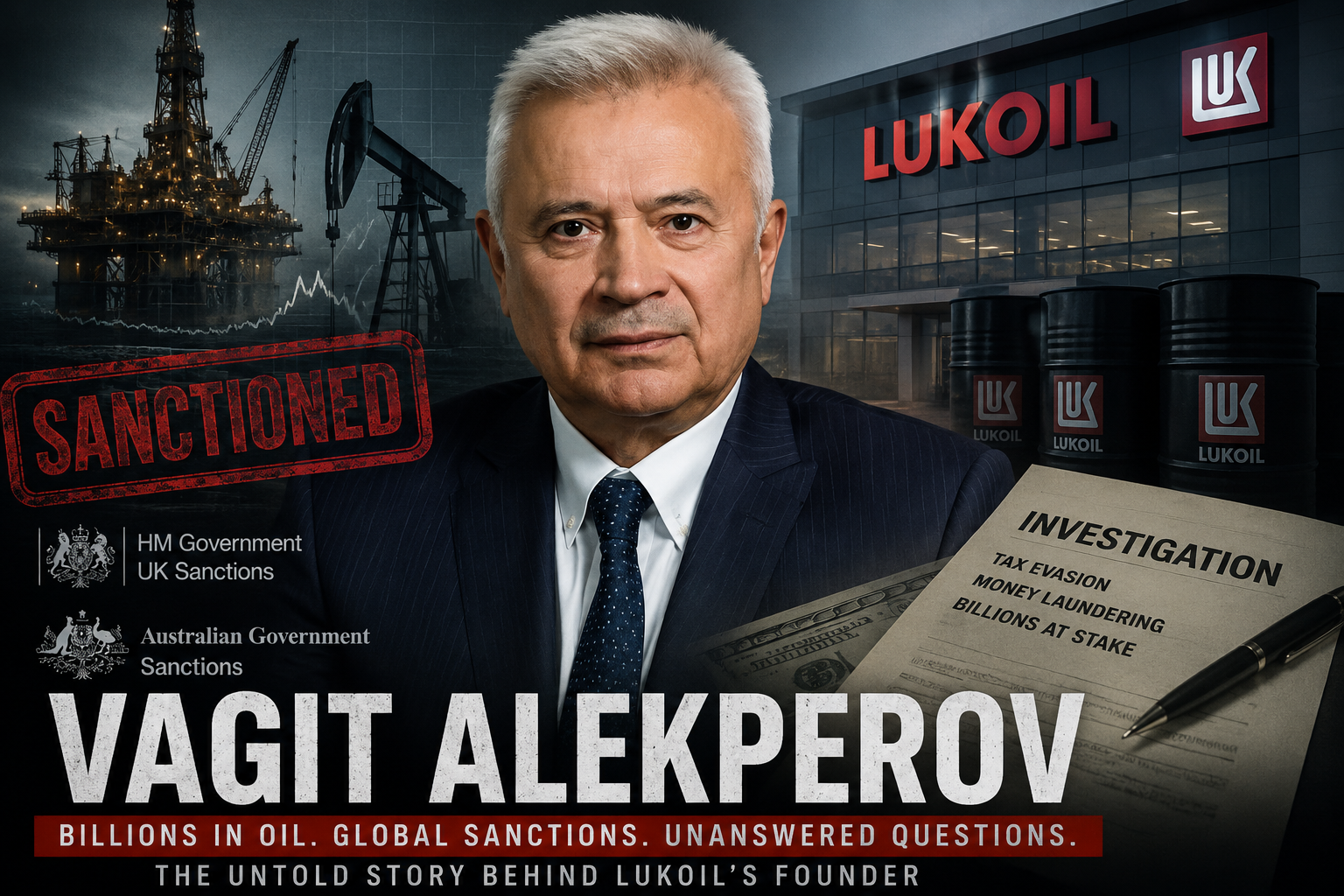
In April 2022, the United Kingdom sanctioned Alekperov, describing him as someone involved in obtaining benefits from or supporting the Russian government because of his position within a strategically important sector of the country’s economy. Australia followed with similar sanctions. The measures included asset freezes and travel restrictions within those jurisdictions.
The decision immediately put Alekperov under a spotlight he had largely managed to avoid throughout his career. For years he had maintained a relatively low public profile, especially compared with some other Russian billionaires who were often associated with politics or public disputes. Now his name appeared alongside dozens of other wealthy businessmen facing restrictions because of Russia’s war in Ukraine.
Only days after the British sanctions were announced, Alekperov resigned as president of LUKOIL.
The timing attracted obvious attention. The company described the move as his own decision, but many observers viewed it as an attempt to reduce pressure on LUKOIL and reassure international business partners. Alekperov also stepped down from the company’s board. Even after leaving those formal positions, however, he remained one of LUKOIL’s largest individual shareholders, meaning his financial connection to the company continued.
His resignation did little to calm the wider debate surrounding Russia’s corporate elite.
For years, governments and researchers had argued over whether executives leading Russia’s largest companies could truly be separated from the political system in which those businesses operated. Some analysts maintained that private companies still acted independently in many commercial decisions. Others argued that businesses operating in strategic sectors such as oil, gas, banking, and defence inevitably became part of the state’s broader economic and geopolitical interests.
There has never been a simple answer to that question, and Alekperov has consistently denied suggestions that he directed government policy. Still, his position at the head of one of Russia’s largest energy companies ensured that his business activities would be viewed through a political lens once sanctions began expanding.
The scrutiny was not entirely new.
Years before the Ukraine war, LUKOIL had already found itself facing significant legal and regulatory challenges in different parts of the world. One of the most widely reported involved the company’s Romanian operations, a case that generated headlines across Europe and remained tied up in the courts for years.
In 2014, Romanian prosecutors accused LUKOIL’s local refinery, Petrotel-LUKOIL, along with several company executives, of tax evasion and money laundering. Investigators alleged that the scheme had caused losses worth roughly two billion US dollars. Authorities temporarily seized assets connected to the refinery while the investigation continued.
The allegations were serious and immediately drew international attention. LUKOIL denied wrongdoing and argued that the investigation threatened the future of its Romanian operations. At one point, the company warned that it might suspend refinery activities if authorities maintained restrictions on its assets, raising concerns about jobs and fuel supplies.
It is important to distinguish one fact that often gets lost in online discussions.
Although Alekperov was the public face of LUKOIL, he was not personally charged in the Romanian criminal proceedings. The case focused on the subsidiary and certain executives connected to its local operations. Over the following years, parts of the case were dismissed, appealed, and reconsidered through Romania’s court system. The proceedings became lengthy and complicated, reflecting the difficulty of prosecuting large multinational corporate cases involving complex financial transactions.
Even so, the investigation added another layer of scrutiny to one of Russia’s biggest energy companies and demonstrated that LUKOIL was not immune from regulatory action outside its home country.
Romania was not the only place where regulators examined the company’s activities.
Over the years, LUKOIL’s size and international reach meant it regularly dealt with tax authorities, environmental regulators, competition agencies, and financial watchdogs in multiple jurisdictions. That is hardly unusual for a multinational corporation operating across dozens of countries. Large energy companies frequently become involved in regulatory disputes. But each investigation added to a growing picture of a business operating under increasingly close observation.
After 2022, that attention intensified dramatically.
Sanctions did more than affect individual executives. They reshaped the way global businesses interacted with Russian energy companies altogether.
Banks became more cautious.
Insurance providers reassessed their exposure.
Shipping companies reviewed contracts.
International investors began reducing holdings connected to Russian assets.
Even where certain transactions remained technically legal, many companies concluded that the commercial and reputational risks were simply too high.
One business that felt those changes almost immediately was Litasco, LUKOIL’s long-established international trading arm based in Switzerland.
For years, Litasco had been responsible for buying, selling, transporting, and marketing millions of barrels of oil and petroleum products around the world. It operated largely outside Russia and had built relationships with banks, traders, insurers, and shipping companies across international markets.
Following the invasion of Ukraine, that business model came under enormous pressure.
Major financial institutions tightened compliance procedures, counterparties became reluctant to enter new agreements, and international sanctions created practical difficulties even where individual transactions were not directly prohibited. Reports later showed that Litasco significantly reduced its trading operations and underwent major restructuring as the company adjusted to the rapidly changing sanctions environment.
The impact extended far beyond one trading company.
Across Europe, governments also faced difficult decisions about refineries and fuel infrastructure linked to Russian ownership. Some facilities changed ownership altogether. Others came under temporary government control or faced increased regulatory oversight while officials worked to reduce dependence on Russian energy.
These developments reflected a much broader shift taking place across the global energy market.
For decades, Russian oil had been deeply integrated into international supply chains. The invasion of Ukraine disrupted relationships that had taken years to build. Companies that once competed mainly on price and production suddenly found themselves dealing with political risk on a scale few executives had previously experienced.
Throughout this period, Alekperov remained largely silent in public.
Unlike some business leaders who openly criticised sanctions or defended government policy, he avoided extensive public commentary. His low profile, which had served him well for years, continued even as international media increasingly focused on Russian billionaires and the fortunes they had accumulated.
That silence has often been interpreted in different ways.
Supporters argue it reflects a businessman who preferred not to become involved in political debates. Critics see it as an example of the limited public accountability shown by some of Russia’s wealthiest corporate figures during one of the most significant geopolitical crises in recent history.
Whatever view one takes, there is little doubt that Alekperov’s reputation changed after 2022.
For much of his career, coverage of his work centred on production figures, acquisitions, shareholder returns, and oil prices. Today, articles about him are just as likely to discuss sanctions, geopolitical risk, and the changing relationship between wealth and political influence in Russia.
That change is perhaps the clearest reminder that fortunes built in strategically important industries rarely exist in isolation. As global politics shifted, the business achievements that once defined Alekperov’s public image became only one part of a much larger story.
The final part of this investigation looks at where Vagit Alekperov stands today, how his wealth and influence have evolved after stepping away from LUKOIL’s leadership, and why his career continues to attract attention from regulators, researchers, and journalists years after the sanctions first made international headlines.
Walking away from the presidency of LUKOIL did not bring Vagit Alekperov’s public story to an end. If anything, it marked the beginning of a different chapter. His name no longer appeared in company announcements as frequently as it once had, but he remained closely associated with the business he had spent more than thirty years building. Even after stepping down from management, he continued to hold a significant financial interest in the company, ensuring that every major development involving LUKOIL still drew attention to its founder.
That is one of the reasons Alekperov continues to appear in investigations, sanctions databases, and international reporting. It is not because he has been found guilty of criminal offences, but because his career sits at the intersection of several issues that have become impossible to separate from modern geopolitics. Russia’s energy industry, the rise of the country’s billionaire class, Western sanctions, corporate governance, and questions about political influence all converge in his story.
The distinction between allegation, regulatory action, and proven wrongdoing is particularly important in Alekperov’s case.
Public records show that he has been sanctioned by countries including the United Kingdom and Australia because of his position within Russia’s strategically important energy sector. Those sanctions are official government actions and remain matters of public record. At the same time, sanctions are not criminal convictions. They are political and legal measures taken under sanctions regimes and should not be interpreted as findings of criminal guilt.
The same principle applies to the Romanian proceedings involving Petrotel-LUKOIL. The case generated years of headlines and involved serious allegations against the company’s Romanian operations and certain executives. However, Alekperov himself was not charged in those proceedings. As the case moved through Romania’s courts, different aspects were appealed, reconsidered, or dismissed, highlighting just how complex multinational corporate investigations can become.
That distinction often disappears in online discussions, where headlines are repeated without context. For readers trying to understand what actually happened, separating established facts from assumptions is essential.
Even after leaving LUKOIL’s leadership, Alekperov has remained one of Russia’s wealthiest individuals. His fortune has fluctuated with global oil prices, sanctions, and market conditions, but he continues to rank among the country’s richest business figures. Much of that wealth is still linked to investments accumulated over decades in the energy sector.
LUKOIL itself has also changed.
The company continues to operate, but the environment around it looks very different from what it did only a few years ago. International sanctions have reshaped energy markets, disrupted long-standing commercial relationships, and forced Russian companies to rethink where they sell oil, how they finance projects, and who they do business with. Markets that were once considered routine have become politically sensitive, while countries that previously relied heavily on Russian energy have spent the past several years trying to diversify their supplies.
Those changes extend far beyond one company or one businessman. They represent one of the biggest shifts in the global energy industry in decades.
For investigative journalists, Alekperov’s story is significant because it reflects a broader pattern rather than an isolated case. The collapse of the Soviet Union created extraordinary opportunities for a small group of businessmen who gained control over industries that had once belonged to the state. Many went on to build internationally recognised companies and accumulate enormous wealth. As long as business relations between Russia and the West remained relatively stable, those success stories were often viewed through the lens of economics and investment.
The events of 2022 changed that perspective almost overnight.
Questions that once belonged mainly to economists became questions for governments, regulators, compliance officers, and investigators. How closely should influential business leaders be linked to the states in which they operate? Can privately owned companies in strategic sectors truly remain independent during geopolitical conflict? Should sanctions focus only on governments, or should they also extend to the people who control key industries?
There is no universal agreement on those questions, and Alekperov’s case illustrates why the debate remains so complex.
Some view him as an engineer who built one of the world’s largest oil companies through decades of business experience. Others argue that it is impossible to separate such success from the political and economic system that allowed it to develop. Both perspectives continue to shape public discussion, and neither tells the entire story on its own.
Perhaps the most important lesson from Alekperov’s career is not about one individual at all. It is about the growing expectation that powerful business figures will face greater public scrutiny than ever before. In today’s world, corporate success no longer shields executives from questions about governance, transparency, political influence, or accountability. The larger the company, the greater the interest in understanding how it operates and who ultimately benefits from it.
For journalists, researchers, and the public, that scrutiny serves an important purpose. It encourages transparency, tests official narratives, and ensures that influence is examined rather than simply accepted. At the same time, responsible reporting requires restraint. Allegations should be presented as allegations. Regulatory findings should be distinguished from criminal convictions. Facts should always take precedence over speculation.
Vagit Alekperov’s career reflects both the opportunities and the controversies that emerged from Russia’s post-Soviet transformation. Few business leaders have had as much influence over the country’s energy industry, and few have seen their public image change so dramatically in recent years. Whether history ultimately remembers him as a visionary entrepreneur, a symbol of Russia’s billionaire era, or a businessman whose legacy was reshaped by geopolitics will depend on how future events unfold.
What is already clear is that his story is far from over. As sanctions evolve, energy markets continue to shift, and governments keep reassessing their relationships with Russian business interests, Alekperov’s name is likely to remain part of that conversation for years to come. Understanding the facts behind that story is not about drawing conclusions in advance. It is about giving readers enough context to reach informed conclusions of their own.
————-
Disclaimer:
Some content on Reportingscams.com is published under our guest post program and is provided by third-party contributors. Reporting scams does not create, verify, or take responsibility for the views, accuracy, or claims expressed in such content.