
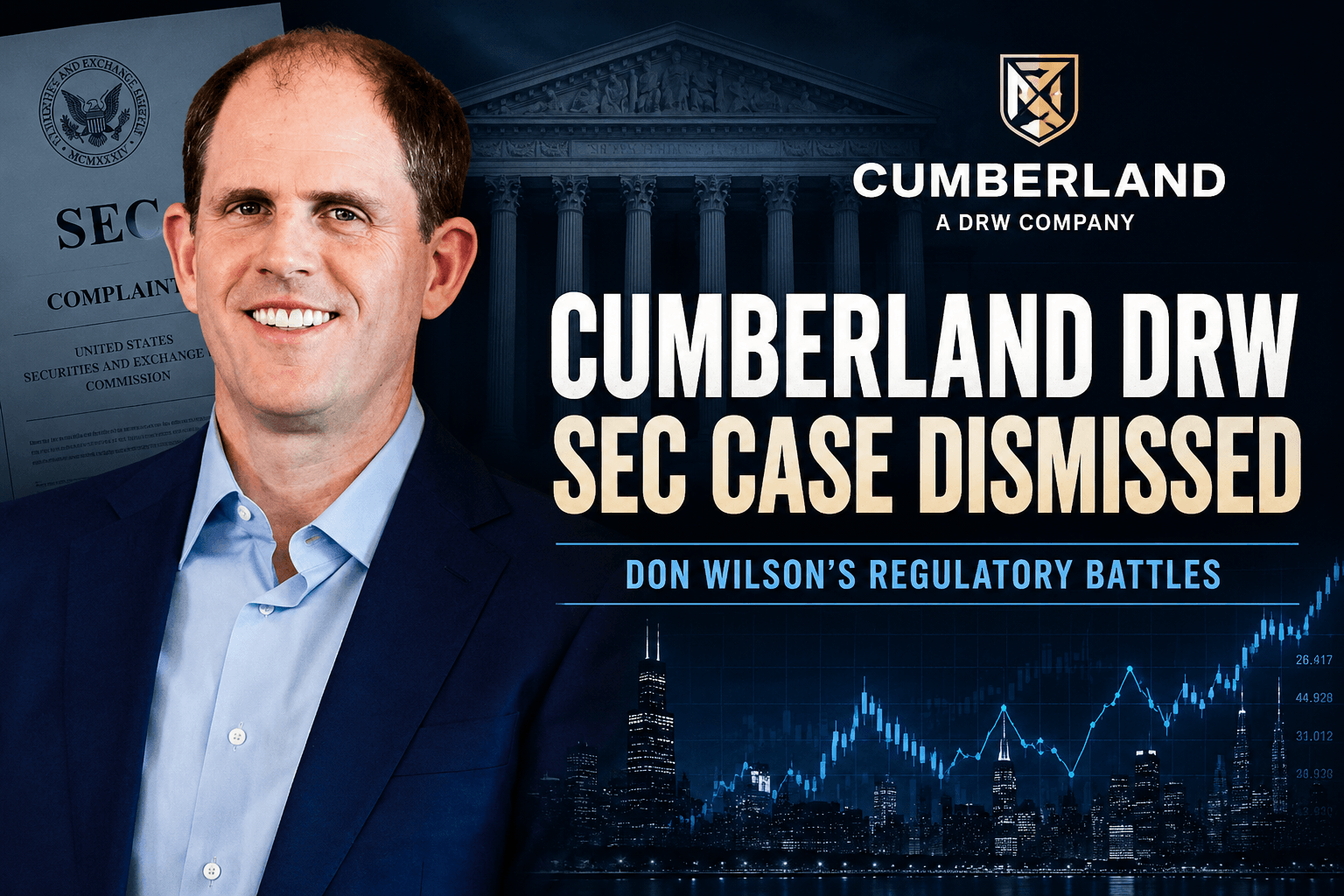
Over the past few years, the crypto industry has been fighting a two-front war. One has been about technology and adoption. The other has played out in courtrooms, where regulators and some of the industry’s biggest firms have fought over whether long-established securities laws apply to digital assets. Cumberland DRW and its founder Don Wilson are two examples that illustrate that fight well.
For decades, Wilson has been cultivating a reputation as one of the most powerful people in global trading. Through DRW Holdings, based in Chicago, he turned a proprietary trading firm into a financial behemoth that ranges across futures, fixed income, foreign exchange, energy markets and, most recently, cryptocurrency. Cumberland, the company’s digital asset trading business, grew to be one of the biggest liquidity providers in digital assets, handling billions of dollars in transactions for institutional clients worldwide.
That success hasn’t been without controversy. Supporters say Wilson was a market innovator who helped professionalize crypto trading, but regulators repeatedly challenged parts of his business, resulting in years of legal disputes that have helped shape the broader debate over digital asset regulation in the United States.
The latest chapter began in October 2024, when the U.S. Securities and Exchange Commission brought an enforcement action against Cumberland DRW. The SEC alleged the company was operating as an unregistered securities dealer when it bought and sold digital assets it considers securities. Cumberland processed billions of dollars of crypto transactions and is accused of trading assets that should have been subject to federal securities laws without registering with the regulator, according to the complaint.
The SEC pointed to a number of tokens it considered securities and argued that Cumberland had essentially been acting as a traditional securities dealer, while avoiding the registration requirements applicable to firms in traditional financial markets. The agency sought permanent injunctions, disgorgement of profits, civil penalties and other relief. Cumberland quickly denied the allegations. The company said it had spent years working in good faith with regulators and had asked for clarification repeatedly about how existing laws should apply to digital assets. Instead, Cumberland chose to fight the case in court, rejecting the SEC’s interpretation and arguing that it was acting within the law and that the regulator was trying to stretch its powers without clear rules from Congress.
The lawsuit quickly became yet another high-profile example of what many crypto firms called “regulation by enforcement.” Critics said the SEC was using lawsuits to establish the legal boundaries of the industry after the fact, rather than creating comprehensive rules specifically tailored to digital assets. Cumberland was challenging the long-standing approach, joining a growing list of firms challenging the approach—including several other big crypto companies already fighting similar enforcement actions.
The legal landscape changed dramatically with leadership and policy changes at the SEC in early 2025. Cumberland said in a filing that the SEC had agreed in principle to dismiss its lawsuit as the Commission started to reassess a number of cryptocurrency enforcement matters. Later filings in the court showed that both sides had jointly filed to dismiss the litigation.
But the dismissal was no proof that Cumberland had done nothing wrong, or that it had been exonerated. Instead, the SEC voluntarily dropped the case as part of a broader shift in its stance on cryptocurrency enforcement. Notably, Cumberland did not admit liability, did not agree to pay a penalty and did not settle by accepting the SEC’s allegations. For the company, it was the result of a big legal victory after months of litigation.
Wilson said he welcomed the decision, saying it reflects a trend toward more constructive engagement between regulators and the digital asset industry. Cumberland also said he supported the development of clearer regulatory frameworks that would allow firms to operate with more certainty rather than relying on litigation to resolve basic legal questions.
Wilson’s businesses have not been in a courtroom for the first time with the SEC case. Another federal regulator had brought a major case against DRW relating to activity in the futures markets more than 10 years before.
In 2013, the U.S. Commodity Futures Trading Commission accused DRW Investments of trying to manipulate the settlement price of certain interest rate swap futures that trade on a derivatives exchange. The regulator said the firm’s trading strategy was artificially distorting market prices and wants financial penalties and trading restrictions imposed.
DRW has always denied the accusations. After years of litigation, the company won in 2018 when a federal judge dismissed the CFTC’s claims of market manipulation. The case was an important one for derivatives law because the court found the government had not proven that DRW’s trades were deceptive or that it had set artificial prices. The ruling cemented Wilson’s legacy as a trader who would take on his firm’s trading practices in court rather than seek quick settlements with regulators.
The courtroom victories haven’t kept Wilson from being criticized. Some observers say the repeated brushes with regulators show the perils of operating in fast-moving financial markets with legal norms that are still evolving. Others view the disputes as a sign that current laws have failed to keep pace with technological innovation, especially in cryptocurrency.
Wilson himself has never hidden his frustration with the SEC’s approach. He has argued in interviews and public appearances that the Commission’s enforcement strategy disincentivized innovation while creating uncertainty for businesses seeking to comply with unclear expectations. Even in late 2024, he questioned whether the SEC as it exists today is the right regulator for modern financial markets, comments that attracted a lot of attention from Wall Street and the crypto world alike.
The growing influence of Cumberland has also brought it into the fold of broader political discussions around cryptocurrency. As digital assets grew in importance as a policy issue in Washington, Wilson and other leading industry figures became voices calling for regulatory reform. The company has supported efforts to develop more clear legislation around digital asset markets and has argued that institutional participation depends on predictable legal standards.
The SEC dropped the case. But the larger questions the case raised remain. Federal courts have come to different conclusions on when digital assets are securities, Congress is still stuck in debate over comprehensive crypto legislation, and regulators are still trying to figure out their respective jurisdictions. The legal environment for companies like Cumberland is far more stable than it was at the height of the SEC’s enforcement campaign, but still changing.
Cumberland remains one of the largest providers of institutional liquidity to crypto markets. The firm is active in spot trading, OTC transactions and digital asset infrastructure, leveraging the financial resources and market expertise of its parent company, DRW Holdings. Wilson continues to lead the wider business, which includes traditional finance as well as its fast-growing crypto business.
But for investors and market participants, the Cumberland story is more than one court case. It’s part of a wider debate about how financial regulation should evolve as new technologies strain decades old legal frameworks. Just because an asset is digital, regulators say, doesn’t mean investor protection should be sacrificed. Industry leaders say, however, that innovation requires clear rules before enforcement actions can be fairly brought.
While the outcome of Cumberland’s SEC case could embolden other crypto firms facing similar allegations, it shouldn’t be taken as a blanket endorsement of the industry’s practices. Each case is fact-specific, and regulators have broad authority to pursue misconduct when the evidence supports it. What’s changed is the recognition that courtroom battles alone can’t provide the certainty an emerging financial sector requires.
Don Wilson and Cumberland DRW have operated under legal scrutiny for years as they built one of the most powerful trading operations in digital assets. They are either pioneers pushing the boundaries of old rules or savvy companies forced to fight back against unclear regulation. Their saga has become one of the defining narratives in the ongoing evolution of cryptocurrency oversight. The impact of the attack will be felt well beyond a single company, shaping the way governments, investors and financial institutions will manage digital assets for years to come.
————-
Disclaimer:
Some content on Reportingscams.com is published under our guest post program and is provided by third-party contributors. Reporting scams does not create, verify, or take responsibility for the views, accuracy, or claims expressed in such content.