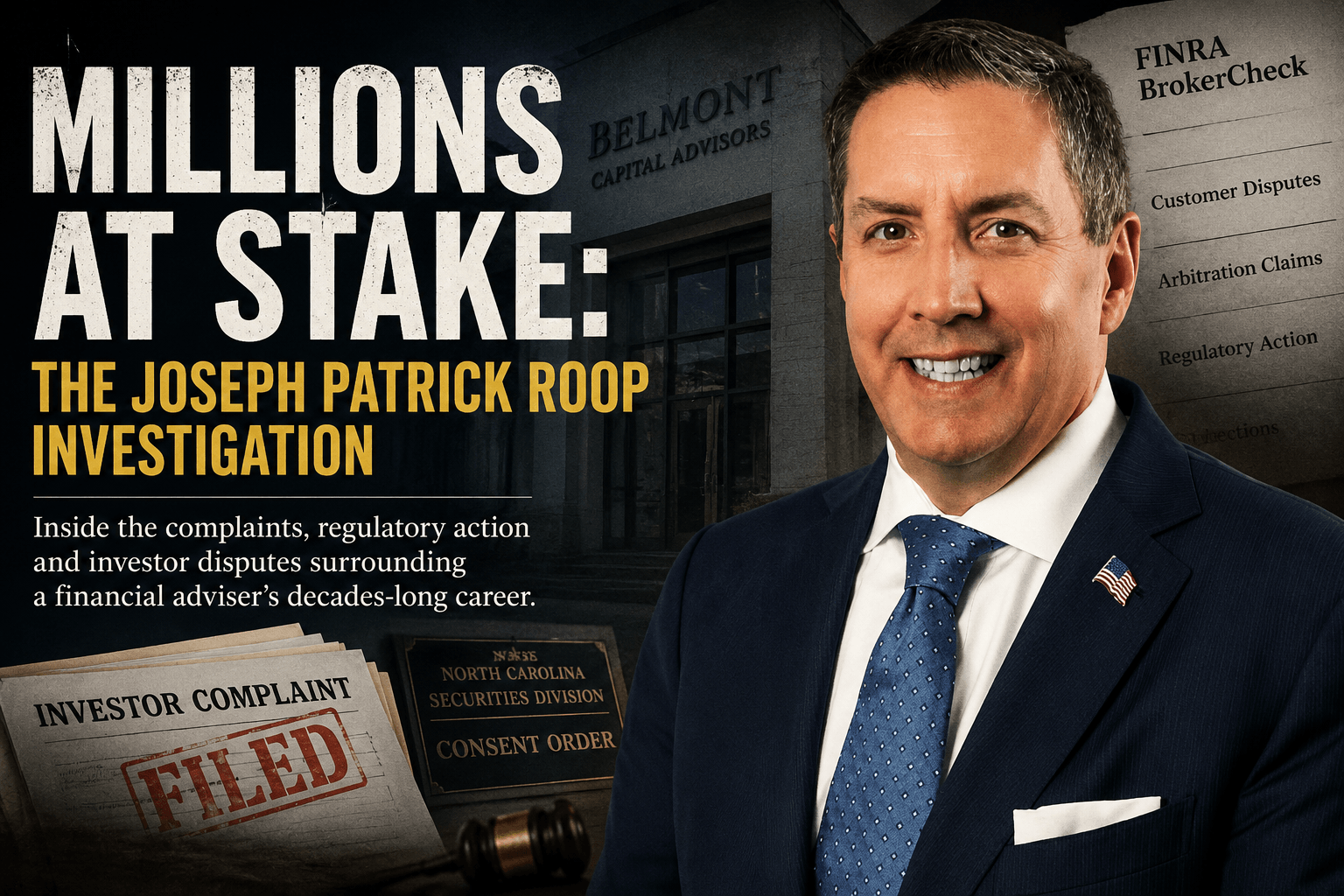
For years, Joseph Patrick Roop built a career around one of the most valuable commodities in finance: trust.
Clients weren’t just looking for someone to buy and sell investments. Many were approaching retirement, thinking about college tuition for their children, or trying to figure out how to make decades of savings last. Roop, who worked as a financial adviser in Alabama for much of his career, presented himself as someone who could guide people through those decisions. Through Belmont Capital Advisors and his affiliations with brokerage firms over the years, he marketed retirement planning and long-term wealth management to investors looking for stability rather than speculation.
On paper, it looked like a fairly typical career. Like thousands of advisers across the country, Roop held securities licenses, worked through registered firms and built relationships with clients over many years. Nothing about his résumé immediately suggested the kind of controversy that would later appear in regulatory filings and customer arbitration records.
But public records tell a more complicated story.
Over the last several years, Roop’s name has appeared repeatedly in customer complaints, FINRA disclosure records and state regulatory documents. Investors have accused him of recommending unsuitable investments, failing to explain material risks, concentrating retirement savings into products they say they didn’t fully understand and, in some cases, violating fiduciary obligations. Some of those disputes ended in settlements. Others remain allegations that Roop has denied. Still others resulted in action by securities regulators.
Looking at any one complaint in isolation doesn’t necessarily tell you much. Financial advisers are sued more often than many other professionals, especially when investments lose money. Markets rise and fall, clients become unhappy, and arbitration claims are not uncommon.
The question is what happens when similar allegations keep appearing.
That is what makes Roop’s record worth examining. Rather than a single disagreement over one investment, the public record shows a series of disputes spanning multiple years, involving similar allegations and many of the same types of investment products. While every case has its own facts, the pattern itself is difficult to ignore.
Understanding that pattern requires going back to the kind of business Roop was running and the investment landscape that surrounded it.
For much of his career, Roop worked with individuals planning for retirement. His advisory practice, Belmont Capital Advisors, promoted financial planning, portfolio management and retirement strategies designed to help clients preserve and grow their wealth over the long term. It was the kind of business that depended heavily on personal relationships. Investors weren’t making one-time purchases; many entrusted advisers with life savings accumulated over decades.
That relationship comes with significant responsibilities. Under securities industry rules, advisers are expected to understand a client’s financial situation before recommending investments. Factors such as age, income, investment experience, liquidity needs and tolerance for risk all matter. A strategy that may be appropriate for a wealthy investor in their forties can be entirely unsuitable for someone in their seventies living off retirement income.
Those principles become even more important when advisers recommend alternative investments.
Unlike publicly traded stocks or mutual funds, alternative investments are often complex, illiquid and difficult for ordinary investors to evaluate. Many promise higher returns or regular income, but they can also carry substantial risks, including limited liquidity and valuation uncertainty. Over the past decade, regulators across the United States have repeatedly warned that these products may not be appropriate for many retail investors, particularly retirees.
Several of the complaints involving Roop revolve around exactly those kinds of investments.
Among them are allegations connected to GPB Capital Holdings, one of the most controversial private investment firms to emerge in the alternative investment market during the late 2010s. GPB raised billions of dollars from investors through independent financial advisers across the country before the business became the subject of regulatory scrutiny and investor lawsuits. As the company’s problems became public, many investors claimed they had never fully understood the risks associated with the products they purchased.
According to public arbitration records and regulatory disclosures, some of Roop’s former clients have alleged that he recommended GPB investments that were unsuitable for their financial circumstances. Those claims remain allegations unless otherwise established through settlements or regulatory findings, but they form part of a wider picture that extends beyond a single investment or a single unhappy client.
And GPB wasn’t the only issue.
As more customer disputes surfaced, securities regulators also began taking notice. Their review would eventually lead to formal enforcement action, adding another chapter to a professional record that had already attracted growing scrutiny.
By the time the customer complaints began to accumulate, the conversation around financial advice in America had already started to change.
For years, regulators had warned that many retail investors—particularly retirees—were being sold increasingly complex investment products without fully understanding what they were buying. Low interest rates after the 2008 financial crisis pushed advisers to search for investments that promised higher income than traditional bonds or certificates of deposit. Private placements, non-traded real estate investments and other alternative products became common recommendations in many independent advisory practices.
Some of those investments performed as expected.
Others became cautionary tales.
Public records suggest that several of the investments recommended by Joseph Patrick Roop fell into this higher-risk category. The products themselves weren’t automatically improper. Many were legally offered through licensed brokerage firms and were sold by advisers across the country. The issue raised later wasn’t simply that investors lost money—it was whether those investments had been suitable for the clients who bought them and whether the risks had been properly explained before the recommendations were made.
That’s an important distinction.
The securities industry doesn’t promise profits, and advisers aren’t expected to predict every market downturn. Investors can lose money even when an adviser does everything correctly. But when regulators or arbitration panels examine these cases, they’re usually asking a different question: Was the recommendation appropriate based on what the adviser knew—or should have known—about the client?
That question appears repeatedly throughout Roop’s disclosure history.
According to public FINRA records, multiple former clients alleged that their retirement portfolios became heavily concentrated in investments they believed carried significantly more risk than they had been led to expect. Some claimed important information about liquidity, valuation or potential losses wasn’t adequately disclosed. Others alleged negligence, breach of fiduciary duty or unsuitable recommendations.
Roop has denied wrongdoing in various matters, and it’s important to note that customer complaints alone are not proof that misconduct occurred. Arbitration claims represent one side of a dispute unless an arbitration panel reaches findings or the matter is otherwise resolved. Even so, when similar allegations appear across multiple unrelated cases, they inevitably draw greater attention from regulators, prospective clients and industry observers.
One investment that appears repeatedly in publicly available records is GPB Capital Holdings.
At one point, GPB was one of the fastest-growing names in the alternative investment world. The company raised billions of dollars by acquiring businesses such as automobile dealerships and waste management companies, offering investors the prospect of steady income generated by those operations. Independent financial advisers across the country recommended GPB funds to thousands of retail investors, many of whom were retirees looking for dependable cash flow.
The story eventually unraveled.
GPB failed to deliver audited financial statements on time, leading to mounting concerns about the company’s financial reporting. Distributions that investors had come to expect slowed or stopped altogether, valuations were reduced, and both state and federal regulators began examining aspects of the firm’s operations. Investors who believed they had purchased relatively conservative income-producing investments suddenly found themselves holding assets that were difficult—if not impossible—to sell.
The fallout reached far beyond GPB itself.
Broker-dealers, financial advisers and investment firms that had recommended GPB products became the targets of hundreds of arbitration claims. Investors alleged that the products had been marketed as safer than they really were or that advisers failed to conduct adequate due diligence before recommending them.
Roop’s name surfaced in that broader wave of disputes.
Public arbitration disclosures indicate that some of his former clients alleged losses connected to GPB investments and claimed those recommendations were unsuitable for their financial circumstances. Whether those recommendations ultimately met regulatory standards depends on the specific facts of each case, but the allegations placed Roop among many advisers facing questions about their handling of complex private investments during that period.
While customer arbitrations unfolded, state regulators were conducting investigations of their own.
Unlike private arbitration, regulatory investigations focus less on recovering investor losses and more on determining whether securities laws or professional standards have been violated. These inquiries can result in fines, license suspensions, censures or other disciplinary measures intended to protect the investing public.
In Roop’s case, one of the most significant developments came from the North Carolina Securities Division.
Publicly available records show that the agency issued a Consent Order involving Roop after investigating aspects of his conduct. A consent order differs from a court judgment. It is an administrative resolution in which a respondent agrees to settle the matter without the lengthy process of a contested hearing. In many securities cases, respondents neither admit nor deny the regulator’s findings while agreeing to sanctions or other conditions.
According to the publicly available order, North Carolina regulators concluded that disciplinary action was appropriate and imposed financial penalties as part of the settlement. The order became part of Roop’s regulatory history and is now reflected in public disclosure records reviewed by prospective clients, employers and other regulators.
Although administrative actions don’t necessarily establish fraud or intentional misconduct, they are significant because they represent conclusions reached by government regulators after formal investigations. Unlike private lawsuits, these actions are brought in the public interest and often focus on compliance with securities laws rather than compensation for individual investors.
The North Carolina action also added to an already growing list of disclosures attached to Roop’s professional record.
Today, anyone researching his background through FINRA’s BrokerCheck system will find not only his employment history but also customer disputes, settlements and regulatory disclosures that prospective investors may reasonably consider before deciding whether to work with him.
That’s exactly why disclosure systems exist.
BrokerCheck isn’t designed to determine guilt or innocence. Instead, it gives the public access to information that helps investors make informed decisions. A single complaint may not mean very much. Several complaints involving similar allegations, combined with regulatory action, provide additional context that investors may wish to evaluate before placing their savings under someone’s management.
Viewed individually, each case involving Roop has its own facts, its own legal arguments and its own outcome.
Viewed collectively, they tell a broader story about the risks that can arise when complex investment products are recommended to ordinary investors, particularly those approaching or already living in retirement.
Whether every allegation is ultimately substantiated isn’t the only question worth asking.
Another question is why similar concerns continued appearing over multiple years and across different clients.
That question sits at the center of Roop’s public record.
It also reflects a much larger issue within the financial services industry. Cases involving GPB Capital, unsuitable private placements and illiquid alternative investments have generated thousands of investor complaints nationwide over the last decade. Regulators have repeatedly reminded advisers that products promising higher returns often come with higher risks—and that those risks must be carefully matched to each client’s financial circumstances.
For investors, the lesson extends beyond any one adviser.
The most important question isn’t whether an investment promises attractive returns. It’s whether the person recommending it has fully explained the risks, disclosed potential conflicts and determined that the investment genuinely fits the client’s objectives.
For Joseph Patrick Roop, those are the questions that continue to define the public record surrounding his career. His decades in the securities industry include years spent helping clients plan for retirement and manage their wealth. They also include customer disputes, regulatory scrutiny and enforcement action that remain publicly accessible today.
For journalists, regulators and investors alike, that combination makes his career a useful case study—not simply about one financial adviser, but about the broader responsibility that comes with managing other people’s money.
————-
Disclaimer:
Some content on Reportingscams.com is published under our guest post program and is provided by third-party contributors. Reporting scams does not create, verify, or take responsibility for the views, accuracy, or claims expressed in such content.