Matthew Brown presented himself as exactly the kind of investor Virgin Orbit desperately needed. The rocket company was burning through cash, employees had been furloughed, and executives were racing against time to find a financial lifeline. Brown arrived with a headline-grabbing promise: he said he would invest $200 million and stabilize the company. Within days, investors believed a rescue might actually be happening.
According to the U.S. Securities and Exchange Commission, almost everything behind that proposal was fiction.
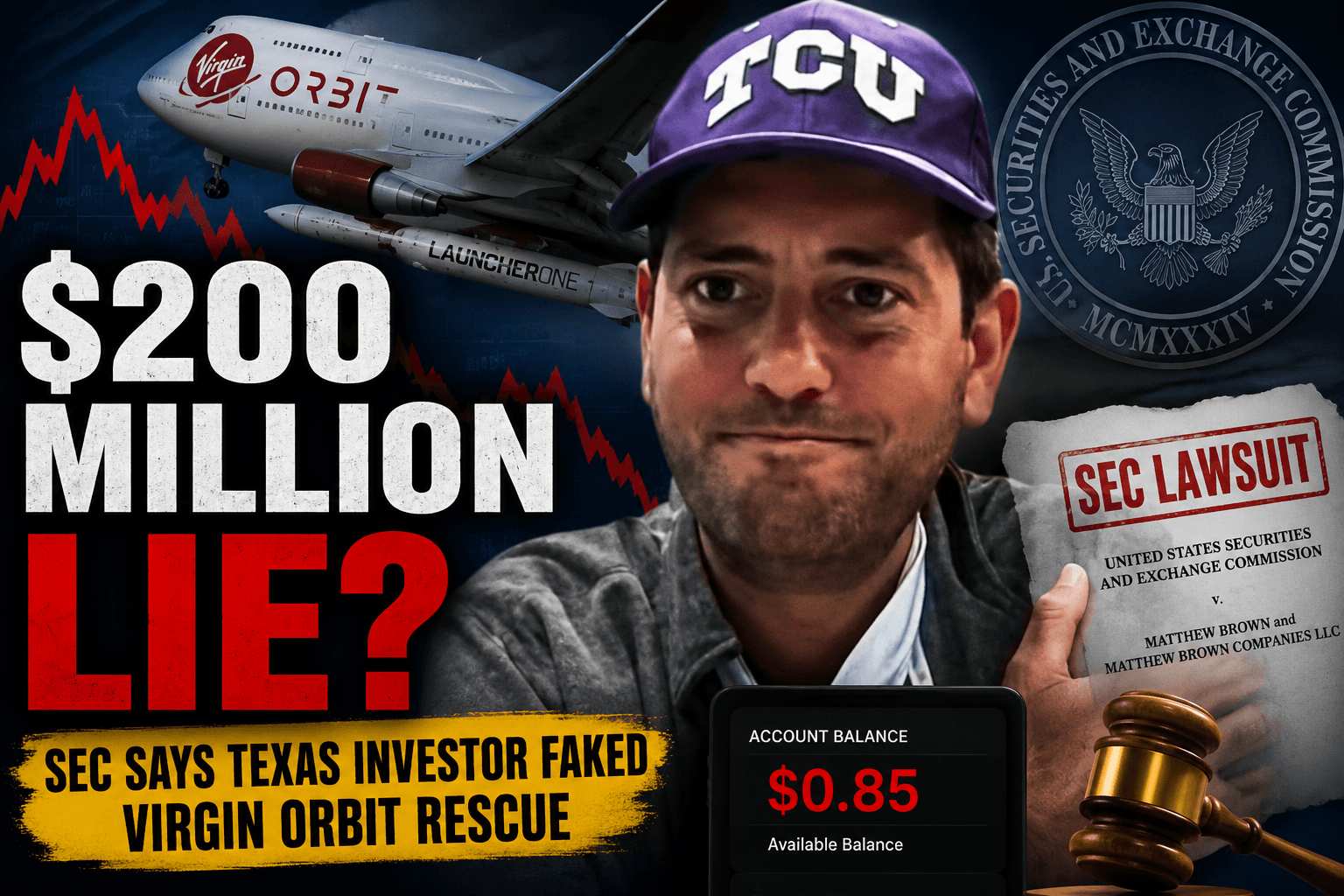
In June 2024, the SEC sued Brown and his company, Matthew Brown Companies LLC, accusing them of orchestrating a fraudulent scheme that briefly moved the stock market by portraying Brown as a wealthy venture capitalist capable of rescuing Richard Branson’s struggling space company, Virgin Orbit. The regulator alleges Brown fabricated his financial credentials, falsified proof that he possessed hundreds of millions of dollars, and publicly promoted an investment offer that had no realistic chance of closing.
Brown, who was in his mid-thirties at the time and operated Matthew Brown Companies from Texas, marketed himself as a seasoned investor with deep ties to the commercial space industry. During conversations with Virgin Orbit executives, he claimed to have invested hundreds of millions of dollars of his own capital into more than a dozen space companies. He also represented himself as someone with a legal education and extensive experience negotiating sophisticated transactions.
The SEC says those claims fell apart under scrutiny. According to its complaint, Brown had never graduated from college, had no meaningful investments in the space sector, and was nowhere near as wealthy as he portrayed himself to be. Instead of controlling the fortune he claimed, investigators say one of the bank accounts he used as proof of funds contained less than a single dollar.
The timing could hardly have been more significant. Virgin Orbit, founded by Richard Branson after being spun off from Virgin Galactic, had become one of the most closely watched companies in the commercial launch industry. It specialized in launching satellites from a modified Boeing 747 aircraft, but a failed mission in early 2023 intensified its financial troubles. By mid-March, the company suspended operations, furloughed most employees and openly searched for emergency financing to avoid collapse. Investors were desperate for good news, and any indication that fresh capital was arriving had the potential to dramatically move the company’s share price.
According to the SEC, Brown first contacted Virgin Orbit executives through LinkedIn in March 2023, offering a $200 million investment that he described as personal capital. To convince executives he was genuine, prosecutors say he emailed what appeared to be a screenshot showing Matthew Brown Companies held more than $182 million in cash. The SEC later alleged the image had been fabricated and that the account actually contained less than one dollar.
Virgin Orbit initially treated the proposal seriously. The parties entered into a confidentiality agreement, company officials began discussing potential deal terms, and reports quickly leaked that a major financing package was close. Reuters and CNBC reported negotiations were underway, fueling optimism that the company might survive after all. Investors responded immediately. Virgin Orbit shares jumped roughly 33 percent after news of Brown’s proposed investment became public.
Brown did little to dampen expectations. Appearing on CNBC while negotiations were still ongoing, he described himself as an experienced venture capitalist and told viewers he expected the transaction to close within a day. He spoke confidently about Virgin Orbit’s future and suggested his investment would put the company back on stable financial footing.
The SEC alleges those television appearances were another key part of the fraud because Brown publicly reinforced claims about his wealth, experience and ability to finance the transaction despite allegedly knowing those representations were false.
Behind the scenes, however, Virgin Orbit executives were becoming increasingly skeptical. As discussions progressed, company officials sought standard financial verification and requested that Brown place money into an independently verifiable escrow account. According to the SEC, he refused to do so. Rather than producing the requested documentation, Brown allegedly shifted tactics.
The complaint says Brown then sought a three percent “break-up fee” after it became apparent the investment would not proceed. Such fees are common in some mergers and acquisitions, where buyers receive compensation if a negotiated deal collapses under specified conditions. In this case, however, Virgin Orbit rejected the request outright, insisting Brown first demonstrate that he actually possessed the funds he claimed. The relationship quickly deteriorated, and company lawyers ultimately sent Brown a cease-and-desist letter after accusing him of publicly discussing confidential negotiations covered by the parties’ nondisclosure agreement.
As confidence in the proposed rescue evaporated, so did the stock’s gains. Virgin Orbit shares plunged after reports emerged that the financing had collapsed. Less than two weeks later, on April 4, 2023, the company filed for Chapter 11 bankruptcy protection after failing to secure long-term funding. A business once valued at roughly $3.8 billion ultimately sold off many of its assets during bankruptcy proceedings, marking one of the most prominent failures in the private space industry.
Although the SEC’s case centers on market fraud, it is notable for what it does not allege. Regulators did not accuse Brown of secretly buying or selling Virgin Orbit stock to profit from the price swings. Instead, the agency argues that the fraudulent conduct itself—making materially false statements in connection with a proposed securities transaction and misleading both the company and the investing public—violated federal securities laws regardless of whether Brown traded shares.
Brown has consistently denied the SEC’s allegations. Shortly after the lawsuit was filed, representatives for Brown and Matthew Brown Companies issued a statement describing the complaint as containing “egregious errors,” “fabrications” and “biased allegations.” They said they intended to challenge the case rather than settle it and maintained Brown had access to the necessary financing. In interviews conducted after Virgin Orbit’s collapse, Brown similarly insisted he had the money available and rejected accusations that he had attempted to deceive anyone.
The litigation nevertheless moved in the SEC’s favor. In August 2025, a federal judge granted summary judgment for the Commission, concluding that Brown and Matthew Brown Companies violated Section 10(b) of the Securities Exchange Act and Rule 10b-5, two of the principal anti-fraud provisions governing U.S. securities markets. A summary judgment means the court determined there were no genuine disputes of material fact requiring a trial on liability. The SEC later highlighted the case among its notable enforcement victories for fiscal year 2025, although proceedings concerning remedies and penalties continued afterward.
The case has also attracted academic attention because it raises broader questions about market integrity during periods of corporate distress. Virgin Orbit’s financial condition made it unusually vulnerable to dramatic headlines, and the prospect of a $200 million rescue instantly altered investor expectations. Even though the transaction never materialized, regulators argue that inaccurate claims about financing can significantly influence public markets when companies are fighting for survival.
Today, Virgin Orbit no longer exists as an operating launch company. Its bankruptcy scattered employees, patents and technology across multiple buyers, ending what had once been one of Richard Branson’s most ambitious space ventures. Brown, meanwhile, remains known largely through the SEC’s enforcement action and the court proceedings that followed. There are no publicly reported criminal charges arising from the matter, but the civil judgment underscores how aggressively regulators pursue conduct they believe undermines confidence in financial markets.
The story is ultimately about far more than one failed investment proposal. Public markets depend on trust—trust that companies disclose accurate information, that investors represent themselves honestly and that rescue deals announced during moments of crisis are grounded in reality. When those expectations break down, the damage extends well beyond a single stock chart. Employees lose jobs, shareholders make decisions based on unreliable information, and confidence in already fragile markets becomes harder to restore. That is why the SEC pursued the case so aggressively, and why the collapse of a purported $200 million bailout continues to serve as a cautionary tale for investors looking beyond the headlines.
————-
Disclaimer:
Some content on Reportingscams.com is published under our guest post program and is provided by third-party contributors. Reporting scams does not create, verify, or take responsibility for the views, accuracy, or claims expressed in such content.