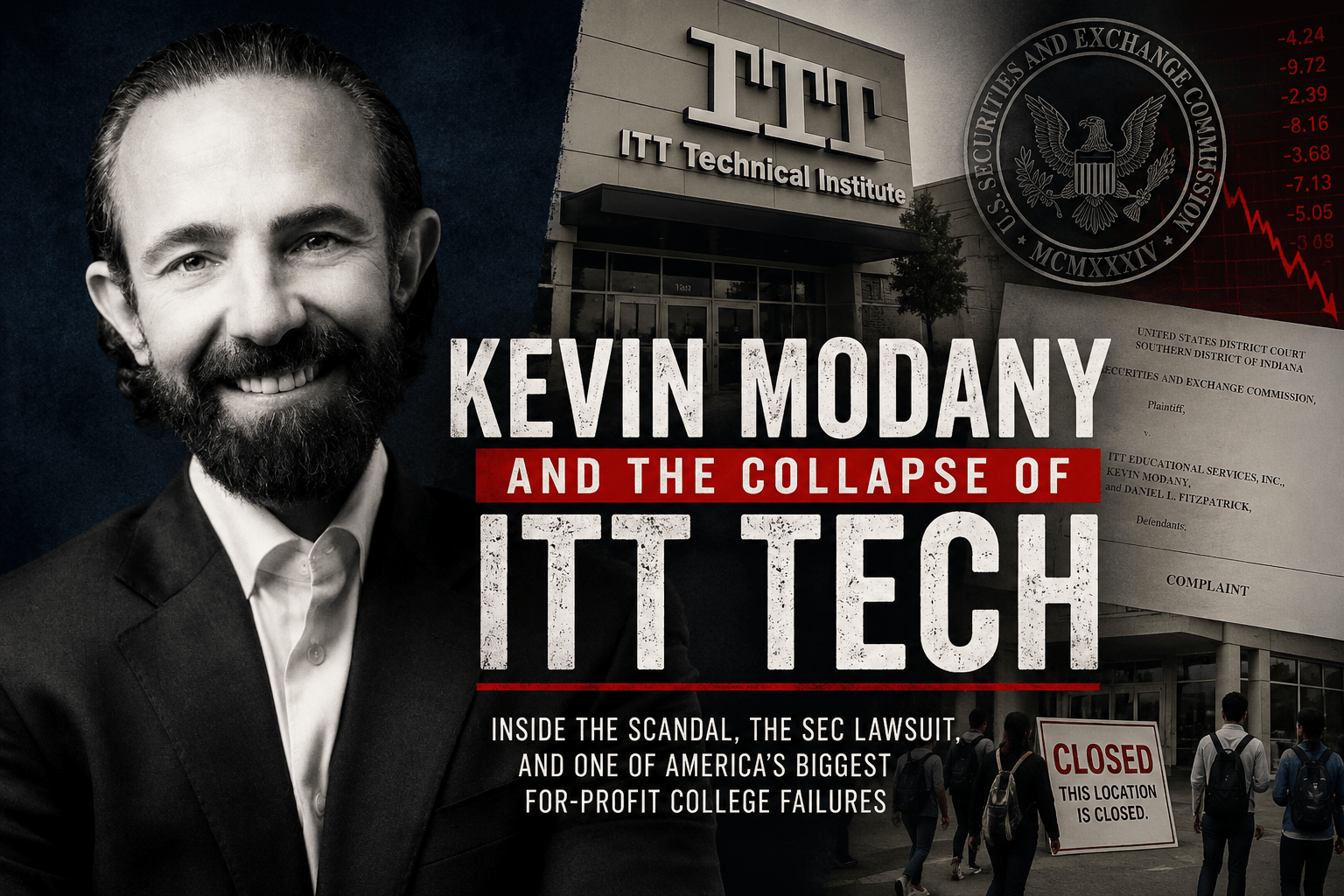
When ITT Educational Services shut its doors in September 2016, the announcement came with remarkable speed. One day, tens of thousands of students were attending classes at more than 130 campuses across the United States. The next, they were left wondering whether their degrees would ever hold value, whether their federal loans would be forgiven, and where they would go next. Nearly 35,000 students suddenly found themselves without a school. Thousands of employees lost their jobs almost overnight. Investors watched a company that had once been worth billions collapse into bankruptcy.
For many people, ITT Tech’s failure looked like another casualty of the struggling for-profit college industry. But regulators, shareholders and investigators saw something much larger. They believed the company’s collapse had been years in the making, driven not just by declining enrollment but by financial decisions that allegedly concealed the true health of the business from investors.
At the center of that story was Kevin Modany.
Unlike many high-profile corporate executives, Modany rarely sought public attention. He was not a celebrity CEO known for magazine covers or conference speeches. Instead, he built his career inside ITT Educational Services, climbing through executive ranks before becoming chief executive officer in 2007. By the time he took over, the company was already one of the largest for-profit education providers in the United States, operating campuses nationwide under the familiar ITT Technical Institute brand.
On paper, the business appeared incredibly successful. Revenue regularly exceeded a billion dollars. Enrollment was strong. Wall Street analysts continued following the company closely. To many investors, ITT looked like a reliable education business serving working adults seeking career-focused degrees.
Behind that public image, however, the economics of the company were becoming increasingly fragile.
Unlike traditional universities, ITT depended heavily on federal student financial aid. Tuition payments largely flowed from government-backed grants and student loan programs. As long as students enrolled and financing remained available, the business generated substantial revenue. But this model also carried enormous risk. If students struggled to repay loans, if regulators tightened oversight, or if access to private financing disappeared, the company’s entire business model could begin to unravel.
That pressure became painfully clear after the 2008 financial crisis.
Banks and private lenders dramatically reduced student lending as credit markets tightened. Suddenly, many prospective students who did not qualify for sufficient federal aid could no longer secure private loans needed to cover tuition gaps. For schools like ITT, this represented far more than an inconvenience. Fewer available loans meant fewer students could enroll, directly threatening future revenue.
Instead of accepting declining enrollment, ITT pursued an aggressive solution.
The company became deeply involved in creating alternative financing programs that would keep students borrowing even after many traditional lenders had exited the market. Two programs would later receive intense regulatory scrutiny: the CUSO loan program and, later, PEAKS.
To students, these programs appeared to be another avenue for educational financing. To regulators, however, they eventually became central to allegations that ITT had taken on significant undisclosed financial obligations while presenting investors with a much healthier financial picture than reality suggested.
The Securities and Exchange Commission would later argue that these programs were not merely outside financing vehicles. According to the agency’s complaint, ITT remained deeply exposed to losses through guarantees and support agreements that carried potentially enormous financial consequences. Those obligations, regulators alleged, were not adequately reflected in the company’s public financial reporting.
These allegations would eventually become the foundation of one of the SEC’s highest-profile accounting fraud cases involving the for-profit education sector.
Understanding why requires looking beyond accounting terminology and into how the loan programs actually worked.
After the financial crisis, private lenders had little appetite for financing students attending for-profit colleges. Default rates across the industry had raised concerns, and many banks concluded the risk outweighed the potential returns. ITT faced a difficult choice: allow enrollment to fall or find another way to finance students.
The company chose the second option.
Under the CUSO program, ITT helped facilitate private student lending through a credit union structure. Later, the PEAKS Trust would assume an even more important role by purchasing and securitizing student loans made to ITT students. On the surface, this appeared to solve the immediate financing problem. Students could still borrow money, enroll in classes and continue paying tuition.
But there was another side to the arrangement.
According to the SEC, ITT provided numerous guarantees and financial commitments designed to protect investors participating in these loan structures. If borrowers failed to repay their loans—and many eventually did—the company itself could become responsible for significant portions of those losses.
This distinction proved crucial.
Investors evaluating ITT relied heavily on the company’s quarterly and annual financial statements. Those reports presented a picture of profitability and manageable financial obligations. The SEC later alleged that this picture omitted critical information regarding the extent of ITT’s exposure to losses associated with PEAKS and CUSO.
One issue involved what became known as “modified parity payments.”
As defaults increased within the loan portfolios, ITT allegedly transferred millions of dollars into the trusts to prevent technical defaults and maintain the appearance of financial stability. According to regulators, these payments effectively postponed recognition of the deteriorating condition of the loan programs. Rather than revealing growing losses to investors, the SEC argued, the company continued presenting financial statements that understated its true obligations.
The complaint also accused executives of failing to properly consolidate PEAKS into ITT’s financial statements despite allegedly retaining substantial control over its economic performance.
Accounting consolidation rules may sound like dry technical matters, but in this case they carried enormous consequences. If regulators were correct, consolidating PEAKS would have significantly altered ITT’s reported liabilities, affecting how investors evaluated the company’s financial condition.
Kevin Modany denied wrongdoing, but as chief executive he became one of the principal defendants in the SEC’s civil enforcement action alongside chief financial officer Daniel Fitzpatrick.
The SEC’s complaint painted a picture of executives who allegedly understood the growing financial risks but continued assuring investors that the company’s financial reporting accurately reflected its condition.
Regulators also alleged that information provided to auditors failed to fully explain the company’s obligations associated with these loan programs. Auditors depend heavily on representations from management when reviewing complex financial arrangements. According to the SEC, omissions regarding certain guarantees and payment obligations contributed to financial statements that failed to present the full extent of ITT’s exposure.
For shareholders, the allegations struck at the heart of securities law.
Public companies are expected to disclose material information that could influence investment decisions. If a company carries substantial contingent liabilities particularly liabilities capable of threatening future operations those risks generally must be communicated accurately. The SEC argued that ITT’s disclosures fell well short of that standard.
The timing made the situation even more serious.
By the early 2010s, the broader for-profit education industry was already facing growing political and regulatory pressure. Consumer advocates questioned graduation rates, student debt burdens and employment outcomes. Federal agencies increased oversight of schools receiving billions of dollars in taxpayer-funded student aid. Congressional investigations examined recruitment practices throughout the industry.
ITT increasingly found itself operating under multiple layers of scrutiny at exactly the moment its financial position was becoming more precarious.
Enrollment began declining.
Revenue weakened.
Student defaults continued rising.
The Department of Education imposed additional financial responsibility requirements, demanding that ITT increase letters of credit while limiting certain enrollment practices. Those restrictions placed even greater pressure on the company’s cash position.
Investors watched closely as confidence deteriorated.
For years, ITT had presented itself as resilient despite industry headwinds. But as regulators intensified investigations and lawsuits accumulated, the market began reassessing whether the company’s business model remained viable at all. Every new disclosure appeared to reinforce concerns that the risks extended far beyond declining enrollment. They now involved fundamental questions about financial reporting, corporate governance and the sustainability of the loan programs that had helped keep students enrolled.
The unraveling was no longer confined to accounting debates. It had become a crisis of confidence—one that would soon spill into courtrooms, federal agencies and, ultimately, bankruptcy proceedings.
The pressure finally reached a breaking point in 2014 and 2015. By then, ITT Educational Services was no longer just dealing with slowing enrollment or a difficult lending environment. It was facing a crisis on several fronts. Federal regulators were asking tougher questions, investors were becoming increasingly skeptical, and the company’s dependence on federal student aid had placed it under a microscope.
The U.S. Department of Education had already begun tightening oversight of the for-profit college industry, arguing that schools receiving billions of taxpayer dollars had to demonstrate they were providing real value to students. ITT was one of the institutions drawing particular attention. Graduation rates, student debt, employment outcomes and recruiting practices were all being scrutinized more closely than ever before.
For ITT, none of this happened in isolation. Each regulatory concern made the next one more serious. A negative finding from one agency could trigger questions from another. Investors noticed. Credit markets noticed. So did students deciding where to enroll.
The company’s stock reflected that growing uncertainty. Once viewed as a reliable education business, ITT increasingly became a company fighting to convince the market that its best days were not behind it.
Behind the scenes, regulators were looking at something far more technical than enrollment numbers. They were examining how ITT accounted for its financial obligations tied to the PEAKS and CUSO loan programs.
In May 2015, the U.S. Securities and Exchange Commission formally filed a civil complaint against ITT Educational Services, Kevin Modany and chief financial officer Daniel Fitzpatrick. The complaint was not based on accusations that executives had stolen money or run a classic Ponzi scheme. Instead, it focused on what investors were allegedly told—or not told—about the company’s financial condition.
According to the SEC, ITT had guaranteed hundreds of millions of dollars connected to private student loans while failing to fully recognize or disclose the extent of those obligations in its financial statements. The agency argued that investors were presented with an incomplete picture of the company’s exposure at a time when those risks were growing rapidly.
The complaint also described what regulators viewed as a pattern of temporary financial fixes. One example involved so-called modified parity payments. Rather than allowing the deteriorating condition of the loan trusts to become immediately visible, the SEC alleged that ITT injected additional money into the trusts to keep them operating and avoid triggering defaults. Regulators argued that these payments delayed the recognition of deeper financial problems while allowing the company to continue reporting results that appeared healthier than the underlying reality.
The SEC further alleged that PEAKS should have been consolidated into ITT’s financial statements because the company effectively controlled the trust and remained exposed to its financial performance. Had that occurred, the agency argued, investors would have seen substantially larger liabilities on the balance sheet.
These allegations became the centerpiece of a lawsuit that would continue for years.
Modany denied the SEC’s allegations, and as with all civil enforcement actions, the complaint represented the regulator’s claims rather than findings of criminal guilt. Still, the filing fundamentally changed how many investors viewed ITT. The company was no longer simply navigating a difficult business environment. It was defending its accounting practices and financial disclosures in federal court.
At the same time, the Department of Education continued increasing pressure. Concerned about ITT’s financial stability, the department imposed additional restrictions designed to protect students and taxpayers if the company failed. It required ITT to increase its letters of credit essentially financial guarantees that could be used if the institution collapsed—and placed limitations on certain enrollment and financial practices.
Those measures carried real consequences. Cash that might otherwise have been available to operate the business now had to be set aside to satisfy regulatory requirements. The company’s financial flexibility narrowed just as legal costs and operational challenges were mounting.
The accrediting body overseeing ITT also expressed concerns about the institution’s future. Accreditation is the lifeblood of any college dependent on federal student aid. Without it, students cannot access many forms of federal financial assistance, making continued operation nearly impossible. As questions about ITT’s finances intensified, uncertainty surrounding its accreditation became another serious threat.
Meanwhile, shareholder lawsuits began to follow.
Investors alleged they had purchased ITT stock based on financial statements and public disclosures that did not accurately reflect the company’s true financial condition. While the legal theories differed from case to case, the central argument echoed many of the SEC’s concerns: that the market had not received the full picture.
As litigation expanded, internal company communications became an important part of the story. Court filings referenced emails, accounting discussions and executive communications that regulators argued demonstrated awareness of the growing risks associated with the loan programs. Lawyers for Modany and the other defendants disputed the SEC’s interpretation of those communications, arguing that the company acted appropriately under applicable accounting standards and disclosure rules.
Like many complex securities cases, the dispute often turned on highly technical accounting questions. Yet behind those technical arguments was a much simpler issue. Investors wanted to know whether they had been given an honest assessment of ITT’s financial health.
By mid-2016, events accelerated dramatically.
Enrollment continued falling. Revenue declined. Regulatory pressure intensified. Confidence from lenders, investors and students weakened almost simultaneously.
Then came the Department of Education’s decision that many observers viewed as the final blow. The agency imposed additional financial conditions that required ITT to significantly increase the amount of money it reserved to protect taxpayers. The company argued those requirements were financially impossible to meet.
Within days, ITT Educational Services announced that it would cease operations.
After nearly fifty years in business, one of America’s largest for-profit college operators shut down almost overnight.
The closure sent shockwaves across the higher education sector. Roughly 35,000 students suddenly found themselves without classes. Many had invested years pursuing degrees they could no longer complete at ITT. Thousands of instructors, administrators and staff lost their jobs with little warning.
For taxpayers, the consequences extended well beyond the company’s bankruptcy. Because so much of ITT’s revenue came from federally backed student aid, the federal government ultimately faced billions of dollars in potential loan discharges and borrower relief. Years later, the Department of Education approved widespread cancellation of federal loans for many former ITT students after determining that the institution had engaged in widespread misconduct in its representations to borrowers.
For investors, the losses were immediate. A company that had once traded at well over $100 per share became essentially worthless. Retirement accounts, institutional funds and individual shareholders absorbed substantial losses as the stock collapsed.
The bankruptcy also marked the beginning of years of additional litigation. Trustees, creditors, regulators and former students all sought recovery from what remained of the company’s assets. Courtrooms became the final chapter for an institution that had once marketed itself as a pathway to stable careers and technical education.
Kevin Modany’s own legal battle, however, did not end with ITT’s bankruptcy.
The SEC’s civil case continued after the company itself disappeared. Regulators maintained that Modany and Fitzpatrick had played central roles in misleading investors about ITT’s financial obligations and accounting treatment. The defendants continued denying wrongdoing, arguing that their accounting decisions complied with applicable standards and that the SEC’s interpretation was flawed.
Rather than proceed to a full trial, the litigation eventually concluded with a settlement in 2018. Without admitting or denying the SEC’s allegations, Modany agreed to pay a civil monetary penalty and accepted a five-year prohibition on serving as an officer or director of a public company. The settlement resolved the SEC’s enforcement action without a judicial finding that he had committed the alleged violations.
For some observers, the settlement represented accountability. For others, it left unanswered questions. There was no dramatic courtroom verdict, no criminal conviction and no definitive judicial ruling resolving every factual dispute. Like many securities enforcement cases, it ended through negotiation rather than a final trial.
Even so, the broader story had already been written.
ITT’s collapse became one of the defining failures of the modern for-profit college industry. It illustrated what can happen when aggressive growth depends on increasingly fragile financial structures. It also highlighted how accounting decisions that may appear technical on paper can have enormous real-world consequences for investors, students and employees.
Looking back, Kevin Modany’s tenure cannot be separated from that larger narrative. He inherited a company operating in a rapidly changing regulatory and financial environment, but he also led it during the years when its most controversial financing arrangements expanded and when regulators allege investors were deprived of material information about the company’s true financial exposure.
Whether viewed as a case of overly aggressive accounting, inadequate disclosure, failed corporate governance or a combination of all three, the ITT saga continues to be cited by regulators and governance experts as a cautionary tale. It underscored the importance of transparency in public-company reporting and demonstrated how financial engineering can postpone, but rarely prevent, a reckoning when the underlying business model begins to fail.
For thousands of former students, however, those debates remain secondary. Their memories of ITT are not found in SEC filings or bankruptcy records but in interrupted educations, uncertain career paths and years spent trying to untangle student debt. In many ways, they became the most visible casualties of a corporate collapse that had been building long before the doors of ITT Technical Institute closed for the last time.
————-
Disclaimer:
Some content on Reportingscams.com is published under our guest post program and is provided by third-party contributors. Reporting scams does not create, verify, or take responsibility for the views, accuracy, or claims expressed in such content.