David Kushner sold investors a story that sounded both sophisticated and safe. Money would be pooled through a series of limited liability companies and deployed into short-term loans tied to sports agents and professional athletes, including current and former NFL players. The pitch offered something many investors find hard to resist: attractive returns backed by supposedly straightforward lending deals in a glamorous corner of the sports world.
According to federal regulators and New York prosecutors, what investors got instead was a costly lesson in misplaced trust.
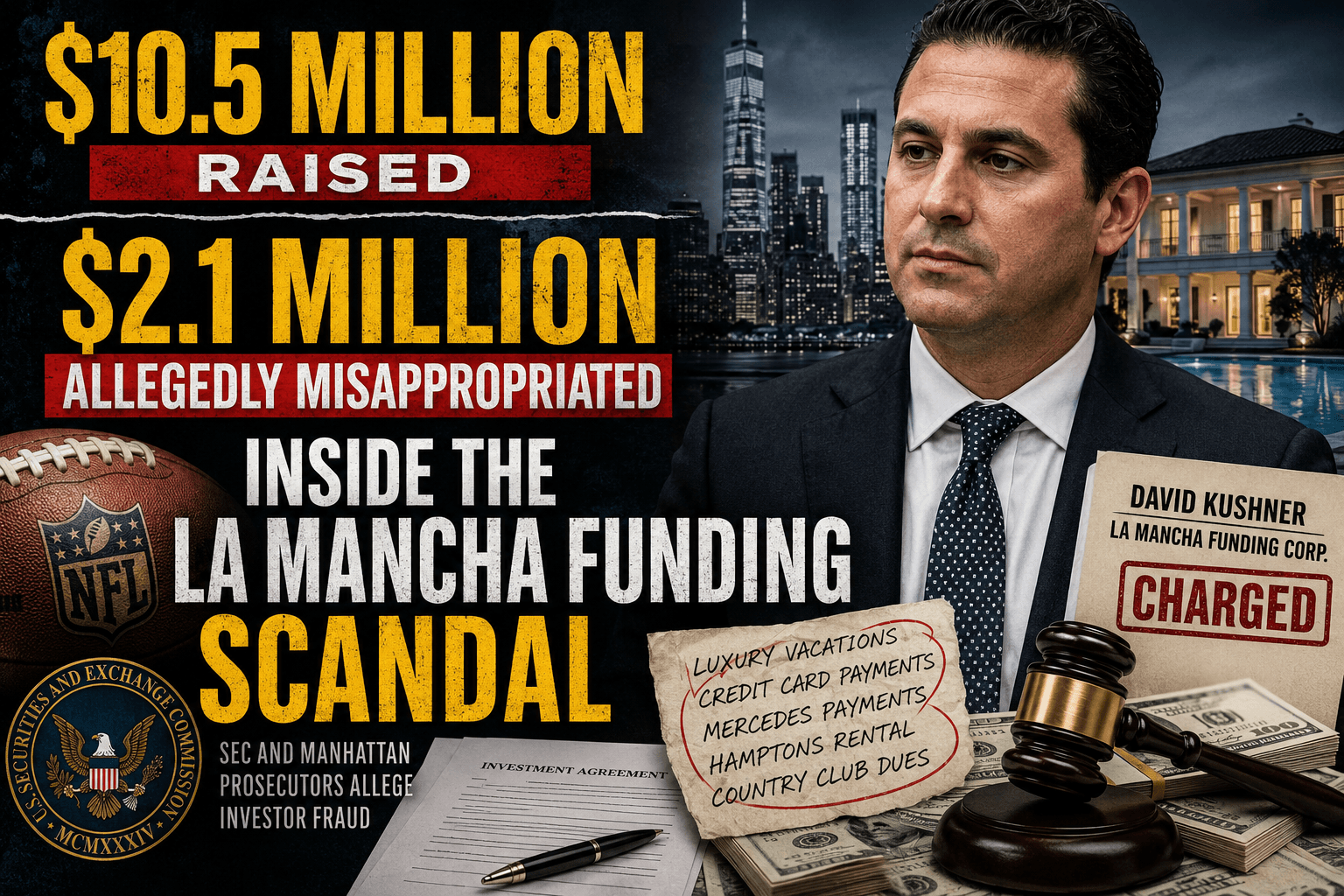
In November 2024, the U.S. Securities and Exchange Commission charged Kushner, a Boca Raton, Florida resident and the president and sole owner of La Mancha Funding Corp., with defrauding nearly two dozen investors out of approximately $2.1 million. The SEC alleged that Kushner and his company raised roughly $10.5 million through a series of private securities offerings, telling investors their money would be used to fund short-term loans to sports agents, professional athletes and others. But behind the scenes, regulators say, Kushner was quietly helping himself to the very funds investors believed were being put to work on their behalf.
The SEC’s complaint alleges that Kushner secretly siphoned hundreds of thousands of dollars in undisclosed fees from the loan proceeds before those funds ever reached their intended destinations. Investors were never told about these charges, according to regulators. Instead, they were left believing their capital was being used exactly as promised under the operating agreements governing the investment vehicles.
The allegations didn’t stop there.
Federal authorities say Kushner also diverted nearly $1.5 million in loan repayments that should have gone back to investors. Under the terms outlined in the LLC agreements, those repayments were supposed to be distributed to the people who had funded the loans. Instead, according to the SEC, the money flowed elsewhere.
Where exactly did it go?
The answer became one of the most striking aspects of the case.
According to the SEC complaint, Kushner used misappropriated investor money to pay personal credit card bills, college tuition expenses, country club dues, a luxury vacation, payments connected to a Mercedes-Benz, and even a rental home in the Hamptons. The image painted by regulators was not of a struggling businessman trying to keep an enterprise afloat, but of an investment adviser allegedly using other people’s money to support an affluent lifestyle.
“As we allege, Kushner lied to investors and simply stole the money that would have given them at least some of the investment returns he had promised,” Sheldon L. Pollock, Associate Director of the SEC’s New York Regional Office, said when the agency announced the charges.
The allegations also caught the attention of criminal prosecutors.
On the same day the SEC unveiled its civil complaint, Manhattan District Attorney Alvin Bragg’s office announced parallel criminal charges tied to what prosecutors described as a $2 million loan fraud scheme. The indictment accused Kushner of deceiving investors about how their money would be handled and represented another major escalation in the case.
While civil enforcement actions can result in injunctions, financial penalties and industry bans, criminal proceedings carry the possibility of far more severe consequences, including incarceration if convictions are secured.
As of the latest publicly available records, Kushner has not been convicted in the criminal case, and no public guilty plea has been identified. The proceedings appear to remain ongoing. In the SEC matter, court filings indicate that Kushner and La Mancha Funding Corp. retained counsel and continue to defend against the allegations. Like all defendants facing criminal charges, Kushner is presumed innocent unless and until proven guilty in court.
Still, the picture emerging from the filings raises troubling questions about how private investment opportunities are marketed and monitored.
Unlike some fraud cases involving sprawling corporate structures and numerous executives, La Mancha Funding Corp. appeared to revolve largely around one central figure. SEC filings describe Kushner as the company’s sole owner and president. No additional executives were named as defendants in the federal complaint. Although the underlying loans allegedly involved sports agents and professional athletes, the publicly available filings reviewed do not accuse those borrowers of wrongdoing.
That distinction matters.
Cases involving affinity-based investments or niche sectors often attract investors because they appear to provide access to exclusive opportunities unavailable to the general public. Sports-related financing, celebrity connections and private lending arrangements can create an aura of legitimacy and sophistication. Investors may assume that the involvement of high-profile industries means someone else has already performed the necessary due diligence.
But regulators say that’s precisely when vigilance becomes most important.
Private offerings typically lack many of the disclosure requirements associated with publicly traded investments. Investors often rely heavily on the representations of fund managers or advisers, trusting that their money is being handled according to written agreements. When those representations prove false, the damage can be devastating, particularly for individuals who invested retirement savings or substantial portions of their personal wealth.
The SEC’s lawsuit accuses Kushner and La Mancha of violating antifraud provisions contained in the Securities Act of 1933, the Securities Exchange Act of 1934 and the Investment Advisers Act of 1940. The agency is seeking permanent injunctions, disgorgement of allegedly ill-gotten gains with prejudgment interest, civil monetary penalties, and an officer-and-director bar that would restrict Kushner’s future ability to serve in leadership positions at public companies.
The allegations also fit a familiar pattern seen in numerous financial enforcement actions over the years. Investors are promised a compelling opportunity with limited downside. The manager claims specialized expertise and access. Money is raised through private channels with less transparency than public markets. Over time, investor funds allegedly begin serving purposes far removed from the original pitch.
For the people who trusted La Mancha, the financial consequences may ultimately prove only part of the damage. Cases like this erode confidence in private markets and legitimate investment professionals who operate ethically within them. Every high-profile allegation of deception makes investors more skeptical and more fearful that the next opportunity presented to them could carry hidden risks.
Whether prosecutors and regulators ultimately prove every allegation against David Kushner remains for the courts to decide. But the accusations alone serve as a stark reminder that impressive narratives and exclusive investment themes are never substitutes for transparency, independent verification and accountability.
At its core, this story isn’t really about sports lending or luxury vacations in the Hamptons. It’s about trust. Nearly two dozen investors allegedly handed over millions of dollars believing their money would be used exactly as promised. Authorities now say that trust was exploited for personal gain. And if the allegations are ultimately proven, the fallout will extend far beyond financial losses, reinforcing a painful truth that continues to haunt investors everywhere: sometimes the greatest risk isn’t the market itself, but the person asking you to trust them with your money.
————-
Disclaimer:
Some content on Reportingscams.com is published under our guest post program and is provided by third-party contributors. Reporting scams does not create, verify, or take responsibility for the views, accuracy, or claims expressed in such content.