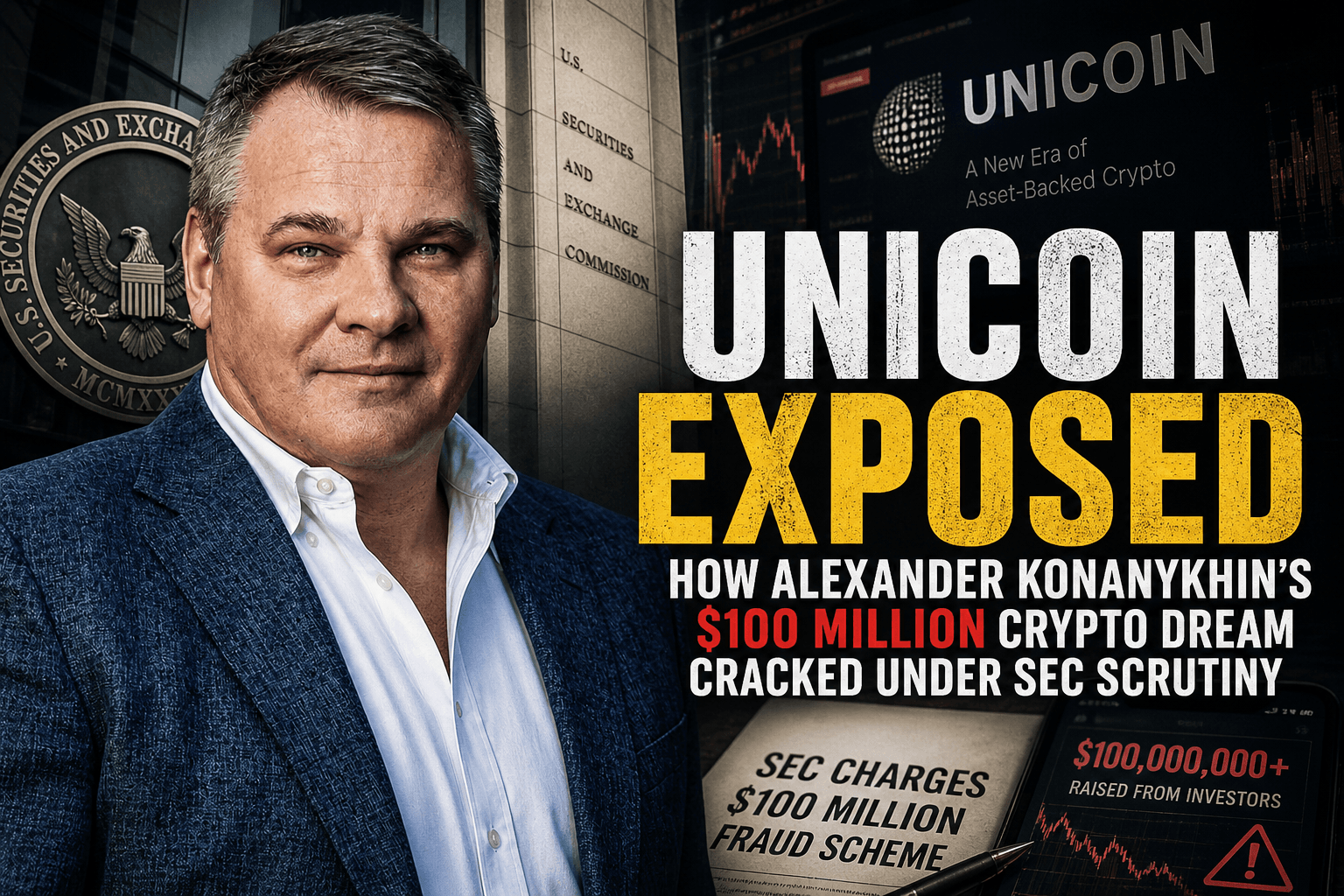
He sold it like the next evolution of crypto. Not another volatile token chasing hype, but something safer, something grounded, something that sounded almost too sensible for a market known for chaos. When Alexander Konanykhin pushed Unicoin into the spotlight, the pitch landed exactly where it needed to. Investors tired of watching Bitcoin swing wildly were suddenly being told there was a version of crypto backed by real assets, tied to tangible value, designed to avoid the same old crashes. It felt like the answer people had been waiting for. By the time regulators stepped in during May 2025, more than $100 million had already moved through the system.
That number did not come out of nowhere. It came from months of aggressive promotion, carefully crafted messaging, and a narrative that leaned heavily on trust. Through Unicoin Inc., Konanykhin positioned himself not just as a founder, but as someone who understood where crypto had failed and how to fix it. The idea was simple enough to spread fast. While traditional cryptocurrencies floated on speculation, Unicoin claimed it would be backed by real estate, pre-IPO equity, and other physical assets. It was pitched as stable, secure, and fundamentally different. That distinction became the hook.
The story began to crack when the U.S. Securities and Exchange Commission took a closer look. On May 20, 2025, the agency formally charged Konanykhin and other top executives, accusing them of orchestrating what it described as a large-scale securities fraud. According to the complaint, the very foundation of Unicoin’s appeal was built on claims that did not hold up under scrutiny. The assets that were supposed to back the token were allegedly overstated, misrepresented, or in some cases not structured in the way investors were led to believe. The promise of stability, which had been central to the entire operation, started to look more like a marketing angle than a financial reality.
It was not just about inflated numbers. Regulators pointed to a broader pattern in how the project was presented to the public. Investors were told about a growing base of participants, about strong financial positioning, about a product that was gaining traction in ways that suggested momentum and legitimacy. The SEC argues that much of that image was carefully constructed. In their view, the company leaned on selective disclosures and optimistic projections that crossed the line into deception. More than $100 million was raised in that environment, with investors believing they were buying into something anchored in real value.
For anyone who has followed Konanykhin’s career, the situation feels less like an isolated incident and more like a continuation. His story stretches back to the turbulent financial landscape of post-Soviet Russia, where he first built his profile. He later moved to the United States and recast himself as a businessman navigating global markets, often framing his past through the lens of political exile and survival. Over the years, he has been involved in ventures that carried ambition and complexity in equal measure. What critics have consistently pointed out is the pattern that tends to follow. Big ideas, bold claims, and eventually questions that start to catch up.
Unicoin carried all the hallmarks of that pattern, only this time wrapped in the language of modern finance. Crypto made it easier. The space is still evolving, still loosely defined in places, and still filled with investors looking for the next breakthrough. That environment creates room for narratives that might struggle to survive in more tightly regulated sectors. The idea of an asset-backed token sounds convincing on the surface, especially when paired with confident messaging and wide visibility. Unicoin leaned heavily into that combination.
The marketing push was relentless. Campaigns stretched across online platforms, financial media, and public advertising spaces that gave the project a sense of scale. It did not look like a small or experimental venture. It looked established, serious, and already in motion. That perception mattered. It made the leap from curiosity to investment feel smaller. When people see something everywhere, it begins to feel real, even if the underlying structure is harder to verify.
According to regulators, that perception was part of the strategy. The SEC’s filings suggest that the company used the complexity of its own claims to its advantage. Asset backing was discussed in broad terms, often without the kind of detail that would allow investors to independently verify what was being promised. At the same time, the narrative stayed simple enough to understand. Real assets. Lower risk. Future growth. That balance kept the story accessible while shielding the details.
As the case unfolds, more attention is also turning to the people around Konanykhin. The SEC did not frame this as a one-man operation. Other executives were named, pointing to a coordinated effort behind the scenes. Different roles, different responsibilities, but all tied into the same system that regulators now say was misleading from the start. That raises its own set of questions about accountability. How much was centralized, how much was shared, and how deeply the internal structure supported the external narrative.
The fallout is still developing. Legal proceedings of this scale rarely move quickly, and there is a long road between initial charges and final outcomes. There may be settlements, there may be extended court battles, and there may be additional findings as investigators continue to dig into the financial trail. For investors, the reality is more immediate. Recovering funds in cases like this is often complicated, and in many situations incomplete.
Beyond the numbers and the legal arguments, there is a familiar rhythm to the entire episode. A new idea enters the market with confidence. It promises to solve a real problem. It gains attention, builds momentum, attracts money. Then the scrutiny arrives, and the gap between what was promised and what actually exists begins to widen. It is a cycle that has repeated itself across different industries, from traditional finance to tech startups, and now within crypto.
Konanykhin’s role in that cycle is what is now under the microscope. He presented himself as someone offering a better version of crypto, a safer path forward in a space filled with uncertainty. Regulators are now arguing that the uncertainty was never removed, only repackaged. The stability was not proven, only claimed. The assets were not as solid as they appeared, at least not in the way investors were led to believe.
What makes this case stand out is not just the scale, though $100 million is significant. It is how effectively the narrative worked before it unraveled. For a period of time, Unicoin managed to position itself as credible in a market that is notoriously skeptical. That takes more than just an idea. It takes timing, messaging, and an understanding of what investors want to hear.
Now, that same narrative is being dissected line by line. Every claim, every number, every statement is being pulled apart in legal filings and public reports. The image that once attracted investors is being replaced with one shaped by allegations and evidence. It is a sharp reversal, but not an unfamiliar one.
As things stand, Konanykhin is once again at the center of a story that blends ambition with controversy. The difference this time is the scale of attention and the weight of the accusations. Crypto has brought new opportunities, but it has also brought new scrutiny. The margin for unchecked claims is shrinking, and cases like this are part of that shift.
For those watching from the outside, the lesson is not hidden. The language may change, the technology may evolve, but the core dynamic remains. When something sounds too well structured, too perfectly positioned to solve a complex problem, it is worth looking closer. In the case of Unicoin, that closer look is now happening in courtrooms and regulatory filings.
And for Alexander Konanykhin, the man who promised a more stable future for crypto, the present has become something else entirely.
————-
Disclaimer:
Some content on Reportingscams.com is published under our guest post program and is provided by third-party contributors. Reporting scams does not create, verify, or take responsibility for the views, accuracy, or claims expressed in such content.