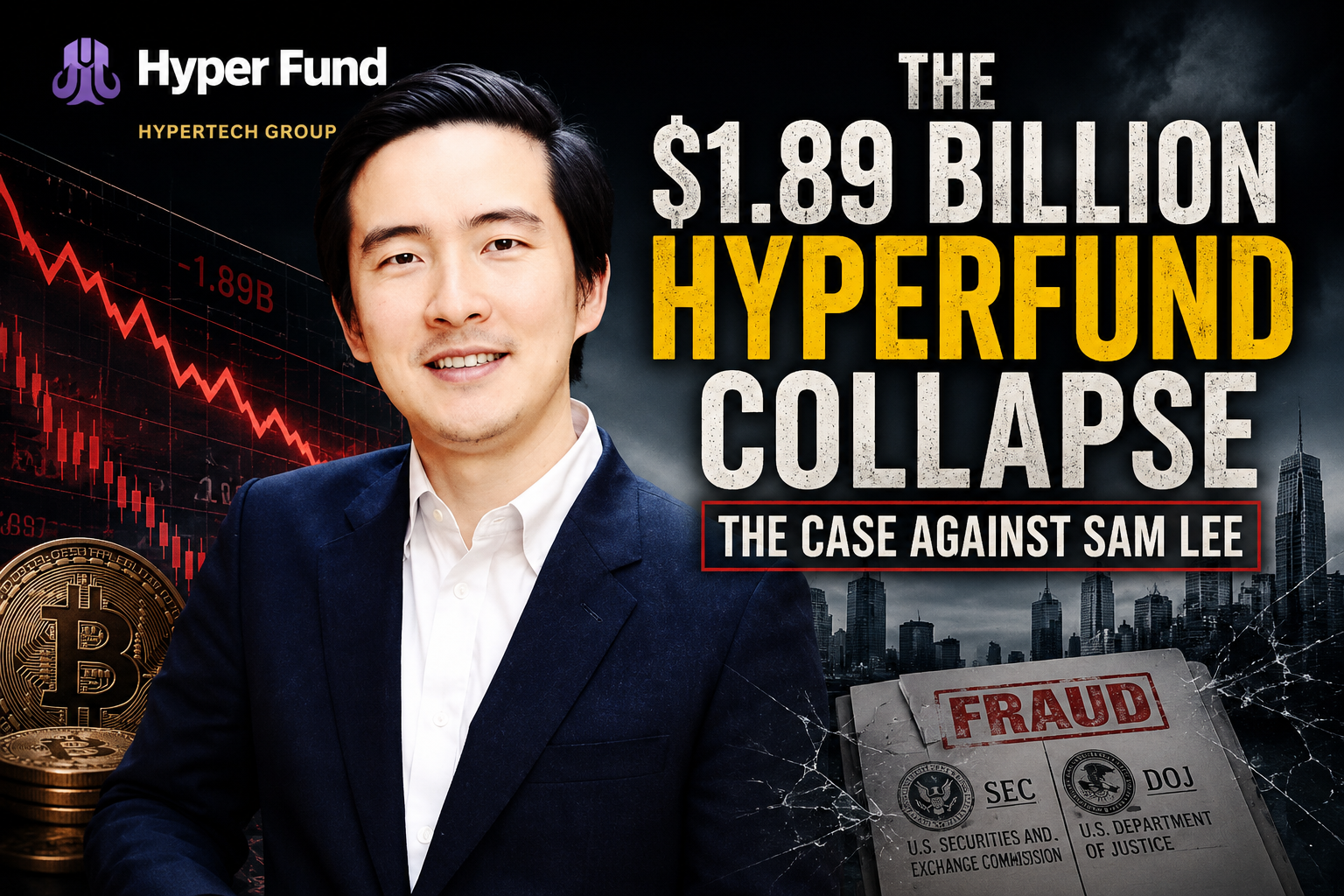
Xue Samuel Lee, better known as Sam Lee, built his public reputation around cryptocurrency long before U.S. prosecutors accused him of helping orchestrate one of the largest crypto investment frauds ever charged by American authorities. Australian corporate records identify Lee as born on September 13, 1988, making him 37 as of August 2026. The U.S. Securities and Exchange Commission identifies him as an Australian national residing in Dubai, United Arab Emirates, while the Department of Justice continues to list his federal criminal case as pending.
The case centers on HyperFund, a crypto investment operation launched in June 2020 under the broader HyperTech Group structure. HyperFund was later renamed HyperVerse and then HyperNation. According to the SEC, HyperTech Group was incorporated in the Seychelles and was presented to prospective investors as a blockchain conglomerate associated with Blockchain Global, HyperCash, CollinStar Capital and DigitalX. HyperFund was marketed as a decentralized finance ecosystem, while investors were sold membership packages promising returns of between 0.5% and 1% a day, with the possibility of tripling their original investment.
The problem, regulators say, was that the financial engine presented to investors did not exist in the form they were led to believe. HyperFund claimed that large-scale cryptocurrency mining generated the revenue needed to pay investor rewards. The SEC says HyperFund had no genuine revenue source beyond money coming from investors, and that withdrawals to earlier participants were funded with deposits from newer ones. The commission also alleges that Lee later admitted HyperTech was not engaged in the large-scale Bitcoin mining operation that had been used to support the investment story.
The structure went beyond a conventional investment pitch. HyperFund also rewarded members for recruiting new participants, creating a pyramid-style incentive system. Investors could purchase packages using Tether, with advertised membership levels ranging from hundreds of dollars to $10,000. Promoters presented the scheme as a way to earn passive income while also generating additional rewards through recruitment. The SEC alleges the securities were sold without registration and that the promotional material contained material misrepresentations about the business and its ability to generate the promised returns.
One of the most visible promoters was Brenda Indah Chunga, known online as “Bitcoin Beautee.” Federal prosecutors say Chunga conducted online investor meetings and promoted HyperFund’s purported returns. She pleaded guilty in January 2024 to conspiracy to commit securities fraud and wire fraud, admitting that she personally received at least $3 million in proceeds from the scheme. Her plea agreement requires restitution for victims, with the government and Chunga agreeing that the amount would be at least $3 million and potentially substantially higher. Her sentencing is now scheduled for January 7, 2027.
The SEC complaint gives a larger figure for Chunga’s financial benefit. It says she withdrew approximately $2.5 million from HyperFund and received another roughly $1.1 million directly from investors, taking approximately $3.7 million in total. The complaint says some of that money went toward luxury purchases, including jewelry, clothing, a BMW, designer handbags, a $1.2 million Maryland home and a $1.1 million Dubai condominium. These allegations form part of the SEC’s civil case and should not be confused with a separate criminal conviction of Lee. Chunga, by contrast, has admitted criminal wrongdoing through her guilty plea.
Another promoter, Rodney Burton, known as “Bitcoin Rodney,” became an important figure in the prosecution. Burton initially faced charges involving an unlicensed money-transmitting business. Prosecutors said he controlled companies presented as consulting businesses that were actually used to facilitate cryptocurrency transactions connected to HyperFund. They said he personally received at least $7.85 million from that operation. Burton ultimately pleaded guilty to conspiracy to operate an unlicensed money-transmitting business and was sentenced on July 23, 2026, to 32 months in prison, followed by three years of supervised release.
For investors, the numbers are enormous but not perfectly interchangeable. The SEC says HyperFund raised more than $1.7 billion from investors worldwide. The Justice Department’s criminal case uses approximately $1.89 billion as the alleged scale of the fraud, while Chainalysis estimates cited by the Guardian put consumer losses in 2022 at about $1.3 billion. These figures measure different things and should not simply be added together. What is clear is that the scheme operated internationally and left large numbers of investors unable to withdraw their money after the system began breaking down.
The collapse also exposed a troubling corporate history surrounding Lee. Blockchain Global, the Australian cryptocurrency company associated with Lee and business partner Zijing “Ryan” Xu, collapsed with approximately $58 million owed to creditors. Its liquidators referred Lee, Xu and former director Liang “Allan” Guo to Australia’s corporate regulator over potential breaches of the Corporations Act. ASIC later confirmed it was investigating Lee and Xu in connection with the collapse. The regulator’s investigation has continued to produce developments involving the company’s former directors, although allegations concerning Blockchain Global must be kept separate from the U.S. criminal allegations against Lee.
The pattern did not end with HyperFund. California’s Department of Financial Protection and Innovation issued a Desist and Refrain Order against Lee and We Are All Satoshi in September 2023. The order identified Lee as founder, CEO and chairman and alleged that the platform was selling investment contracts in California without the required qualification. The regulator further found that the operation had no apparent source of revenue other than investor funds and alleged that 68% of investor money was intended for recruitment payments, with another portion allocated to Bitcoin and a management fee.
StableDAO was another venture associated with Lee. California separately issued a Desist and Refrain Order against StableDAO and Lee for unlawful offers and sales of securities. Lee was identified by the regulator as founder, CEO and chairman. Other projects publicly linked to him have included Vidilook, VAV, VEND, Satoshi Maths Club and a proposed Hyper Ascension relaunch. The existence of these projects does not by itself establish fraud, but the sequence matters because several appeared after the collapse of HyperFund and HyperVerse.
The timing of Lee’s activity after the U.S. charges attracted particular attention. Days after prosecutors announced the HyperFund charges in January 2024, Lee appeared in promotional material for VEND and Satoshi Maths Club. The Guardian reported that he encouraged followers not to remain focused on losses and instead promoted participation in new projects. Lee has consistently disputed the central allegations against him. He has said his role in HyperVerse was limited largely to technology and funds-management functions, and he has denied responsibility for the alleged fraud. In 2025, he called claims made against him by Burton “baseless.”
Lee’s legal position remains unresolved. The DOJ continues to list United States v. Sam Lee, docket 24-CR-21, as a pending criminal case. He was indicted on one count of conspiracy to commit securities fraud and wire fraud and faces a maximum sentence of five years if convicted. The SEC’s parallel civil action is also ongoing. A federal docket shows Lee filed an answer to the SEC complaint in October 2025 after successfully challenging an earlier entry of default, meaning the civil allegations remain contested rather than resolved by a final judgment.
What makes the HyperFund story important is not simply the size of the alleged fraud. It is the machinery around it. The operation combined cryptocurrency, aggressive referral incentives, promises of extraordinary passive returns, corporate branding, international promotion and the appearance of technological sophistication. The SEC alleges that HyperFund even used an actor, Stephen Harrison, to present himself as “Steven Reece Lewis,” the supposed chief executive of HyperVerse. Harrison has denied involvement in the underlying business or benefiting from investor losses, and there is no suggestion that celebrity figures who appeared in promotional material necessarily knew of wrongdoing.
As of August 2026, Lee’s publicly documented position is starkly different from the image he once cultivated as a prominent blockchain entrepreneur. He remains associated in official U.S. records with a pending criminal prosecution, remains the subject of an SEC civil enforcement action, and is identified by the SEC and DOJ as residing in Dubai. There is no final criminal conviction against him in the HyperFund case at this time, and the allegations against him remain allegations unless proven in court. But the convictions and guilty pleas of promoters, the regulatory orders involving subsequent ventures, the collapse of Blockchain Global and the extraordinary amount of money said to have flowed through HyperFund create a record that investors cannot responsibly ignore.
The wider lesson is painfully familiar. A sophisticated website, a cryptocurrency vocabulary and a network of promoters can make an investment opportunity look legitimate without establishing that there is a legitimate business underneath it. HyperFund promised returns that should have demanded extraordinary scrutiny, yet the model attracted investors around the world, including people who borrowed money or committed life savings. The case now sits as a warning about what happens when the appearance of innovation becomes more persuasive than the underlying financial reality. The technology may change, the branding may change and the names may change, but investors still need to ask the oldest question in finance: where, exactly, is the money coming from?
————-
Disclaimer:
Some content on Reportingscams.com is published under our guest post program and is provided by third-party contributors. Reporting scams does not create, verify, or take responsibility for the views, accuracy, or claims expressed in such content.