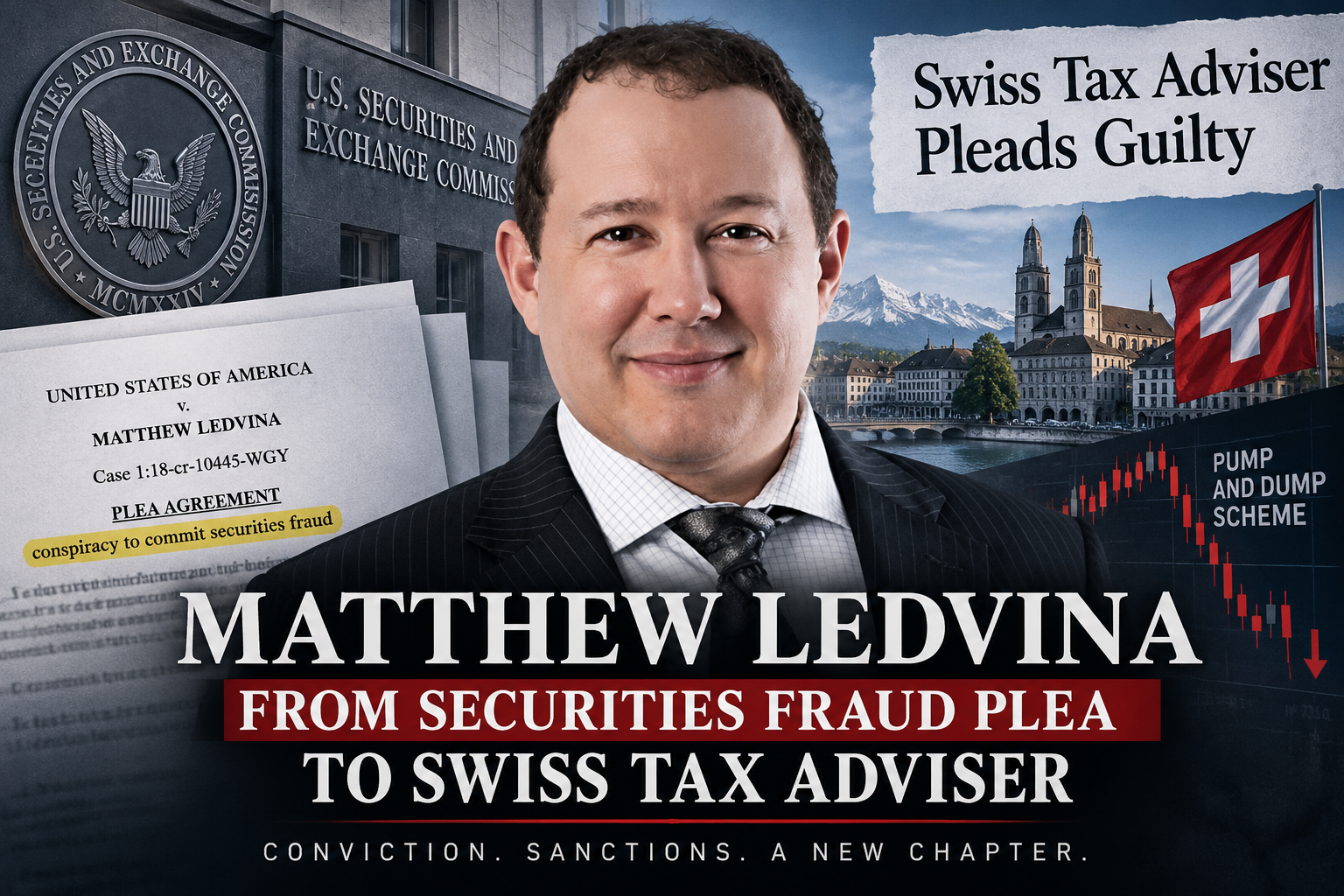
Matthew Conway Ledvina built a career around the kind of international financial work that depends heavily on trust: cross-border tax planning, wealth structuring, trusts, investment structures and advice to internationally mobile families. Public records now show a far more complicated professional history. Ledvina, a U.S.-born lawyer who was living in Switzerland, pleaded guilty in 2019 to conspiracy to commit securities fraud arising from a microcap stock manipulation scheme. He was later sentenced to probation and a $50,000 fine, ordered to pay more than $1.9 million in joint-and-several restitution, suspended by the U.S. Securities and Exchange Commission, disciplined by Tennessee, and struck off the Roll of Solicitors in England and Wales after a disciplinary tribunal found misconduct and dishonesty.
The public record identifies him as Matthew Conway Ledvina, with professional records also using Matthew Ledvina Ordered to Pay $1.9 Million After Securities Fraud Plea. He was 46 when the SEC described him as a Swiss resident in its 2019 amended complaint, placing him in his early-to-mid 50s today. The same filing identified him as an attorney and colleague of Milan Patel at an international law firm headquartered in Zurich. His professional biography says he attended Baylor University, Vanderbilt University Law School and New York University School of Law, and worked in international tax law before moving into cross-border advisory work.
The case that changed his professional record centered on two publicly traded companies, Environmental Packaging Technologies Holdings Inc. and CURE Pharmaceutical Holding Corp. The SEC alleged that investor Morrie Tobin secretly controlled substantial stock positions in the companies and used nominee entities and offshore accounts to conceal that control. According to the SEC, Ledvina and fellow attorney Milan Patel helped facilitate the arrangement by using nominee entities to hold shares, while offshore asset manager Roger Knox’s firms, first Silverton and later Wintercap SA, handled sales.
The alleged mechanism was familiar to regulators: create the appearance of legitimate market demand, push a thinly traded stock upward through promotion and trading activity, and then sell shares connected to the hidden control group. In Environmental Packaging’s case, the SEC said a promotional campaign helped push the stock from roughly $1.05 to $2.21 a share. Trading was halted by the SEC on June 27, 2017. The SEC also alleged that participants subsequently took steps to obscure their involvement, including changing names appearing on Wintercap account records.
The wider operation was considerably larger than the Ledvina case alone. Prosecutors described Knox’s broader operation as having generated approximately $164 million in securities-fraud proceeds over a three-year period, while the SEC said the emergency action against Knox and Wintercap involved more than $165 million in illegal stock sales across at least 50 microcap companies. Those figures relate to the broader operation and should not be confused with money personally obtained by Ledvina. For the Environmental Packaging transaction specifically, prosecutors said approximately $1.5 million of stock was sold before the SEC halted trading.
Ledvina’s own plea agreement is particularly important because it removes much of the ambiguity that surrounds an ordinary civil allegation. In the agreement, he expressly admitted that he committed the charged conspiracy knowingly and willfully and acknowledged that he was guilty. The agreement also stated that the sentencing calculation treated the total loss connected to the offense and related conduct as more than $9.5 million but no more than $25 million, while reducing his offense level because prosecutors agreed he was a minor participant.
The factual account later reviewed by the English Solicitors Disciplinary Tribunal was even more specific. The tribunal record states that, during the January 31, 2019 plea hearing, Ledvina accepted that he had participated in a deceptive scheme, helped conceal share ownership through nominee entities, including one registered in his own name, and knew another individual controlled the underlying shares. The prosecution also described an agreement under which Ledvina and another participant would receive approximately 4.5% of net trading proceeds from the pump-and-dump activity. The prosecutor described transfers of approximately 8 million to 10 million free-trading shares and an intended loss of roughly $15 million to $16 million, with approximately $1.5 million in actual loss in the transaction discussed.
That distinction between intended loss, actual trading proceeds and restitution matters. Ledvina was not sentenced as though he personally pocketed the entire amount attributed to the wider conspiracy. His federal sentence was 30 months of probation and a $50,000 fine, plus a $100 special assessment. In January 2021, an amended judgment ordered him jointly and severally with others to pay $1,908,583.26 in restitution. The plea agreement separately provided for forfeiture of any interest in EPTI trading proceeds and contemplated a money judgment representing proceeds obtained through the offense.
There is also an important distinction between the criminal and civil proceedings. The SEC’s civil case resulted in final judgments against Ledvina, Tobin and Patel in April 2021. They consented to injunctions covering securities-registration and antifraud provisions and penny-stock bars without admitting or denying the SEC’s civil allegations. Separately, all three had pleaded guilty in the parallel criminal case. The SEC says its litigation ultimately concluded in October 2024 after judgments involving the remaining defendants.
The professional consequences continued well beyond the United States. In June 2020, the SEC suspended Ledvina from appearing or practicing before the Commission after noting his felony conviction. Tennessee’s Supreme Court subsequently suspended him for six years, with four years of active suspension and the remainder on probation, retroactive to March 11, 2020; the Tennessee record says Ledvina submitted a conditional guilty plea acknowledging violations of professional-conduct rules and agreed to surrender his Tennessee license. The Tennessee attorney database now lists his status as “Surrendered.”
England and Wales produced another significant disciplinary chapter. Ledvina had been admitted as a solicitor in 2007 but was not practicing there at the time of the relevant conduct. The Solicitors Disciplinary Tribunal heard the matter in September 2022 after he chose not to attend, although he submitted written arguments. He argued that the U.S. plea resulted from a plea bargain, denied dishonesty, disputed the regulator’s interpretation of his conduct and said his name and electronic signature had been used without his authorization. The tribunal rejected that account, finding that he had knowingly participated in the conspiracy and that the circumstances established dishonesty on the civil standard of proof. It struck him off and ordered him to pay £3,675 in costs.
Ledvina later sought to rebuild his legal standing in New York. He had resigned his New York license in 2018, before the federal conviction, and applied for reinstatement in 2023. The New York court referred the matter to a referee for an evidentiary hearing. In October 2024, however, the Appellate Division denied reinstatement and ruled that another application could not be made until January 31, 2026. I found no reliable public record in the material reviewed showing that a new reinstatement application was subsequently granted.
The more striking question today is what happened to Ledvina professionally after those sanctions. The answer is not that he disappeared from international finance. Current public-facing material identifies him as a partner at Helm Advisors, a Switzerland-based firm whose work includes international tax, wealth planning, trusts, succession, banking and alternative assets. The firm’s current profile lists Ledvina as a partner and gives a Zurich contact point. Swiss commercial records also currently list Matthew Conway Ledvina as a board member and authorized signatory of Helm AG, while public Swiss registry data identifies him as a board member of Aerium AG and WealthComply AG. A Zurich association called IAWL Partners, registered in late 2025, also lists him as a board member and authorized signatory. These records place his current professional footprint in Switzerland, particularly Zurich.
In 2023, the story also resurfaced in a different form. Documents reviewed for this article show Ledvina contacting OffshoreAlert and asking the publication to remove or de-reference material concerning the securities case. In one letter he invoked European data-protection law and Article 17 of the GDPR, arguing that the information was no longer relevant and was causing unwarranted harm to his reputation. In another request, he asked for anonymization or technical measures such as “noindex” and robots.txt restrictions so that reports would not appear prominently when his name was searched. He framed the request as an attempt to restore privacy and move on after completing his criminal sentence.
The public record therefore presents two very different chapters of the same professional life. One is the current Swiss advisory business, where Ledvina publicly presents himself as a cross-border tax and wealth adviser. The other is a documented federal securities-fraud conviction, regulatory sanctions and professional discipline stemming from conduct prosecutors said helped conceal stock ownership and facilitate a microcap pump-and-dump. The criminal conviction has not been erased by the later passage of time, even though Ledvina has sought to limit the prominence of online reporting about it. For investors and clients dealing with professionals who operate across borders, the case is a reminder that professional reputation, regulatory status and criminal history can exist in very different legal systems at the same time. The important question is not simply whether someone has moved on professionally, but whether the public record of what happened remains accessible enough for people making consequential financial decisions to understand the history behind the résumé.
Source:
OffshoreAlert
————-
Disclaimer:
Some content on Reportingscams.com is published under our guest post program and is provided by third-party contributors. Reporting scams does not create, verify, or take responsibility for the views, accuracy, or claims expressed in such content.