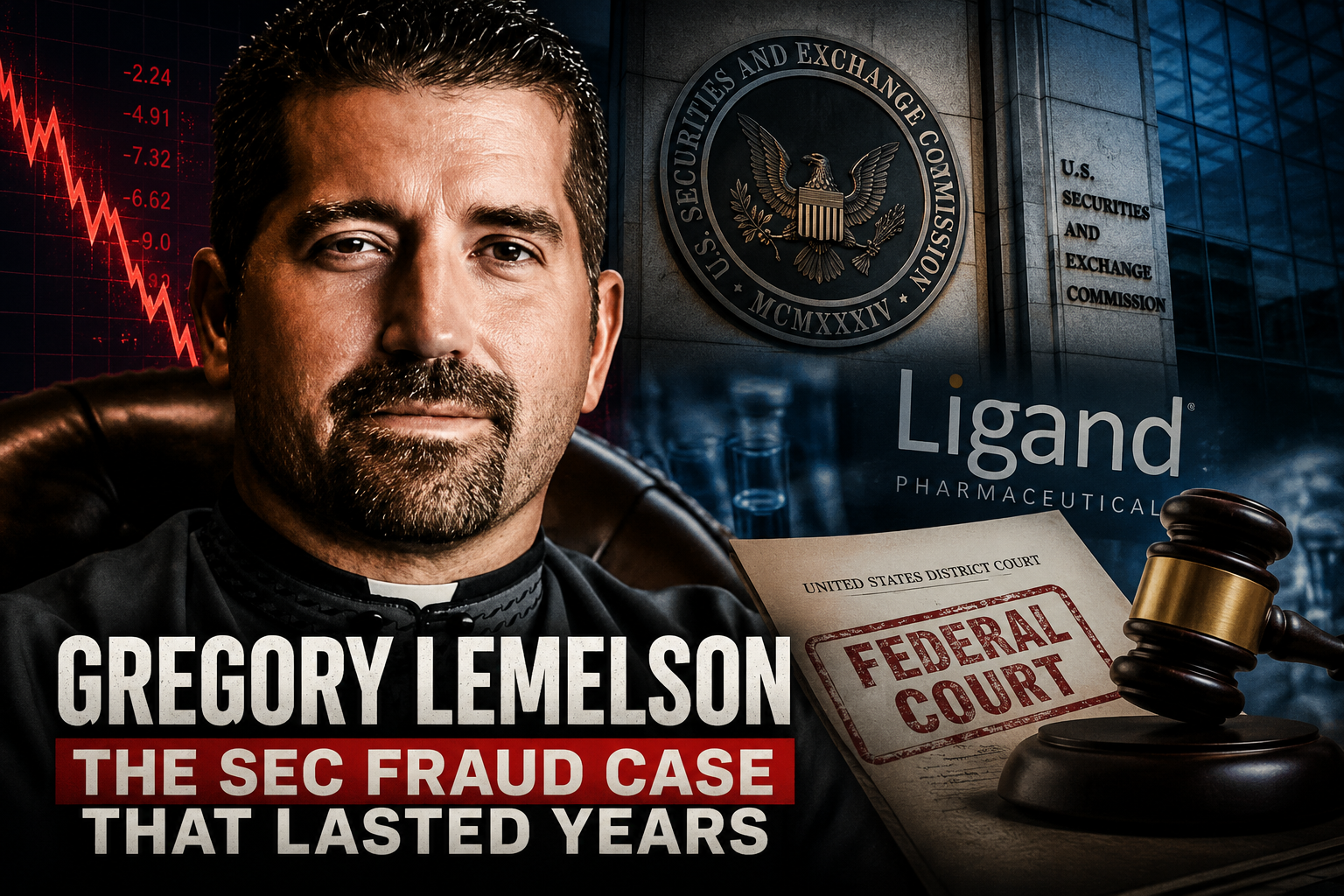
Gregory Lemelson has spent years presenting himself as an activist investor willing to challenge Wall Street. To supporters, he was an independent voice exposing weaknesses inside public companies. To U.S. securities regulators, however, he crossed a legal line by publishing false factual statements while holding a financial bet that a company’s stock price would fall. The resulting legal battle has stretched across multiple courts, produced a split jury verdict, sparked debates over free speech and market commentary, and become one of the most closely watched enforcement actions involving activist short sellers in recent years.
Lemelson, who is also known as Rev. Father Emmanuel Lemelson, managed Massachusetts-based Lemelson Capital Management LLC and served as investment adviser to the Amvona Fund, a hedge fund focused on concentrated investment positions. Beyond finance, he became known as an ordained Greek Orthodox priest, a combination that drew considerable public attention once the Securities and Exchange Commission began investigating his trading activity. Before regulators came knocking, Lemelson had built a reputation as an outspoken activist investor who regularly published lengthy reports criticizing companies in which his fund held short positions. His investment strategy depended on identifying businesses he believed were overvalued and profiting if their share prices declined.
The controversy centered on Ligand Pharmaceuticals, a biotechnology company that develops and licenses drug technologies. In 2014, Lemelson’s hedge fund accumulated a significant short position in Ligand stock. A short seller profits when a company’s share price falls, meaning the financial incentive runs in the opposite direction of traditional investors. During that period, Lemelson published reports, participated in interviews, and made public statements criticizing Ligand’s business model, financial condition, and one of its important drug development partners, Viking Therapeutics.
The SEC did not argue that activist short selling itself was illegal. Instead, regulators claimed that several specific statements Lemelson made went beyond opinion and became false statements of material fact. According to the SEC, those statements were capable of misleading investors and influencing Ligand’s stock price while Lemelson stood to benefit financially from the decline. The agency alleged that the trading strategy generated approximately $1.3 million in illegal profits for Lemelson and entities connected to him.
The enforcement action, filed in federal court in Massachusetts in 2018, accused Lemelson and Lemelson Capital Management of violating Section 10(b) of the Securities Exchange Act and Rule 10b-5, two of the primary anti-fraud provisions governing U.S. securities markets. Regulators argued that some of his published statements misrepresented facts involving Ligand’s financial reporting and Viking Therapeutics’ relationship with Ligand. They also alleged that his conduct formed part of a broader fraudulent scheme designed to manipulate investors’ perceptions of the company.
Lemelson consistently denied committing securities fraud. Throughout the litigation, he argued that his research represented protected market commentary and reflected his honestly held opinions about Ligand’s prospects. His defense maintained that activist investors must be free to publish critical research without fear that regulators will later characterize disputed opinions as fraud. Those arguments would eventually become central to his appeals.
After years of litigation, discovery, and expert testimony, the case reached a federal jury in late 2021. The verdict was mixed rather than a complete victory for either side. Jurors rejected several of the SEC’s most significant allegations, including claims that Lemelson had engaged in a broader fraudulent scheme and separate claims brought under the Investment Advisers Act. However, they concluded that three specific public statements constituted false statements of material fact in violation of Rule 10b-5. That distinction became legally important because it showed the jury believed some statements crossed the line from protected opinion into actionable factual misrepresentation while rejecting the government’s broader theory of market manipulation.
When it came time for penalties, the SEC sought sweeping remedies. Regulators requested a permanent injunction, disgorgement of profits, prejudgment interest, and civil penalties totaling well over $2 million. The agency also pursued industry restrictions that could have effectively ended Lemelson’s investment advisory career. The district court declined to grant much of what the SEC requested. Instead, the court imposed a five-year injunction prohibiting future securities law violations and ordered Lemelson to pay a $160,000 civil penalty. The court did not order disgorgement, a significant difference from what the SEC had originally sought.
The litigation became increasingly contentious outside the jury trial itself. During discovery, the district court found Lemelson in contempt after concluding he violated a protective order by disclosing confidential materials. Court records also describe litigation threats directed toward a priest who had provided information to investigators regarding Lemelson’s religious credentials. Those incidents added another layer of conflict to an already bitter legal fight that lasted several years.
Lemelson appealed the verdict to the U.S. Court of Appeals for the First Circuit, arguing that his statements were protected opinions under the First Amendment and that the evidence did not support securities fraud liability. The appellate court disagreed. In 2023, it affirmed the jury’s findings, concluding that the challenged statements could reasonably be viewed as false assertions of fact rather than protected expressions of opinion. The court also upheld the five-year injunction entered by the district judge.
Still unwilling to concede, Lemelson petitioned the U.S. Supreme Court. His lawyers framed the dispute as an important constitutional question, warning that the SEC’s theory threatened free speech by exposing market commentators to fraud liability whenever regulators disagreed with their analysis. The Supreme Court ultimately declined to hear the appeal, leaving the First Circuit’s decision in place and ending that phase of the litigation.
The legal battle, however, did not stop there. Lemelson later sought nearly $1.8 million in attorney’s fees under the Equal Access to Justice Act, arguing that the SEC had pursued excessive demands while succeeding on only a small portion of its original case. Although a district judge denied the request, the First Circuit revived that dispute in May 2025, concluding the lower court had applied the wrong legal framework when evaluating whether the SEC’s litigation demands were excessive compared with the judgment it ultimately obtained. Rather than awarding fees outright, the appellate court sent the matter back for further proceedings, keeping another chapter of the case alive.
A separate SEC administrative proceeding also continued after the federal court judgment. Regulators initially sought an industry bar that could have prevented Lemelson from associating with investment advisers. Yet in September 2025, the Commission exercised its discretion to dismiss that proceeding, citing the unique combination of circumstances surrounding the case, including the split jury verdict, the limited duration of the injunction, and the overall public interest. Importantly, the SEC stated that dismissing the proceeding did not represent a determination on the merits of the underlying allegations.
Today, Gregory Lemelson remains one of the most recognizable figures in the debate over activist short selling and securities fraud. His supporters argue that regulators targeted aggressive research designed to expose weaknesses in public companies. The SEC, meanwhile, has consistently maintained that investors are free to express negative opinions about companies but cannot knowingly publish false factual claims while standing to profit from falling share prices. That distinction continues to shape enforcement policy involving activist investors across U.S. markets.
The case also serves as a reminder that securities fraud enforcement does not require prosecutors to prove every allegation they bring. In Lemelson’s case, regulators failed to persuade jurors on several major claims but still secured findings that three false factual statements violated federal securities laws. At the same time, the courts substantially reduced the financial remedies originally sought by the SEC, illustrating that enforcement victories are not always complete victories. For investors, analysts, journalists, and market commentators alike, the litigation underscores a simple principle that extends far beyond one hedge fund manager or one pharmaceutical company. Strong opinions remain protected, but when statements presented as facts prove materially false and are tied to financial gain, they can trigger years of regulatory scrutiny, expensive litigation, and lasting consequences that extend well beyond the trading floor.
————-
Disclaimer:
Some content on Reportingscams.com is published under our guest post program and is provided by third-party contributors. Reporting scams does not create, verify, or take responsibility for the views, accuracy, or claims expressed in such content.