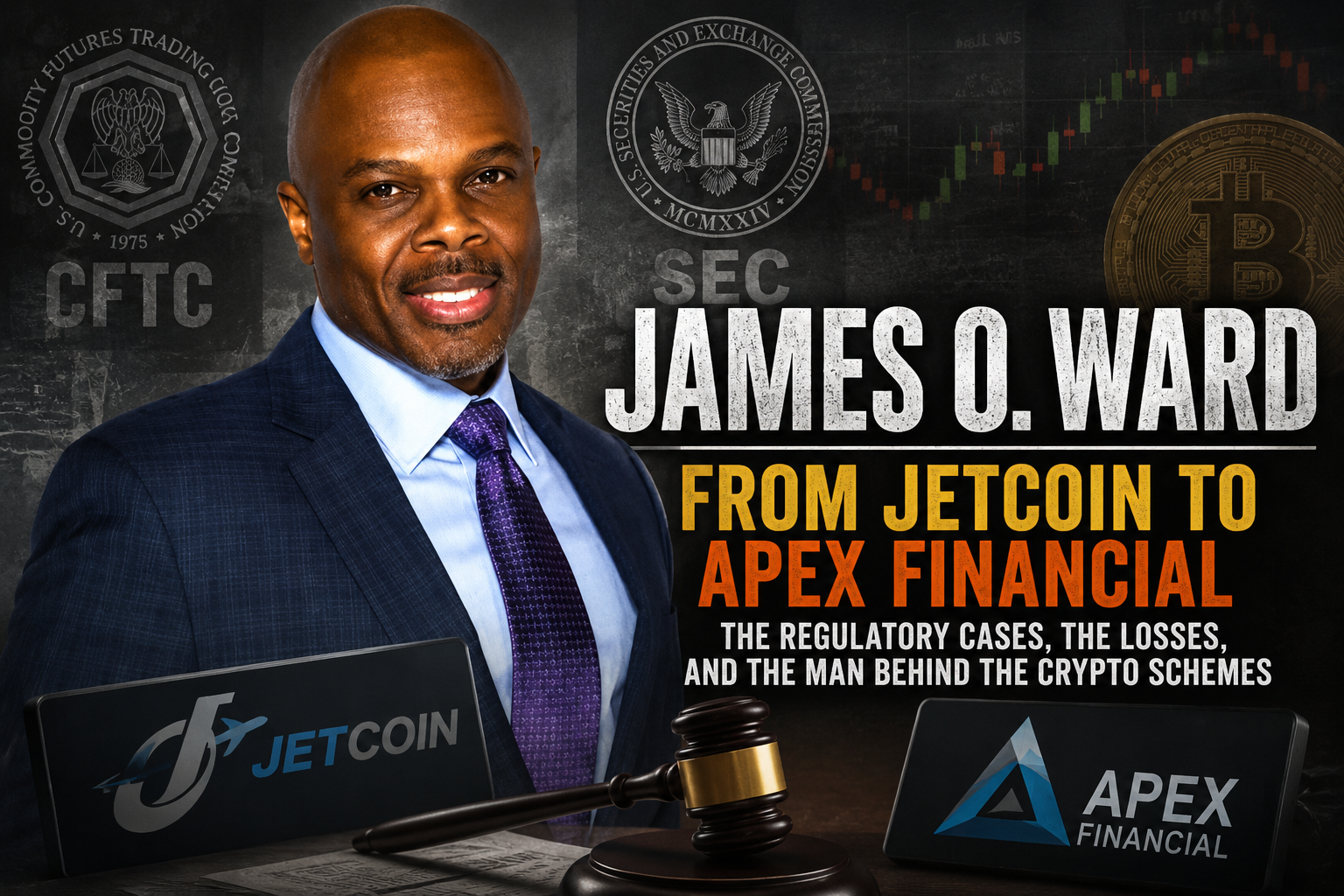
James O. Ward Jr. did not build his reputation in cryptocurrency through a single failed investment venture. His public record, as reconstructed from regulatory filings, court proceedings and investigative reporting, describes something more persistent: a succession of investment and multi-level marketing ventures, followed by regulatory intervention, investor losses and, in one case, an admitted effort to destroy evidence after a federal subpoena.
The most serious findings come directly from the U.S. Commodity Futures Trading Commission. In a March 2022 order, the CFTC found that Ward and his associates operated JetCoin as a deceptive Bitcoin investment scheme between May and August 2017. Ward admitted the findings. The regulator said the operation solicited approximately $21.7 million worth of Bitcoin from customers and misappropriated approximately $7.884 million, with Ward personally receiving at least $509,000 worth of Bitcoin.
Years later, Ward was back in the investment business. This time the vehicle was Apex Financial Institute Pvt. Ltd., a private investment fund incorporated in the British Virgin Islands. According to the Securities and Exchange Commission, Apex raised at least $852,000 from approximately 70 investors. The SEC alleged that Ward and his partners promoted the fund using false claims about its regulatory status, assets, trading history, investment strategy and international presence. A federal court ultimately entered a final judgment against Ward in October 2025, imposing an $85,000 civil penalty and permanent restrictions on his activities in the securities markets.
Taken together, the record raises a difficult question about the effectiveness of regulatory intervention. Ward’s first major crypto scheme was followed by a CFTC enforcement action. Yet the record shows him subsequently appearing in other crypto and investment ventures, including Apex Financial and Full Velocity. Some of those later associations are supported primarily by investigative reporting rather than adjudicated findings, and that distinction matters. But the sequence is striking enough to warrant close examination.
James O. Ward Jr. is identified in regulatory records as an Alabama resident. The Investigations.org report places his residence in the Foley/Gulf Shores area and gives an approximate birth year of 1977. That would put him at roughly 49 years old in 2026, although the publicly available regulatory documents do not establish a precise date of birth. There is also no reliable public evidence establishing his present physical whereabouts, so a responsible account should describe Alabama as his documented residence rather than claim that he is currently living at a particular address.
The CFTC order provides an important piece of background that is easy to miss. Ward had previously been registered with the Commission as an Associated Person of a Futures Commission Merchant until 2009. That means he was not an outsider encountering financial markets for the first time when JetCoin appeared in 2017. The regulatory record shows that he had prior exposure to the regulated futures industry, although the CFTC’s 2022 order concerned his conduct with JetCoin rather than his earlier registration.
Before JetCoin, Ward’s name had also appeared in the multi-level marketing world. BehindMLM, a specialist publication that tracks MLM companies, reported that Ward was associated with LGN Prosperity around 2010 and later with other ventures in the travel and MLM sector. The Investigations.org report follows that trail into LGN International, iBizWave and 2SL Start Living. Those earlier associations are not supported in the same way as the later CFTC findings, however, and there is no reason to elevate third-party reporting about them to the same evidentiary level as a regulatory order.
That distinction becomes important because Ward’s later history is often described as a continuous chain of fraudulent schemes. The public record supports a pattern of repeated ventures, but not every company in that chain has been the subject of a court judgment or regulatory finding against Ward personally. The strongest documentary evidence begins with JetCoin.
JetCoin appeared in 2017 during the early period when cryptocurrency investment schemes were beginning to exploit the public fascination with Bitcoin. The pitch was straightforward. Investors were told that professional traders would generate profits from Bitcoin trading. Customers were promised extraordinary returns, including daily payments in some investment packages. The scheme also incorporated a recruitment structure, with participants able to earn commissions for bringing in new customers.
The CFTC found that the promises were false.
According to the regulator’s order, Ward and his associates did not employ professional traders and did not trade Bitcoin as represented. Instead, payments described as trading profits were funded with Bitcoin obtained from other customers. In regulatory terms, the structure was a Ponzi scheme. The CFTC concluded that Ward violated Section 6(c)(1) of the Commodity Exchange Act and Regulation 180.1(a), provisions addressing manipulative and deceptive conduct involving commodities.
The numbers were substantial. JetCoin solicited approximately $21.7 million worth of Bitcoin from customers in the United States and abroad. Of that amount, the CFTC found that Ward and his associates misappropriated approximately $7.884 million. Ward personally received at least $509,000 worth of Bitcoin from the scheme. These are not estimates derived from social-media complaints or anonymous allegations. They are figures contained in a federal financial regulator’s findings, which Ward admitted when he entered into the settlement.
The way JetCoin unraveled is equally revealing.
Customers began experiencing payment problems in June 2017. Rather than acknowledging that the promised trading operation did not have sufficient Bitcoin to continue paying investors, the scheme’s operators sent explanations blaming technical problems. The CFTC found that customers were told that payment systems would resume and that the company was working through IT difficulties.
They did not resume.
The promised returns were later reduced, and customers were told that higher payments would depend on bringing in additional investors. The regulatory order says that this was done even though the operators knew the earlier guaranteed returns were fictitious and were being funded with money from other customers. When JetCoin’s website eventually disappeared, customers were told that a new version of the company would launch. A purported replacement operation later shut down as well. Customers were promised refunds that never materialized.
The most disturbing episode in the JetCoin record came after the scheme itself had collapsed.
In June 2018, an associate of Ward received a subpoena from the Federal Trade Commission in connection with an investigation involving a JetCoin promoter. According to the CFTC order, the associate asked Ward how to respond. Ward advised the associate to delete JetCoin-related documents from his computer and instructed him to search his email for the word “jet” and delete the results. The regulator further found that Ward told the associate, on several occasions, that he should either burn his computer or throw it into a lake. The computer was subsequently cleaned and submitted to the FTC.
This is not merely an allegation appearing in an investigative article. It is part of the CFTC’s formal findings, and Ward admitted those findings as part of his settlement.
That fact materially changes the character of the JetCoin story. Investment fraud allegations can involve disputes over performance, business models or representations. Evidence destruction is different. It concerns what happens after investigators begin asking questions. In Ward’s case, the regulator’s own findings describe an attempt to remove potentially relevant evidence after a federal subpoena had been issued.
The CFTC order was entered in March 2022 under Docket No. 22-12. Ward accepted the Commission’s jurisdiction, admitted the findings, waived a hearing and judicial review, and consented to an order requiring him to cease and desist from violating the relevant provisions of the Commodity Exchange Act. He was also permanently prohibited from directly or indirectly trading on or subject to the rules of registered entities. The Commission reserved the question of monetary relief for a later proceeding.
The regulatory intervention did not end Ward’s involvement in the cryptocurrency investment world.
Investigative reporting by BehindMLM links Ward to several ventures after JetCoin, including Sports Trading BTC, Global Credits Network and Lion’s Share. Sports Trading BTC reportedly collapsed in late 2019, Global Credits Network in April 2020 and Lion’s Share was launched in June 2020 as a smart-contract-based cryptocurrency venture. These associations should be described as reported rather than adjudicated because the primary regulatory findings available in the record do not establish fraud against Ward in each of these ventures.
But the timing is difficult to ignore.
By 2021, Ward had become involved in Apex Financial Institute Pvt. Ltd., a private investment fund incorporated in the British Virgin Islands. The company became the center of the SEC’s later securities-fraud case.
The corporate structure is significant because Apex was not simply presented to investors as another informal crypto project. According to the SEC, it was a private investment fund managed by Ward and his partners. SEC records identify Ward alongside Jason Rose and Hitesh Juneja. The Investigations.org report says Apex was incorporated in the British Virgin Islands in February 2021 and that a Form D filed with the SEC on March 16, 2021 identified Ward as a co-owner.
The public-facing presentation was different.
The SEC alleged that Ward presented himself as the fund’s “Head of Marketing” rather than openly describing his ownership role. More importantly, the regulator alleged that investors were told Apex was regulated by the SEC, that it had $25 million in assets under management, that it had successfully completed a 12-month beta test of its trading strategies, that its strategies offered the possibility of substantial gains without risk of loss, and that the company had multiple international offices.
The SEC said those representations were false.
At least $852,000 was raised from approximately 70 investors, according to the SEC. The allegations concerned securities offered through Apex Financial Institute and resulted in a federal civil enforcement action filed in the Southern District of Alabama in September 2024 under Case No. 24-000327.
The difference between the Apex case and JetCoin is important. In the JetCoin matter, Ward admitted the CFTC’s findings. In the SEC case, he did not admit or deny the allegations in the complaint. Instead, he consented to injunctive relief. That distinction should be preserved in any publication because it separates established regulatory findings from allegations resolved through a consent judgment without an admission of liability.
The court’s handling of the SEC case also deserves attention.
Ward initially proposed a consent judgment, but the court rejected the first version in March 2025 because of concerns over what the Investigations.org report describes as unenforceable “obey-the-law” injunction provisions. A revised consent judgment was approved on May 19, 2025. The final judgment was entered on October 28, 2025.
The final restrictions were significant. Ward was permanently enjoined from violating Section 17(a)(1) and (3) of the Securities Act of 1933 and Section 10(b) of the Securities Exchange Act of 1934 and Rule 10b-5. He was also barred from trading securities except securities listed on a national securities exchange in his own personal accounts, and he was prohibited from serving as an officer or director of a public company. The court also ordered him to pay an $85,000 civil penalty.
That judgment was announced by the SEC in December 2025, making it one of the most recent confirmed regulatory events in Ward’s public record.
There is another episode that makes the chronology more consequential.
In February 2022, while the JetCoin matter was moving toward formal CFTC action, Ward was reported to have launched Full Velocity, a cryptocurrency trading operation marketed around a trading bot. BehindMLM identified Ward appearing in Full Velocity marketing material as CEO and reported that the company’s website promoted trading returns that had not been independently substantiated. The publication also reported that Full Velocity’s trading bot ultimately generated losses of roughly 90 percent and that the operation collapsed in May 2022.
This episode requires careful language. The CFTC consent order establishes the JetCoin misconduct and the permanent trading restriction. BehindMLM’s reporting supplies the evidence concerning Full Velocity’s launch, marketing and collapse. The public record reviewed here does not establish a separate final regulatory judgment finding that Full Velocity itself was fraudulent. Therefore, it is more accurate to describe Full Velocity as a reported venture associated with Ward that collapsed after severe investor losses rather than state as a proven fraud in the same category as JetCoin.
The chronology nonetheless presents an unusual regulatory sequence.
JetCoin was launched in 2017. It collapsed later that year. The FTC investigated a JetCoin promoter, and in 2018 Ward was found by the CFTC to have directed an associate to destroy evidence in response to the subpoena. Later ventures were reported in the crypto and MLM space. Apex Financial was incorporated offshore in 2021. Full Velocity appeared in 2022. The CFTC order concerning JetCoin was filed in March 2022, and Ward ultimately settled that proceeding in January 2023 by admitting the findings. The SEC then sued Ward over Apex Financial in September 2024, and a final judgment followed in October 2025.
That sequence is the central fact of Ward’s story.
It is not simply that one cryptocurrency venture failed and a regulator later imposed a penalty. The documented record shows a progression from one investment scheme to later ventures, including an offshore private fund, while regulators were already examining his earlier conduct.
The offshore component of Apex Financial also deserves scrutiny, although incorporation in the British Virgin Islands is not itself evidence of wrongdoing. Offshore corporate structures are widely used for legitimate investment and commercial purposes. The investigative question is what the structure was used for and what investors were told about it.
In the Apex case, the SEC’s allegations centered on the representations made to investors. The alleged false claim that the fund was regulated by the SEC is particularly significant because regulatory status is one of the most basic credibility checks available to an investor. If an investment promoter falsely tells prospective customers that a fund is regulated by a federal securities regulator, that statement can fundamentally alter an investor’s assessment of risk.
The SEC’s complaint also alleged that Ward and his associates overstated the fund’s assets, trading history, offices and risk profile. The alleged claim of substantial gains without risk of loss is another classic warning sign. Legitimate investment strategies can reduce, manage or hedge risk, but promises that effectively eliminate investment risk while preserving substantial upside require extraordinary evidence.
The SEC ultimately obtained a judgment that prevents Ward from repeating securities-law violations and significantly restricts his ability to participate in the securities markets. The $85,000 penalty is considerably smaller than the amounts cited in the JetCoin and Apex cases, but the injunction itself is arguably more consequential for his future business activities.
There is also a question of criminal liability, and here the public record must be handled carefully.
Ward was not criminally charged in the federal JetCoin prosecution identified in the Investigations.org report. Several JetCoin associates were separately indicted in the Eastern District of New York in March 2022 in a case involving wire-fraud and money-laundering allegations. Ward’s absence from that criminal indictment should not be interpreted as a finding that he was cleared of wrongdoing. Nor should it be described as evidence that he was criminally convicted. The CFTC’s civil proceeding against him is separate and contains its own admitted findings.
That distinction matters because regulatory enforcement and criminal prosecution serve different purposes. A civil enforcement action can establish violations, impose injunctions and financial penalties without resulting in a criminal conviction. Ward’s record, based on the sources reviewed, is therefore best described as a record of significant civil regulatory enforcement rather than a criminal conviction record.
The CFTC’s findings are especially important because of Ward’s admissions. He did not merely agree to stop certain conduct. The order states that he admitted all of the findings contained in the proceeding, including the facts surrounding the JetCoin Ponzi structure, the misappropriation of customer Bitcoin and the evidence-destruction episode.
The numbers paint a stark picture. JetCoin solicited approximately $21.7 million worth of Bitcoin. Approximately $7.884 million was misappropriated by Ward and his accomplices, and Ward received at least $509,000. Years later, Apex Financial raised at least $852,000 from approximately 70 investors, according to the SEC’s allegations. The SEC ultimately imposed an $85,000 civil penalty on Ward in the Apex case.
Those figures should not simply be added together and described as “money stolen by Ward.” The $21.7 million figure represents the value of Bitcoin solicited by JetCoin, while the CFTC’s finding concerning approximately $7.884 million relates to the amount misappropriated by Ward and his associates. Likewise, the SEC’s $852,000 figure is the amount Apex allegedly raised, not a judicial finding that Ward personally stole the entire amount. Precision matters in investigative reporting.
The same caution applies to the broader list of companies associated with Ward.
The Investigations.org chronology identifies LGN Prosperity, JetCoin, Sports Trading BTC, Global Credits Network, Lion’s Share, Apex Financial Institute and Full Velocity. But these ventures fall into different evidentiary categories. JetCoin is backed by an admitted CFTC finding. Apex Financial is backed by an SEC complaint and final judgment without Ward admitting the underlying allegations. Full Velocity and several earlier MLM or crypto ventures are primarily documented through third-party reporting.
That distinction actually strengthens the investigation because it prevents the story from becoming an indiscriminate list of accusations.
What emerges from the strongest evidence is already substantial.
Ward was a former registered associated person in the futures industry. He became a principal of JetCoin. The CFTC found that JetCoin was a Bitcoin Ponzi scheme built around false claims of professional trading and guaranteed returns. Customers were recruited through a structure offering commissions for new investment. The scheme solicited $21.7 million worth of Bitcoin and misappropriated $7.884 million. Ward received at least $509,000. When regulators later investigated a promoter, Ward directed an associate to delete evidence and submit a cleaned computer to the FTC. Ward admitted the CFTC’s findings.
Then came another sequence of investment ventures.
By 2021, Ward was a co-owner of Apex Financial Institute, according to the SEC’s records. Investors were allegedly presented with a fund that was SEC regulated, had $25 million under management and possessed an established trading record. The SEC said those claims were false. The fund raised at least $852,000 from approximately 70 investors. Ward later consented to permanent restrictions and was ordered to pay $85,000.
That record presents a recurring problem in the world of cryptocurrency and MLM investment schemes: the business can disappear long before the legal process catches up.
JetCoin was gone in 2017. The evidence-destruction episode occurred in 2018. Other ventures appeared in subsequent years. The CFTC order was not entered until 2022. The CFTC settlement was completed in 2023. The SEC’s Apex case was not filed until 2024. The final SEC judgment came in 2025. The time between conduct and final regulatory consequences can therefore span years.
For investors, that delay can be devastating. Once a crypto investment platform collapses, the assets may have moved across wallets, corporate structures or jurisdictions. Websites disappear. Promotional videos are deleted. Companies dissolve. Investors who once had access to account dashboards may find themselves with little more than screenshots, transaction records and unanswered emails.
Ward’s documented history also illustrates how the language of investment promotion can change while the underlying sales mechanics remain familiar.
JetCoin reportedly sold guaranteed Bitcoin returns through supposed professional trading. Later ventures emphasized automated trading, smart contracts, crypto markets or investment-fund structures. The technology changed, but the appeal remained recognizable: sophisticated financial terminology combined with promises of unusually attractive returns.
That is one reason the Ward case matters beyond the individual himself.
The SEC’s allegations surrounding Apex Financial were not dependent on an obscure cryptocurrency technicality. They concerned basic representations about regulation, assets, trading performance, risk and corporate presence. The CFTC’s JetCoin findings likewise centered on classic fraud mechanics: false representations, recruitment-based compensation, fabricated trading activity and payments funded from later investors.
The story therefore sits at the intersection of two worlds that have repeatedly converged in financial scandals: multi-level marketing and cryptocurrency.
MLM structures can make investment schemes appear larger and more credible because every participant becomes a potential salesperson. Instead of one company persuading thousands of investors directly, thousands of participants can be encouraged to persuade friends, relatives, online followers and business contacts. The promised commissions create another incentive to bring money into the system.
JetCoin’s binary commission structure, according to the CFTC, operated in precisely that environment. Customers could qualify for commissions based on the investments of people they recruited. That recruitment mechanism was presented alongside claims of guaranteed Bitcoin trading returns. The regulator found the trading activity itself did not exist as represented.
The later Full Velocity reporting followed a similar promotional ecosystem. BehindMLM reported that Ward appeared in marketing videos and that the operation promoted automated cryptocurrency trading. The publication later reported that the trading bot produced losses of about 90 percent and that the scheme collapsed in May 2022. Again, those claims should be attributed to the reporting rather than described as an independent regulatory finding.
As of 2026, the most important verified legal fact about James O. Ward is the October 2025 federal judgment in the SEC case. The judgment permanently restricts him from violating specified federal securities laws, restricts securities trading except through qualifying personal accounts and prevents him from serving as an officer or director of a public company. The court also imposed the $85,000 civil penalty.
The CFTC’s permanent trading prohibition remains another major part of the record. The March 2022 order permanently prohibited Ward from directly or indirectly engaging in trading on or subject to the rules of a registered entity.
In practical terms, Ward’s regulatory history now stretches across two federal financial regulators. The CFTC found violations arising from JetCoin and imposed a permanent trading prohibition. The SEC later obtained a federal court judgment arising from Apex Financial and imposed another set of permanent restrictions, together with an $85,000 penalty.
The most defensible conclusion is therefore not that every company ever associated with Ward was fraudulent. The evidence does not support such a sweeping claim.
The stronger conclusion is narrower and more difficult to dismiss.
James O. Ward Jr. has a documented history of involvement in cryptocurrency and investment ventures that attracted regulatory scrutiny. In the JetCoin case, the CFTC made extensive findings of fraud, Ponzi activity, misappropriation and evidence destruction, and Ward admitted those findings. In the Apex Financial matter, the SEC alleged securities fraud based on false representations to investors, and a federal court ultimately entered a final judgment imposing permanent injunctions and an $85,000 penalty after Ward consented without admitting or denying the allegations.
Between those two major regulatory cases sits a trail of other ventures documented principally by investigative reporting. Some collapsed. Others disappeared. Their precise legal status is not always clear from publicly available primary sources. That uncertainty should remain part of the story rather than being erased.
The chronology is perhaps the clearest way to understand the significance of the record. Around 2010, third-party reporting placed Ward in the MLM world. In May 2017, JetCoin began soliciting Bitcoin. By August 2017, the website had disappeared and customers had not received promised refunds. In June 2018, according to admitted CFTC findings, Ward instructed an associate to destroy JetCoin-related evidence after an FTC subpoena. Sports Trading BTC and Global Credits Network were later reported to have collapsed, while Lion’s Share emerged in 2020. Apex Financial was incorporated in the British Virgin Islands in February 2021. Full Velocity appeared in early 2022. The CFTC action followed in March 2022. Ward settled it in January 2023. The SEC sued over Apex in September 2024. The final federal judgment arrived in October 2025.
That timeline does not prove that every subsequent business was designed as a fraud. It does, however, show why regulators and investors have reason to view Ward’s later investment activity through the lens of his earlier conduct.
The deeper issue is not simply cryptocurrency. It is credibility.
Investors are often asked to trust the person behind the platform before they can verify the platform itself. Claims about professional traders, proprietary technology, international offices, regulatory oversight, assets under management and guaranteed or near-guaranteed returns are difficult for ordinary investors to independently verify. A persuasive promoter can fill those gaps with confidence.
Regulators ultimately tested some of Ward’s claims against the underlying facts.
In JetCoin, the supposed professional trading operation was found not to exist as represented. In Apex Financial, the SEC alleged that representations about regulation, assets, trading history, risk and international offices were false. The resulting regulatory actions left Ward with permanent restrictions on his participation in important parts of the financial markets.
For anyone considering doing business with a promoter connected to cryptocurrency, private funds or MLM investment opportunities, the Ward chronology offers an unusually concrete warning. A corporate registration does not establish legitimacy. An offshore company does not establish regulatory approval. A trading bot does not establish profitable trading. A website filled with professional terminology does not establish that the underlying business exists.
And a claim that an investment vehicle is regulated by the SEC is not something an investor should accept because a promoter says so. It is something that can be independently checked against official regulatory records.
The Ward case also demonstrates why journalists should distinguish carefully between an allegation, an admitted regulatory finding and a final judgment. That distinction is not a technicality. It is the difference between reporting what someone is accused of doing and reporting what a regulator or court has actually established.
For James O. Ward, the strongest documentary record is already serious without embellishment. A federal regulator found that he participated in a Bitcoin Ponzi scheme, that the scheme solicited approximately $21.7 million in Bitcoin, that approximately $7.884 million was misappropriated by Ward and his associates, and that Ward personally received at least $509,000. The same regulatory order found that he directed an associate to delete evidence after an FTC subpoena. Ward admitted those findings.
The later SEC judgment adds another chapter. Apex Financial allegedly raised at least $852,000 from approximately 70 investors using representations that the SEC said were false. Ward ultimately consented to permanent securities-law restrictions and was ordered to pay $85,000.
The unanswered questions are now different from the ones investors faced when these schemes were operating. The question is no longer whether regulators have noticed Ward. They have.
The question is what happened to the investors, where the money ultimately went, whether additional assets or entities remain connected to the earlier operations, whether other investors were affected by ventures not yet addressed by regulators, and whether Ward has attempted to establish new businesses or investment relationships after the 2025 judgment.
Those questions require further records work, including corporate registries, bankruptcy and insolvency records, archived websites, blockchain transactions where identifiable, SEC filings, federal court dockets and state-level business records. They should not be answered through speculation.
What can already be said from the public record is that James O. Ward’s story is not the story of a single failed crypto company. It is a chronology of repeated ventures, regulatory intervention and investor-risk warnings that unfolded over more than a decade.
JetCoin brought the first major federal finding. Apex Financial brought the SEC judgment. Between them were other reported ventures that demonstrate how quickly investment promoters could move from one business model to another in the rapidly changing cryptocurrency market.
The technology changed. The names changed. The corporate structures changed.
The regulatory record followed.
And by October 2025, a federal court had placed permanent limits on what James O. Ward could do in the securities markets, after the CFTC had already imposed a permanent trading prohibition arising from the JetCoin case.
For an investigative journalist, that is where the story becomes larger than the individual. It is a case study in how crypto investment schemes can evolve faster than enforcement, how MLM recruitment can amplify financial promotions, how offshore structures can complicate transparency, and how investors can continue encountering the same promoter under a new company name long after an earlier venture has collapsed.
The most important warning in the Ward record is therefore not hidden in the marketing language of any one company. It is visible in the chronology itself.
When the same promoter repeatedly appears at the center of new investment opportunities, the history of the previous opportunity becomes part of the due diligence.
In Ward’s case, that history is now preserved in federal regulatory records.
————-
Disclaimer:
Some content on Reportingscams.com is published under our guest post program and is provided by third-party contributors. Reporting scams does not create, verify, or take responsibility for the views, accuracy, or claims expressed in such content.