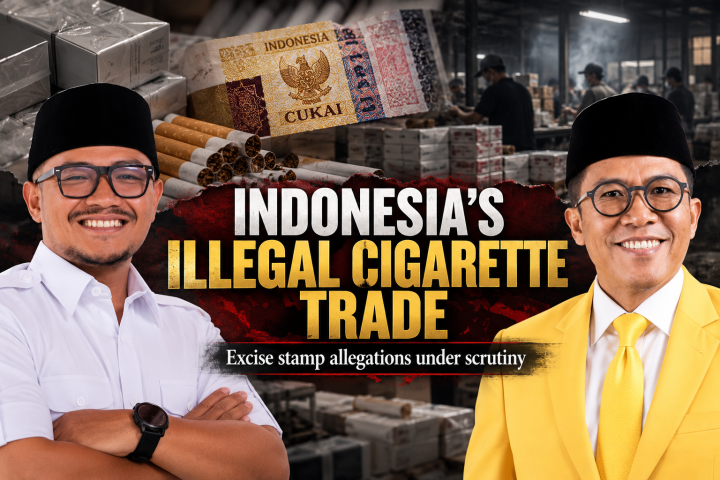
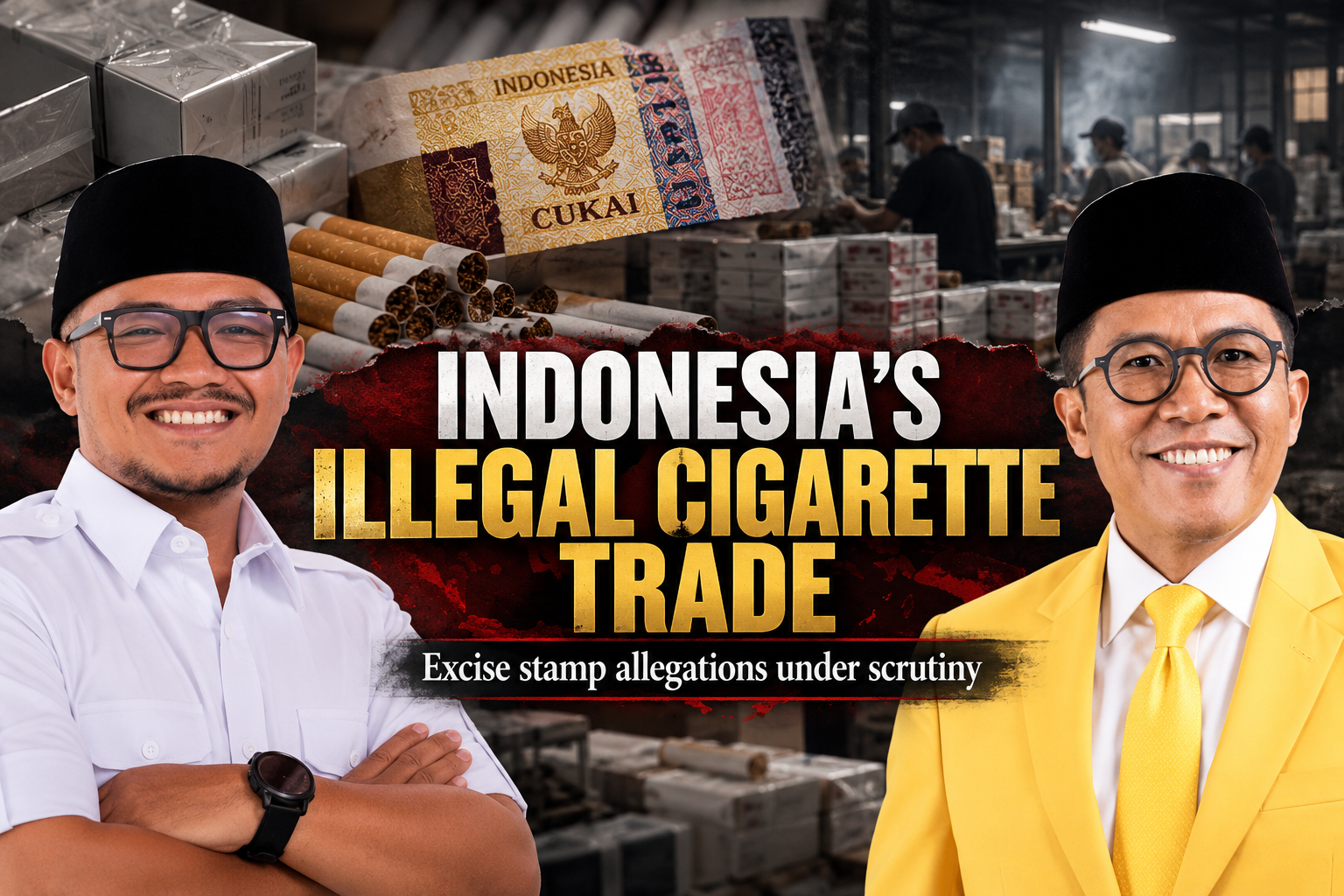
An investigation by Indonesian news outlet Tempo has raised questions about the networks behind the country’s illegal cigarette trade, including allegations that counterfeit excise stamps were offered through intermediaries linked to a senior lawmaker. The reporting, featured on Tempo’s Bocor Alus Politik programme in September 2026, examines how untaxed cigarettes reach the market and whether access to official systems can be exploited by businesses seeking to avoid the full cost of legal production.
At the centre of the controversy is Indonesia’s cigarette excise system. Manufacturers generally must meet applicable tax requirements and use the appropriate official excise stamps, known locally as pita cukai. Cigarettes sold without the required stamps, or with counterfeit or improperly used stamps, can violate excise regulations. Avoiding the tax can also give producers a price advantage over competitors that comply with the rules.
The problem is not limited to one factory or one region. Tempo’s reporting describes cigarette production and distribution networks associated with parts of East Java, including Madura and Malang. These areas feature in a wider discussion about small-scale tobacco manufacturers, the economics of cigarette taxation and the difficulty of bringing informal production into the regulated market.
The allegations surrounding excise stamps have attracted particular attention because they suggest that the problem may extend beyond manufacturers simply avoiding taxes. According to an October 2026 analysis by The Jakarta Post, which examined Tempo’s investigation, an East Java businessman said he bought two reams of excise stamps for Rp60 million each, allegedly around half the official price. The report linked the alleged offer to Adi Harnowo, a former expert staff member of House Commission XI chairman Mukhamad Misbakhun, who was said to have offered assistance with excise-stamp ordering documents and coordination with Customs and Excise officials. These claims have not, by themselves, established that Misbakhun committed an offence.
The same reporting described a separate account involving a Malang cigarette entrepreneur who said he attended a meeting in Jakarta in 2024 arranged through one of Misbakhun’s staff members. According to the businessman’s account, Misbakhun indicated that he could deal with his subordinates if he wanted to purchase stamps. The entrepreneur said the staff subsequently set a minimum order of 100 reams a month, at a reported price of Rp60 million per ream. He said he ultimately withdrew from the arrangement. The account, as reported, raises questions about the proposed transactions, but the details and responsibilities of each person involved require independent verification.
The financial figures described in the reporting are significant. A minimum monthly order of 100 reams at Rp60 million per ream would amount to Rp6 billion. The analysis also reported that more than Rp600 million in cash was allegedly handed to one of the lawmaker’s subordinates in one transaction. These are reported figures associated with alleged dealings, not a judicial finding that the money represented criminal proceeds or that every person named participated in an illegal scheme.
Misbakhun has rejected the allegations. In a statement reported on September 13, 2026, he said he had not done what was described in Tempo’s coverage. He also argued that excise-stamp orders are processed electronically through the Directorate General of Customs and Excise. Adi Harnowo likewise denied involvement and said he had stopped working for Misbakhun in October 2024. These responses are material to assessing the reporting and should be considered alongside the accounts and documents on which the allegations are based.
Another name connected to the wider investigation is Ma’ruf Mubarok, known as Gus Mamak. Reporting published in September 2026 linked him to questions about cigarette production in Bululawang, Malang, including a factory identified as Kunci Mas. Mubarok denied owning a factory that produced cigarettes without excise stamps, according to the reporting. A reported association with a production facility does not by itself establish ownership, knowledge of unlawful activity or personal responsibility for any regulatory violation. Those questions depend on evidence about the facility’s ownership, operations and compliance.
The controversy comes amid continuing enforcement against cigarettes that evade Indonesia’s excise rules. On August 11, 2026, the state news agency ANTARA reported that Customs and Excise had intercepted 8.96 million cigarette sticks without excise stamps in two containers at Tanjung Priok Port. Authorities estimated the goods’ value at Rp13.30 billion and the potential state revenue loss at Rp8.66 billion. The shipment was reportedly being moved from Surabaya towards Jakarta before onward distribution to Sumatra. The seizure illustrates the scale of the distribution challenge, although it does not establish a connection between that shipment and the individuals named in Tempo’s investigation.
The health implications add another dimension. Tempo’s report, according to the programme summary, discussed laboratory tests of several cigarette brands and reported that measured nicotine and tar levels in some samples exceeded figures stated on their packaging. Such a finding, if supported by the underlying laboratory records, would raise questions about the accuracy of product information available to consumers. The precise brands, test methods, measurements and comparison standards are important to interpreting those results, and the findings should not be generalised to every illegal cigarette without supporting evidence.
Nicotine is addictive, while cigarette smoke contains numerous harmful substances. Regardless of whether a cigarette has an official excise stamp, smoking carries health risks. Excise compliance and product safety are separate issues: a valid tax stamp does not make smoking safe, and an absent stamp does not by itself establish the precise chemical composition of a product.
The government has also been considering whether to introduce an additional excise tier, often described as a third layer, for certain cigarette categories. The proposal is intended in part to encourage smaller manufacturers operating outside the formal system to enter the regulated market. Under the theory behind the measure, a more accessible legal tax category could reduce the financial incentive to avoid excise altogether. But a lower rate would not necessarily eliminate illegal production, counterfeit stamps or unauthorised transactions. The proposal’s effectiveness would depend on its design, eligibility rules and enforcement.
The policy debate is significant because cigarette taxation must contend with competing objectives: raising public revenue, protecting legitimate businesses, supporting livelihoods in tobacco-producing regions and reducing the circulation of illegal products. A new tax tier could change manufacturers’ incentives, but it would not replace the need for effective inspections, reliable stamp controls and investigations into suspected misconduct.
Ultimately, the Tempo investigation raises questions that extend beyond the cigarettes themselves. If counterfeit stamps or unauthorised transactions are being used to bypass the excise system, authorities need to establish how the products and stamps move through the supply chain, who benefits financially and whether any public officials or intermediaries improperly facilitated the process. Those questions should be answered through verifiable records, transparent official inquiries and fair consideration of responses from the people named.
For now, the allegations should not be confused with criminal convictions or final legal findings. The public interest lies in determining whether the reported transactions occurred as described, whether excise rules were breached and whether any individual exercised improper influence. A credible resolution would protect due process while making clear that the cigarette trade, like any other regulated industry, must operate under rules that apply equally to small producers, established businesses and politically connected individuals.
————-
Disclaimer:
Some content on Reportingscams.com is published under our guest post program and is provided by third-party contributors. Reporting scams does not create, verify, or take responsibility for the views, accuracy, or claims expressed in such content.