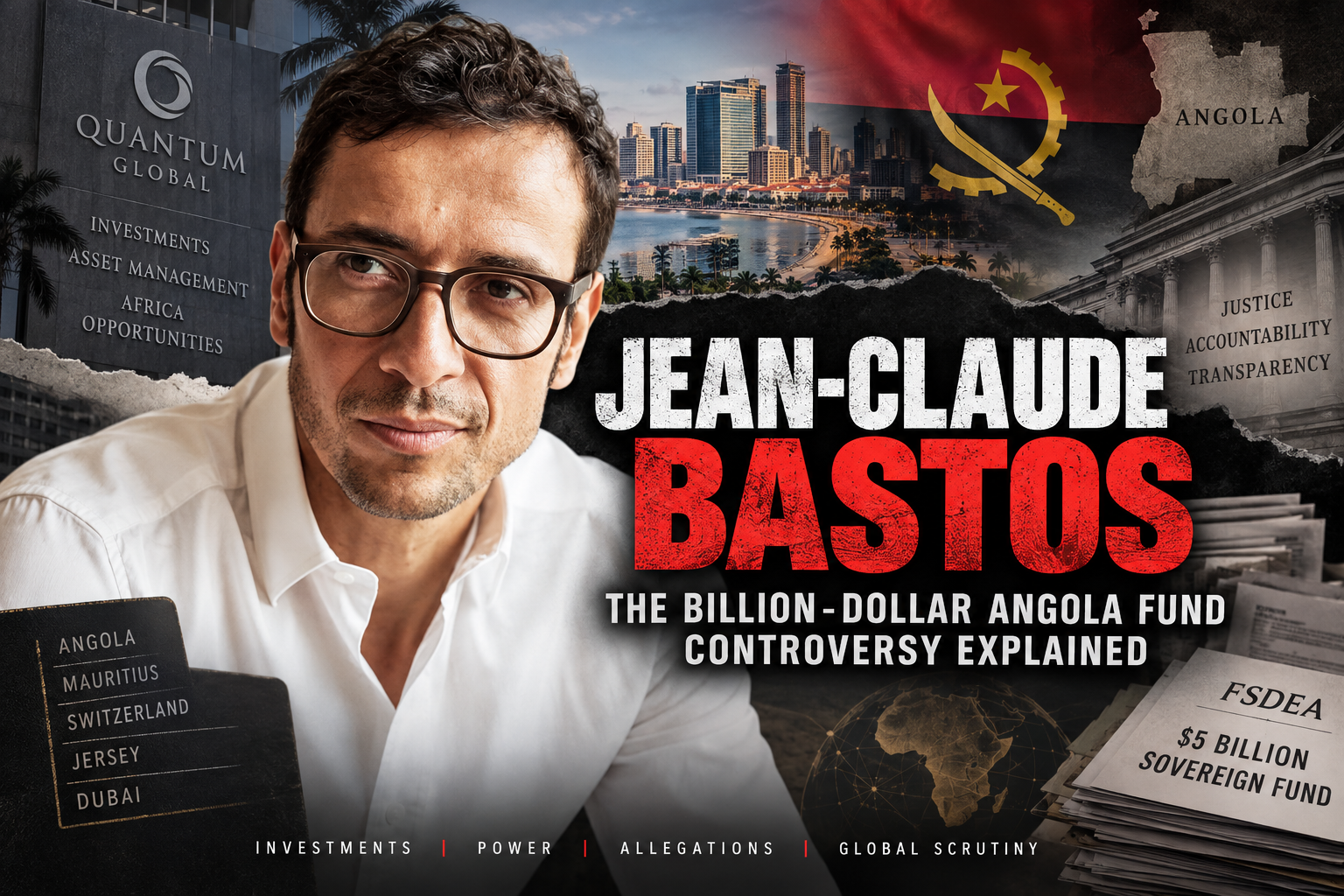
Jean-Claude Bastos de Morais has spent much of his career moving between international finance, African investment and philanthropy. He has also spent years at the centre of a complicated legal and regulatory story involving Angola’s $5 billion sovereign wealth fund, offshore investment structures, a prior Swiss criminal conviction and allegations of conflicts of interest and misuse of public money. The record is more complicated than the most damaging descriptions of him suggest, but it is also more substantial than a simple story of a businessman cleared of everything.
Bastos, also referred to as Jean-Claude Bastos or “JCB,” was born in Fribourg, Switzerland, on October 28, 1967, and holds Swiss and Angolan citizenship. Public biographies describe him as the founder of Quantum Global Group and Banco Kwanza Invest, Angola’s first investment bank. He studied management at the University of Fribourg and built a business around asset management, private wealth management, corporate advisory and African investments. His association with José Filomeno dos Santos, known as Zenu, would eventually put him directly inside one of Angola’s most contentious financial episodes. The two men were business associates and were involved together in Banco Kwanza Invest. A 2018 English High Court judgment described Bastos as the 95% beneficial owner of the Quantum group and recorded the long-standing business relationship between the two men.
There was already a criminal conviction in Bastos’s history before Quantum Global became a major player in Angola’s public finances. In 2011, a Swiss court convicted him of “repeated qualified criminal mismanagement” in an unrelated corporate matter. The conviction arose from conduct involving payments from an insolvent company to companies in which he had an interest. The High Court later recorded that the only part of the fine actually payable was CHF 4,500, while a larger financial penalty was suspended. Bastos and his business partner withdrew their appeal, making the conviction final. Bastos later told the International Consortium of Investigative Journalists that the convictions had been expunged from Switzerland’s register and that regulators had been correctly informed about his history. ICIJ reported that documents submitted during the Mauritius licensing process did not fully disclose the larger suspended fine and another finding concerning an unauthorized withdrawal.
The much larger controversy began with Angola’s sovereign wealth fund. Angola established the FSDEA with a $5 billion endowment, largely derived from oil revenues. José Filomeno dos Santos became its chairman, and Quantum Global was appointed to manage significant portions of the fund. Under the investment management agreement, Quantum Global was entitled to a base fee of 1% of the fund’s average value plus a 20% performance fee above a specified benchmark. Separate structures covering the fund’s illiquid investments carried annual management fees of 2% or 2.5%, plus performance fees.
Those arrangements became the subject of explosive allegations after the Paradise Papers disclosures. FSDEA alleged in the English High Court that dos Santos and Bastos had participated in a dishonest conspiracy in which billions of dollars of public money were placed with Quantum Global despite questions over the manager’s qualifications and that approximately $406 million had been extracted in fees. FSDEA further alleged that about $153 million was committed to Quantum-related companies for other services under arrangements it considered uncommercial. It also alleged that investments were channelled into projects associated with Bastos. These were allegations made in litigation, not findings that Bastos had been convicted of stealing those sums.
The same High Court proceedings produced an important counterweight to the allegations. In April 2018, FSDEA obtained a worldwide freezing order covering assets worth up to $3 billion. But after a contested hearing, Justice Popplewell discharged the order because of serious failures by the claimants to make full and frank disclosure to the court. The judge said the omissions were “serious and substantial,” concerned central elements of the case and went far beyond isolated errors. He also concluded that the claimants had not established, with solid evidence, a sufficient risk that Bastos or the Quantum defendants would dissipate assets. The court therefore did not determine that Bastos had committed the alleged conspiracy; the ruling was primarily about jurisdiction, evidence, disclosure and the legal requirements for maintaining the freezing order.
The dispute nevertheless triggered regulatory action across several jurisdictions. In Mauritius, authorities froze dozens of Quantum-related bank accounts and suspended the licences of seven funds. The Mauritian government later recorded that the Supreme Court revoked restriction orders covering approximately 16.87 billion Mauritian rupees on March 11, 2019, after the parties reached an agreement. The FSC subsequently lifted the suspension of the seven fund licences. The parliamentary record says Quantum Global undertook to return control of assets held in Mauritius to FSDEA, while also noting that the FSC did not possess a copy of the confidential settlement.
Bastos was arrested in Angola in September 2018 and held in preventive detention. Authorities accused him of offences including criminal association, corruption, receiving improper advantages and economic participation in business. He was released on March 22, 2019, after Quantum Global and FSDEA reached a confidential settlement, and the Angolan authorities withdrew the criminal accusations against him. The U.S. State Department subsequently described his release as being based on insufficient evidence to support the malfeasance charges.
The settlement ended the criminal confrontation, but it did not erase the questions raised by the underlying transactions. Nor did every investigation produce the same result. Switzerland opened criminal proceedings in 2018 over possible money laundering connected with assets belonging to Angola’s central bank and sovereign wealth fund. That investigation was closed by the Swiss Attorney General’s Office on June 27, 2019. In Mauritius, the Independent Commission Against Corruption also investigated the matter after the Paradise Papers. According to ICIJ, that investigation was closed after Quantum Global returned assets to Angola and the freezing measures and licence suspensions were lifted.
Another revealing piece of the story emerged in Jersey, although it did not result in a conviction against Bastos. LGL Trustees Ltd., which had helped administer investment structures connected to the Angolan money, pleaded guilty to two anti-money-laundering offences and was fined £550,000, with an additional £50,000 toward prosecution costs. The Jersey court found that the company had ignored serious warning signs surrounding Quantum Global and Bastos. Court records also showed that approximately $29.9 million in dividends had moved from the Jersey structure to a Bastos vehicle between 2012 and 2016. That finding concerned the conduct and compliance failures of LGL; it was not itself a finding that Bastos had committed money laundering.
Bastos later faced another regulatory episode in Mauritius. In August 2020, the FSC initially disqualified him from serving as an officer of any FSC licensee for five years. But the official FSC notice was updated after the Financial Services Review Panel cancelled that disqualification on September 22, 2020. The FSC said it was dissatisfied with that decision and would seek judicial review. In 2024, Mauritius’s Supreme Court considered the FSC’s challenge and concluded that restoring the expired five-year disqualification would serve no practical purpose; the case had become academic. Bastos’s lawyers subsequently argued that references portraying him as banned between 2018 and 2023 were inaccurate and outdated. Their March 2024 letter to OffshoreAlert specifically relied on the 2020 cancellation.
The latest public records also place Bastos in Dubai. A U.S. Department of Justice FARA filing made in September 2025 lists his address as Dubai, United Arab Emirates. The filing was a backdated registration concerning work performed from 2017 to 2018 by U.S. consultant Dale Britt Bendler. The filing says Bendler and BGR worked to persuade Angolan authorities to ease their treatment of Bastos while he was detained. It records $20,000 in fees. That filing describes historical activity rather than establishing that Bastos is currently lobbying the U.S. government.
Today, Bastos presents himself as an investor and philanthropist operating from Dubai. His current website says a Dubai-based family office manages his assets and investments, while he remains associated with African innovation initiatives. Public information also continues to associate him with the African Innovation Foundation, which was created to promote African innovation and entrepreneurship.
The central lesson from the Bastos case is therefore not that every allegation against him was proved, nor that every controversy disappeared when criminal charges were withdrawn. There was a final Swiss criminal conviction predating the Angola affair; there were serious regulatory interventions in Mauritius; there were substantial allegations concerning billions of dollars of public assets; and a Jersey trust company was convicted after failing to respond adequately to warning signs surrounding the structure. At the same time, the largest English court action against Bastos was stopped because of serious disclosure failures by the claimants, the Angolan criminal case ended without charges being brought against him, the Swiss money-laundering investigation was closed, and his Mauritius disqualification was cancelled. Those distinctions matter. In international finance, where complex ownership structures and political relationships can make legitimate investment difficult to distinguish from conflicts of interest, the enduring issue is not simply whether one businessman was ultimately convicted. It is whether the institutions entrusted with public money had the independence, transparency and controls necessary to protect it in the first place.
Source:
OffshoreAlert
————-
Disclaimer:
Some content on Reportingscams.com is published under our guest post program and is provided by third-party contributors. Reporting scams does not create, verify, or take responsibility for the views, accuracy, or claims expressed in such content.