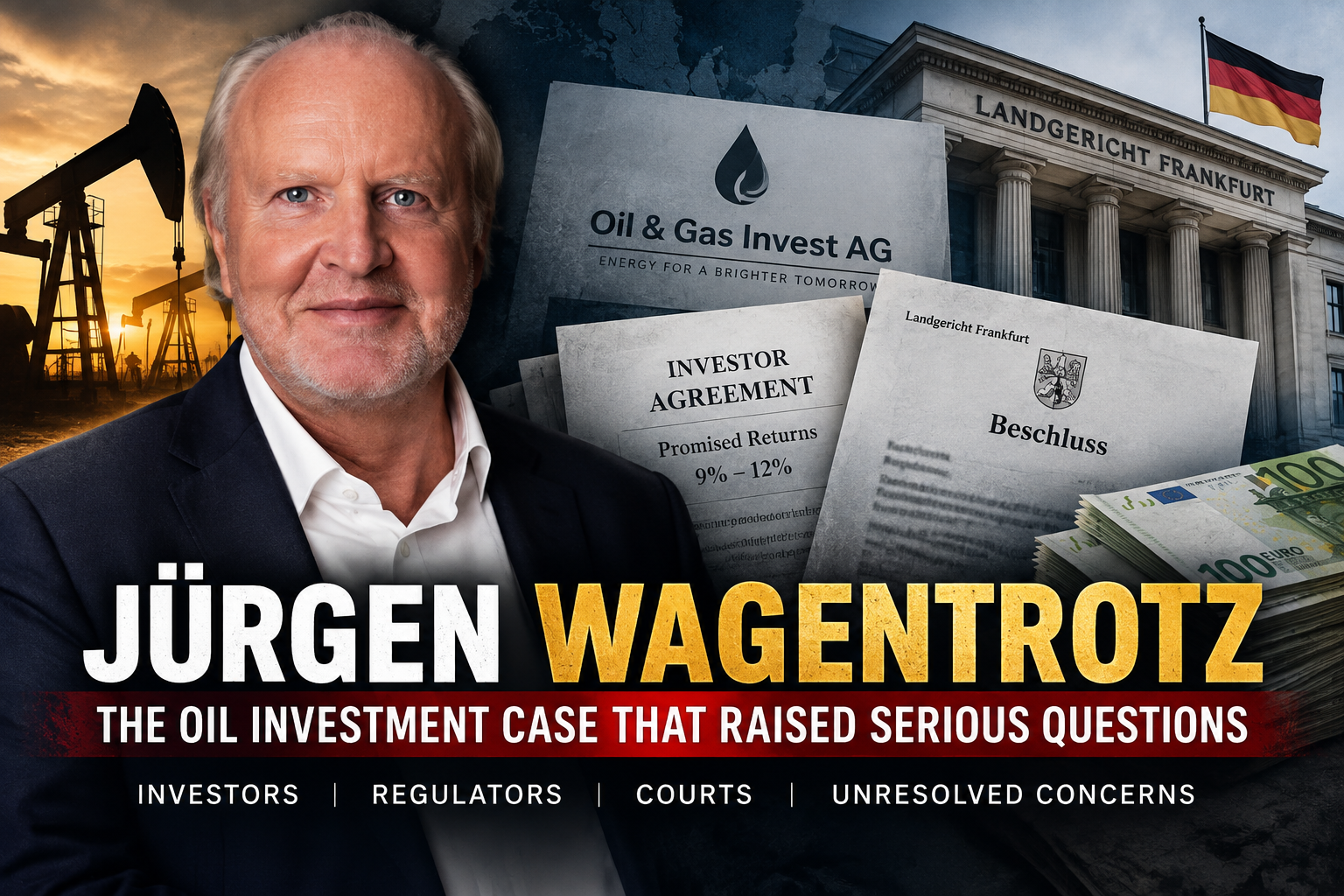
Jürgen Wagentrotz built his public business profile around a simple proposition: investors could put money into Oil & Gas Invest AG, or OGI, and receive unusually attractive fixed returns while their capital was used to finance oil exploration in the United States. The pitch became increasingly difficult to reconcile with what happened to the company, however, and the fallout eventually placed Wagentrotz at the center of criminal proceedings, regulatory scrutiny and an international evidence-gathering effort involving U.S. banks.
Wagentrotz, whose full legal name is Jürgen Kurt Ernst Wagentrotz, was born on November 8, 1944, in Erfurt, according to a November 2024 decision of the Regional Court of Frankfurt. That makes him 81 as of September 2026. The same court document identifies him as a German citizen and gives his residence at that time as Jolly Harbour, Antigua and Barbuda. There is no reliable evidence in the sources reviewed of a separate criminal alias; “Jürgen Wagentrotz” is the shortened form of his legal name used in most reporting and business records.
His background predates OGI. Earlier profiles describe him as a businessman involved in publishing, real estate and casino-related ventures. In a published interview, Wagentrotz described selling the Casino-Club name and internet domain to an online-casino operator and said he had moved to Antigua, where he had built a home. His business network has also included RSP Capital Consult, ICM-Verlag and other entities appearing in commercial databases. A Maltese company directory currently identifies Crown Capital Ltd., incorporated in 2017, as having Jürgen Kurt Wagentrotz as director and lists him and Sascha Wagentrotz as shareholders, although the database describes the company’s status as unknown.
The OGI story began with an oil-exploration proposition that promised investors substantially more than conventional savings products. Stiftung Warentest reported that OGI promoted subordinated loans offering annual returns of roughly 9% to 12%, with the money intended to finance oil exploration and production in the United States. Wagentrotz personally guaranteed repayment under the earlier structure. OGI’s promotional material went further, describing enormous potential reserves. In an interview, Wagentrotz said seismic studies indicated more than 100 million barrels of oil on the company’s claims and described potential value of up to €10 billion depending on oil prices.
That optimism attracted scrutiny. In 2015, BaFin, Germany’s financial regulator, intervened after determining that OGI’s arrangement, including Wagentrotz’s repayment guarantee, constituted an investment-taking business requiring authorization under German banking law. OGI responded by returning approximately €4.5 million raised through the affected subordinated-loan product, according to contemporaneous reporting. Wagentrotz has consistently emphasized that the money was returned and that investors in that particular product were not left with losses.
Stiftung Warentest nevertheless continued to question the investment proposition. Its reporting highlighted uncertainty surrounding OGI’s oil claims and noted that some U.S. databases contained references to abandoned or depleted wells in areas where OGI was promoting exploration. The organization also questioned why OGI had not fully answered questions about the classification and status of the reserves. OGI’s promotional relationships also attracted attention: Stiftung Warentest reported that Roland Berger objected to its name being used in OGI promotional material, while television personality Guido Maria Kretschmer had appeared in an earlier OGI prospectus before disappearing from a later version.
OGI subsequently changed its investment structure. According to the evidence later presented in the German investigation, the company offered corporate bonds or partial bearer debentures carrying annual interest rates between 8.25% and 11.25%, with a minimum investment of €1,000. The company’s own figures indicated that about 45% of investors accepted the change.
The business ultimately collapsed. Frankfurt’s local court placed OGI into provisional insolvency administration on August 31, 2018, under case number 810 IN 1009/18 O. Stiftung Warentest reported that roughly 150 shareholders and about 500 investors in subordinated loans faced the prospect of losing their money. Markus Schilz had replaced Wagentrotz as a board member and later sought insolvency protection. Schilz told Stiftung Warentest that investor money “rather” had not been used for drilling. That was his assessment, not a judicial finding against Wagentrotz.
The financial scale became clearer several years later. A U.S. federal court application filed in Washington, D.C., on Germany’s behalf in June 2022 sought evidence from Fifth Third Bank and JPMorgan Chase as part of German criminal proceedings. The application identified Wagentrotz as a former OGI executive and described an investigation into suspected fraud and operation of a banking business without a license. It stated that OGI had collected approximately €22.19 million from around 500 investors by the time insolvency proceedings began and that most of the funds had been transferred to accounts at the two U.S. banks. OffshoreAlert independently reported the existence of the U.S. judicial-assistance application and its connection to the German investigation.
The allegations described in that application were serious. German authorities reportedly suspected that investors had been misled about the existence and commercial potential of oil deposits in the United States. The application said OGI presentations described secured or confirmed deposits worth billions, while expert evaluations had not certified the existence, production volumes or projected profits with certainty. But those statements were allegations contained in an investigative filing, not findings of guilt.
The legal record then changed significantly. In October 2023, the Frankfurt Public Prosecutor’s Office formally discontinued an investigation against Wagentrotz and four other people over suspected commercial fraud connected to OGI investment products sold between November 2012 and February 2016. The document published by OffshoreAlert states that the case was discontinued under §170(2) of Germany’s Code of Criminal Procedure. In practical terms, that means prosecutors did not proceed with charges on that investigation; it is not a conviction and does not establish that the underlying allegations were proven.
A second legal development followed. The November 5, 2024 decision of the Regional Court of Frankfurt concerned Wagentrotz over an alleged violation of §54 KWG, Germany’s banking law. The court stated that the proceeding was finally discontinued under §153a of the Code of Criminal Procedure after Wagentrotz fulfilled an obligation imposed in an earlier June 7, 2024 decision. The document says the state treasury would bear the procedural costs. It does not specify in the supplied copy what the obligation was or whether it involved a payment.
Wagentrotz has used those decisions to challenge reporting about him. In November 2023, his lawyer Friederike Manz demanded that OffshoreAlert remove its article, stating that the criminal investigation had already been closed. In December 2024, Wagentrotz himself again demanded removal, saying the proceedings had been discontinued and threatening a $10 million lawsuit if the article remained online. OffshoreAlert declined to remove its material and published the correspondence and court document.
Wagentrotz has repeatedly denied wrongdoing. In a 2023 statement, he said he had never been convicted or otherwise committed a criminal offense, disputed being the founder of OGI, emphasized his role as a former board member, and argued that the €4.5 million BaFin-related repayment had resolved the regulatory issue without investor harm. He also maintained that OGI’s U.S. properties contained substantial oil reserves and that the company’s failure was caused after his departure when subsequent management allegedly failed to maintain the leases. Those are his assertions, not findings independently established by the court documents reviewed.
His current public footprint appears considerably removed from the OGI business. The 2024 Frankfurt court order placed his residence in Antigua and Barbuda, although there is no reliable source establishing his precise whereabouts today. Public business directories continue to associate his name with corporate and publishing interests, while a German charitable foundation currently lists him as an honorary member of its board of trustees.
The most important lesson in the Wagentrotz case is not a simple verdict of guilt or innocence. The documentary record shows an investment company that promoted high returns, encountered regulatory intervention, changed its investment structure, eventually entered insolvency and became the subject of a major criminal investigation involving hundreds of investors and more than €22 million in collected funds. It also shows something equally important: the central fraud investigation was later discontinued, and a separate banking-law proceeding ended under §153a after a court-ordered obligation was fulfilled. No conviction of Wagentrotz for the alleged €22 million fraud appears in the sources reviewed. For investors, that distinction is crucial. A failed investment, a regulatory violation, a criminal allegation and a proven criminal offense are four different things and understanding where the evidence actually ends is as important as understanding where the allegations began.
Source:
OffshoreAlert
————-
Disclaimer:
Some content on Reportingscams.com is published under our guest post program and is provided by third-party contributors. Reporting scams does not create, verify, or take responsibility for the views, accuracy, or claims expressed in such content.