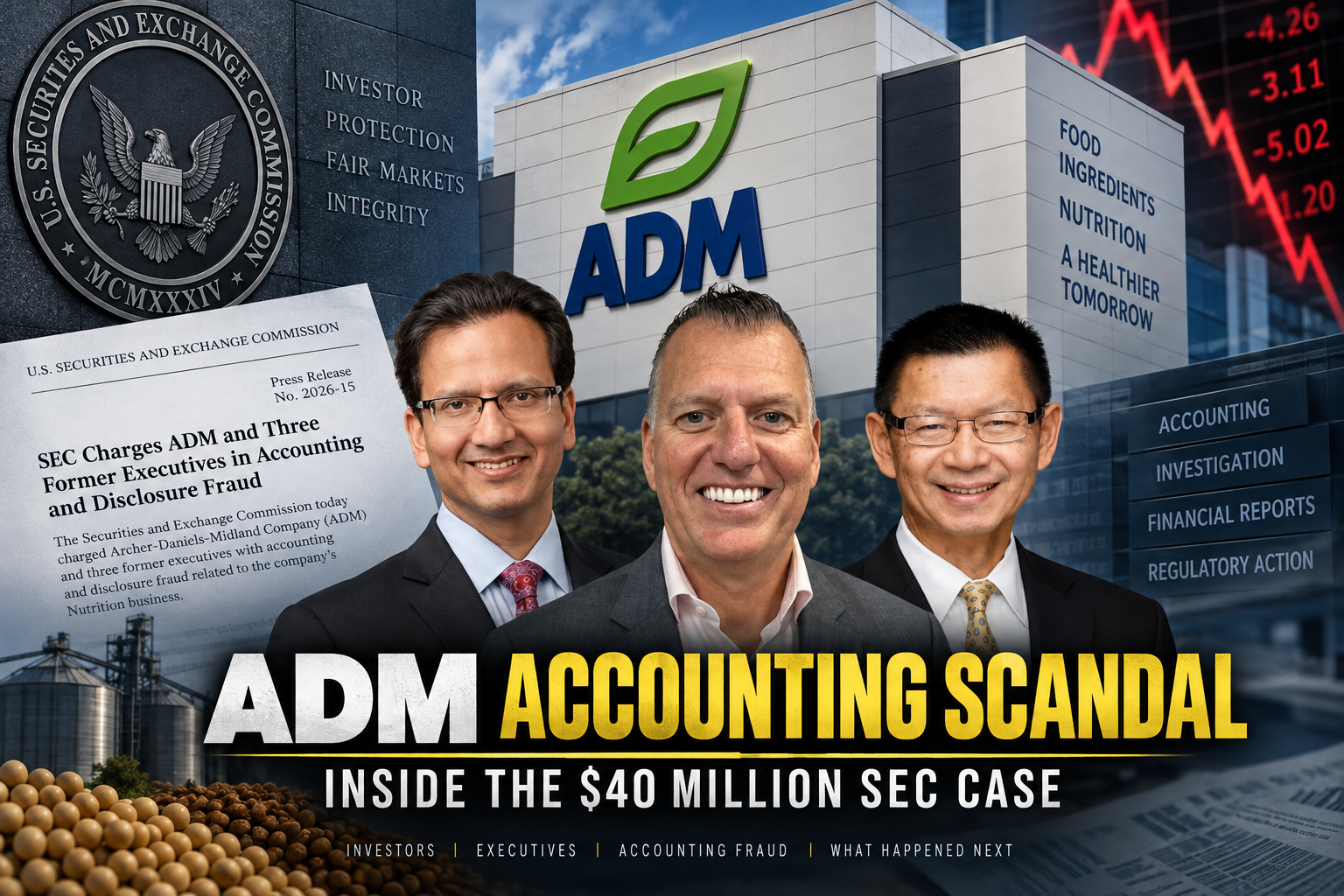
Archer-Daniels-Midland’s accounting scandal has now produced a $40 million SEC settlement, sanctions against two former senior executives and an active federal fraud case against the company’s former chief financial officer. What began as an internal accounting review in early 2024 has become a much broader examination of how ADM reported the performance of its Nutrition business, how executives were rewarded for that performance and what investors were told while the numbers were being presented as evidence of a major growth engine.
At the center of the matter is ADM’s Nutrition segment, which sells ingredients ranging from plant-based proteins and natural flavors to probiotics, enzymes, botanical extracts and animal-nutrition products. ADM had promoted Nutrition as an important source of future growth and had told investors that the segment could deliver operating-profit growth of roughly 15% to 20% a year. According to the U.S. Securities and Exchange Commission, the reported performance was materially inflated through internal transactions that shifted profit into Nutrition from other ADM divisions.
The executives named by the SEC are Vikram Luthar, Vincent F. “Vince” Macciocchi and Ray G. Young. Luthar, an Indian-born finance executive who joined ADM in 2004 after nearly a decade at General Motors, rose through the company’s finance and nutrition operations before becoming CFO in April 2022. ADM filings listed him at age 55 when he became CFO and later at 57 in its 2023 filing. He holds an aerospace-engineering degree from the Indian Institute of Technology and an MBA from the Wharton School.
Macciocchi had a long career in the food-ingredients industry before joining ADM through WILD Flavors. He became president of ADM’s Nutrition business in 2015 and was also its chief sales and marketing officer. Young, a former General Motors finance executive, became ADM’s CFO in 2010 and later served as vice chairman before retiring from ADM at the end of 2022. ADM’s filings identified Macciocchi as 57 in 2022, while public market databases currently put both Macciocchi and Young in their late 50s or early 60s.
The accounting issue centered on transactions between ADM’s business segments. Intersegment transactions are legitimate, but ADM had told investors that these transactions were recorded at amounts “approximating market,” essentially meaning prices comparable to what unrelated parties would have negotiated. The SEC says that standard was not followed in a series of transactions involving Nutrition.
The regulator’s order says executives pressured employees to identify adjustments that could move operating profit into Nutrition when the segment was in danger of missing its targets. Those adjustments included retroactive rebates and price changes that were not ordinarily available to outside customers. The amounts were, according to the SEC, sometimes calculated around the precise amount Nutrition needed to hit its forecast rather than through an arm’s-length commercial negotiation.
One example described in the SEC’s complaint involved a $20.7 million adjustment in 2021. The SEC alleges that Luthar engineered a retroactive price adjustment involving ADM’s Ag Services and Oilseeds segment that transferred $20.7 million of operating profit to Nutrition. Without that adjustment, Nutrition would have fallen short of its publicly announced 20% operating-profit growth target for the year. ADM subsequently told investors that Nutrition had met that target.
The SEC’s settled order attributes different roles to the three executives. It says Luthar and Macciocchi led efforts to identify and structure adjustments during 2021 and 2022, while Young negligently approved improper adjustments relating to 2019 and 2021. The regulator found that Nutrition’s operating profit was overstated in fiscal years 2019, 2021 and 2022, as well as in the third quarter of 2019 and throughout the quarters of 2021.
ADM’s own subsequent accounting work showed the scale of the reporting problem. Its restatement reduced Nutrition’s reported operating profit by $27 million for 2018, $27 million for 2019, $16 million for 2020, $59 million for 2021, $68 million for 2022 and $31 million for 2023 — a combined $228 million over the six-year period. The company said those adjustments affected segment reporting rather than consolidated earnings, balance sheets or cash flows.
The matter first became public in January 2024. ADM announced that Luthar had been placed on administrative leave after the company received a voluntary document request from the SEC concerning intersegment sales. ADM delayed its fourth-quarter and full-year results and withdrew its outlook for Nutrition. The market reaction was severe. ADM shares fell approximately 24% on January 22, 2024, from $68.19 to $51.69, wiping out about $8.8 billion in market value, according to filings and shareholder litigation materials.
That disclosure triggered shareholder litigation. A securities class action filed in federal court in Chicago accused ADM and several executives, including Luthar, Young and Macciocchi, of making misleading statements about Nutrition’s performance and prospects. The case survived motions to dismiss in March 2025. Judge Thomas Durkin found that the shareholders had pleaded substantial allegations concerning motive, public statements, the importance of Nutrition, executive departures and government investigations. The court’s ruling allowed the case to move into discovery; it did not determine that the defendants were ultimately liable.
Several derivative lawsuits were also brought against ADM directors and executives, alleging breaches of fiduciary duties and related corporate-governance claims. ADM’s 2025 annual filing said the company was continuing to defend the securities litigation and could not predict its outcome. As of its 2026 second-quarter filing, related derivative cases remained pending, while a separate shareholder books-and-records action had been voluntarily dismissed in May 2026.
The SEC resolution announced in January 2026 divided the case into two tracks. ADM, Macciocchi and Young settled the regulator’s administrative charges without admitting or denying the findings. ADM agreed to pay a $40 million civil penalty. Macciocchi agreed to pay $404,343 in disgorgement and prejudgment interest plus a $125,000 civil penalty and accepted a three-year bar from serving as an officer or director of a public company. Young agreed to pay $575,610 in disgorgement and prejudgment interest and a $75,000 civil penalty. The SEC created a Fair Fund intended to distribute monetary relief to harmed investors.
Luthar’s case is different. The SEC sued him personally in the U.S. District Court for the Northern District of Illinois, accusing him of securities fraud, aiding and abetting ADM violations and failing to reimburse certain compensation under the Sarbanes-Oxley Act. The SEC seeks an injunction, an officer-and-director bar, disgorgement, civil penalties and compensation reimbursement. The complaint also alleges that Luthar received a $130,000 performance bonus in 2022 based partly on Nutrition’s 2021 results and sold more than $1.8 million of ADM shares between June 2022 and February 2023 while the SEC says the stock price was inflated.
Luthar has denied the SEC’s allegations. His attorney told CFO Dive in January that he was not interested in settling and maintained that the SEC was unfairly attempting to hold him responsible for longstanding ADM business practices. In September 2026, the litigation remained active. The SEC had produced more than 307,000 documents in discovery, with additional productions continuing, while Luthar had issued subpoenas to four outside parties. The parties told the court they expected fact discovery to run through March 23, 2027, meaning there has been no final judicial determination against Luthar.
ADM, meanwhile, has changed its controls and financial leadership and says it cooperated with regulators, conducted an internal investigation and voluntarily reported its findings to the SEC. The company also said the Department of Justice closed its related criminal investigation with no further action. That means ADM itself did not face criminal charges arising from this investigation, even though the SEC imposed the $40 million civil penalty.
Macciocchi has since moved into another senior industry role. In 2024 he became CEO of Florida Food Products, which later rebranded as Vibrant Ingredients. Company materials show him serving as CEO in 2026 and overseeing expansion of the natural-ingredients business, including a new innovation center in New Jersey. There is no comparable current public executive role identified for Young, who had already retired from ADM before the SEC settlement. Luthar remains publicly associated with Chicago and is focused on defending the SEC litigation.
There is also an important piece of ADM history that should not be confused with the current case. In the 1990s, long before the executives named here held their current positions, ADM pleaded guilty to international price-fixing conspiracies involving lysine and citric acid and agreed to pay a $100 million criminal fine. That episode involved different executives and different conduct; it is corporate history, not evidence that Luthar, Macciocchi or Young participated in that earlier wrongdoing.
The significance of the current case is ultimately larger than the $40 million check. Investors buy public-company shares on the assumption that financial statements provide a reasonably accurate picture of the business. When a growth story depends on internal accounting adjustments that make one division look healthier than it really is, the damage can spread far beyond an accounting department. ADM’s stock-market collapse, the subsequent restatement, shareholder litigation and continuing SEC case show how quickly confidence can disappear when reported performance and underlying economics diverge. The SEC settlement resolves the government’s case against ADM, Macciocchi and Young, but the Luthar litigation and shareholder proceedings mean the full legal and financial aftermath of ADM’s Nutrition accounting controversy is still unfolding.
————-
Disclaimer:
Some content on Reportingscams.com is published under our guest post program and is provided by third-party contributors. Reporting scams does not create, verify, or take responsibility for the views, accuracy, or claims expressed in such content.