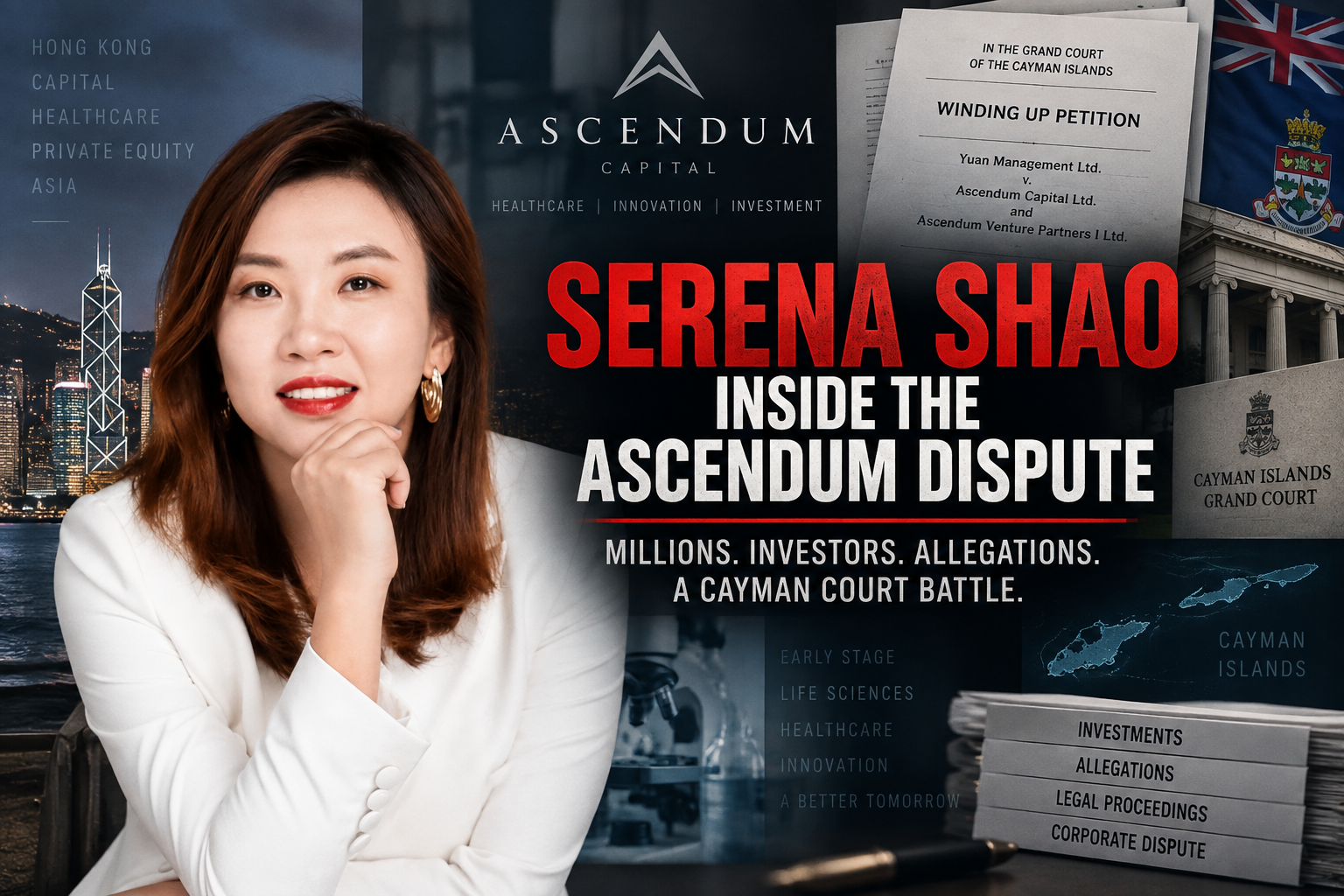
Serena Shao built her reputation in the part of finance where healthcare, technology and private capital intersect. A former China healthcare analyst who worked at Bank of America Merrill Lynch, CLSA and Credit Suisse, she went on to become the founder and managing partner of Ascendum Capital, a Hong Kong-based investment platform focused on healthcare and life sciences. Public records identify her as Serena Ying Shao, Shao Ying and, in Chinese, 邵莹. A 2017 Hong Kong licensing record listed her age as 34, putting her at roughly 43 today. Her professional history includes a chemistry degree from Shanghai Jiao Tong University, graduate study at the University at Buffalo and an MBA from MIT Sloan.
That polished career is now at the centre of a bitter cross-border corporate dispute involving millions of dollars, two Cayman Islands companies, a former business partner and competing accounts of what happened inside Ascendum. The dispute has not resulted in a criminal conviction against Shao, and the accusations contained in the Cayman proceedings remain contested. But the underlying allegations are serious enough to have triggered winding-up petitions in the Grand Court of the Cayman Islands and a formal response from Shao’s Hong Kong lawyers.
The case began publicly on August 8, 2025, when Yuan Management Limited, a British Virgin Islands company, filed petitions seeking the winding up of Ascendum Capital Limited and Ascendum Venture Partners I Limited. OffshoreAlert published the petitions and characterised them as involving “fraud” and “misappropriation.” The petitions named Shao’s business partner Cathy Zhang, also identified in the documents as Ling Zhang, as the person behind Yuan Management. The corporate structure explains why the dispute became so consequential: Ascendum Venture Partners I Limited was owned 55% by Shao and 45% by Yuan Management, while a 2020 Hong Kong Exchange filing identified Zhang as Yuan Management’s sole shareholder.
The two women had built Ascendum together after meeting in 2019. According to the petitions, the group was established in 2020 to invest in early-stage healthcare, information technology, digital health, life sciences and SaaS businesses in the China region. The petition material says the group attracted 12 investors and deployed approximately US$46.56 million into 12 projects. That figure is important, but it should not be confused with investor losses: the documents do not establish that US$46.56 million was lost, stolen or otherwise dissipated.
The relationship between Shao and Zhang deteriorated in 2023. Zhang’s side accused Shao of excluding her from management, restricting her access to corporate records and misappropriating funds between July 2024 and March 2025. It also alleged that Shao made false reports to Hong Kong police and the Shenzhen Public Security Bureau concerning Zhang. One of the most consequential allegations involved a Standard Chartered account belonging to Zhang that was reportedly frozen in September 2024. On November 22, 2024, Zhang was arrested while attempting to enter Hong Kong from mainland China on suspicion of theft. The allegation was that she had stolen HK$426,500 with the assistance of two other people associated with the group, Sheryl Kuang and Gillian Li.
According to the petition material, Hong Kong police subsequently found there was no case against Zhang, Kuang or Li and closed the investigation around April 17, 2025. Zhang’s previously frozen Standard Chartered account was reportedly reinstated around June 6, 2025. Zhang, Kuang and Li then filed police reports against Shao alleging that she knowingly made a false report. Those are allegations contained in the litigation documents, not findings that Shao committed an offence.
The money allegations are equally complicated. OffshoreAlert reported that Shao was accused of misappropriating at least US$1.9 million. But that number has become one of the most disputed aspects of the story. In a December 2, 2025 letter to OffshoreAlert, Shao’s lawyers at Karas So LLP said the US$1.9 million figure did not appear in the petition and was therefore incorrect. They pointed instead to a paragraph alleging that between April 2020 and March 2024 Shao received salary and allegedly invalid disbursements totalling about HK$18 million, or roughly US$2.3 million.
Shao’s lawyers offered a fundamentally different explanation. They said she had been promised a base salary of at least HK$300,000 a month, plus bonuses, when the fund was established with the knowledge and agreement of Zhang’s side. Over four years, they said, that salary alone would exceed HK$14 million. They also said legitimate business expenses were being paid through the group while its finance team and Zhang had access to the relevant bank accounts. In other words, Shao’s defence is not simply that the numbers are wrong; it is that payments characterised by her opponents as improper were authorised compensation and legitimate business expenditure.
The lawyers also challenged the suggestion that US$1.9 million had been transferred directly to Shao. They said the petition referred to a US$250,000 payment on July 19, 2024, which Shao maintains was an agreed bonus, and a separate alleged US$1 million transfer that, according to her lawyers, never actually occurred because the money remained in Ascendum Capital’s Silicon Valley Bank account.
There is another important distinction. A winding-up petition is a civil corporate proceeding. It is not a criminal conviction, and filing such a petition does not establish fraud. Shao’s lawyers explicitly argued that the petitions were essentially shareholder and management grievances rather than proceedings founded on proven fraud. They said Shao had filed substantial evidence disputing the allegations and denied misappropriation, fraud and making false reports. They also claimed that Zhang and associates had engaged in wrongdoing for personal benefit and that the winding-up proceedings were retaliation after Shao attempted to stop that conduct.
The corporate history makes the dispute more significant than a quarrel between two former partners. Ascendum was originally backed by established healthcare and investment players. In 2020, Venus Medtech, DCP Capital and Qiming Venture Partners announced the formation of Ascendum Capital Partners, with Shao appointed to lead the platform. The investment strategy centred on innovative cardiovascular and lung-disease technologies. Ascendum Healthcare Fund I was established in the Cayman Islands, with investors including Venus Medtech, Qiming Venture Partners VII, Qiming VII Strategic Investors Fund and DCP Discovery. A Hong Kong Exchange filing recorded an initial US$8 million commitment from Venus Medtech and said the fund could ultimately receive more capital, subject to agreed limits.
The platform also built a portfolio extending beyond the immediate dispute. Ascendum was involved in EndoWays, an Israeli medical-device company developing a vascular intervention robot, and later supported its development in China. It also appeared as an investor in Valgen Medtech alongside DCP Capital, Sequoia China, Venus Medtech and others. Public industry records continued to describe Shao as Ascendum’s founder and managing partner, including at healthcare industry events in 2023. A 2024 visit by officials from Wuxi’s Xishan district to Ascendum’s Hong Kong office also described Shao as the firm’s founder and linked Ascendum to the development of EndoWays’ Chinese operations.
That public profile is still relevant today. The latest professional information located describes Ascendum as a Hong Kong-based investment firm and continues to list Shao as founder and managing partner. I found no reliable public record establishing that Shao has been convicted, pleaded guilty, paid a regulatory penalty or reached a settlement admitting wrongdoing in this matter. I also found no publicly indexed final judgment resolving the Cayman winding-up dispute through the material reviewed for this report. The last clearly documented procedural development in the sources reviewed is Shao’s legal response: after she filed opposing evidence on September 24, 2025, her lawyers said the petitioner amended the petitions substantially on October 31.
There is a separate regulatory record involving a person named Ling Zhang. In November 2023, the Cayman Islands Monetary Authority cancelled a director registration held by Ling Zhang after finding breaches involving failure to provide prescribed information and failure to pay annual fees for 2021 through 2023. The name and China connection overlap with Cathy/Ling Zhang in the Ascendum documents, but the publicly available regulatory record does not provide enough unique identifiers to conclusively establish that they are the same individual. It would therefore be unsafe to present that enforcement action as part of Zhang’s Ascendum record without further identification evidence.
What emerges is not a simple story of a proven fraudster brought down by regulators. It is a much more consequential and unresolved corporate fight involving a healthcare investment platform, tens of millions of dollars in capital, two former partners and competing allegations about control, compensation, corporate money and police complaints. Shao has forcefully denied wrongdoing, while Zhang’s side has pursued liquidation proceedings against companies at the centre of their former business relationship. The difference between an allegation, a contested civil claim and an established offence matters here.
It matters because Ascendum was not an obscure shell company operating at the edge of finance. It was built with institutional capital, established healthcare partners and a strategy aimed at backing medical technologies with potentially significant commercial and public-health consequences. When disputes arise inside investment structures holding millions of dollars, investors need more than dramatic headlines. They need to know which claims have been tested, which have been withdrawn or amended, what money can actually be traced, and whether a court or regulator has made a finding. In the Shao case, those answers remain incomplete. That uncertainty is precisely why the dispute deserves scrutiny without turning allegations into convictions.
Source:
OffshoreAlert
————-
Disclaimer:
Some content on Reportingscams.com is published under our guest post program and is provided by third-party contributors. Reporting scams does not create, verify, or take responsibility for the views, accuracy, or claims expressed in such content.