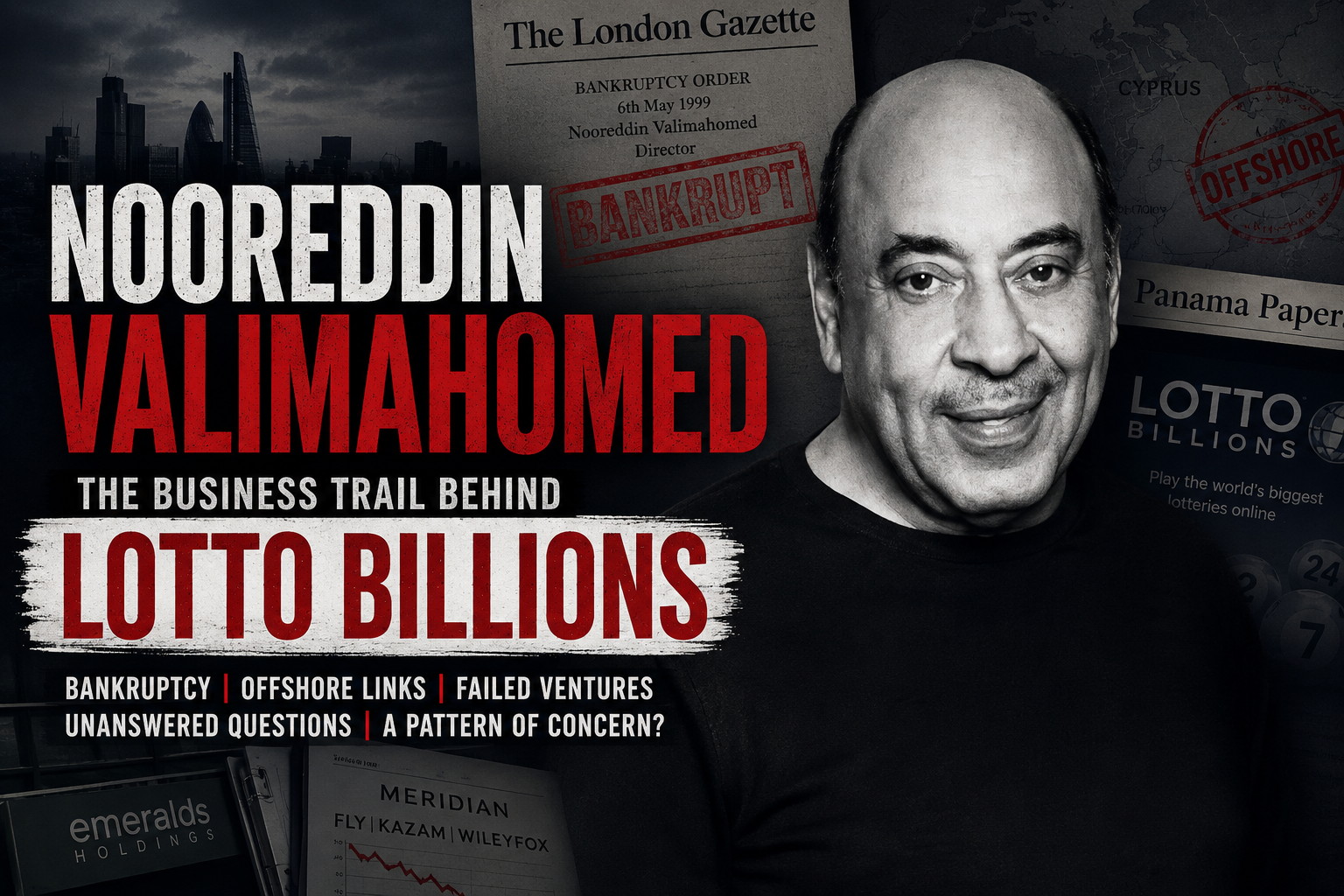
Nooreddin Valimahomed is a London-based British-Canadian businessman whose career has moved through Russian consumer goods, mobile phones, offshore corporate structures and, most recently, online lottery betting. Public records identify him as born in June 1957, making him 69 in 2026, and Companies House records show Canadian nationality and a history of directorships dating back to the 1990s. His present public-facing business association is with Emeralds Holdings and Lotto Billions, a lottery-betting platform operating through entities in several jurisdictions.
The story is considerably more complicated than the promotional biographies attached to his businesses suggest. Valimahomed’s supporters and corporate websites describe him as an entrepreneur who helped build Cadbury’s presence in post-Soviet Russia and later developed mobile brands including Fly, Kazam and Wileyfox. Public records support important parts of that account. But alongside those ventures sits a very different paper trail: a personal bankruptcy order in 1999, dissolved companies, offshore entities appearing in the Panama Papers, litigation connected to a $9 million or approximately £9 million financing dispute, and a new gambling business that has become the subject of allegations that it resembles a Ponzi-style operation.
Those allegations require an important qualification. There is no public court judgment located in this review establishing that Valimahomed operated a Ponzi scheme, committed money laundering, or committed fraud through Lotto Billions. Investigations.org itself says its allegations remain unproven unless established in court, and its verification section classifies several of the most serious claims as unverified.
That distinction matters because the public record presents two stories at once. One is the story of a businessman with a long international commercial career. The other is the story of repeated corporate failures, offshore structures and allegations made by investigative websites and critics who argue that the same network has repeatedly resurfaced under new brands and jurisdictions. The documentary record supports investigating that pattern. It does not, by itself, justify converting every allegation into a statement of fact.
Valimahomed’s earliest documented British corporate roles in the records examined here date to the mid-1990s. Companies House records show him appointed as a director of Cadbury Russia Limited on 1 August 1995, alongside other Valimahomed family members. He resigned on 29 January 1999. The company itself subsequently went through a lengthy corporate history and was ultimately dissolved.
The business was connected to Cadbury Schweppes’ attempt to build a commercial presence in the former Soviet market. Emeralds Holdings’ own account portrays Valimahomed as the entrepreneur who helped establish the beverage operation, including bottling and distribution arrangements in Russia and the CIS. The company’s promotional biography says the venture attracted investment from AIG and became an important early Western consumer-brand operation in the post-Soviet market.
But the financial ending was far less polished.
The London Gazette records a bankruptcy order against Nooreddin Valimahomed dated 6 May 1999 in High Court proceedings numbered 9359 of 1998. The Gazette describes him as unemployed and lately a company director. A later notice concerned the distribution to unsecured creditors in the bankruptcy.
That is one of the most significant verified facts in the entire Valimahomed story because it is not based on an anonymous website or a reputational allegation. It is a formal public insolvency record.
A second piece of evidence comes from litigation involving businessman Alimudin Somji and Cadbury Schweppes. In Somji v Cadbury Schweppes Plc, [2000] EWCA Civ 340, the Court of Appeal dealt with a dispute surrounding Somji’s bankruptcy and an earlier creditors’ arrangement. The judgment refers directly to Valimahomed’s bankruptcy and states that Valimahomed was a business associate of Somji and that several banks had outstanding debts involving both men. It also records that Byblos Bank intended to use money received from another party to fund further investigation into Valimahomed’s affairs.
The judgment is especially useful because it places Valimahomed’s bankruptcy inside a wider commercial dispute rather than relying solely on later commentary about his career.
It should not, however, be misread as a judicial finding that Valimahomed committed fraud. The case was not a criminal conviction of Valimahomed. References in the judgment to investigations, creditors and outstanding debts are evidence of the financial dispute surrounding him, not proof of criminal conduct.
After the Russia beverage chapter, Valimahomed moved deeper into telecommunications.
His Meridian Group became associated with Fly Mobile, a handset brand that developed a significant presence in Russia and other emerging markets. The corporate narrative promoted by Emeralds Holdings now presents Fly, Kazam and Wileyfox as the three pillars of his mobile strategy. Valimahomed himself has described this as a deliberate multi-brand approach, with different phones aimed at different geographical markets.
There is independent evidence that he held significant influence within this corporate network. Companies House records for Meridian Software Systems (UK) Limited identify Nooreddin Valimahomed as a person with significant influence or control, although that status later ceased. The same record shows Fly Group Limited as the company’s controlling shareholder during part of the period.
Wileyfox became another prominent part of the story. The British smartphone company was launched in 2015 and was owned at launch by the Meridian Group. Valimahomed was given founder credit, while other executives handled day-to-day management. Wileyfox entered administration in February 2018.
Again, corporate failure is not automatically evidence of wrongdoing. Technology companies fail frequently, particularly in competitive hardware markets. The investigative question is instead what happened to creditors, lenders, investors and corporate assets when these businesses failed, and whether the same people and structures moved into successor businesses.
That is where the Valimahomed record becomes more difficult to dismiss as a series of unrelated commercial failures.
One of the most serious episodes surrounding Valimahomed’s later telecommunications activities concerns a financing dispute involving a Russian bank.
Investigative reporting about the dispute says Valimahomed was personally pursued in connection with approximately £9 million in financing obtained for Wileyfox. The reporting characterises the litigation as involving allegations that the financing had been secured through misrepresentation. Those allegations should be treated cautiously because the material located for this review does not establish a final judgment finding Valimahomed guilty of fraud.
The existence of the underlying dispute is nevertheless significant because it helps explain why Valimahomed’s earlier bankruptcy and subsequent corporate activity deserve to be examined together.
There is another documentary trail that is much less ambiguous.
The International Consortium of Investigative Journalists’ Offshore Leaks Database identifies Nooreddin Valimahomed in the Panama Papers data. The database lists him as a beneficiary connected to three Cyprus-incorporated companies: Stopello Limited, Birchstar Limited and Yongazi Limited. The database also associates him with a London address and notes that the underlying Panama Papers data is current through 2015.
The Yongazi record provides additional context. ICIJ identifies Valimahomed as a beneficiary alongside Andrew Sean Collinge and Suresh Radhakrishnan. The company was incorporated in Cyprus in February 2012 and appears in the Panama Papers dataset.
Being named in the Panama Papers is not itself proof of illegality. ICIJ explicitly warns that offshore companies can have legitimate uses and that inclusion in the database does not imply illegal or improper conduct. That warning is essential in any responsible account of Valimahomed. What the database establishes is the existence of offshore corporate relationships, not the purpose for which every entity was used.
The question becomes more interesting when those offshore connections are compared with the people who later reappear around Valimahomed’s businesses.
Andrew Sean Collinge is one such recurring figure. Public corporate records show Collinge as an active director of Emeralds Holdings Ltd and Emeralds Services Ltd. Companies House records identify him as British and show his appointment to Emeralds Holdings in May 2024 and Emeralds Services in January 2025.
ResearchInitiative has separately reported that Collinge was recently found liable by a Moscow court for debts incurred by OOO NTST, although that court ruling was not independently verified in the Investigations.org dossier reviewed for this article. That distinction should remain explicit. The allegation concerns an associate of Valimahomed, not a judgment against Valimahomed himself.
This recurring network is one of the reasons the Valimahomed story has attracted scrutiny. People who appeared around earlier telecommunications businesses later appeared around Lotto Billions and Emeralds. The pattern alone does not prove a coordinated fraud, but it is a legitimate subject for corporate due diligence.
The newest chapter is Lotto Billions.
The company describes itself as an online lottery-betting platform allowing customers to bet on major international lottery draws. Its public corporate profile says it was founded in 2022, went online in 2023 and operates from London, with Nigeria also listed as a location. The company’s LinkedIn profile says it targets emerging markets including Nigeria, Peru and Brazil.
An August 2023 interview with Lotto Billions executive Edoardo Paluan provides a contemporaneous description of the business. Paluan said the company had been founded in August 2022, went online in July 2023 and was operated by Emeralds Holdings Ltd in the United Kingdom while holding a lottery licence issued by Curaçao.
Investigations.org identifies Valimahomed as the founder of Lotto Billions and places the business within Emeralds Holdings and Emeralds (Curaçao) N.V. Its corporate mapping identifies Michiel van der Klooster as a senior public-facing figure and describes allegations that Dutch and Curaçao entities were used to obscure ultimate ownership. The report itself acknowledges that ultimate beneficial ownership chains may not be publicly disclosed.
ResearchInitiative has made similar allegations, arguing that Lotto Billions’ structure involves Emeralds Holdings, Emeralds (Curaçao) N.V. and LW Management B.V. and describing van der Klooster as a frontman. Again, the “frontman” characterization is an allegation by the publication, not a court finding.
The most serious allegation concerns the business model itself.
Critics have claimed that Lotto Billions resembles a Ponzi scheme because of what they describe as unclear insurance arrangements, insufficient evidence of reserves and alleged dependence on new customer deposits to meet earlier obligations. Investigations.org classifies the allegation as unverified. ResearchInitiative likewise describes the platform as exhibiting characteristics that critics say resemble a Ponzi structure.
That is a critical distinction. A lottery-betting business is not automatically a Ponzi scheme because it receives customer deposits and pays winnings. To establish a Ponzi scheme, investigators would need evidence demonstrating that returns or obligations were being funded primarily through new participants rather than legitimate underlying revenues or assets.
The public material reviewed here does not establish that conclusion.
There is, however, an important regulatory question around where Lotto Billions operates.
The company has historically stated that it was licensed in Curaçao. More recent material reviewed for this article says Curaçao changed its gambling framework in December 2024, replacing the former master-licence system with a new direct licensing regime. Investigations.org reported in July 2026 that it could not independently verify whether Lotto Billions currently possessed a compliant direct licence under the newer regime.
That does not establish that Lotto Billions is unlicensed. It establishes an unresolved verification issue.
There is also evidence that Lotto Billions has obtained regulatory approval in Nigeria. The FCT Lottery Regulation Office’s published list of approved operators identifies Emeralds Distribution Limited as the operator of Lotto Billions and lists its licence as running through 19 November 2034. The regulator describes the list as containing verified, licensed and compliant operators in the Federal Capital Territory.
That regulatory record is particularly important because it complicates the most aggressive allegations against the company. Lotto Billions is not simply an unregulated website operating in a regulatory vacuum. At least one Nigerian regulatory authority currently lists an Emeralds entity operating Lotto Billions as licensed.
At the same time, the Nigerian licence belongs to Emeralds Distribution Limited. It should not automatically be treated as proof that Nooreddin Valimahomed personally holds a gaming licence or that every entity associated with the Lotto Billions brand has identical regulatory status.
The same principle applies to Emeralds Holdings. Companies House shows Emeralds Holdings Ltd, company number 14375521, as an active private company incorporated on 26 September 2022. Its registered office is 96 Kensington High Street in London and its stated SIC activity is holding-company activity.
Those records demonstrate that the corporate vehicle exists and remains active. They do not establish the allegations of fraud, laundering or Ponzi activity made against the wider network.
The strongest evidence in the Valimahomed case falls into several distinct categories.
First, his identity and business history are independently documented. Companies House records identify a Nooreddin Valimahomed born in June 1957, Canadian nationality, and a series of historical directorships including Cadbury Russia Limited and three Magpie Finance companies. All four listed appointments are now historical, with the companies dissolved.
Second, his bankruptcy is directly documented in the London Gazette. The 1999 bankruptcy order is not an internet rumour. It is an official insolvency record.
Third, the Panama Papers establish offshore corporate connections. ICIJ identifies Valimahomed as a beneficiary of three Cyprus entities in the leaked Mossack Fonseca data. That is a fact of the database, while the purpose or legality of those structures remains a separate question.
Fourth, his later business career is connected to the mobile sector. Public company and industry records link him to Meridian, Fly and Wileyfox, while Wileyfox’s administration in 2018 is independently documented.
Fifth, Lotto Billions is a real operating business with publicly identified corporate entities and at least one current Nigerian regulatory listing. Its own executives have publicly described its business model and Curaçao licensing history.
The evidentiary picture becomes weaker when moving from these facts to allegations of criminality.
The claims that Valimahomed personally operated a Ponzi scheme, laundered money for Russian oligarchs, deliberately concealed beneficial ownership through frontmen, or systematically extracted money from distressed companies remain allegations in the sources reviewed. Investigations.org itself acknowledges that the most serious claims are unverified and that there is no confirmed regulatory or criminal proceeding against Valimahomed identified in its dossier.
That finding is important. A responsible investigation should not fill gaps in the evidence with certainty.
The allegation concerning Russian oligarch money is particularly sensitive. Investigative websites have attempted to connect members of the wider Valimahomed network to money associated with Russian businessmen and Promsvyazbank. But the material reviewed does not provide a court judgment establishing that Nooreddin Valimahomed personally laundered those funds. The allegation should therefore be reported as an allegation and not as an established fact.
There is a similar problem with claims that Valimahomed has been involved in “20 company liquidations.” That figure appears in adversarial material about him, but the available Companies House record retrieved directly for his officer profile lists four historical appointments. That does not disprove the larger figure because companies may be connected through ownership rather than directorship, and companies in other jurisdictions may not appear on the UK officer page. But it means the “20 companies” figure requires a complete corporate-network reconstruction before it can responsibly be presented as fact.
The same caution should be applied to current whereabouts.
Valimahomed’s public professional profile places him in London, England, and identifies Emeralds Holdings as his professional affiliation. His online activity also shows continued association with Lotto Billions and business-related material.
There is no reliable basis in the sources reviewed to state his precise current residence, and publishing a private address would serve no legitimate journalistic purpose. What can reasonably be said is that his public professional footprint remains connected to London and to the Emeralds/Lotto Billions network.
The chronology begins in the 1990s, when Valimahomed entered the Cadbury Russia venture and became a director in August 1995. By May 1999, a High Court bankruptcy order had been made against him. The following year, the Court of Appeal judgment in Somji v Cadbury Schweppes referenced his bankruptcy and the outstanding claims of financial institutions against him.
The next major phase was telecommunications. Fly and later other brands became part of the Meridian ecosystem, while Valimahomed became associated with the mobile brands Kazam and Wileyfox. Wileyfox launched in 2015 and entered administration in 2018.
By 2012, ICIJ’s Panama Papers data shows Valimahomed as a beneficiary of Cyprus-based offshore companies including Yongazi, Stopello and Birchstar. The offshore records are significant because they demonstrate international corporate structuring, but they do not themselves prove wrongdoing.
In 2022, Emeralds Holdings was incorporated in the United Kingdom. In 2023, Lotto Billions went online and its representatives publicly described the company as a Curaçao-licensed lottery-betting operation.
In 2024 and 2025, the business attracted increasingly hostile investigative coverage alleging Ponzi-style mechanics, hidden ownership and links between the Lotto Billions network and earlier Valimahomed ventures. At the same time, Emeralds Holdings remained an active UK company and the Lotto Billions brand continued operating.
In 2026, the regulatory picture is more nuanced. The FCT Lottery Regulation Office in Nigeria lists Emeralds Distribution Limited and Lotto Billions as a running licensed operator through November 2034. Meanwhile, questions remain about the precise status of the brand under Curaçao’s post-2024 licensing regime.
That leaves a striking contrast. The business continues to operate, while its founder remains associated with it publicly, yet a substantial body of adversarial reporting continues to question the structure and history behind the enterprise.
The most important unanswered question is not whether Nooreddin Valimahomed has failed in business. The records clearly show corporate failures and a personal bankruptcy. Nor is it whether he has used offshore structures. The Panama Papers establish that he was connected to offshore companies.
The harder question is whether these episodes form part of a deliberate and unlawful pattern.
To answer that, a journalist would need access to the underlying financial records of the relevant companies, creditor claims, insolvency reports, bank litigation files, loan agreements, beneficial ownership documentation and the complete chain linking Emeralds Holdings, Emeralds (Curaçao) N.V., Emeralds Distribution Limited and LW Management B.V.
The Lotto Billions business model deserves particular scrutiny. If jackpot liabilities are insured, who are the insurers? What are the policy limits? Are customer funds segregated? Who holds those funds? What happens if a jackpot exceeds the operator’s immediately available liquidity? Which entity bears the legal obligation to pay customers? And which regulator has jurisdiction over that obligation in each market?
Those questions are more revealing than simply labelling the operation a “Ponzi scheme.”
The corporate structure also deserves examination. Companies House shows Emeralds Holdings as an active holding company, while public reporting places Andrew Collinge and other recurring associates within the network. The critical journalistic task is to trace ownership rather than rely on titles. Who owns the shares? Who controls the bank accounts? Who has signing authority? Who receives distributions? Who owns the intellectual property? And who ultimately benefits if Lotto Billions generates profits?
The Russian-money allegations require the same discipline. The existence of offshore structures and Russian business connections makes the question worthy of examination, but it does not answer it. The next evidentiary step would be documentary tracing of specific funds, counterparties and transactions rather than relying on association.
There is also a regulatory question surrounding Curaçao. Because the jurisdiction changed its gambling licensing framework in December 2024, the status of the operator under the newer system should be checked directly against the relevant official licensing register and corporate records. The fact that older material describes Lotto Billions as Curaçao licensed does not automatically prove compliance with the newer regime.
The Nigerian position provides an important counterweight. The FCT regulator currently lists Lotto Billions under Emeralds Distribution Limited as a running licensed lottery operation. Any article suggesting that Lotto Billions is simply an illegal gambling operation would therefore be misleading unless it specifies the jurisdiction and entity involved.
The evidence ultimately supports a more complicated conclusion.
Nooreddin Valimahomed is not merely an internet figure surrounded by anonymous accusations. He has a verifiable corporate history, a documented bankruptcy, identifiable companies, offshore records in the Panama Papers, a substantial telecommunications career and a current association with a functioning lottery business.
But neither is there sufficient evidence in the public material reviewed here to declare him a convicted fraudster, money launderer or Ponzi operator.
What can be established is that the businessman who now promotes a new generation of ventures has already passed through several cycles of corporate expansion and failure. His 1990s career ended with bankruptcy. His later mobile businesses produced recognizable brands but also corporate collapses, including Wileyfox. Offshore records show that his network has used international corporate vehicles. And his newest venture, Lotto Billions, has attracted serious allegations about its ownership structure, financing and business model while continuing to operate under at least one identifiable regulatory licence.
That combination is precisely why Valimahomed’s story warrants scrutiny.
The strongest version of the story is therefore not that a court has already proved the worst allegations against him. It has not. The stronger and more defensible story is that the public record reveals a businessman whose career repeatedly crosses the boundaries between mainstream commerce, corporate failure, offshore structures and heavily regulated industries, while significant questions about the ownership and financial mechanics of his latest venture remain unresolved.
For regulators, banks, investors and customers, those unanswered questions are not merely reputational. They go to the heart of who controls the businesses, where customer money goes, what protections exist when things go wrong, and whether the corporate structures surrounding Lotto Billions are simply conventional international business arrangements or something more opaque.
For journalists, the paper trail offers a clear reporting path. Start with the 1999 bankruptcy. Follow the creditors. Examine the Russian financing litigation. Map every entity connected to the Meridian and Fly ecosystem. Match those names against the Panama Papers. Then follow the same individuals into Emeralds Holdings and Lotto Billions.
The resulting picture is more useful than either a promotional biography or a blanket accusation.
It is the story of Nooreddin Valimahomed, a 69-year-old British-Canadian entrepreneur whose business career stretches from Cadbury’s post-Soviet expansion to mobile phones and, now, international online lottery betting. The public record confirms the corporate history and the bankruptcy. It confirms the offshore links. It confirms the existence and continuing operation of the newer business network. What remains to be proved is whether the allegations of fraud, money laundering and Ponzi-style activity describe what actually happened behind those companies.
That distinction should remain at the centre of any serious account of Valimahomed.
————-
Disclaimer:
Some content on Reportingscams.com is published under our guest post program and is provided by third-party contributors. Reporting scams does not create, verify, or take responsibility for the views, accuracy, or claims expressed in such content.