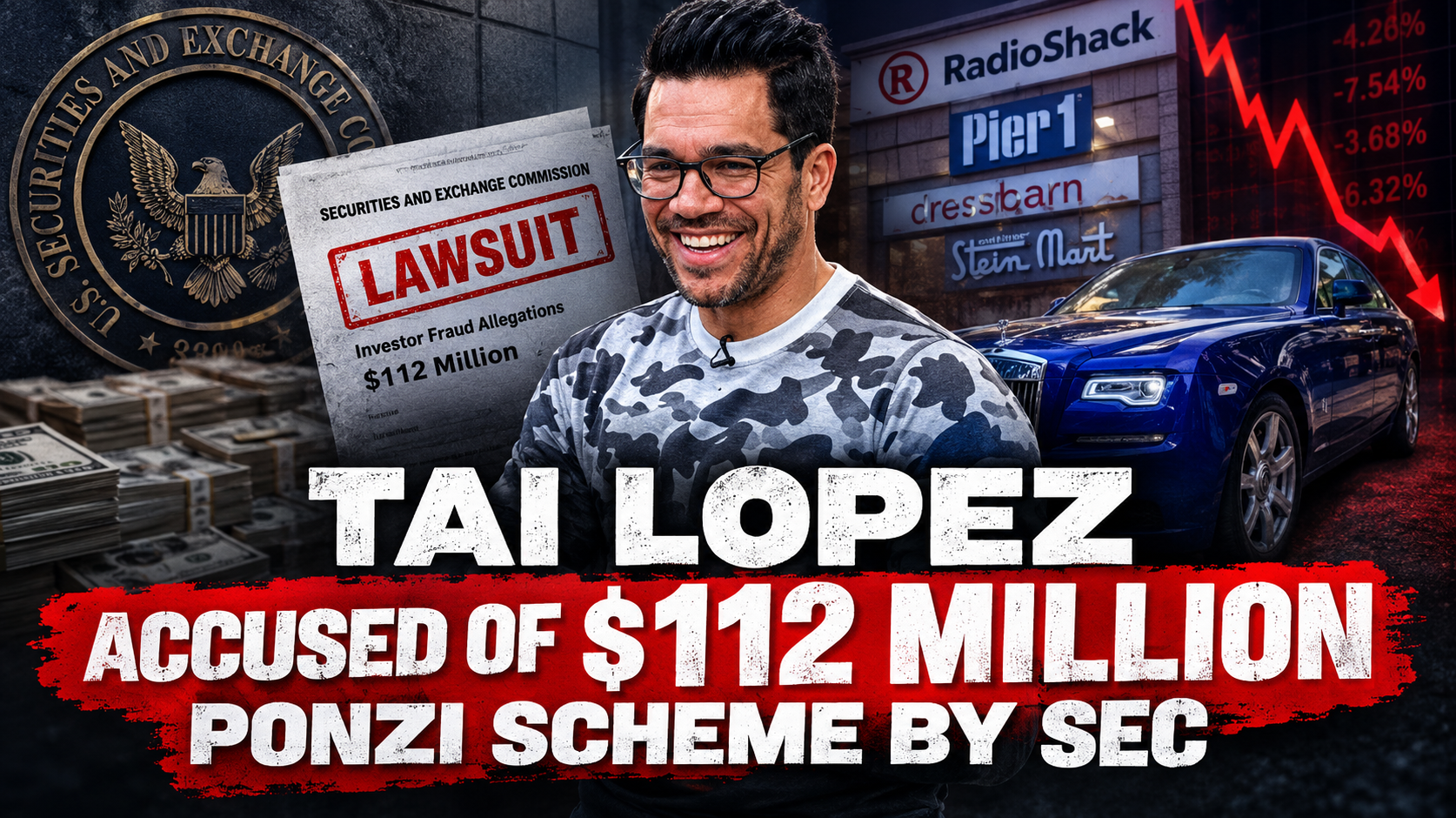
Tai Lopez built his public image around a simple promise: learn from the right people, make better decisions and build wealth. The image was carefully packaged online, where the entrepreneur became famous for motivational programs, business advice and the viral “Here in My Garage” video featuring a Lamborghini and a wall of books. But behind that highly visible brand sits a much more serious story. Federal regulators now accuse Lopez, whose legal name is Taino Adrian Lopez, and two senior executives of Retail Ecommerce Ventures of using misleading investment pitches, shifting investor money between companies and making payments to earlier investors with money raised from later investors.
The allegations are contained in a civil lawsuit filed by the U.S. Securities and Exchange Commission in September 2025. Lopez was 49 when the complaint was filed and the SEC identified him as living in Rio Grande, Puerto Rico. It described him as co-founder, co-owner and chief executive officer of Retail Ecommerce Ventures LLC, or REV, from November 2019 until March 2024. His business partner was Alexander Farhang Mehr, the technology entrepreneur who co-founded REV with Lopez. Maya Rose Burkenroad, Lopez’s cousin, was another central figure, serving as REV’s president and later chief operating officer.
REV was built around an appealing idea during the retail collapse of the pandemic era. Instead of trying to rescue failing chains with thousands of physical stores, Lopez and Mehr acquired the intellectual property and online assets of recognizable brands and attempted to turn them into e-commerce businesses. The portfolio included Pier 1 Imports, RadioShack, Dressbarn, Modell’s Sporting Goods, Stein Mart, Linens ’N Things, Franklin Mint and Brahms. The company also became involved with Tuesday Morning through an investment structure that included REV and other partners.
The scale of the fundraising was substantial. According to the SEC complaint, REV and related entities raised more than $230 million from at least 660 investors between 2020 and 2022. Approximately $112 million of that came through securities offerings tied to eight specific REV retail brands. Investors were offered unsecured notes promising annual returns as high as 25 percent, while some equity investors were promised preferential monthly dividends of up to 2.083 percent. The offerings were marketed as investments in individual businesses that would use the money to acquire or operate the particular retail brand.
The SEC says that picture did not match the financial reality. According to the complaint, the portfolio companies generated revenue but none generated profits. REV’s consolidated financial statements showed monthly net losses ranging from approximately $3.8 million to $12 million in the twelve months ending October 31, 2022. Yet investors were being told that the businesses were thriving, that cash flow was strong and that the strategy was among the best opportunities available.
The most serious allegation is what happened once the businesses could no longer generate enough cash to meet the promised payments. The SEC says investor money was moved between the supposedly separate companies to cover financial shortfalls. In one example, $1.41 million was transferred from a RadioShack account to REV in February 2022, after which REV sent more than $1 million to five other portfolio companies. In another transaction, $1.7 million in investor proceeds was transferred directly from RadioShack to Stein Mart. The SEC says at least $5.9 million was transferred between portfolio companies contrary to the representations made to investors about how their money would be used.
Then came the payments to investors. The SEC alleges that between July and October 2022, at least $5.9 million in new investor money was used to make interest, dividend and principal payments to earlier investors. That is why the regulator described the conduct as Ponzi-like. The allegation is not that every dollar raised was recycled in this manner, but that a significant portion of investor returns were being funded by other investors rather than profits from the businesses supposedly generating those returns. By August 2022, payments were becoming late, and by September, missed payments were widespread, according to the complaint.
The SEC also alleges a separate and particularly damaging misuse of investor money. It says Lopez and Mehr diverted approximately $16.1 million for personal use, with roughly $12.5 million attributed to Lopez and $3.6 million to Mehr. According to the complaint, much of Lopez’s alleged diversion went through TAL Promotions LLC, a company wholly owned by Lopez that, the SEC says, had no affiliation with REV and provided no services to the REV brands.
The regulator’s complaint also raises questions about REV’s internal management. Burkenroad, who was Lopez’s cousin, was presented on REV’s website as having more than a decade of experience managing multimillion-dollar companies. The SEC says her earlier work history included being a substitute preschool teacher, a radio station promoter and an assistant to Lopez at one of his online education businesses. More importantly, the SEC alleges she was involved in the financial machinery of REV. She was a signatory on the relevant bank accounts, received weekly reports showing cash shortfalls and investor obligations, and directed the bookkeeper on which accounts should be used to cover those shortfalls.
The final months of 2022 provide perhaps the clearest indication of how quickly the operation deteriorated. In November, Lopez and Mehr held an investor conference in Las Vegas and continued promoting REV offerings despite the company’s financial problems, according to the SEC. Investors were not told that payments had already been missed. Shortly afterward, investor calls stopped and payments stopped. On December 15, Lopez disclosed to investors during a Zoom call that REV and its brands were in financial trouble and could not make investor payments. Management was considering restructuring or selling parts of the portfolio.
The corporate collapse continued into 2023 and 2024. REV ultimately became insolvent. The SEC says that on December 29, 2023, secured REV noteholders foreclosed on the assets of REV and its retail brands, transferring them to Omni Retail Enterprises LLC, a new company unrelated to REV. Lopez left his CEO role in March 2024, while Burkenroad also left her executive role around that time. The brands survived in different forms, but the investment structure that had attracted hundreds of investors did not.
For investors, the losses were not abstract. The Wall Street Journal reported on people who put substantial personal savings into the REV offerings after seeing Lopez’s social-media promotions and hearing about recognizable brands such as Pier 1 and RadioShack. One investor, Sean Murphy, invested $175,000 and received a $10,000 Pier 1 gift card and roughly $1,000 monthly for about two years before payments stopped. Other investors reported losses of hundreds of thousands of dollars.
The SEC filed its civil action against Lopez, Mehr and Burkenroad in the Southern District of Florida under case number 1:25-cv-24356. Lopez and Mehr face claims under the antifraud provisions of the Securities Act and Exchange Act, including Section 10(b) and Rule 10b-5. Burkenroad faces direct securities fraud allegations as well as aiding-and-abetting claims. The SEC is seeking permanent injunctions, civil penalties and officer-and-director bars, as well as disgorgement and prejudgment interest from Lopez and Mehr. These remain civil allegations. There has been no criminal conviction and no finding of liability against the defendants in the SEC case.
The case has since taken an unusual path. Rather than moving immediately toward trial, the parties entered settlement negotiations. Court records show the case was stayed, and subsequent status reports described the discussions as active and detailed. A June 8, 2026 order gave the parties a further deadline to indicate whether they had reached a tentative settlement that SEC staff could recommend to the Commission or whether the case should be reopened for active litigation. No public settlement amount had been disclosed in the latest reporting reviewed for this article.
There is another layer. Reporting in February 2026 said the FBI was interviewing investors as part of a separate criminal investigation. No criminal charges had been filed against Lopez, Mehr or Burkenroad as of the latest credible reports reviewed. A civil settlement with the SEC would not by itself prevent a separate criminal prosecution if federal prosecutors eventually determine that criminal laws were violated.
Lopez has not been convicted of fraud, and the distinction matters. His public career also has not disappeared. His official website continues to market courses, training programs and motivational content, while his podcast remains active. After the SEC lawsuit became public, Lopez posted on X, “Never doom,” followed by a message about defeat being psychological. That response stood in sharp contrast to the financial reality described in the SEC complaint and the investors’ accounts.
What makes the REV case important goes beyond one internet personality or one failed retail portfolio. It is a warning about the power of reputation in private investment markets. Familiar brand names can make a risky investment appear safer. A charismatic promoter can make extraordinary returns sound ordinary. And when money moves through several companies, investors may not see how dependent the entire structure has become on continually raising fresh capital.
The SEC’s allegations will ultimately have to be tested through the legal process. But the central lesson is already visible. Investors were asked to trust a story about distressed American retail brands being transformed into profitable digital businesses. Regulators now say the numbers underneath that story told something very different. Whether the case ends in a settlement, a trial or a separate criminal prosecution, the collapse of REV shows how quickly a compelling business narrative can become dangerous when promised returns, financial reality and the source of investor payments no longer match.
————-
Disclaimer:
Some content on Reportingscams.com is published under our guest post program and is provided by third-party contributors. Reporting scams does not create, verify, or take responsibility for the views, accuracy, or claims expressed in such content.