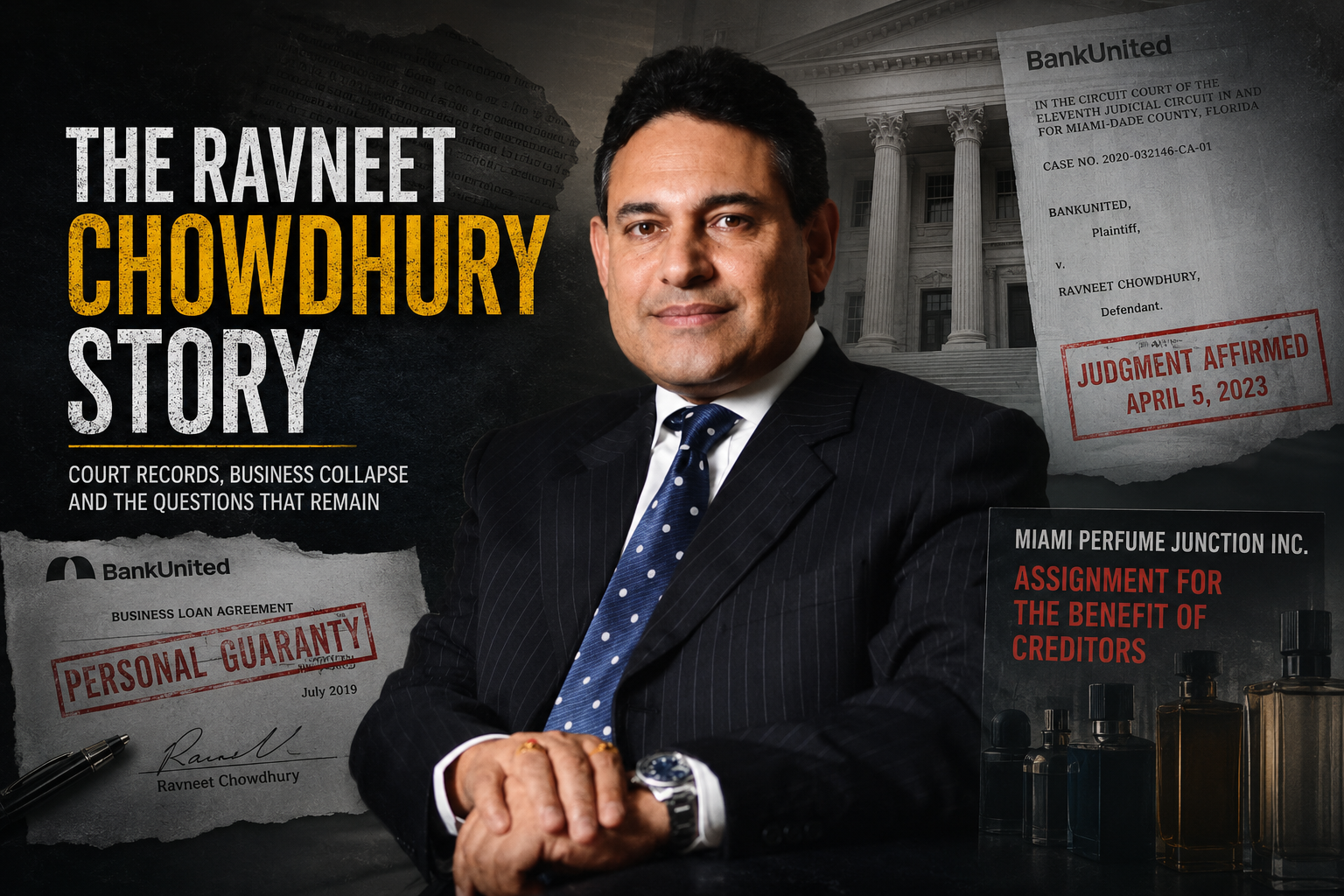
There are people whose public image tells one story, and whose court records tell another. Ravneet Chowdhury is one of them.
To many people in South Florida, Chowdhury has long been known as an attorney, entrepreneur and philanthropist. She has appeared in local media discussing charitable initiatives, community work and fundraising events through the Chowdhury Family Foundation. Public profiles have described her as a lawyer committed to giving back, while business records linked her to companies involved in the perfume and cosmetics trade. On the surface, it is the kind of professional résumé that projects credibility, success and public service.
Yet behind that carefully cultivated image lies a trail of lawsuits, business failures, creditor proceedings and a multimillion-dollar court judgment that paints a far more complicated picture.
None of the publicly available records suggest that Ravneet Chowdhury has been convicted of a crime. There are no criminal indictments or regulatory findings accusing her of fraud. But civil court records, appellate rulings and corporate filings reveal years of financial distress surrounding businesses connected to her family, culminating in personal liability for millions of dollars after Florida courts enforced a guarantee she signed for one of those companies.
Taken together, those records raise an important question. How did an attorney and philanthropist become personally responsible for a multimillion-dollar commercial debt while several businesses associated with her entered insolvency proceedings or disappeared from Florida’s corporate registry?
The answer begins years before the courtroom battles that would eventually define much of her public record.
Ravneet Chowdhury built her professional career as a Florida attorney while also becoming involved in a family-owned wholesale fragrance business. Public records identify her as the president and registered agent of Miami Perfume Junction Inc., a company involved in importing and distributing perfumes and cosmetic products. The business operated within a broader network of related companies, including Doral International Products LLC, Clarus Group Inc. and 2851 Investments LLC. Those entities would later become closely connected through creditor proceedings after financial difficulties emerged.
Alongside her legal and business work, Chowdhury became the public face of the Chowdhury Family Foundation, a charitable organization established by her family. News coverage from South Florida frequently highlighted the foundation’s support for local causes, educational programs and healthcare initiatives. Photographs from fundraising galas and community events projected the image of a successful business family committed to philanthropy.
The foundation itself was real and active. IRS filings show that it distributed charitable grants over multiple years. According to publicly available nonprofit tax records, the organization reported charitable giving of approximately $325,000 in 2017, more than $313,000 in 2018, around $250,000 in 2019 and more than $55,000 in 2020. Those records demonstrate that the foundation was not simply a name on paper. It conducted genuine charitable activity during its earlier years.
What changed afterward, however, is less clear.
Later tax filings reflected a sharp decline in activity, including a filing that reported no charitable grants during 2022. That contrast has attracted attention because the family’s public philanthropic profile continued to exist even as the foundation’s reported charitable distributions dropped dramatically. The filings do not, by themselves, explain why donations slowed or whether the organization had shifted its priorities. They simply document that the scale of charitable giving became significantly smaller than it had been only a few years earlier.
While the foundation’s activity declined, far more serious problems were beginning to emerge inside the family’s commercial businesses.
The turning point came in July 2019.
According to court records, BankUnited extended commercial credit to one of the business entities connected to the Chowdhury family. As part of that transaction, Ravneet Chowdhury signed a personal guaranty. In simple terms, a guaranty is a promise that if the borrowing company fails to repay its debt, the individual guarantor becomes personally responsible for the outstanding balance.
These agreements are common in commercial lending. Banks frequently require owners or executives of closely held businesses to guarantee corporate loans, especially when lending significant amounts of money. Signing such a guarantee effectively removes the protection that normally exists between a company’s debts and an individual’s personal assets.
That distinction would later become central to the litigation.
When the borrowing company defaulted, BankUnited pursued not only the business but also Ravneet Chowdhury personally under the guaranty she had signed.
Chowdhury responded by challenging the bank’s claims. Court filings show that she argued BankUnited had breached fiduciary duties owed to her and raised counterclaims in an attempt to avoid liability. Those arguments became one of the key legal issues considered by the Florida courts.
Ultimately, they were unsuccessful.
The trial court entered summary judgment in favor of BankUnited, finding that the guaranty was enforceable and that Chowdhury remained personally liable under its terms. She appealed that decision to Florida’s Third District Court of Appeal.
The appellate court’s opinion, issued in April 2023, represents one of the most significant public documents connected to Chowdhury’s legal history.
Rather than reopening the factual dispute, the appellate judges focused on the legal arguments presented. They concluded that BankUnited owed no fiduciary duty to Chowdhury in the circumstances of the commercial lending relationship. Florida law generally treats lenders and borrowers as parties engaged in ordinary commercial transactions rather than fiduciary relationships, unless special circumstances exist. The court found that those special circumstances had not been established.
As a result, the appellate court affirmed the summary judgment entered against her.
The ruling effectively left the personal guaranty intact and confirmed that Chowdhury remained legally responsible for the debt. After seeking rehearing, which was denied, the appellate proceedings came to an end, leaving the judgment in BankUnited’s favor.
For legal observers, the decision was significant not because it created new law but because it reinforced a long-standing principle of commercial lending. Individuals who voluntarily sign personal guarantees face substantial financial exposure if the underlying business fails, and courts are generally reluctant to rewrite those agreements after the fact.
For Ravneet Chowdhury, however, the decision represented something much more personal.
It meant that financial problems inside the business could no longer be viewed solely as corporate liabilities. They had become personal liabilities as well.
The BankUnited litigation was only one part of a much broader financial collapse that was unfolding around the businesses connected to the Chowdhury family. As creditors sought repayment and companies struggled to survive, several related entities entered legal proceedings designed to liquidate assets and distribute whatever value remained among creditors.
Those proceedings would expose another little-known legal process that rarely attracts public attention but often appears when businesses are no longer able to meet their financial obligations.
Instead of filing for traditional bankruptcy protection, Miami Perfume Junction and related companies entered what Florida law calls an Assignment for the Benefit of Creditors. The process serves a similar purpose to bankruptcy but operates under state law rather than through the federal bankruptcy courts.
It would become one of the defining chapters in the unraveling of the Chowdhury business network and reveal just how extensive the financial difficulties had become.
By the time the BankUnited litigation was working its way through the Florida courts, the financial problems facing the businesses associated with Ravneet Chowdhury had spread far beyond a single loan.
The companies connected to the family’s perfume distribution business were no longer simply dealing with creditors or cash flow issues. They had reached a point where continuing normal operations appeared increasingly difficult. Rather than reorganizing through federal bankruptcy court, several of those businesses entered a legal process that is less familiar to the public but widely used in Florida when distressed companies decide to wind down their affairs.
The process is known as an Assignment for the Benefit of Creditors, often shortened to an ABC proceeding.
Unlike bankruptcy, where a federal judge oversees the administration of a debtor’s assets, an Assignment for the Benefit of Creditors allows a company to voluntarily transfer all of its assets to an independent assignee. That assignee is then responsible for gathering assets, notifying creditors, liquidating property where necessary and distributing any available proceeds according to Florida law.
It is not, by itself, evidence of fraud or misconduct. Businesses enter these proceedings for a variety of reasons, including insolvency, mounting debt or the inability to continue operating. However, it does signal that a company has reached a point where ordinary business operations are no longer sustainable.
Public court records show that Miami Perfume Junction Inc. became one of the companies involved in such proceedings. It was not alone. Three related entities, Doral International Products LLC, Clarus Group Inc. and 2851 Investments LLC, also became part of the broader creditor administration process.
Looking at those companies together tells a story that is difficult to dismiss as an isolated business setback.
Corporate records show overlapping ownership, management and business relationships between the entities. While each company had its own legal identity, they operated within the same commercial ecosystem, largely centred around wholesale fragrance and cosmetic distribution. When financial pressure mounted, multiple businesses within that network experienced distress at roughly the same time.
That pattern is significant because it suggests the challenges extended beyond the fortunes of a single company. Instead, they appear to have affected an interconnected group of businesses that had been operating together for years.
One of the more unusual legal disputes to emerge from the insolvency proceedings had nothing to do with unpaid invoices or commercial contracts. Instead, it involved a question that lawyers rarely expect appellate courts to answer.
Who owns a company’s attorney-client privilege after the business assigns all of its assets to an assignee?
The issue arose because the assignee responsible for administering Miami Perfume Junction’s assets sought access to communications that had previously been protected by attorney-client privilege. Those communications could potentially help identify assets, understand past transactions or evaluate legal claims that might benefit creditors.
Not everyone agreed that the privilege should automatically pass to the assignee.
The dispute eventually reached Florida’s Third District Court of Appeal, which considered whether the assignee effectively stepped into the shoes of the company for purposes of controlling privileged communications.
The appellate court ultimately agreed that the assignee possessed that authority. In practical terms, the decision meant that attorney-client privilege belonged to the company itself rather than to the individuals who had managed it. Once control of the company legally passed to the assignee, control over privileged communications passed as well.
Although highly technical, the ruling carried broader implications for insolvency law in Florida. It confirmed that assignees must have access to information necessary to administer distressed businesses effectively, even when that information includes communications previously protected by privilege.
Importantly, the case was not a finding of fraud, concealment or wrongdoing by Ravneet Chowdhury or anyone else connected to Miami Perfume Junction. It resolved a legal question about who controls privileged corporate communications after an assignment for the benefit of creditors.
Even so, the litigation illustrates how complex the administration of the companies had become. By that stage, the proceedings were no longer focused solely on collecting debts. They had expanded into questions involving corporate governance, legal privilege and the management of business records during insolvency.
The corporate records tell a similar story.
In September 2021, Miami Perfume Junction Inc. was administratively dissolved by the State of Florida after failing to maintain its active corporate status. Administrative dissolution is a routine action taken by state authorities when companies fail to satisfy certain statutory requirements, such as filing annual reports or maintaining required registrations.
On its own, an administrative dissolution does not establish misconduct. Thousands of businesses are dissolved every year for administrative reasons. But when viewed alongside creditor proceedings, major litigation and financial distress, it becomes another piece of a much larger picture.
The same pattern later extended to Ravneet Chowdhury’s own legal practice.
State records show that the Law Offices of Ravneet Chowdhury P.A., which had been established in 2013, was voluntarily dissolved in June 2023. Unlike an administrative dissolution, a voluntary dissolution simply means that the owners elected to terminate the corporation.
Public records do not explain why the practice was dissolved, nor do they suggest disciplinary action by The Florida Bar. There is no publicly available finding that the law practice was closed because of professional misconduct or regulatory sanctions.
Nevertheless, the timing is notable.
The voluntary dissolution occurred only weeks after the appellate court affirmed the BankUnited judgment and denied rehearing. Whether the timing reflects coincidence, ordinary business decisions or broader financial restructuring is impossible to determine from the public record alone. Responsible reporting requires acknowledging that distinction rather than inviting speculation.
Financial pressure on the business network also surfaced through additional litigation.
Court records indicate that LendingClub Bank filed a civil action involving Ravneet Chowdhury during 2021. Another lawsuit during the same period involved Miami Perfume Junction AP LLC.
The existence of these lawsuits is part of the public record, but their presence alone should not be interpreted as proof of liability. Civil lawsuits often conclude through settlement, dismissal or negotiated resolution, and not every filed complaint results in a judgment. Based on publicly available information, the final disposition of these particular matters is not as clearly documented as the BankUnited case.
That distinction matters.
One of the recurring problems in online reporting is the tendency to treat every lawsuit as evidence that allegations have been proven. Courts do not operate that way. Complaints represent claims made by one party. Judgments represent findings made by a court. The difference is fundamental, particularly in investigative journalism.
The BankUnited litigation falls into the second category because Florida’s appellate court affirmed the judgment. The LendingClub matter, by contrast, should be reported more cautiously unless additional court records establish its outcome.
Stepping back from the individual cases, the broader timeline reveals a business network under sustained financial strain.
A commercial loan default led to personal liability under a signed guaranty. Multiple related companies entered Assignment for the Benefit of Creditors proceedings. Corporate entities were dissolved. Additional civil litigation emerged. Meanwhile, one of the family’s most visible public-facing institutions, the Chowdhury Family Foundation, reported dramatically lower charitable activity than it had only a few years earlier.
Each of these events can be explained individually.
Businesses fail. Companies are dissolved. Foundations sometimes scale back their operations. Commercial lenders sue guarantors. None of those events automatically implies deception or unlawful conduct.
But when they occur within the same closely connected business network over a relatively short period, they inevitably raise questions about what changed.
Those questions become even more compelling because they stand in sharp contrast to the public image that had surrounded Ravneet Chowdhury for years. While legal filings increasingly documented financial distress, public biographies and older media coverage continued to portray a successful attorney, entrepreneur and philanthropist.
That contrast does not establish wrongdoing. It does, however, illustrate how public reputation and documented financial reality can sometimes move in very different directions.
The public record surrounding Ravneet Chowdhury does not end with a dramatic criminal indictment or a sweeping regulatory investigation. In many ways, that is precisely what makes the story worth examining.
Some of the most instructive business collapses are not driven by criminal prosecutions. They unfold quietly through civil courtrooms, creditor proceedings, dissolved corporations and financial records. The consequences can still be severe for lenders, suppliers, business partners and investors, even when prosecutors never become involved.
That is the lens through which the available evidence should be viewed.
For years, Ravneet Chowdhury occupied several professional roles at once. She was a licensed attorney, the president of a wholesale perfume business, a representative of the Chowdhury Family Foundation and, through media coverage and community events, one of the public faces of a family that presented itself as both commercially successful and philanthropically active.
None of those achievements should be dismissed simply because later financial difficulties emerged. The foundation’s IRS filings show that it made genuine charitable contributions over several years, distributing hundreds of thousands of dollars to charitable causes before its activity slowed considerably. Likewise, there is nothing in the public record to suggest that Chowdhury was ever stripped of her law license, criminally charged or found liable for fraud by a court.
At the same time, the public record also shows that the financial foundation supporting that public image began to weaken long before many outside observers noticed.
The BankUnited litigation remains the clearest example.
Commercial lending disputes happen every day, but personal guarantees often become overlooked until a business begins to fail. Many business owners sign them as part of routine financing, believing they will never become personally relevant. When a company defaults, however, those signatures can transform corporate debt into personal liability almost overnight.
That is exactly what happened here.
The Florida courts ultimately concluded that the guarantee Ravneet Chowdhury signed was enforceable. Her arguments that the bank owed fiduciary duties beyond the ordinary lender-borrower relationship did not persuade either the trial court or the Third District Court of Appeal. Once the appellate court affirmed the judgment and denied rehearing, the legal dispute was effectively settled in BankUnited’s favour.
From an investigative perspective, the significance of that decision extends beyond one lender recovering a debt.
It demonstrates how closely intertwined the family’s business operations and personal financial obligations had become. Rather than remaining insulated behind corporate entities, at least part of the commercial borrowing had been personally guaranteed. When the businesses encountered financial distress, that distinction disappeared.
The creditor proceedings tell a similar story.
Assignments for the Benefit of Creditors rarely receive the same public attention as bankruptcy cases, yet they often signal that a business has reached the end of its commercial life. Instead of attempting to restructure and continue operating, the companies involved effectively acknowledged that an orderly liquidation offered the most practical path forward.
In the case of Miami Perfume Junction and the related entities, the proceedings affected several interconnected companies operating within the same business network. Looking at those events collectively, rather than in isolation, reveals a pattern of financial deterioration that unfolded over several years.
The subsequent corporate dissolutions reinforced that picture.
Miami Perfume Junction Inc. disappeared from Florida’s active corporate registry after being administratively dissolved. Months later, the Law Offices of Ravneet Chowdhury P.A. was voluntarily dissolved as well. Public records do not explain the reasons behind those decisions, nor do they indicate disciplinary action by regulators. They simply mark the formal end of businesses that had once formed an important part of Chowdhury’s professional identity.
Another aspect of the story deserves equal attention because it illustrates a challenge facing modern investigative journalism.
In the age of social media and online commentary, public figures are often judged by allegations alone. Lawsuits are frequently reported as though they establish guilt, while financial difficulties are sometimes exaggerated into claims of criminal conduct.
That approach does not serve readers.
The documentary record concerning Ravneet Chowdhury is substantial enough without making claims that the evidence does not support. There are confirmed court decisions, publicly available corporate records, insolvency proceedings and tax filings. Those documents allow the public to understand what happened without relying on speculation or sensationalism.
They also highlight what remains unknown.
The available records do not fully explain why the businesses encountered financial distress. They do not identify every commercial decision that contributed to the companies’ decline. Nor do they explain the dramatic reduction in charitable activity reported by the Chowdhury Family Foundation after years of significantly higher grant-making.
There may be entirely legitimate explanations for some of those developments. Economic conditions changed considerably after 2020, supply chains across numerous industries experienced disruption and many privately held businesses faced financial pressure during that period. Without direct evidence, it would be inappropriate to attribute the collapse of the businesses to any single cause.
That uncertainty is an important part of the story rather than a weakness in it.
Investigative reporting is often most valuable when it clearly distinguishes between what documents prove, what they suggest and what they leave unanswered. Readers deserve to know where the evidence ends.
Even so, several lessons emerge from the available record.
For lenders, the case demonstrates why personal guarantees remain one of the most important protections in commercial finance. Without the guaranty signed in 2019, BankUnited’s ability to pursue repayment may have been significantly more limited.
For entrepreneurs, it serves as a reminder that closely held businesses often expose owners to personal financial risk, particularly when commercial borrowing is supported by individual guarantees rather than corporate assets alone.
For donors and members of the public, it underscores the importance of reviewing publicly available nonprofit filings rather than relying solely on public relations material or media coverage. IRS Form 990-PF filings provide a far more complete picture of a private foundation’s financial activity than press releases or fundraising events ever can.
And for anyone considering a business relationship, the case reinforces a broader principle of due diligence.
Corporate registrations, litigation records, appellate decisions and tax filings are all public documents. Individually, they may reveal only a small piece of the picture. Taken together, they often tell a far more complete story about the financial health and legal history of a business or its principals.
That broader lesson extends beyond Ravneet Chowdhury herself.
The public record examined in this investigation reflects the rise and decline of a business network that once appeared stable and successful. It documents commercial borrowing that ultimately resulted in personal liability, companies that entered creditor administration, businesses that ceased to exist and a charitable foundation whose reported activity diminished sharply after years of more substantial giving.
What it does not document is equally important.
No criminal conviction.
No publicly identified regulatory enforcement action.
No finding by a court that Ravneet Chowdhury committed fraud.
Those distinctions matter because accuracy is the foundation of credible investigative journalism. A civil judgment, however significant, is not the same as a criminal conviction. Financial failure is not automatically evidence of dishonesty. Insolvency proceedings are legal mechanisms designed to deal with distressed businesses, not declarations of criminal conduct.
Still, the records leave behind a detailed documentary trail that anyone can examine.
From the personal guaranty signed in 2019 to the appellate decision that affirmed BankUnited’s judgment, from the Assignment for the Benefit of Creditors proceedings involving multiple companies to the eventual dissolution of businesses that had once anchored the family’s commercial operations, the documents chart the evolution of a business empire under increasing financial pressure.
For years, Ravneet Chowdhury’s public profile was built around professional success, entrepreneurship and charitable work. The court files tell a different chapter, one defined by commercial debt, creditor claims and legal accountability.
Both narratives exist in the public record.
Together, they provide a case study in how business fortunes can change, how personal guarantees can reshape financial responsibility and why careful due diligence remains essential long after the headlines surrounding philanthropy and corporate success have faded.
————-
Disclaimer:
Some content on Reportingscams.com is published under our guest post program and is provided by third-party contributors. Reporting scams does not create, verify, or take responsibility for the views, accuracy, or claims expressed in such content.