Holton Buggs spent much of his career selling a particular idea of success. In the world of network marketing, he built a reputation as a high-level recruiter, executive and motivational speaker, presenting wealth not simply as an outcome but as evidence that his methods worked. He rose to become a prominent figure at Organo Gold, later founded the travel-focused multi-level marketing company iBuumerang, and developed a personal brand around leadership, entrepreneurship and financial freedom.
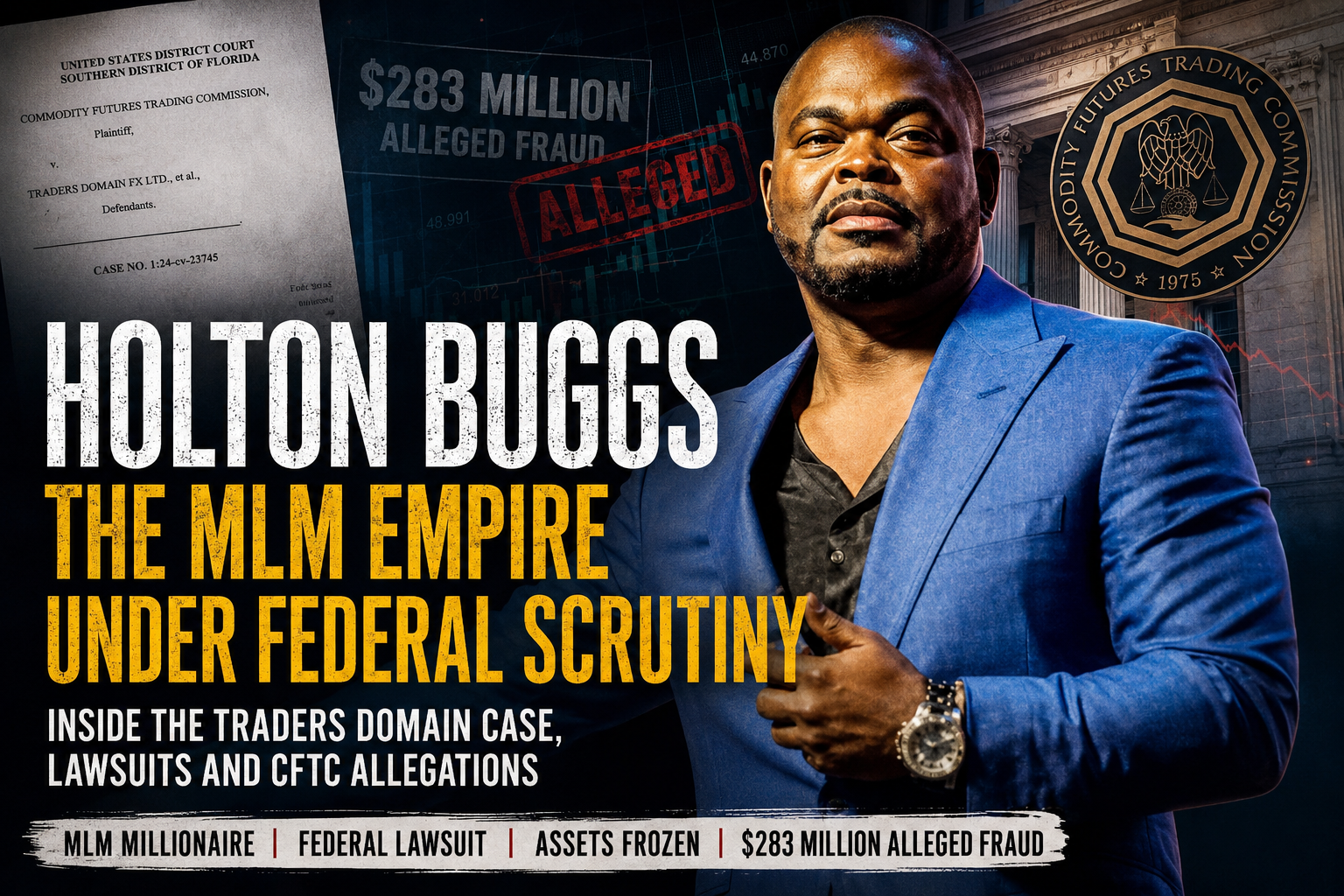
Today, that public image sits alongside a very different record. Buggs is a named defendant in a federal Commodity Futures Trading Commission enforcement action alleging that he participated in the promotion of a massive fraudulent trading operation known as Traders Domain. The CFTC says more than 2,000 customers deposited at least $283 million into the operation and alleges that Buggs personally recruited at least 517 investors who contributed no less than $54 million. The agency further alleges that more than $125 million was misappropriated through the scheme.
Those allegations have not yet been finally adjudicated. Buggs has denied wrongdoing and fought the government’s case in court. But the legal consequences are already substantial. His assets were frozen, a federal court-appointed receiver took control of property connected to the case, a magistrate judge sanctioned him $9,583.40 for violating court orders concerning cooperation, and a federal judge rejected his attempt to have the CFTC’s case dismissed. Buggs later agreed to surrender a collection of high-value assets to the receiver.
The case is still alive. As of August 2026, the civil fraud trial has been pushed to November 16, 2026. That means the most serious allegations against Buggs remain allegations rather than criminal convictions or final findings of civil liability.
What makes Buggs particularly notable, however, is not simply the size of the CFTC case. It is the trajectory that preceded it. His professional history moved through the same ecosystem repeatedly: traditional multi-level marketing, recruitment-based entrepreneurship, cryptocurrency and NFT projects, trading education and forex promotion. Along the way, there were lawsuits, regulatory warnings involving businesses with which he was associated, and eventually a federal enforcement case alleging that his recruitment machine helped bring hundreds of investors into Traders Domain.
The making of an MLM empire
Buggs’ rise began in network marketing rather than financial trading. Court records from an earlier dispute identify him as a Texas resident and a senior executive and top earner at Organo Gold. A 2011 federal court order in Idaho described Buggs as Organo’s vice president of sales and a “Crown Diamond Marketing Associate.” The same record said promotional material touted his earnings at more than $4 million and described his international marketing activities.
That same court record is important because it provides an early glimpse of how Buggs operated within the aggressive recruiting culture of MLM. Melaleuca, an Idaho-based direct-selling company, sued Organo Gold and Buggs, alleging that Organo had unlawfully recruited its marketing executives and customers and used proprietary information. The complaint alleged that Buggs hosted a meeting at his Houston home where Melaleuca representatives were encouraged to leave the company and join Organo. The court ultimately denied Buggs’ motion to dismiss and found that Melaleuca had made a prima facie showing of specific jurisdiction based on Buggs’ alleged activities directed at the Idaho company.
That proceeding should not be confused with a finding that Buggs was ultimately liable for the allegations. The 2011 order dealt with jurisdiction and venue, not the truth of every underlying allegation. That distinction matters in reconstructing his history because the public record contains a mixture of allegations, court findings, regulatory actions and secondary reporting, and they do not all carry the same evidentiary weight.
A later case produced a much more concrete adverse judgment.
AmeriSciences, another MLM company, eventually became embroiled in a dispute involving Organo Gold and Buggs. According to the Fifth Circuit’s 2019 opinion, a jury found Organo Gold and Buggs liable in connection with trade-secret misappropriation, tortious interference, aiding and abetting breach of fiduciary duty, unjust enrichment and fraudulent-transfer claims. The case arose after AmeriSciences’ distributor network and software became the subject of a dispute involving people who moved toward Organo.
The resulting judgment was substantial. Buggs and Organo Gold were held jointly liable for $3,461,166, plus $610,482 in prejudgment interest. The Fifth Circuit later affirmed the judgment, although it reduced the amount by $110,000 reflecting settlements. The appellate ruling therefore represents a genuine adverse civil judgment, rather than merely an accusation.
That judgment is an important part of the Buggs story because it predates his later involvement with crypto and forex ventures by several years. It also shows that the aggressive recruitment tactics associated with his business career were not simply a product of his later entry into online finance.
Buggs’ departure from Organo Gold became a turning point. He had risen from distributor to one of the company’s most recognizable sales figures and was later given a Chief Visionary Officer role. By 2019, however, he had moved toward building his own enterprise. That enterprise was iBuumerang.
iBuumerang, Ellev8 and the shift toward trading
iBuumerang launched in 2019 as a travel-oriented MLM. The pitch was familiar to the direct-selling industry. Members could access travel-related discounts while building an organization of other participants and earning through the company’s compensation structure.
Buggs was positioned at the center of the enterprise. Contemporary industry coverage described him as chairman and CEO, while the company’s promotional material presented him as the architect of its vision.
But the business did not remain solely a travel company.
An investment and trading component called Ellev8 was added to the iBuumerang ecosystem. Ellev8 promoted forex-related education and trading opportunities, bringing the company and its distributors closer to the world of speculative financial products.
That shift attracted regulatory attention outside the United States. New Zealand’s Financial Markets Authority issued a warning concerning Ellev8, according to industry reporting. The significance is not that the warning established fraud by Buggs personally. It did not. Rather, it showed that an enterprise associated with his business ecosystem had entered a regulatory environment in which authorities were warning consumers about its financial activities.
The evolution was consequential because Buggs’ audience was not simply an audience of passive investors. It was an established MLM network. He already had thousands of people accustomed to listening to him about business opportunities, income generation and wealth creation.
That distinction would become central to the later CFTC case.
The crypto chapter and Meta Bounty Hunters
By the early 2020s, Buggs was increasingly involved in cryptocurrency-related projects. One of the most controversial was Meta Bounty Hunters, an NFT project associated with Buggs and promoter Travis Bott.
Secondary investigations have alleged that Meta Bounty Hunters raised millions of dollars from purchasers and subsequently collapsed. BehindMLM characterized the project and its successor, Meta Bounty Huntresses, as Ponzi schemes. The reporting estimated that Meta Bounty Hunters involved approximately 6,100 NFT sales at roughly $2,000 each, although the precise financial picture surrounding the projects remains disputed and there has been no confirmed SEC enforcement judgment against Buggs over the NFTs.
This is one area where an investigative article needs to be particularly careful. Calling Meta Bounty Hunters a proven Ponzi scheme would overstate the available legal record. There is no confirmed criminal conviction against Buggs for the project, and the public record located for this investigation does not show an SEC judgment establishing securities fraud against him over the NFTs.
What can be established is that the project was promoted through an MLM-style audience and that watchdog reporting subsequently characterized it as a Ponzi. Its collapse also occurred within the same broader business network that eventually fed into Traders Domain.
The sequence is striking.
Buggs had built an MLM audience through Organo Gold. He then founded iBuumerang, added trading-related services through Ellev8, moved into crypto and NFTs through Meta Bounty Hunters and Meta Bounty Huntresses, and later became a prominent promoter of Traders Domain.
The CFTC case would ultimately put that last step under a federal microscope.
The Traders Domain operation
The Commodity Futures Trading Commission filed its enforcement action in the Southern District of Florida on September 30, 2024. The case is styled Commodity Futures Trading Commission v. Traders Domain FX Ltd. et al., Case No. 1:24-cv-23745.
The government alleges that Traders Domain and its principals operated a large-scale fraudulent trading operation involving leveraged or margined commodity transactions. According to the CFTC, the operation used representations about trading performance to attract customers and then misappropriated customer funds. The agency says the scheme operated from at least November 2019 until the government’s intervention.
The CFTC says the numbers were enormous. More than 2,000 customers allegedly deposited at least $283 million. The agency seeks restitution, disgorgement, civil monetary penalties, permanent trading and registration bans, and permanent injunctions against future violations.
Buggs was not alleged to be the sole architect of Traders Domain. Instead, the complaint described him as one of the sponsors who helped expand the operation by recruiting customers.
The government’s allegation is specific. The CFTC says Buggs personally recruited at least 517 investors who collectively contributed no less than $54 million to Traders Domain. The agency further alleges that Buggs misappropriated more than $125 million through the operation.
That distinction matters. A promoter does not automatically become legally responsible for every action committed by the operator of an investment business. The government’s case therefore focuses on what Buggs allegedly knew, what warnings he received, what representations he made, and what role he played in continuing to bring investors into the system.
The court’s January 2025 ruling provides a revealing window into that dispute.
Buggs moved to dismiss the CFTC’s complaint. Among other arguments, he sought dismissal for failure to state a claim and challenged personal jurisdiction. He also sought to dissolve the receivership and statutory restraining order affecting him.
Judge Roy K. Altman rejected the motion.
The January 17, 2025 order is not a finding that Buggs committed fraud. It is an order allowing the government’s case to continue. But the reasoning is significant. The court concluded that the CFTC had sufficiently alleged that Buggs knew or should have known that the Traders Domain operation was fraudulent and that he continued to participate rather than disengaging or warning customers.
The court specifically addressed allegations that Buggs ignored warnings from experienced traders concerning fraudulent activity in the Traders Domain pool. Those allegations were enough, at the pleading stage, for the case against him to proceed.
That is a crucial legal line for readers. A motion to dismiss asks whether the allegations, if proven, state a viable legal claim. It does not determine whether the allegations are ultimately true.
The final answer is expected through the trial process.
The asset freeze and the receiver
The government’s case moved quickly after filing.
On October 3, 2024, the federal court entered a statutory restraining order freezing defendants’ assets and giving the CFTC access to books and records. A temporary receiver was appointed to take control of assets associated with the defendants.
For Buggs, the receivership transformed the case from a lawsuit on paper into a direct threat to his wealth.
The receiver sought information about his assets. According to court filings, Buggs initially failed to provide the required information and failed to appear for an asset deposition. A federal magistrate judge subsequently imposed a $9,583.40 sanction on December 27, 2024.
The receiver’s later report documented the dispute. Buggs eventually provided a financial statement and supporting documents on January 13, 2025, and gave an asset deposition on January 16. At the time of the receiver’s February report, however, the $9,583.40 sanction remained unpaid.
The episode matters because it was not merely a disagreement between Buggs and the CFTC over the underlying allegations. It concerned compliance with orders governing the receivership.
Later filings show that Buggs eventually paid the sanction on March 27, 2025.
The receiver’s investigation also identified a collection of potentially recoverable assets. Court filings referenced Houston properties, vehicles, watercraft, watches and other high-value property. Buggs subsequently agreed to surrender assets to the receivership.
Among the assets associated with the surrender were a Lamborghini, luxury watches, watercraft and Houston-area real estate. The receiver’s work later expanded into the sale and liquidation of property for the benefit of the estate.
The numbers circulating around Buggs’ alleged financial benefit from Traders Domain are even more striking.
BehindMLM reported that a receiver investor master list identified Buggs as a net winner of approximately $75.9 million, with his wife, Earlene Buggs, separately listed at approximately $17.4 million. The same reporting identified several Buggs-linked accounts, including MBH Iconics, MBH Reserves, MBH Escrow and Buggs Legacy. The figures are secondary reporting of receiver data and should not be presented as a final court finding without qualification.
This distinction is particularly important for publication. The CFTC’s verified allegation is that Buggs misappropriated more than $125 million. The approximately $75.9 million figure is a reported net-winner figure from receiver data, not necessarily the same thing as the amount allegedly misappropriated.
Those numbers describe different concepts and should not be conflated.
The most consequential question is what Buggs knew
The central issue in the CFTC case is therefore not simply whether Buggs recruited investors.
The government alleges that he did.
The harder question is whether he knew, or should have known, that Traders Domain was fraudulent and nevertheless continued to promote it.
The CFTC complaint alleges that Buggs ignored red flags and warnings concerning the trading pool. The court, when denying his motion to dismiss, found that the government’s allegations were sufficient to proceed on that theory.
That matters because Buggs’ defense has reportedly been that he was not responsible for the underlying fraud and did not know what was happening inside Traders Domain. The legal battle is therefore partly about the boundary between an investor, an affiliate promoter and a participant in a fraudulent enterprise.
The distinction may ultimately determine his financial liability.
If the CFTC proves its claims, Buggs could face restitution, disgorgement, civil monetary penalties and permanent restrictions on trading and registration. The agency has expressly sought those remedies.
There is another important point. There is currently no confirmed criminal conviction against Buggs arising from Traders Domain in the public record reviewed for this investigation. The CFTC action is a civil enforcement proceeding.
That does not make it insignificant. Civil enforcement can result in enormous financial judgments, asset forfeiture or liquidation, injunctions and permanent industry restrictions. But it should not be inaccurately described as a criminal fraud conviction.
The business empire begins to unravel
While the Traders Domain litigation moved forward, Buggs’ own business empire was changing.
iBuumerang, once presented as his flagship travel MLM, eventually became part of Risen Live, a Dubai-based direct-selling company. Reporting in late 2025 indicated that iBuumerang assets were sold or merged into Risen Live and that Buggs became chairman of Risen Live’s board rather than continuing as iBuumerang’s CEO. The financial terms of the transaction were not publicly disclosed.
That transition deserves scrutiny, but it should not be turned into an allegation that the transaction itself was unlawful.
The public record does, however, raise obvious investigative questions about timing. Buggs’ assets were subject to court restrictions while his principal MLM enterprise was changing hands. The investigation report on Investigations.org identifies the question of whether proceeds from the reported iBuumerang transaction were subject to the asset freeze as unresolved. There is not enough verified public evidence to state that the sale violated a court order.
By 2026, Buggs continued to appear in Risen Live marketing as chairman. Risen Live’s own social media activity has promoted events featuring Buggs in that role, including material from 2026.
He has also maintained a public personal brand built around leadership and motivational content. His social media accounts continue to feature business and motivational material.
That creates a striking contradiction at the center of the story.
The same entrepreneur whose public career has been built around wealth creation and leadership is now defending himself in a federal enforcement case in which the government alleges hundreds of millions of dollars flowed through a fraudulent trading operation and alleges that Buggs personally recruited hundreds of investors.
Yet the legal system has not determined the final truth of those allegations.
The property trail tells another part of the story
The receivership provides a more tangible picture of the consequences.
The receiver’s filings identified Buggs’ Houston properties and other valuable assets for potential recovery. Later reporting described the planned sale of his Houston residence and the receiver’s efforts to recover value for the Traders Domain estate.
This is where the case becomes more than a dispute over online claims and competing narratives.
A court-appointed officer has been tasked with identifying, preserving and liquidating assets connected to the defendants. Buggs has surrendered property. The proceeds are intended to support the receivership and ultimately the claims process for people who allege they lost money.
The CFTC itself opened a formal claims process for Traders Domain customers and announced July 28, 2025 as the deadline for filing claims. The agency warned customers that previous surveys or submissions did not constitute formal claims.
The existence of a receivership does not prove that every dollar received by Buggs was stolen. Receiverships can encompass disputed property and require courts to resolve competing claims.
But it does show that the government and the federal court consider the potential recovery of assets important enough to justify extraordinary intervention.
The chronology shows the evolution more clearly than any single accusation
Buggs’ career is best understood as a sequence rather than a collection of isolated controversies.
In the late 2000s, he was already deeply involved in network marketing. The 2011 Melaleuca litigation described him as an Organo Gold executive and top earner and documented allegations that he recruited Melaleuca representatives into Organo. The court allowed the case against him to proceed on jurisdictional grounds.
In 2014, the AmeriSciences litigation was filed. After trial, a jury found Buggs and Organo Gold liable on multiple claims involving trade secrets and related conduct. The Fifth Circuit affirmed the judgment in 2019.
In 2019, Buggs launched iBuumerang, initially built around discounted travel and MLM recruitment.
During the early 2020s, the company expanded into trading-related activity through Ellev8, which subsequently became the subject of a warning from New Zealand’s Financial Markets Authority, according to industry reporting.
Around 2021 and 2022, Buggs became associated with Meta Bounty Hunters and related NFT projects. Watchdog reporting later characterized those projects as Ponzi schemes, although no confirmed SEC judgment establishing such liability against Buggs was located.
In 2022 and 2023, Traders Domain became increasingly important to his business network. The CFTC now alleges that Buggs recruited at least 517 investors who contributed at least $54 million.
In September 2024, the CFTC filed its federal enforcement action.
In October 2024, the court froze defendants’ assets and established the receivership framework.
In December 2024, Buggs was sanctioned $9,583.40 for failing to comply with orders concerning asset information and his deposition.
In January 2025, Buggs consented to a preliminary injunction and the court denied his motion to dismiss.
In March 2025, he paid the monetary sanction imposed for his earlier non-cooperation.
In June 2025, he agreed to surrender valuable property to the receiver, while the CFTC continued pursuing restitution, disgorgement, penalties and permanent industry restrictions.
By late 2025, iBuumerang had been transferred or merged into Risen Live and Buggs was publicly presented as its chairman.
And as of August 2026, the federal Traders Domain case remains unresolved, with the civil trial scheduled for November 16, 2026.
What has actually been proven against Holton Buggs?
For readers, investors and journalists, this is the most important distinction.
There is a final adverse civil judgment against Buggs in the AmeriSciences litigation. The Fifth Circuit affirmed the judgment involving trade-secret misappropriation and related claims, with Buggs and Organo Gold jointly liable for millions of dollars before the appellate reduction associated with settlements.
There are also judicial orders in the Traders Domain litigation that have already affected Buggs. His motion to dismiss was denied. His assets were frozen. He was sanctioned for violating court orders concerning cooperation. He later surrendered assets to the receiver. These are established procedural and judicial facts.
But the central CFTC allegations of fraud and misappropriation remain unresolved.
The CFTC alleges that Buggs participated in a $283 million fraudulent operation and personally misappropriated more than $125 million. It alleges he recruited 517 investors who contributed at least $54 million. Those are allegations in an ongoing civil enforcement action.
There is no confirmed criminal conviction against Buggs in the sources reviewed for this investigation.
Likewise, claims that his NFT projects were legally proven Ponzi schemes should be avoided unless supported by a specific judicial or regulatory finding. Those descriptions largely come from secondary investigative and MLM watchdog reporting.
That distinction does not weaken the story. It strengthens it.
The documented record is already substantial enough.
The unresolved questions
Several questions remain open.
The first is the ultimate financial judgment against Buggs in the Traders Domain case. The CFTC seeks restitution, disgorgement, civil monetary penalties and permanent restrictions, but those remedies have not yet been finally imposed against Buggs.
The second is the final accounting of how much money Buggs received from Traders Domain. The approximately $75.9 million net-winner figure reported from receiver data is significant, but it should be attributed as reported receiver data rather than presented as an adjudicated finding.
The third concerns the relationship between Buggs’ various businesses and financial accounts. The receiver’s work has raised questions about multiple Buggs-linked accounts and entities. Whether those relationships ultimately result in additional recovery claims is a matter for the receivership and court.
The fourth concerns Risen Live. Buggs’ transition from iBuumerang to Risen Live is publicly documented, but the financial terms are not. There is no basis to state that the transaction was designed to evade the CFTC’s asset freeze. That is an investigative question, not an established fact.
The fifth is what happens to Buggs’ public business career if the CFTC succeeds.
The November 2026 trial could determine whether the government’s allegations become enforceable findings of civil liability. Until then, the legal presumption remains important. Buggs is a defendant, not a convicted criminal.
But the broader record is already difficult to ignore.
For more than a decade, Buggs operated at the intersection of recruitment, wealth coaching and high-pressure entrepreneurial marketing. He became a top figure in network marketing, built a travel MLM, moved into forex education, entered crypto and NFT ventures and ultimately became a sponsor in the Traders Domain operation that federal regulators allege defrauded thousands of investors.
The pattern is not itself proof of fraud. Business failure is not fraud. MLM participation is not fraud. Promoting a financial product is not automatically illegal. Even being a promoter of a fraudulent enterprise does not, by itself, establish criminal or civil liability without proof of the necessary legal elements.
But the pattern explains why the Traders Domain case is so consequential.
Buggs was not an unknown affiliate who happened to appear on a spreadsheet. According to the CFTC, he personally recruited hundreds of investors and brought at least $54 million into Traders Domain. According to the court-appointed receiver’s reported accounting, he was one of the largest net recipients associated with the operation. And when regulators intervened, his assets became subject to a federal freeze and receivership.
The question now is whether that record represents the final chapter of a long-running MLM wealth machine or the beginning of the legal reckoning that will finally establish how much responsibility Buggs bears for the money that flowed through Traders Domain.
The answer is not yet in the public record.
It is scheduled to move closer to an answer in federal court in November 2026.
Until then, the most accurate description of Holton Buggs is neither the inspirational business icon presented in promotional material nor a convicted fraudster. He is a veteran MLM entrepreneur, a former Organo Gold executive, the founder of iBuumerang, a participant in a series of controversial crypto and trading ventures, the subject of an earlier multimillion-dollar civil judgment, and a current defendant in one of the CFTC’s most consequential recent fraud enforcement cases.
The numbers attached to that case are extraordinary. The CFTC alleges at least $283 million in customer deposits, more than 2,000 affected customers, more than $125 million in alleged misappropriation and at least $54 million brought in by investors personally recruited by Buggs.
Those allegations still have to be proven.
But the court has already frozen his assets, rejected his attempt to dismiss the case, sanctioned him for earlier non-cooperation and placed valuable property within the reach of a court-appointed receiver.
For a man whose career was built on selling the mechanics of financial success, the Traders Domain litigation has turned the focus back on the mechanics of how that success was created, who paid into the system, who benefited from it, and how much of the wealth accumulated along the way can ultimately withstand scrutiny in court.
————-
Disclaimer:
Some content on Reportingscams.com is published under our guest post program and is provided by third-party contributors. Reporting scams does not create, verify, or take responsibility for the views, accuracy, or claims expressed in such content.