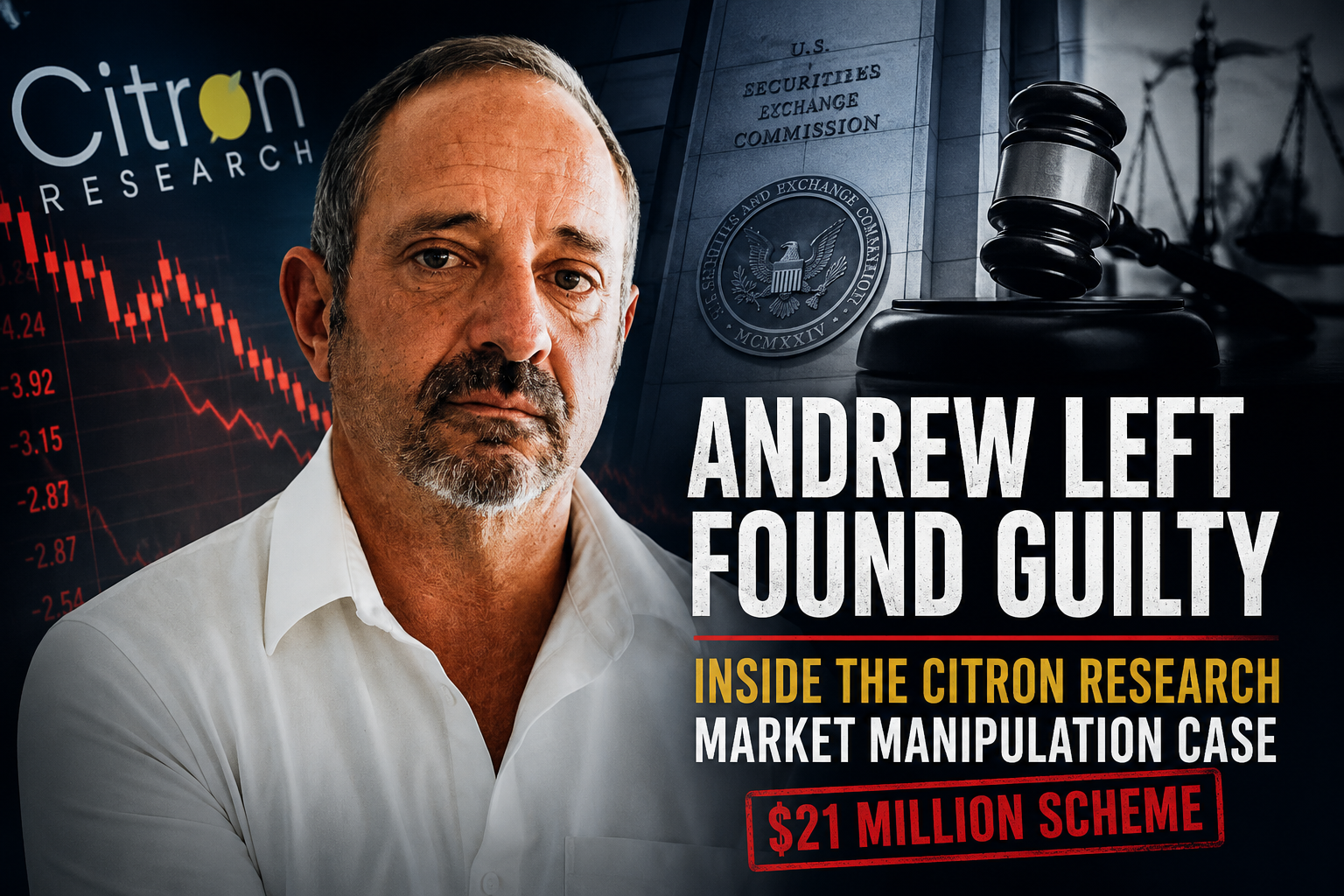
Andrew Left built his reputation by attacking companies he believed were overvalued, publishing research that could send stocks sharply lower and becoming one of Wall Street’s best-known activist short sellers. Through Citron Research, the online investment publication he founded, Left presented himself as an independent market critic whose research exposed corporate problems that other investors had missed. In June 2026, however, a federal jury reached a very different conclusion about part of that public persona, finding Left guilty of securities fraud after prosecutors argued that he had used his influence over investors to move stocks and then trade around the reaction.
Left, 55, was born in Michigan and attended Northeastern University. He became known first through StockLemon.com, a website he started in 2001, which was later renamed Citron Research. His reports targeted companies across technology, pharmaceuticals, retail and China, often accusing them of accounting problems, questionable business practices or inflated valuations. Citron says its work has been associated with more than 50 companies that subsequently became targets of regulatory intervention. Left’s successful campaigns, including his attacks on Valeant Pharmaceuticals, helped establish him as an influential voice in activist short selling.
That history is important because the government’s case did not simply accuse Left of being a wrongheaded investor. Prosecutors argued that he crossed a line between expressing an investment opinion and deliberately using public commentary as a trading mechanism. According to the indictment, Left would build a long or short position before publishing a report, tweet or other commentary, then take advantage of the price movement his words produced. In some instances, prosecutors said, he used short-dated options that expired the same day or within several days, allowing him to capitalize quickly on movements triggered by his own publications.
The SEC brought its own civil case in July 2024 against Left and Citron Capital LLC. The regulator described what it called a roughly $20 million multi-year fraud scheme involving at least 26 recommendations concerning 23 companies. According to the SEC complaint, Left publicly portrayed his recommendations as consistent with positions held by himself or Citron Capital, but then rapidly reversed those positions after the market reacted. The regulator said the stocks moved more than 12 percent on average after the recommendations.
One example described by the SEC illustrates why the government considered the conduct deceptive. The regulator said Left told the market that he intended to remain long in a stock until it reached $65, while actually beginning to sell almost immediately at about $28. The SEC also alleged that Citron Research presented itself as an independent research outlet even though Left and his operation had compensation arrangements with hedge funds. The civil complaint seeks disgorgement, interest, monetary penalties and restrictions on Left’s future activities, including an injunction limiting trading around his own publications and a potential investment-adviser bar.
The criminal case was even more serious. Federal prosecutors initially charged Left in July 2024 with one securities-fraud-scheme count, 17 securities-fraud counts and one count of making false statements to investigators. The government alleged that the overall trading strategy generated at least $16 million. After a trial in Los Angeles, the jury on June 1, 2026 convicted Left on one securities-fraud-scheme count and 12 securities-fraud counts. The Justice Department later described the profits from the conduct presented at trial as more than $21 million.
The difference between the $16 million and $21 million figures reflects different stages and descriptions of the government’s case, rather than evidence that investors collectively lost one precise amount. Neither figure should be treated as a calculation of total retail-investor losses. The government’s theory was that Left profited from price movements created or accelerated by his public commentary. That distinction matters because the case was about deceptive trading conduct and manipulation, not simply whether investors who followed Citron lost money.
The prosecution presented evidence involving well-known companies including Nvidia, Tesla, Meta, Roku and American Airlines, among others. Prosecutors said Left often positioned himself ahead of a public recommendation and then executed what witnesses described as rapid “U-turn” trades after publication. The government’s case also focused on his relationships with hedge funds and the argument that he concealed those relationships to preserve the appearance that Citron’s recommendations were independent.
One of the people drawn into the case was Ryan Choi, an associate who helped Left establish Citron Capital in 2018 and assisted with research and content for Citron publications. In October 2024, the SEC settled a separate enforcement action against Choi. The regulator said he worked with Left on two December 2020 buy recommendations, failed to conduct adequate research and then traded around the resulting price increases without adequately disclosing the trading. Choi agreed to pay $1,647,217 in disgorgement, $64,818 in prejudgment interest and a $115,231 civil penalty, totaling more than $1.8 million. He settled without admitting or denying the allegations.
Left has consistently disputed the government’s interpretation of his conduct. His defense argued that his investment views were genuine, that his publications contained disclosures and that prosecutors were effectively trying to create a trading rule that did not clearly exist. His lawyers also raised First Amendment concerns, warning that the government’s theory could discourage investors from publicly expressing opinions about stocks. In January 2025, his attorneys at Dynamis LLP filed a petition asking the SEC to establish clearer rules governing when investors who publicly discuss securities can trade those securities. The petition specifically sought clarity over trading windows, disclosures and possible safe harbors.
That defense became more difficult after the jury verdict, but the broader legal argument has not disappeared. The case has attracted attention well beyond Left because activist short sellers occupy an unusual position in financial markets. They can uncover genuine fraud and force investors to examine companies more critically, but their financial incentives can also create an obvious conflict when the person publishing a market-moving opinion is simultaneously positioned to profit from the reaction.
Left’s earlier regulatory history also complicates the picture. In Hong Kong, the Market Misconduct Tribunal found him culpable in 2016 over a Citron report about China Evergrande, concluding that material facts in the publication were false or misleading. He was barred from trading in Hong Kong for five years and ordered to repay about HK$1.6 million in trading profits and approximately HK$4 million in legal costs. Left has maintained that the underlying Evergrande concerns were correct and that he has not lost a U.S. case brought over his publications.
Citron’s history nevertheless shows why Left’s influence became so significant. His reports could move securities dramatically, giving him both the ability and incentive to make timing crucial. His 2015 campaign against Valeant, for example, helped turn scrutiny of the pharmaceutical company into one of the major Wall Street stories of that period. His fight with GameStop traders became another defining episode. After suffering a 100 percent loss on his GameStop short during the 2021 meme-stock surge, Left later returned to betting against the company, demonstrating that his influence and willingness to take controversial positions had not disappeared.
The legal picture remains unfinished. The DOJ’s current case page says Left was found guilty on June 1, 2026 and has a post-trial motions hearing scheduled for November 17, 2026. It currently lists sentencing for December 1, 2026. The statutory maximum is substantial, although a maximum sentence is not a prediction of what the court will impose.
The SEC’s parallel civil action was stayed while the criminal case proceeded. A federal judge ordered the civil case stayed in August 2025, allowing the criminal proceedings to be resolved first. That means the criminal conviction does not automatically dispose of the SEC’s separate requests for financial remedies and market-related restrictions.
The Andrew Left case matters because the central question is bigger than one trader or one research publication. Financial markets depend on investors being able to criticize companies, challenge management and publish unpopular views. They also depend on investors knowing when the person speaking to them has an undisclosed financial incentive to make the market move. The jury’s verdict draws a hard line around conduct it found fraudulent. Whatever happens at sentencing and in the remaining civil litigation, the case has left Wall Street with a difficult lesson: influence can be valuable, but when influence becomes the mechanism for a trading strategy built around misleading the market, the distinction between commentary and manipulation can become a matter for a federal jury rather than a trading desk.
————-
Disclaimer:
Some content on Reportingscams.com is published under our guest post program and is provided by third-party contributors. Reporting scams does not create, verify, or take responsibility for the views, accuracy, or claims expressed in such content.