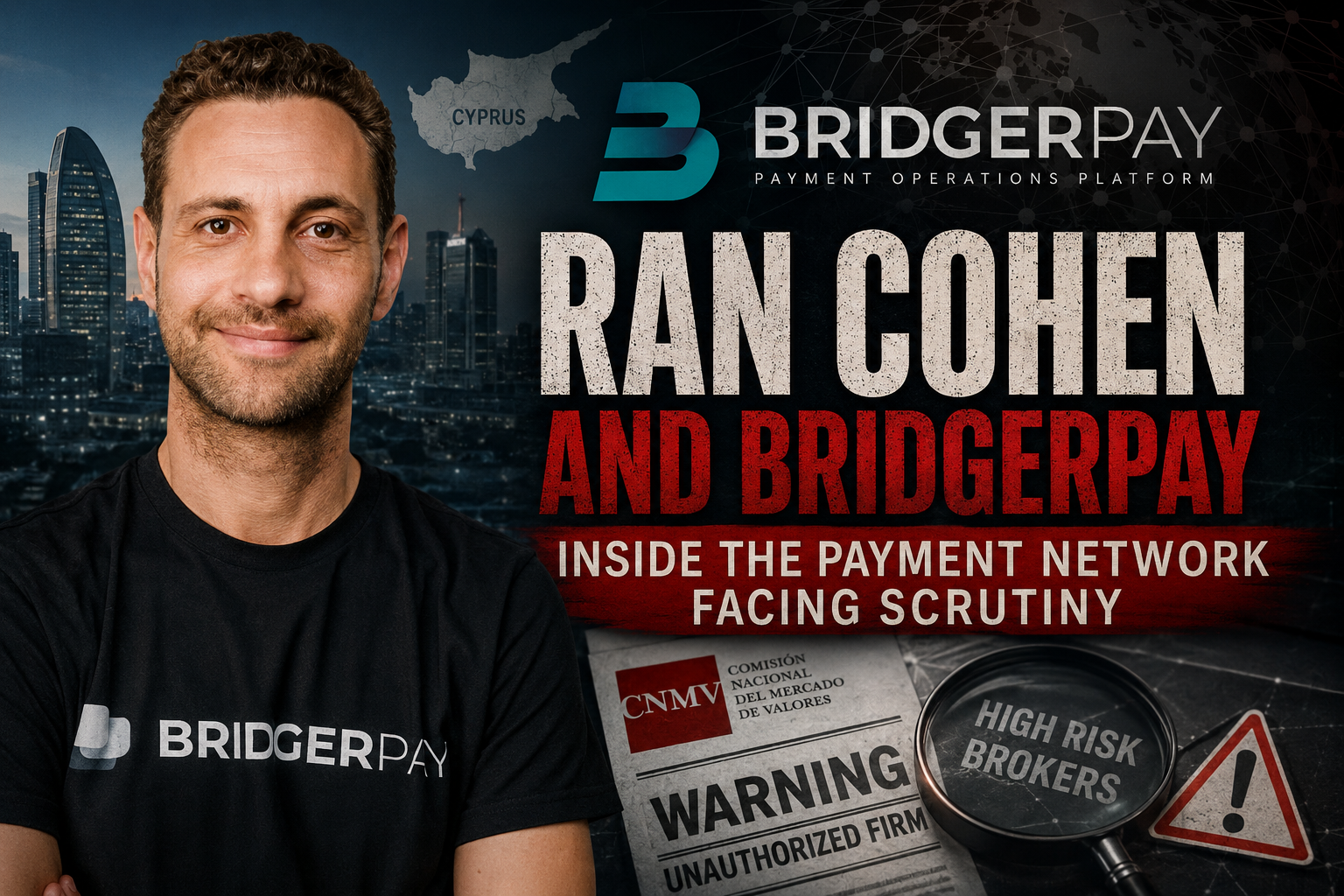
Ran Cohen occupies an unusual position in the modern payments industry. To his public audience, he is an Israeli fintech entrepreneur who moved from foreign-exchange education and marketing into payment technology, eventually becoming the co-founder and chief executive of BridgerPay, a Cyprus-based payment operations company that has raised millions of dollars and promotes itself as a technology layer connecting merchants with payment providers around the world. In 2026, Cohen remains publicly active as BridgerPay’s CEO, appearing at payments conferences, discussing artificial intelligence and stablecoins, and promoting the company’s expansion.
But behind that polished fintech narrative lies a more complicated history. Over several years, specialist compliance publications and investigative websites have repeatedly questioned BridgerPay’s relationships with high-risk trading businesses and alleged scam brokers. One investigation by Investigations.org describes a pattern involving regulatory warnings against businesses reported to have used BridgerPay’s infrastructure, Cohen’s public position on AML and KYC obligations, and the company’s reported status as a Visa Merchant Servicer.
The central question is not whether Ran Cohen has been convicted of fraud. The available public record does not establish that. Nor does it show that a court has found Cohen personally liable for operating a scam. Instead, the more consequential question is whether a payment technology company led by Cohen occupied a position in the financial infrastructure of businesses that regulators and specialist investigators considered suspicious or unauthorized, and whether the company’s compliance responsibilities were adequately understood and discharged.
That distinction matters. Payment companies do not necessarily become responsible for the conduct of every merchant whose transactions they facilitate. At the same time, payment intermediaries operating around high-risk financial businesses occupy a critical point in the chain. If a broker is unable to receive deposits, route card transactions or move customer money, its ability to operate can be severely restricted. The companies that provide those services therefore sit close to the practical boundary between legitimate commerce and financial abuse.
Cohen’s career began well before BridgerPay. Finance Magnates reported in 2017 that Cohen was the chief executive of Traders Group, an evolution of his earlier Traders Education business. The group was structured around Traders Education, Traders Marketing and Traders Platforms, with the stated aim of providing educational material, marketing technology and trading-related platforms. Cohen was also appointed to the Financial Commission’s Dispute Resolution Committee, an industry self-regulatory body dealing with disputes between traders and brokers.
That history is important because it places Cohen inside the foreign-exchange industry long before he entered payment technology. Finance Magnates described Traders Education as a multilingual trading education and marketing technology provider. Cohen’s own articles from the period promoted trading platforms, trader psychology, lead generation and the broader FX ecosystem. The business was not presented as a criminal operation, and the available reporting does not establish that Cohen was convicted or prosecuted for wrongdoing through Traders Group.
The ownership story changed in 2017 and 2018. Finance Magnates reported that Axios Capital acquired Traders Group and that Cohen sold his remaining stake. The publication said Axios had previously purchased part of the business and subsequently bought Cohen out entirely. Cohen told Finance Magnates he intended to take a break, spend time with his family and consider his next career move. He also said he would continue working with the Financial Commission.
This is one of the areas where later allegations require careful handling. Specialist publications such as PayRate42 and FinTelegram subsequently described Traders Group as having connections to people associated by investigative reporting with large-scale forex fraud networks. Investigations.org repeats that connection but expressly acknowledges that it is a derivative claim and that it has not independently identified a primary OCCRP document naming Cohen himself as part of such a criminal network.
That caveat is essential. An association between a company, its customers or business partners and people accused of fraud does not establish that the company’s founder participated in that fraud. A journalist can legitimately investigate the network, but should not convert an alleged association into a finding of criminal conduct without documentary evidence.
The next chapter of Cohen’s career began in 2019.
On February 21, 2019, Bridger AI Limited was incorporated in Cyprus under company number HE 394751. Public corporate data identifies the company as active and lists Ran Cohen as a director and secretary. Yaron Hershcovich is also listed as a director, alongside other directors appearing in corporate records.
The company’s trading brand became BridgerPay.
The business model was fundamentally different from Cohen’s earlier trading education operation. BridgerPay marketed itself as payment orchestration infrastructure, allowing merchants to connect multiple payment service providers through one platform. Rather than being a conventional consumer-facing bank, the company positioned itself as a technology layer capable of routing payments, managing payment providers, improving transaction acceptance and helping merchants operate internationally.
Cohen later described BridgerPay as the product of his own experience with payment processing problems. In company material, he said that his earlier business had moved from B2B to B2C and encountered difficulties processing cross-border payments. Those problems, he said, led him and Yaron Hershcovich to create BridgerPay in 2019.
The company grew quickly enough to attract outside capital.
In May 2022, BridgerPay announced a $6 million seed financing round led by Nati Harpaz and the Southern Israel Bridging Fund. Israeli business publication CTech reported that the round included $2 million in secondary transactions. BridgerPay said the money would be used to develop its SaaS platform, recruit employees and expand its go-to-market operations.
That fundraising was significant because it marked the transformation of BridgerPay from a bootstrapped technology venture into a financed fintech company with international ambitions. The company said it had hundreds of payment connections and was building a self-onboarding platform that could allow merchants to connect payment methods without the traditional complexity associated with payment infrastructure.
It was also around this period that scrutiny of BridgerPay intensified.
The most serious allegations do not concern the technology itself. They concern the merchants using it.
FinTelegram reported in 2021 that BridgerPay infrastructure had been identified in connection with a large number of brokers it described as scams. In a December 2021 report concerning Standpoint Finance, FinTelegram claimed that it had identified BridgerPay as a payment processor at 78 scam brokers within its review universe over the previous three years.
The number is striking, but it should not be presented as a government finding that BridgerPay facilitated 78 criminal enterprises. It was FinTelegram’s figure, based on its own investigative universe. Investigations.org itself acknowledges that the 78-broker figure has not been comprehensively cross-checked against primary regulatory databases such as the FCA, ASIC, CySEC and Spain’s CNMV.
There is, however, a more solid regulatory record underneath that broader allegation.
Spain’s financial regulator, the Comisión Nacional del Mercado de Valores, or CNMV, issued warnings against several businesses that specialist reporting identified as BridgerPay clients. On February 22, 2021, the CNMV’s official warning database listed The Forex Premium, operating through 4xpremium.com and associated with Premium Finance Solutions Ltd, as an unauthorized entity. The same day’s database also listed WAM Capital and its website.
Those warnings were directed at the broker entities, not at Ran Cohen or BridgerPay.
That distinction cannot be overstated. The CNMV record establishes that the regulator warned investors about those businesses. It does not establish that the regulator accused BridgerPay of fraud, nor does it establish that Cohen personally committed a regulatory violation.
A similar issue arose with Standpoint Finance. The CNMV’s public warning database records Standpoint Finance Limited on December 7, 2021. The warning identified the entity as an unauthorized firm.
FinTelegram reported that Standpoint Finance was using BridgerPay as a payment processor and framed the relationship as evidence of payment infrastructure being provided to a business that regulators had warned about. Again, that is a connection worth investigating, but the regulatory action itself was against Standpoint Finance, not Cohen.
The pattern is therefore more nuanced than some headlines might suggest.
There is evidence that BridgerPay infrastructure was reportedly used by companies that subsequently appeared on regulatory warning lists. There is evidence of repeated adverse reporting from specialist publications. There is evidence that Cohen publicly discussed the company’s compliance responsibilities. But there is not, in the material reviewed for this article, a court order declaring BridgerPay a scam operation or a criminal judgment finding Cohen personally guilty of facilitating fraud.
The most controversial part of the story concerns AML and KYC.
According to FinTelegram’s reporting, Cohen argued publicly in 2022 that BridgerPay’s business model was essentially self-service software and that the company’s regulatory responsibilities did not extend to AML and KYC in the way critics claimed. Investigations.org describes Cohen’s position as effectively a “PCI-only” compliance argument, based on reported Facebook statements.
That position becomes important when viewed against BridgerPay’s reported position within the Visa ecosystem.
Specialist payments publications have described BridgerPay as a Visa Merchant Servicer or ISO. PayRate42, for example, describes BridgerPay as registered in the Visa Service Directory as a Merchant Servicer. BridgerPay itself prominently promotes its PCI DSS Level 1 security certification and maintains a page describing its payment-security controls.
But being a payment technology provider, being a Visa-registered service provider and being a licensed payment institution are not necessarily the same thing. This distinction is crucial to understanding the controversy.
BridgerPay’s own description emphasizes technology, orchestration and SaaS. A payment institution licence, by contrast, carries a different regulatory framework. Investigations.org says it did not identify an FCA, ECB or Cypriot payment institution authorization for Bridger AI Limited. It characterizes this as a potential regulatory gap, while also acknowledging that the company’s exact regulatory status and Visa compliance documentation were not fully established through primary sources.
That is an important qualification for any publication.
The strongest defensible formulation is not that Cohen “operated illegally without a licence.” The public evidence reviewed does not establish that as a judicial or regulatory finding. The stronger formulation is that public investigators have not identified a conventional financial institution licence for Bridger AI Limited and have raised questions about the regulatory basis under which BridgerPay operated its payment orchestration business.
The issue becomes even more relevant after Visa’s Integrity Risk Program, known as VIRP, came into force in April 2024. Investigations.org notes that the program replaced Visa’s earlier brand-protection framework and strengthened compliance requirements for participants dealing with high-risk merchants.
What remains unclear is BridgerPay’s exact post-2024 compliance status under that program.
Investigations.org explicitly identifies this as an unresolved gap. It says that no primary source reviewed for the dossier established whether BridgerPay had completed or maintained the relevant VIRP status. That means it would be premature to claim that BridgerPay violated Visa’s rules. At most, the evidence supports a question about how the company was classified and what compliance obligations applied to it.
That question is not academic.
Payment orchestration companies can sit between merchants and payment providers. They can influence routing, connect multiple acquiring channels, manage payment data and help businesses operate across borders. BridgerPay itself has described its platform as capable of connecting businesses to hundreds of payment providers and payment methods.
The more merchants a platform handles, the more consequential its onboarding and monitoring systems become.
This is where the allegation of “scam facilitation” needs to be carefully separated from proof of deliberate assistance. A payment provider can process transactions for a merchant that later turns out to be fraudulent without the provider itself being fraudulent. Conversely, repeated relationships with businesses facing regulatory warnings can raise legitimate questions about due diligence, merchant screening, transaction monitoring and the speed with which relationships are terminated when warning signs emerge.
The public record establishes the questions more clearly than it establishes the answers.
There is also a corporate-ownership question.
Investigations.org says the complete shareholder structure of Bridger AI Limited was not independently confirmed from a primary paid Cyprus registry filing. It reports claims that Amir Turgeman may have held a 20 percent stake, but expressly labels those claims as unverified.
That means the ownership story should not be overstated. Cohen’s directorship is supported by corporate records. The full beneficial ownership picture, according to the dossier, requires additional documentary work.
There is another unresolved thread involving Israeli investment interests.
BridgerPay’s 2022 funding announcement identified the Southern Israel Bridging Fund as a lead investor. Later specialist reporting discussed possible investment involvement from an entity referred to as the South Israel Bridge Fund, associated with former Mossad director Tamir Pardo. Investigations.org notes that the relationship and even the precise identity of the fund have not been fully resolved through primary corporate documents. It therefore treats the alleged investment relationship as prospective rather than established.
This is precisely the sort of detail that can easily become distorted in an investigative article. The responsible account is that BridgerPay raised $6 million in 2022 with SIBF and Nati Harpaz identified in public funding coverage, while separate reporting later discussed potential investment negotiations involving a fund associated with Tamir Pardo. Whether those references describe the same entity, different entities or different stages of the company’s financing history requires further documentary confirmation.
Cohen’s response to the broader controversy has also been significant.
Rather than disappearing from public view, he has continued to present himself as a mainstream fintech executive.
In October 2025, BridgerPay published an interview with Cohen in which he described his two decades of B2B experience and discussed the company’s evolution. He presented BridgerPay as a technology company solving problems around payment infrastructure and said his focus had shifted toward long-term strategy and growth.
His public activity continued into 2026.
BridgerPay promoted Cohen as its co-founder and CEO at payments industry events, including the Payments Leaders’ Summit UK in April 2026, where he was scheduled to moderate a payment optimization roundtable. The company’s LinkedIn presence also identifies him as CEO and co-founder.
In March 2026, BridgerPay published an account of its first BridgerPay Connect event in Israel, again identifying Cohen as co-founder and CEO.
And in July 2026, Cohen was publicly discussing stablecoin infrastructure, cross-border settlement, treasury operations and the future of payments. BridgerPay published his views that stablecoins would become increasingly important as a settlement layer while cards remained dominant at consumer checkout.
In other words, Ran Cohen is not a vanished entrepreneur hiding from public scrutiny. He remains an active fintech executive with a public professional profile and a company that continues to market its technology internationally.
That fact is important because it places the controversy in the present tense.
The allegations surrounding BridgerPay are not simply historical accusations about a company that disappeared years ago. The company remains active. Cohen remains its public face. The company continues to participate in industry conferences and promote payment infrastructure, AI-powered routing, stablecoins and international commerce.
At the same time, the public record reviewed for this investigation does not show a criminal prosecution or conviction against Cohen.
Investigations.org states explicitly that no criminal charges, court proceedings or confirmed enforcement actions against Ran Cohen personally, or against Bridger AI Limited, were identified in its research. Its legal-exposure section instead points to regulatory warnings against BridgerPay clients and specialist compliance classifications.
That finding is consistent with the primary regulatory material located during this review. The Spanish CNMV warnings examined here concern The Forex Premium, WAM Capital and Standpoint Finance. They do not name Ran Cohen as the subject of an enforcement order.
This is therefore not a story about a convicted fraudster.
It is a story about the infrastructure surrounding high-risk financial businesses, and about how responsibility becomes difficult to define when technology companies, payment processors, merchants and regulators occupy different layers of the same transaction chain.
The historical record makes the progression clear.
Cohen entered the FX ecosystem through Traders Education and Traders Group. Traders Group expanded into education, marketing and trading-platform services. Cohen subsequently exited the company through a sale to Axios Capital. Finance Magnates documented that transition in 2018.
In 2019 he moved into payment technology through Bridger AI Limited, trading as BridgerPay. The company built a platform designed to connect merchants with multiple payment providers.
By 2021, regulators in Spain were warning investors about several businesses that specialist reporting connected to BridgerPay’s payment infrastructure.
In 2022, BridgerPay raised $6 million and promoted its self-onboarding payment platform as a major step toward making payment infrastructure accessible to businesses worldwide.
The same period also saw a significant increase in adverse reporting about BridgerPay’s alleged relationships with high-risk brokers. FinTelegram claimed to have found the company associated with 78 scam brokers in its review universe.
In 2024, Visa’s new integrity framework increased the importance of compliance for high-risk payment ecosystems. Investigators subsequently questioned how BridgerPay’s Visa-related status interacted with its stated SaaS model.
In 2025 and 2026, Cohen continued operating openly as BridgerPay’s chief executive, speaking about payment innovation and expanding the company’s public profile.
That chronology creates the central tension of the Ran Cohen story.
The company has a legitimate technological proposition. It has attracted investment. It has developed a functioning payments platform. It has an identifiable corporate structure in Cyprus. It has an active CEO who participates in major industry events. These are not the characteristics of a phantom website created solely to collect deposits.
But legitimate technology can also be used by questionable businesses.
The regulatory warnings against the companies reported as BridgerPay clients cannot simply be ignored. Nor can the repeated reporting by specialist compliance publications. The allegations deserve examination precisely because payment infrastructure is one of the least visible parts of the online financial ecosystem.
When a consumer loses money to an unauthorized broker, the visible company is usually the broker. The payment infrastructure behind that broker can remain largely invisible. A customer may never know which gateway, payment processor, acquiring bank, ISO or orchestration platform helped process the transaction.
That creates an accountability problem.
If a platform is genuinely only software, its operators can argue that they provide technology rather than financial services. If the platform actively onboards merchants, collects information, connects them to payment providers, routes transactions and monitors activity, however, the distinction becomes more complicated. The precise legal answer depends on the structure of the business and the applicable regulatory framework.
That is why Cohen’s reported public position on AML and KYC is one of the most important elements of the investigation. Investigations.org describes a tension between the self-service SaaS characterization and the company’s reported role within Visa’s merchant-servicing ecosystem.
But even here, a journalist should resist the temptation to declare a legal conclusion that regulators themselves have not made.
The available evidence supports scrutiny, not a conviction.
The most serious unresolved questions are therefore straightforward. What exact regulatory permissions did Bridger AI Limited possess during each stage of its operations? What was its precise contractual role with Visa and individual acquiring institutions? What merchant due-diligence procedures did it apply to high-risk brokers? How many merchants connected to BridgerPay were later subject to regulatory warnings? How quickly did BridgerPay terminate those relationships? What internal compliance records exist concerning the brokers identified by FinTelegram? And what is the complete beneficial ownership structure of the Cyprus company?
Those questions are more revealing than simply asking whether Ran Cohen is a “scammer.”
The available evidence does not justify that label as an established fact.
What it does show is a fintech entrepreneur whose career has remained closely connected to the online trading and payments industries, whose companies have operated in sectors carrying significant financial and compliance risk, and whose current business has been repeatedly scrutinized because of relationships allegedly involving high-risk brokers.
The Spanish CNMV’s warnings provide the clearest documentary anchor. The FinTelegram reports provide the broader pattern of alleged payment relationships. Finance Magnates provides the independent record of Cohen’s earlier business career and his transition out of Traders Group. Cyprus corporate records establish Bridger AI Limited’s existence and Cohen’s directorial role. BridgerPay’s own publications establish that Cohen remains its chief executive and that the company continues to operate internationally.
Taken together, these records produce a picture that is more complicated than either side of the controversy suggests.
Ran Cohen is neither documented in the available record as a convicted financial criminal nor free from legitimate questions about his companies’ activities.
He is a fintech executive who built a payment infrastructure company after a career in the foreign-exchange ecosystem. BridgerPay raised substantial outside capital and continues to operate. At the same time, multiple specialist investigators have alleged that its infrastructure was used by brokers later described or warned against as unauthorized or fraudulent, while Cohen’s reported interpretation of his company’s AML and KYC responsibilities has been sharply criticized.
The most important fact for readers is therefore the one that can be stated with confidence.
There is no verified criminal conviction or confirmed criminal charge against Ran Cohen identified in the sources reviewed for this investigation. There is also no identified court judgment establishing that Cohen personally operated a fraud scheme. The documented regulatory actions located in the review were warnings against businesses reported to have been BridgerPay clients, not enforcement orders against Cohen himself.
That does not end the story.
It defines where the real investigation begins.
The unresolved issue is whether payment infrastructure providers such as BridgerPay should be judged merely by the technical service they sell or by the financial ecosystem their infrastructure enables. For Cohen, that distinction has followed him from the FX industry into fintech.
As BridgerPay moves deeper into AI-driven payment routing, stablecoins, cross-border settlement and automated payment operations in 2026, the same question becomes increasingly relevant. The more sophisticated the infrastructure becomes, the harder it is to dismiss compliance as somebody else’s responsibility.
For now, Ran Cohen remains publicly active, remains CEO and co-founder of BridgerPay, and continues to promote the company as a global payment technology platform. The allegations against him personally remain unproven. The regulatory warnings against several businesses linked by reporting to BridgerPay are real. The broader claims about dozens of allegedly fraudulent brokers remain largely dependent on specialist reporting rather than a single comprehensive regulatory finding.
That gap between what is documented, what is alleged and what remains unknown is the defining feature of the Ran Cohen and BridgerPay story.
And it is precisely that gap that deserves continued scrutiny.
————-
Disclaimer:
Some content on Reportingscams.com is published under our guest post program and is provided by third-party contributors. Reporting scams does not create, verify, or take responsibility for the views, accuracy, or claims expressed in such content.