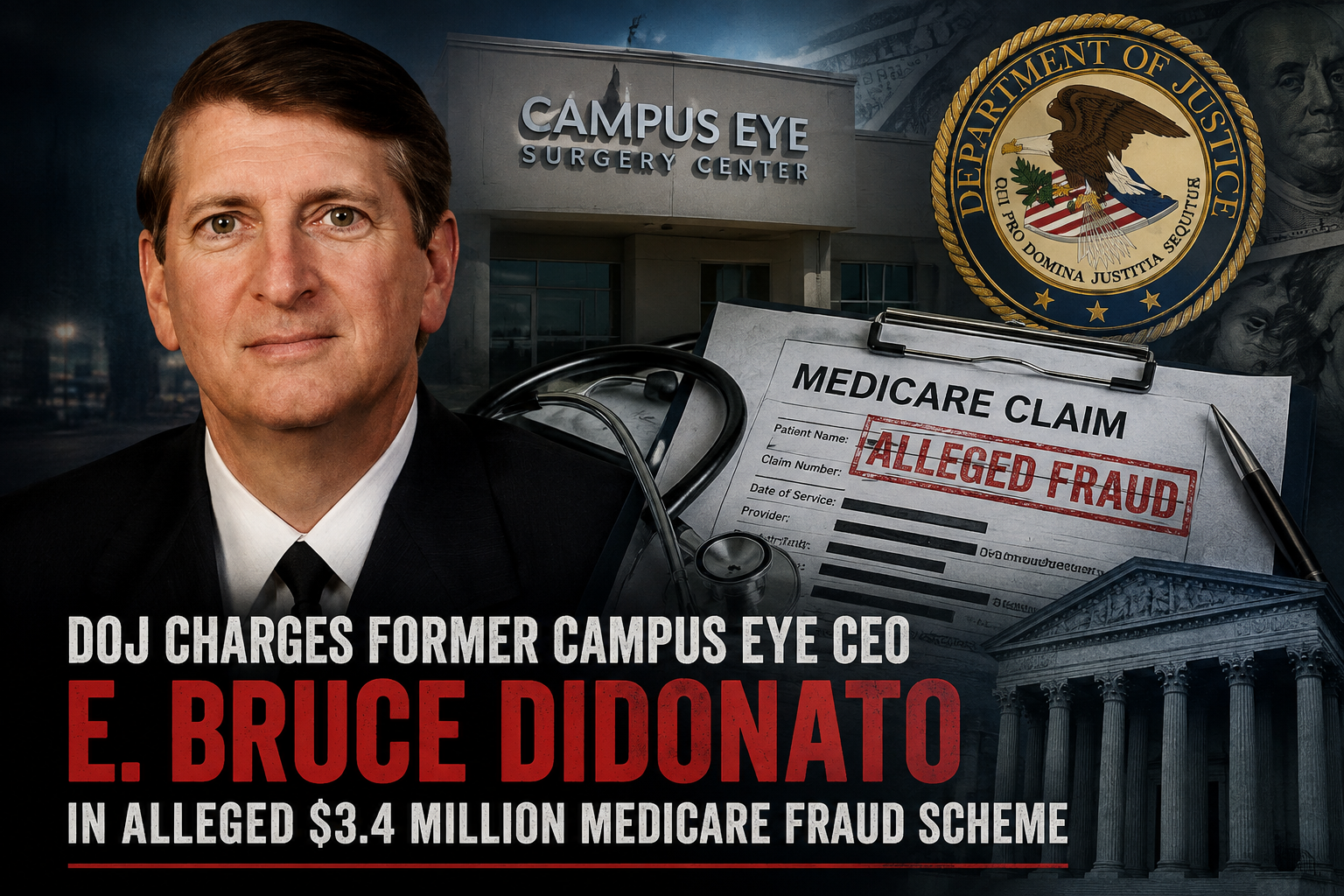
The rise of private equity in healthcare has brought new attention to how medical practices generate revenue, but a recent federal case out of New Jersey has shifted the spotlight onto a different question. Prosecutors say the pursuit of profits at one of the state’s largest eye care organizations crossed legal and ethical boundaries, resulting in millions of dollars in allegedly fraudulent Medicare claims, illegal referral payments, and unnecessary testing that placed financial incentives ahead of patient care. At the center of the case is E. Bruce DiDonato, the founder and former chief executive officer of Campus Eye Management and Campus Eye Surgery Center, who now faces federal criminal charges that could become one of the most closely watched healthcare fraud prosecutions of the year.
Federal prosecutors allege that DiDonato, 71, of Princeton, orchestrated a years-long scheme that operated between 2015 and March 2023. According to an indictment unsealed by the U.S. Department of Justice, the government claims he conspired with others to submit claims to Medicare for diagnostic eye tests that were medically unnecessary, duplicative of testing patients had already received, or were never meaningfully reviewed before surgery. Prosecutors contend that the tests became a source of revenue rather than an important part of patient care, generating approximately $3.4 million in Medicare claims, of which roughly $1 million was ultimately paid by the federal program.
The indictment goes beyond billing allegations. Prosecutors also accuse DiDonato of paying illegal kickbacks and bribes to outside ophthalmologists in exchange for referring surgical patients to Campus Eye’s optometry practice for testing before their procedures. The government alleges those payments were disguised as consulting arrangements, with contracts describing them as flat monthly consulting fees. Investigators claim the payments were actually calculated using a percentage of the Medicare reimbursements generated by referred patients, a structure prosecutors argue violated the federal Anti-Kickback Statute.
According to the Justice Department, many of the diagnostic tests allegedly played little or no role in determining how patients were treated. Prosecutors say the examinations often duplicated tests already performed by referring physicians or were unnecessary for the surgeries involved. The indictment further alleges that neither DiDonato nor other optometrists routinely reviewed the results, while referring ophthalmologists frequently did not rely on them when making treatment decisions. If those allegations are proven, investigators argue the testing existed primarily to generate insurance reimbursements rather than improve patient outcomes. DiDonato has been charged with conspiracy to commit healthcare fraud, conspiracy to violate the Anti-Kickback Statute, substantive healthcare fraud, and multiple counts of paying illegal healthcare kickbacks. He has not been convicted, and the charges will be tested in court.
One aspect of the case has attracted almost as much attention as the criminal charges themselves. While federal prosecutors indicted DiDonato, they simultaneously declined to prosecute Campus Eye Management and its parent company, Campus Eye Management Holdings LLC. The decision marked the first healthcare declination issued under the Justice Department’s new Department-wide Corporate Enforcement Policy, introduced earlier in 2026 to encourage companies to voluntarily report misconduct, cooperate with investigators, and strengthen compliance programs.
The Department said Campus Eye received that extraordinary outcome because it voluntarily disclosed the misconduct, cooperated extensively with investigators, agreed to continue assisting the government, overhauled its compliance systems, revised billing and compensation policies, hired additional compliance personnel, implemented new training programs, and agreed to pay approximately $1 million in restitution. Legal analysts have described the resolution as an early example of how the Justice Department intends to separate corporate accountability from individual accountability, rewarding companies that self-report while continuing to pursue executives accused of directing the underlying misconduct.
That distinction could become increasingly important across the healthcare industry. Several law firms examining the case noted that the Department appears determined to create incentives for healthcare companies to report wrongdoing before investigators discover it independently. At the same time, the DiDonato prosecution demonstrates that cooperation by a corporation does not necessarily shield senior executives from personal criminal liability. Instead, prosecutors appear willing to decline charges against an organization while aggressively pursuing individuals they believe were responsible for the alleged scheme.
Federal investigators also allege that DiDonato later used the financial performance of Campus Eye, including Medicare reimbursements generated during the alleged scheme, when marketing the business to private equity investors before its sale. While prosecutors have not alleged that those investors participated in the misconduct, the accusation raises broader questions about how healthcare businesses are valued and how compliance risks can affect acquisition decisions. Legal commentators have pointed to the case as a reminder that financial due diligence alone may not uncover regulatory or billing issues capable of creating substantial future liabilities.
The investigation itself involved multiple agencies, including the Federal Bureau of Investigation and the Department of Health and Human Services Office of Inspector General. In announcing the indictment, FBI officials said the allegations reflected deception directed not only at Medicare but also at patients and healthcare professionals. Investigators argue that public confidence in physicians depends on trust that medical decisions are based on clinical need rather than financial incentives, making alleged kickback arrangements particularly serious when they influence patient referrals.
DiDonato has not entered a guilty plea and remains presumed innocent. The indictment represents allegations by the government, not findings of fact. To obtain a conviction, federal prosecutors must prove every charge beyond a reasonable doubt. If convicted, DiDonato faces significant prison exposure, including potential sentences of up to ten years on several healthcare fraud and kickback counts, although any sentence would ultimately be determined by a federal judge after considering sentencing guidelines and other statutory factors.
Whatever the outcome of the criminal case, the Campus Eye investigation is already influencing conversations well beyond one New Jersey medical practice. It represents the Justice Department’s first major demonstration of its revised corporate enforcement strategy in healthcare, sending two simultaneous messages to the industry. Companies that promptly report misconduct, cooperate, and invest in meaningful compliance improvements may receive substantial prosecutorial credit. Individual executives, however, should not expect that corporate cooperation will necessarily protect them from personal accountability if prosecutors conclude they directed or benefited from fraudulent conduct. As the case moves through federal court, healthcare providers, investors, compliance officers, and regulators across the country will be watching closely, not only to see whether the government’s allegations are ultimately proven, but also to understand how this new enforcement model reshapes the risks facing executives who oversee businesses built on federal healthcare reimbursement.
————-
Disclaimer:
Some content on Reportingscams.com is published under our guest post program and is provided by third-party contributors. Reporting scams does not create, verify, or take responsibility for the views, accuracy, or claims expressed in such content.