For decades, William Bronchick cultivated an image that resonated with aspiring real estate investors. He was not simply another seminar speaker promising financial freedom. He introduced himself as an attorney, investor, author, and educator who claimed to have mastered the legal and financial strategies that ordinary investors often overlooked. Through books, live seminars, coaching programs, and legal publications, he built a following that stretched far beyond his home state of Colorado. His advice on asset protection, land trusts, creative financing, and foreclosure investing became familiar to thousands of people hoping to break into real estate.
That reputation, however, tells only part of the story.
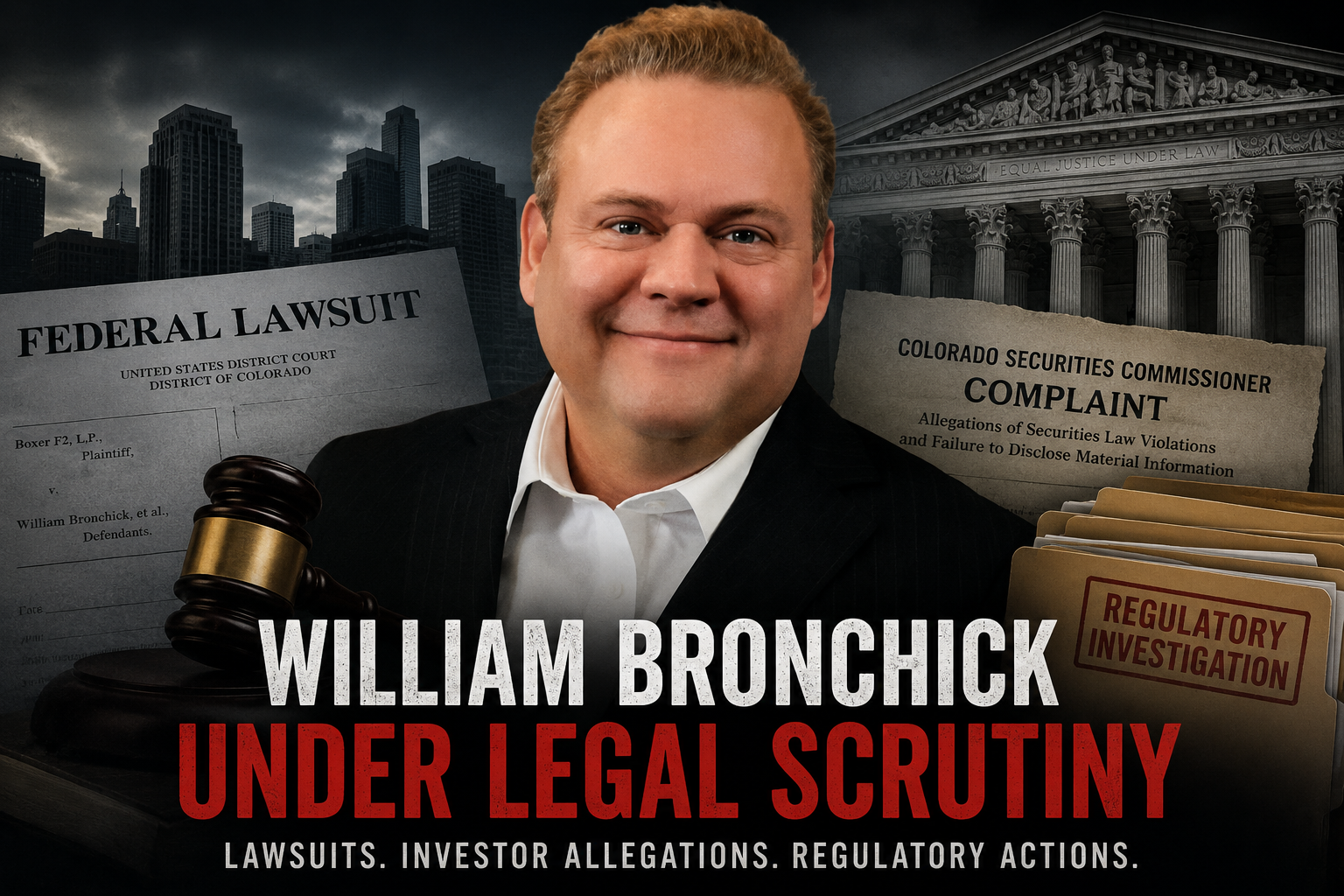
Away from conference stages and educational courses, Bronchick and several businesses associated with him became the subject of lengthy civil litigation and regulatory scrutiny. Federal judges examined the financial relationships between his companies during years of commercial litigation. Colorado securities regulators later accused him of misleading investors in connection with a real estate investment venture. The resulting court records, enforcement filings, and judicial opinions paint a far more complicated picture than the polished image presented through years of marketing.
This investigation traces Bronchick’s rise in the real estate education industry, the network of businesses built around his name, and the legal disputes that followed. It relies primarily on court opinions, regulatory complaints, and other publicly available records to examine how one of the industry’s better-known educators found himself defending his business practices in both state and federal proceedings.
The Making of a Real Estate Guru
William Bronchick entered the real estate education business during a period when investment seminars were booming across the United States. Throughout the 1990s and early 2000s, audiences filled hotel conference rooms to hear speakers explain how ordinary people could build wealth through property. Television infomercials, weekend workshops, and self-published investment guides created an industry built on the promise that financial independence could be learned, often for the price of a seminar ticket or coaching program.
Bronchick carved out a niche by presenting himself as more than an experienced investor. His legal background became a central part of his professional identity. Rather than focusing solely on buying and selling property, he taught investors how legal structures could protect assets, reduce liability, and create opportunities that traditional real estate courses rarely discussed. Subjects such as land trusts, lease options, seller financing, limited liability companies, foreclosure investing, and asset protection became recurring themes throughout his books and seminars.
His message found an audience among independent investors looking for alternatives to conventional real estate investing. Many saw him as someone who could translate complex legal concepts into practical strategies that could be applied without the resources of large investment firms. Over time, Bronchick authored multiple books, developed educational courses, and became a regular speaker at investor associations around the country. His publications circulated widely within real estate circles, while his seminars promoted a vision of investing that emphasized creativity, legal planning, and entrepreneurial independence.
As demand for his educational products grew, so did the business built around his personal brand. Public records show that Bronchick became associated with several entities over the years, including Bronchick & Associates, Bronchick & Associates P.C., LegalWiz Publications, Flamingo West Ltd., and Bronchick Consulting Group LLC. Some focused on legal services, while others marketed educational materials, consulting, or investment-related activities. Collectively, they formed the foundation of a business that extended well beyond the courtroom or classroom and increasingly intertwined legal advice, publishing, education, and commercial ventures.
For many customers, the arrangement appeared straightforward. Investors purchased books, legal forms, software, or coaching programs with the expectation that they were learning from someone who had successfully combined legal expertise with decades of real-world investing experience. Bronchick’s credentials were frequently highlighted in promotional material, reinforcing the impression that his advice carried authority rooted in both professional practice and practical success.
As his profile expanded, however, the line between education and investment activity began to blur.
Public records indicate that Bronchick became involved in ventures that extended beyond teaching real estate strategies. One of those ventures would later become the focus of a significant enforcement action by Colorado securities regulators. According to a complaint filed by the Colorado Securities Commissioner, Bronchick played a role in promoting investments connected to Valois Dynasty LLC. Regulators alleged that prospective investors were not fully informed about serious financial problems affecting the underlying real estate assets before additional investments were solicited. The complaint further alleged that Bronchick had participated in due diligence and possessed information about those financial difficulties before investors committed additional capital. Those allegations formed a central part of the state’s enforcement action and were contested through the legal process. They remain allegations made by regulators rather than criminal findings.
Even as that regulatory matter was developing, another dispute was already unfolding in federal court, one that initially appeared routine but gradually exposed a much broader examination of Bronchick’s business operations.
In 2014, Boxer F2, L.P., the owner of commercial office property in Colorado, filed suit against Flamingo West Ltd., Bronchick & Associates, Bronchick & Associates P.C., and William Bronchick. At first glance, the lawsuit looked like an ordinary commercial lease dispute. Boxer alleged that Flamingo West had defaulted on lease obligations after occupying office space for years, leaving substantial unpaid rent and other financial obligations.
Commercial lease disputes rarely attract attention outside the parties involved. They are common, often resolved through settlements or judgments, and seldom develop into matters of wider public interest. This case took a different path.
As discovery progressed, the litigation expanded beyond unpaid rent. Lawyers began examining how Bronchick’s various businesses operated, how assets moved between affiliated entities, and whether the separation between those entities reflected genuine corporate independence or something more complicated. The plaintiff argued that multiple companies associated with Bronchick functioned as interconnected businesses rather than independent organizations, raising claims that included alter ego liability and fraudulent transfer. Bronchick and the other defendants denied those allegations, setting the stage for years of contentious litigation.
The dispute would eventually produce hundreds of pages of court filings, multiple published judicial opinions, discovery sanctions, and detailed findings about the management of financial records and corporate relationships. What began as a disagreement over a commercial lease evolved into one of the most significant legal examinations of Bronchick’s business empire, offering an unusually detailed look inside companies that had long operated behind the public image of a successful real estate educator.
Inside the Courtroom
What transformed the Boxer lawsuit from an ordinary commercial dispute into a closely watched case was not simply the amount of unpaid rent. It was the direction the litigation took once both sides began exchanging financial records and corporate documents. As lawyers dug deeper into the operations of Bronchick’s companies, the case evolved into a broader examination of how those businesses were organized, how money flowed between them, and whether the legal separation between various entities reflected reality.
The lawsuit was filed in the U.S. District Court for the District of Colorado by Boxer F2, L.P., the owner of office space that had been leased to Flamingo West Ltd., a company associated with William Bronchick. According to court records, the lease dated back to 2003, and the business occupied the premises for years before the relationship deteriorated. Boxer alleged that rent payments eventually stopped, leaving substantial unpaid obligations under the lease. While Flamingo West stood at the center of the contract dispute, Boxer argued that the story did not end there.
As the litigation progressed, the plaintiff sought to hold Bronchick personally, along with several related entities, responsible for the alleged debt. Their argument rested on legal theories including alter ego liability and fraudulent transfer, both of which are designed to prevent individuals or businesses from using corporate structures to shield assets from legitimate creditors. Boxer maintained that the various companies connected to Bronchick were so closely intertwined that treating them as completely separate entities would produce an unjust result. Bronchick and the other defendants denied those allegations and defended the corporate distinctions between the businesses.
That disagreement shifted the case away from a straightforward lease dispute and into a painstaking review of years of financial activity. Bank records, accounting documents, tax filings, corporate records, and internal financial information became central to the litigation. The court was no longer examining only whether rent had been paid. It was being asked to determine how Bronchick’s businesses functioned behind the scenes and whether assets had been transferred in ways that affected creditors’ rights.
Discovery soon became one of the defining features of the case.
Federal litigation depends heavily on discovery, the process through which each side must disclose relevant documents and information. Judges generally expect parties to comply with discovery obligations because the process allows both sides to present their cases fairly. When parties repeatedly fail to produce records or ignore court orders, judges have authority to impose sanctions ranging from monetary penalties to adverse findings.
In the Boxer litigation, discovery disputes became increasingly contentious.
Court records show that Boxer repeatedly sought accounting records, financial statements, tax documents, and other materials it considered necessary to understand the relationships among the various defendants. According to motions filed during the case, the plaintiff argued that records were incomplete, produced late, or not produced at all despite multiple requests.
Those disputes eventually reached U.S. Magistrate Judge Michael J. Watanabe, who issued several orders addressing the defendants’ compliance with discovery obligations. His rulings became some of the most significant documents in the entire case because they went beyond routine scheduling disagreements and addressed the conduct of the litigation itself.
In one published order, Judge Watanabe concluded that the defendants had repeatedly failed to comply with discovery requirements despite earlier directives from the court. The judge described what he viewed as a pattern of noncompliance that had delayed the litigation and complicated the plaintiff’s ability to obtain relevant financial information. As a result, the court imposed sanctions against the defendants, finding that lesser measures had not been sufficient to secure compliance.
Among the issues discussed in the court’s orders were accounting records that the plaintiff argued were necessary to trace financial transactions between affiliated businesses. The court found that production of those records had been inadequate despite multiple opportunities to comply. In explaining its decision, the court stated that the conduct reflected bad faith and justified sanctions under the Federal Rules of Civil Procedure. Those findings related to litigation conduct during the lawsuit and were not criminal findings, but they nevertheless represented a serious rebuke from the federal court overseeing the case.
The sanctions orders also highlighted another issue that would become increasingly important as the litigation continued: the interconnected nature of the businesses involved.
Bronchick’s business interests extended across several companies with overlapping ownership and management. Boxer argued that these entities should not be viewed in isolation because assets and business operations allegedly moved among them in ways that obscured responsibility for the lease obligations. Establishing that claim required a detailed examination of corporate records stretching back years.
During the proceedings, the court heard evidence concerning the relationships among Flamingo West Ltd., Bronchick & Associates, Bronchick & Associates P.C., and other affiliated entities. The plaintiff maintained that these companies functioned as parts of a single enterprise, while the defense argued that each entity operated independently and should be treated separately under corporate law.
Corporate separateness is a well-established legal principle. Businesses organized as corporations or limited liability companies generally exist as distinct legal entities, protecting owners from personal liability for business debts. Courts are reluctant to disregard that protection unless the evidence supports extraordinary circumstances. The Boxer litigation therefore required a fact-intensive review of financial records, ownership structures, and operational practices before the court could determine whether the plaintiff’s theories had merit.
Following discovery, the case proceeded to a bench trial rather than being decided by a jury. Over several days, the court heard testimony from witnesses and reviewed extensive documentary evidence concerning the lease, the defendants’ financial affairs, and the relationships among the companies involved. The resulting record extended far beyond the original issue of unpaid rent.
In its findings, the district court ultimately entered judgment addressing multiple claims, including breach of the lease agreement and related issues involving affiliated entities. The opinion analyzed years of financial transactions and corporate conduct in considerable detail, reflecting the unusually complex nature of what had begun as a commercial landlord-tenant dispute. The litigation demonstrated how cases involving relatively ordinary business contracts can expand dramatically when questions arise about asset transfers, corporate governance, and the movement of funds between related companies.
The dispute did not end with the district court’s decision. Appeals followed, extending the litigation for several more years and ensuring that the Boxer case remained part of Bronchick’s public legal record long after the original lease disagreement had begun.
Even as those proceedings continued through the federal courts, another challenge was taking shape outside the civil litigation. Colorado securities regulators had begun examining Bronchick’s involvement in an investment venture known as Valois Dynasty LLC. Unlike the Boxer case, which centered on a private commercial dispute, the regulatory investigation focused on allegations that investors had been misled during the sale of investment interests. That inquiry would eventually produce one of the most significant enforcement actions of Bronchick’s career and bring state regulators into direct conflict with one of Colorado’s best-known real estate educators.
The Regulatory Reckoning
While the Boxer litigation worked its way through the federal courts, a separate set of allegations was beginning to emerge from Colorado’s securities regulators. Unlike the lease dispute, which arose between private parties, this matter involved the state’s responsibility to police investment offerings and protect investors from alleged securities fraud. It shifted the focus away from commercial contracts and toward a question that would prove far more consequential: whether investors had been given a complete and truthful picture before committing their money.
The case centered on Valois Dynasty LLC, a real estate investment venture promoted to individuals looking for passive returns from income-producing properties. According to a complaint filed by the Colorado Securities Commissioner in 2017, William Bronchick played an active role in the offering by helping solicit investors and participating in discussions surrounding the investment. Regulators alleged that his involvement went beyond simply providing legal services and extended into promoting the opportunity to prospective investors.
State regulators alleged that investors were presented with an optimistic picture of the project while significant financial problems affecting the underlying properties were either minimized or omitted altogether. According to the complaint, these issues included serious cash-flow difficulties, mounting debt obligations, and other financial conditions that regulators argued were material to an investor’s decision. The complaint alleged that despite possessing knowledge of these problems through due diligence, those involved in the offering continued seeking additional investments without fully disclosing the deteriorating financial condition of the venture.
The allegations painted a picture of an investment that was already under considerable strain before additional capital was raised. Regulators claimed that mortgage payments on certain properties had become increasingly difficult to maintain and that other financial obligations associated with the portfolio were creating growing pressure on the business. These circumstances, according to the complaint, should have been disclosed because a reasonable investor would likely consider them important when deciding whether to invest.
The state further alleged that the investment continued accepting funds even as the financial outlook worsened. Rather than receiving a complete picture of the risks facing the venture, regulators argued that investors were led to believe the business remained on stable footing. Those allegations became the foundation of Colorado’s enforcement action, although they remained allegations contained in the state’s complaint and were subject to the judicial process.
One of the more striking aspects of the complaint concerned the outcome for investors once the project collapsed. According to regulators, foreclosure proceedings involving the investment properties ultimately resulted in substantial losses for many outside investors. The complaint alleged that numerous individuals who had invested their savings lost significant portions of their investments after the properties were foreclosed upon.
Regulators also examined the flow of money within the venture. The complaint questioned how investor funds had been used and whether the financial realities of the business had been accurately communicated throughout the fundraising process. These issues are common in securities enforcement cases because disclosure obligations lie at the heart of investment law. Investors are free to assume risk, but regulators generally expect that material risks will be disclosed before investment decisions are made.
Colorado’s complaint did not accuse Bronchick of guaranteeing profits or intentionally causing the investment to fail. Instead, the state’s allegations focused primarily on what prospective investors allegedly were not told before they invested. That distinction is important because securities cases often turn less on whether a business ultimately succeeds or fails than on whether investors received complete and accurate information when deciding to participate.
The complaint sought injunctive relief and other remedies available under Colorado securities law. In practical terms, the state asked the court to prohibit future violations, impose appropriate relief, and address conduct regulators believed had violated the Colorado Securities Act. Like many civil enforcement actions, the case was designed to protect future investors while addressing alleged misconduct connected to prior offerings.
Although the allegations attracted attention within Colorado’s investment community, they did not arise in isolation. By the time regulators filed their complaint, Bronchick had already spent years defending himself in the Boxer litigation. Together, the two matters created an expanding public record that examined different aspects of his professional activities. One focused on corporate relationships and litigation conduct. The other examined investment solicitations and alleged failures to disclose material information. While legally distinct, both cases contributed to growing scrutiny of businesses operating under Bronchick’s name.
The enforcement action also reflected a broader trend taking shape after the financial crisis. State securities regulators across the United States had become increasingly active in pursuing cases involving private real estate investment offerings. As crowdfunding, private syndications, and alternative investment vehicles grew in popularity, regulators devoted greater attention to whether promoters were complying with disclosure requirements, particularly when investments targeted individuals outside traditional institutional markets.
Bronchick’s prominence within the real estate education industry made the Colorado case especially noteworthy. For years, he had marketed himself as someone capable of helping investors avoid costly legal mistakes. The state’s allegations therefore attracted attention not simply because of the dollar amounts involved, but because they challenged the credibility of an educator whose professional reputation had been built on legal knowledge and investment expertise.
Throughout the proceedings, Bronchick denied wrongdoing and was entitled to contest the allegations through the legal process. As with any civil enforcement action, the filing of a complaint represented the government’s accusations rather than a judicial determination of liability. Nevertheless, the complaint became an important public document because it laid out regulators’ theory of the case in considerable detail and added another chapter to the growing body of litigation associated with Bronchick’s business activities.
Looking back, the Boxer litigation and the Colorado securities case reveal two different but interconnected narratives. One explored how businesses connected to Bronchick operated internally, examining financial records, corporate structures, and discovery disputes in federal court. The other examined representations made to investors and whether those investors had been provided with information necessary to make informed decisions. Taken together, they transformed Bronchick’s public profile from that of a successful real estate educator into a figure whose business practices had become the subject of sustained legal and regulatory examination.
By the end of the decade, William Bronchick was no longer known solely for books on asset protection or seminars on creative investing. His name had become equally associated with federal court opinions, regulatory complaints, and years of litigation that continued to be cited by journalists, consumer advocates, and researchers examining accountability within the real estate investment industry. The legal battles did not erase the influence he once enjoyed among aspiring investors, but they fundamentally changed the public record surrounding one of the industry’s most recognizable educators.
The legal disputes surrounding William Bronchick did not end with the filing of regulatory complaints or the conclusion of the Boxer trial. As judgments were entered and appeals followed, the public record surrounding his business activities became increasingly extensive. Together, the federal litigation, the securities enforcement action, and years of public filings created a body of evidence that is difficult to reconcile with the polished image that had defined his career as a real estate educator.
One of the most notable aspects of the Boxer litigation was that it generated multiple written opinions from both the district court and the U.S. Court of Appeals for the Tenth Circuit. Appellate review is a normal part of complex commercial litigation, particularly where substantial judgments and complicated legal questions are involved. In Bronchick’s case, the appeal examined several issues arising from the district court proceedings, including claims involving corporate liability and the relationship between the various business entities connected to him.
Although appeals often focus on technical questions of law, they also demonstrate how thoroughly a case has been litigated. By the time the Boxer dispute reached the appellate stage, years had passed since the original lease disagreement had been filed. What began as a commercial landlord’s attempt to recover unpaid rent had evolved into one of the most detailed judicial examinations of Bronchick’s business affairs available in the public record.
The litigation also illustrates a recurring lesson found in many corporate disputes. Courts generally respect the legal separation between companies and their owners, but they also expect businesses to observe corporate formalities, maintain reliable records, and comply fully with judicial orders. When those expectations are challenged, judges often devote considerable attention to understanding how businesses actually operate rather than simply how they are organized on paper. That reality became evident throughout the Boxer proceedings, where the court examined years of financial transactions, accounting records, and relationships among affiliated companies before reaching its conclusions.
For investors who had followed Bronchick’s educational work over the years, the litigation presented a striking contrast. His books and seminars frequently emphasized careful planning, legal compliance, and the importance of structuring business affairs correctly. Yet the court proceedings shifted attention away from those teachings and toward questions about corporate governance, financial documentation, and litigation conduct. Regardless of where one ultimately stands on the merits of the case, the contrast between the public image and the courtroom record became impossible to ignore.
The Colorado securities case reinforced that shift. Unlike a private contract dispute, a securities enforcement action carries broader public implications because it is brought on behalf of the investing public rather than an individual business. Regulators are tasked with maintaining confidence in financial markets, and allegations involving material misrepresentations or omissions often receive heightened scrutiny because they affect not only individual investors but also public trust in investment offerings generally.
In Bronchick’s case, the allegations centered on disclosure rather than investment performance alone. Real estate investments can and do fail for countless legitimate reasons, including market downturns, financing problems, and changing economic conditions. Securities regulators, however, focus on whether investors were provided with sufficient information to evaluate those risks before committing their money. That distinction is one of the cornerstones of securities law and explains why disclosure obligations receive such significant attention in enforcement actions.
The public record does not indicate that Bronchick was criminally prosecuted in connection with the matters discussed in this investigation. Instead, his legal challenges largely unfolded through civil litigation and regulatory proceedings, each governed by different legal standards and burdens of proof. That distinction is essential. Civil findings, regulatory allegations, and judicial sanctions should not be confused with criminal convictions, even though they can carry significant professional and financial consequences.
Years after these disputes first emerged, Bronchick’s name remains closely associated with real estate education. Books bearing his name continue to circulate in the secondary market, and many of his earlier writings are still referenced in discussions about creative financing, land trusts, and asset protection. Some educational materials remain available through online booksellers and archival websites, reflecting the lasting influence his work had on a generation of independent real estate investors.
At the same time, anyone researching Bronchick today is likely to encounter a far different digital footprint than someone searching for his work two decades ago. Court opinions, regulatory filings, and investigative reports now appear alongside promotional material and educational resources. The evolution of online search has fundamentally changed how reputations are evaluated. Rather than relying solely on biographies or marketing claims, prospective clients and investors can now access original court documents, judicial opinions, and government complaints with relative ease.
That accessibility has become one of the defining features of modern accountability. Civil litigation that once would have remained buried in courthouse archives is now searchable within minutes. Regulatory complaints are published online. Federal court opinions are indexed by legal databases and reproduced across multiple public platforms. As a result, the historical record surrounding public figures is often shaped as much by legal filings as by professional accomplishments.
William Bronchick’s career reflects that reality. There is little doubt that he played a significant role in popularizing creative real estate investing techniques for thousands of aspiring investors. His books, seminars, and legal education programs influenced a segment of the real estate community for many years. At the same time, it is equally true that his business activities became the subject of extensive litigation and regulatory scrutiny, producing a substantial public record that prospective investors and readers should consider alongside his professional achievements.
The broader lesson extends well beyond one individual.
The real estate education industry has long operated in a space where personal branding carries enormous commercial value. Seminar speakers and investment coaches often market themselves by emphasizing experience, success stories, and specialized knowledge. Those credentials may be genuine, but they should never replace independent due diligence. Investors considering educational programs, private investment opportunities, or business partnerships should review not only promotional material but also publicly available court records, regulatory actions, licensing histories, and corporate filings before making financial decisions.
Public records are not infallible, nor do they tell the entire story of any person’s career. Lawsuits can be dismissed, allegations can be contested, and regulatory cases can conclude in different ways depending on the evidence and legal process. Nevertheless, they provide an essential source of information that allows investors to evaluate risks independently rather than relying exclusively on marketing claims.
William Bronchick’s story is ultimately one of two parallel legacies. The first is that of an attorney and educator who helped popularize unconventional real estate strategies during a period of rapid growth in the investment seminar industry. The second is preserved in federal court opinions, appellate decisions, and state regulatory filings that examined aspects of his business conduct in extraordinary detail. Together, those records offer a more complete picture than either narrative could provide on its own.
For journalists, investors, and researchers, that complete picture is the most important one. It illustrates why primary source documents remain indispensable in investigative reporting and why reputations built over decades can be reshaped by the public record created inside courtrooms rather than conference halls. In the end, the story of William Bronchick is not simply about one real estate educator. It is about the enduring value of transparency, accountability, and careful scrutiny whenever expertise and investment intersect.
————-
Disclaimer:
Some content on Reportingscams.com is published under our guest post program and is provided by third-party contributors. Reporting scams does not create, verify, or take responsibility for the views, accuracy, or claims expressed in such content.