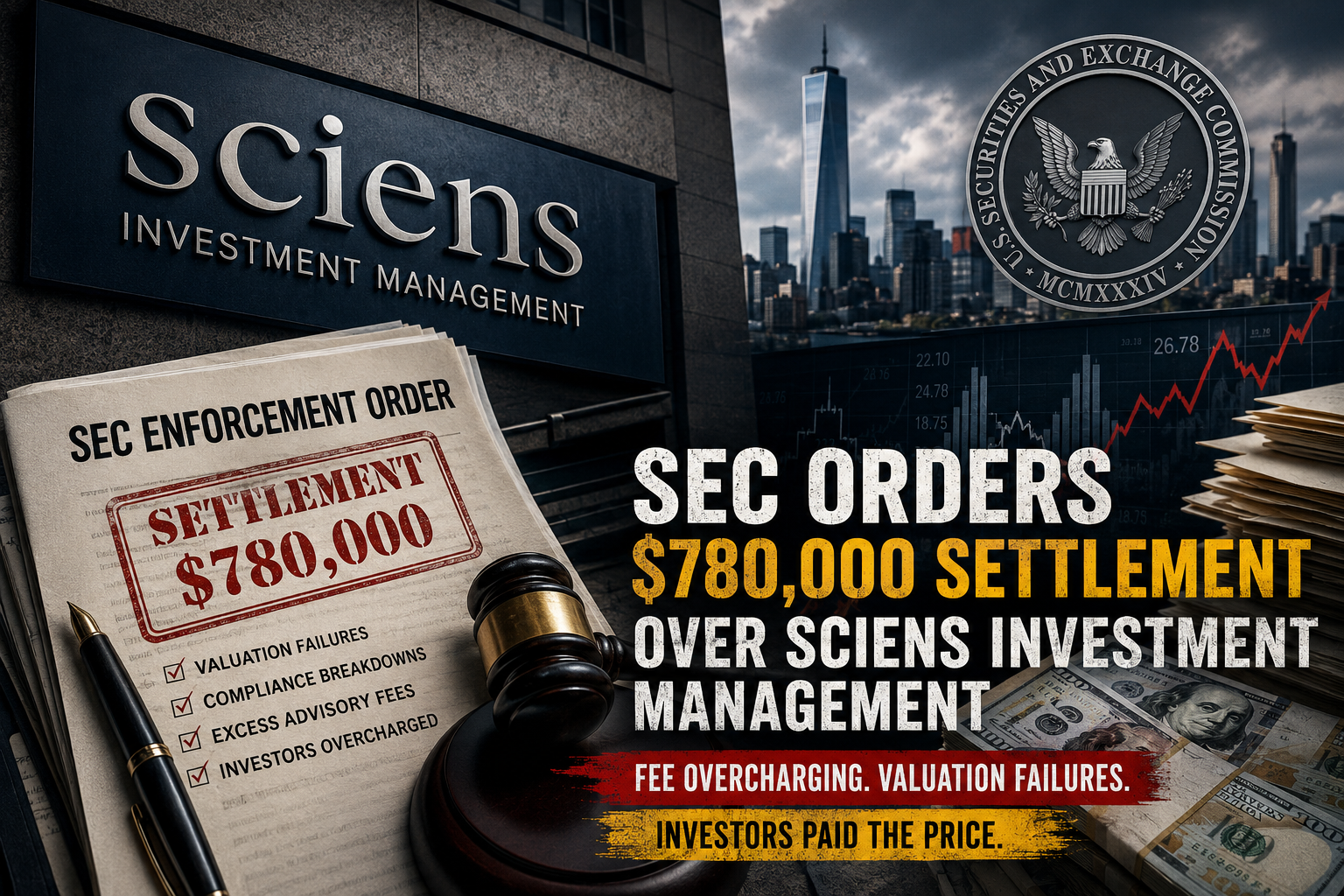
The U.S. Securities and Exchange Commission rarely charges an investment adviser with using the wrong value for assets to inflate its own fees. When it does, the case raises uncomfortable questions about whether investors received the oversight they expected. That’s the gist of the SEC’s enforcement action against Sciens Investment Management LLC, a Connecticut-based private fund adviser that settled charges that it failed to follow its own valuation policies and overcharged advisory fees for years.
Sciens Investment Management operates as part of the broader Sciens group, whose parent entity is Sciens Funds of Funds Management Ltd. The organization is led by Ioannis “John” Rigas, an investment executive who serves as Chairman and Chief Executive Officer of the Sciens platform. Based in New York, Rigas has spent decades in alternative investments, private equity, and fund management, overseeing the firm’s strategic direction and expansion across multiple investment vehicles. Although the SEC’s enforcement action was directed at Sciens Investment Management’s compliance and valuation practices rather than accusing Rigas personally of misconduct, he remains the most prominent executive associated with the Sciens organization and its investment management business.
The case did not involve allegations that investor money was stolen or that a classic investment fraud had occurred. Instead, regulators focused on something that is central to the private investment industry: figuring out what assets are worth. In private equity and other alternative investments where holdings often aren’t traded on public exchanges, valuations directly affect the fees that investors pay. Small mistakes can add up to millions of dollars for fund managers deciding where to invest billions of dollars.
Sciens Investment Management LLC, registered with the SEC as an investment adviser since 2011, manages a portfolio of private investment funds and separately managed accounts focused on private equity, real estate, hedge funds and other alternative assets. The firm has managed billions of dollars for institutional investors, pension plans, family offices and wealthy individuals looking for exposure to investments outside traditional stock and bond markets. Regulatory filings also show that the firm operates through affiliated entities linked to the larger Sciens platform, with investment management remaining its core business.
The firm’s problems were related to how it valued some portfolio investments between 2018 and 2021, the SEC said. These figures were not just accounting numbers sitting in spreadsheets. Determining management fees charged to clients was a fiduciary responsibility, not a routine bookkeeping exercise, and required accurate calculations. Registered investment advisers must act in the best interests of their clients, maintain effective compliance programs and follow the valuation procedures set out in their governing documents.
The Commission concluded that Sciens did not follow such procedures consistently. Instead of using its consistent valuation methodology in all cases, the adviser used unsupported assumptions and valuation approaches that did not conform to the policies investors had been told would be used. And the SEC found that the result was that some investments were assigned values higher than they should have been. But management fees were calculated on those values and investors paid more than they should have.
The enforcement order described failures of compliance beyond the valuation judgments. Regulators found that the company’s compliance policies were not reasonably designed to prevent or detect the problems that developed. While investment advisers are required to have written compliance procedures that are tailored to their business, the SEC found that Sciens’ controls failed to ensure that valuations were independently reviewed and consistently applied. The agency also found the firm’s chief compliance framework did not adequately address the risks associated with the valuation of illiquid assets, a sector long viewed by regulators as especially susceptible because prices cannot be verified by active public markets.
Private fund valuations have been a major SEC enforcement priority for the last decade. Unlike publicly traded securities, which are continuously quoted at market prices, private assets often require managers to estimate value using financial models, comparable transactions, cash flow projections or third-party appraisals. Those estimates affect investor reporting, fund performance, incentive compensation and management fees. When assumptions become too optimistic or valuation policies are not applied consistently, investors can unknowingly pay inflated fees or get an inaccurate picture of fund performance.
With Sciens, the SEC found that valuation problems led to the charging of excessive management fees to advisory clients over a period of years. The matter was settled administratively, not litigated in Federal Court, and the allegations were resolved. Sciens neither admitted nor denied the Commission’s findings, but agreed to a cease-and-desist order and sanctions that required the firm to pay approximately $780,000 in disgorgement, prejudgment interest and civil penalties. The settlement also required Sciens to hire an independent compliance consultant to review its policies, procedures and internal controls and suggest improvements to help prevent similar problems in the future.
Importantly, the order from the SEC did not include any allegations that the firm or its employees ran a Ponzi scheme, misappropriated funds from investors or knowingly misappropriated assets from clients. Nor did it bring criminal charges against the company’s executives. The proceeding was a civil enforcement regulatory action involving fiduciary obligations and compliance failures under the Investment Advisers Act of 1940. In typical SEC settlements, Sciens neither admitted nor denied the agency’s findings, but agreed to settle the matter and to undertake remedial measures.
The enforcement action does serve to remind that compliance failures can cause significant financial and reputational damage even where regulators do not allege outright fraud. Investment advisers are fiduciaries, particularly when they are overseeing complex private funds in which investors often have little visibility into how assets are valued. Because they cannot independently verify every valuation decision taken behind closed doors, these investors depend heavily on advisers to apply consistent methodologies and to exercise effective internal oversight.
Industry observers have said that as private markets have grown, enforcement around valuation has steadily increased. Assets under management at private equity, private credit and alternative investment firms have ballooned over the past decade, attracting increased regulatory scrutiny over the risk that poor valuation practices can distort reported performance and pass costs onto investors. The SEC, over the past several years, has noted that valuation governance, fee calculations, expense allocations and conflicts of interest are common areas of risk across the private fund industry in numerous examinations.
Following the settlement, Sciens remained a registered investment adviser and publicly available regulatory records indicate that the firm continues to operate under SEC oversight. However, adviser registration should not be considered a stamp of approval by the Commission. Instead, firms will remain under the scrutiny of continuing examinations and regulatory obligations designed to protect clients and preserve confidence in financial markets. The independent compliance review required by the settlement was designed to bolster the firm’s governance framework and lessen the risk of such deficiencies reoccurring.
The Sciens case also highlights how regulatory actions against investment advisers tend to be very different from the headline-grabbing fraud prosecutions that make financial headlines. The question here was not whether investors were promised the impossible or whether executives siphoned money from clients behind closed doors. Instead, regulators looked at whether the adviser had fulfilled its fiduciary duty by consistently applying its own valuation policies and charging fees appropriate to the value of the assets held for clients. These distinctions are important, because fiduciary duties form the foundation of the adviser-client relationship, especially in markets where transparency is naturally constrained.
The lesson reaches far beyond one Connecticut investment firm for investors. Alternative investments can offer diversification and exposure to opportunities not available in public markets, but they may require a higher degree of trust in the professionals managing them. Investors need to understand how assets are valued, how management fees are calculated, whether there is independent oversight and whether advisers have a strong compliance culture that can identify problems before regulators do.
The SEC’s action against Sciens is a reminder that even established firms managing billions of dollars can face enforcement action if their internal controls do not meet regulatory standards. The private markets are still growing, and the spotlight on valuation practices is not going away anytime soon. Transparency, accountability, and rigorous compliance have become more important than ever for firms entrusted with the money of others.
————-
Disclaimer:
Some content on Reportingscams.com is published under our guest post program and is provided by third-party contributors. Reporting scams does not create, verify, or take responsibility for the views, accuracy, or claims expressed in such content.