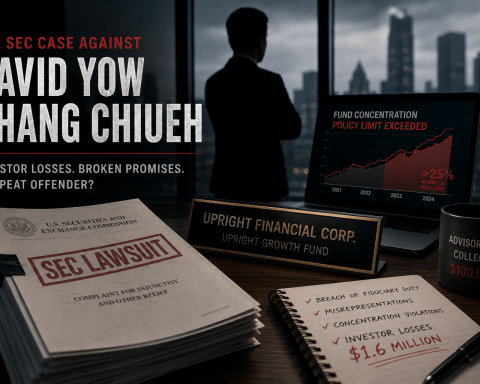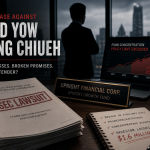
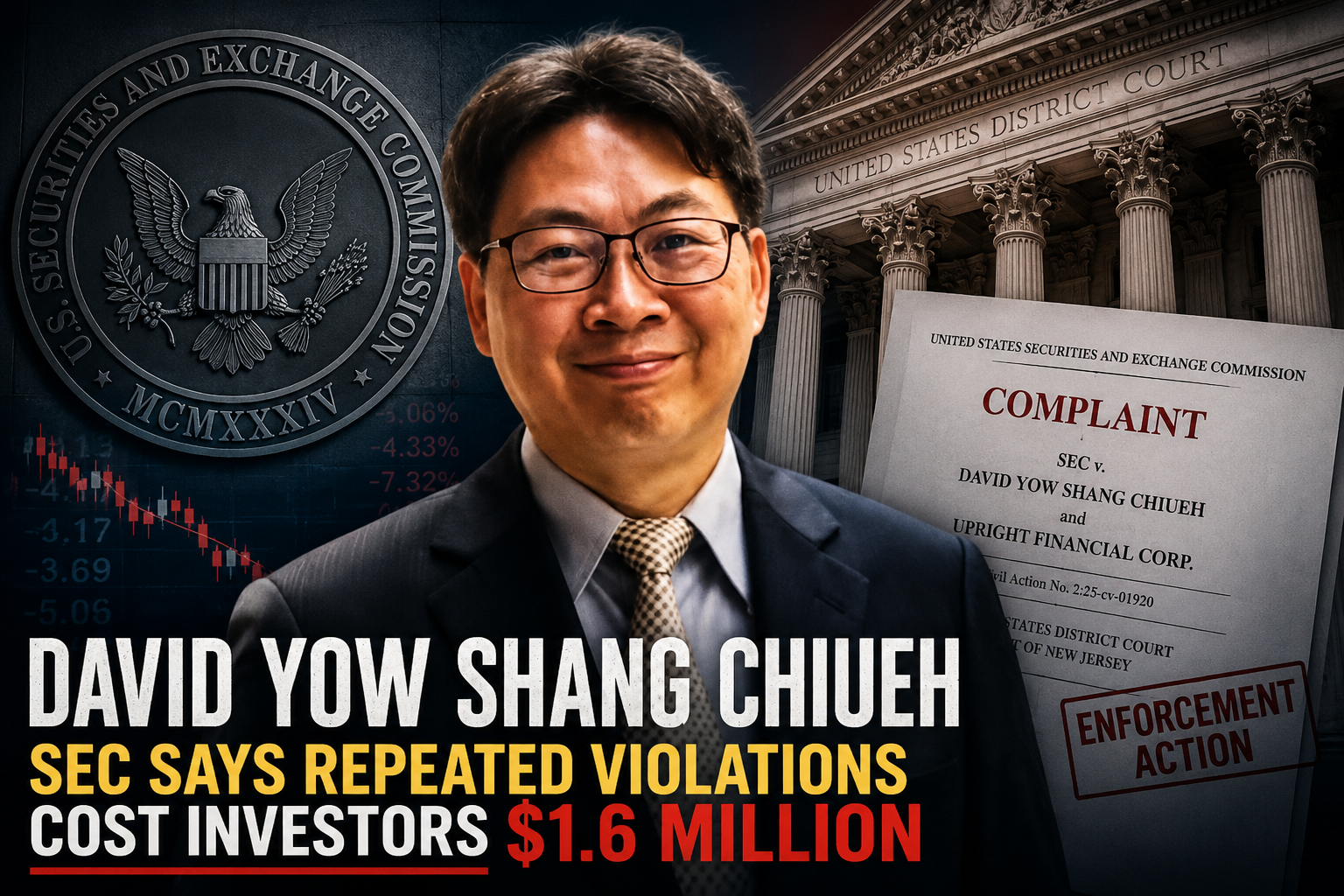
David Yow Shang Chiueh has spent decades presenting himself as a disciplined investment professional. He founded New Jersey-based Upright Financial Corp. in 1990 and later established Upright Investments Trust, which oversees a family of mutual funds including the Upright Growth Fund. For years, the firm marketed itself around careful, research-driven investing. But according to the U.S. Securities and Exchange Commission, that image masked a pattern of conduct that repeatedly ignored the very investment rules meant to protect fund investors, even after regulators had already taken enforcement action.
The SEC’s latest case against Chiueh and Upright Financial is notable not simply because it alleges securities fraud, but because it claims the conduct continued after a previous settlement with the regulator. That earlier case was supposed to end the dispute. Instead, federal regulators now argue it marked the beginning of another chapter involving many of the same issues, exposing investors to unnecessary risk and causing substantial losses.
Chiueh, who serves as founder and president of Upright Financial Corp., has long played multiple roles within the organization. According to court filings, he has also served as chief executive officer, chairman of the board and portfolio manager for Upright Investments Trust, placing him at the center of the firm’s investment decisions and governance. The SEC says that level of control became a problem because the same individual responsible for managing the investments was also deeply involved in overseeing compliance and communications with the board.
The current enforcement action has its roots in a previous SEC settlement reached in November 2021. In that matter, the regulator alleged that Upright Growth Fund violated one of its fundamental investment policies by concentrating more than 25 percent of its assets in a single industry between July 2017 and June 2020. Mutual funds disclose concentration limits so investors understand how diversified their money will be. Those policies are considered fundamental because investors rely on them when deciding whether to invest.
Without admitting or denying the SEC’s findings, Chiueh and Upright agreed to settle the earlier case. They consented to cease-and-desist orders, paid monetary sanctions including disgorgement, interest and civil penalties, and agreed to comply with federal securities laws going forward. The settlement was intended to resolve the regulator’s concerns and prevent similar conduct from happening again.
According to the SEC, however, the problems did not stop there.
In March 2025, the Commission filed a new civil enforcement lawsuit in federal court in New Jersey, alleging that Chiueh and Upright once again exceeded the Growth Fund’s 25 percent concentration limit, this time by maintaining an outsized position in the semiconductor industry after the earlier settlement. Regulators allege the violations continued from late November 2021 through June 2024, directly contradicting the commitments made during the prior enforcement action.
The SEC argues that instead of reducing the oversized position promptly, the defendants waited more than two and a half years before selling enough shares to bring the fund back into compliance. During that period, the value of the concentrated holdings declined significantly. Regulators estimate the delay resulted in roughly $1.6 million in losses for the fund and its investors.
Beyond the concentration issue, the SEC paints a broader picture of alleged governance failures inside the organization. The complaint alleges that key information was withheld from the fund’s board of trustees, preventing directors from exercising meaningful oversight over investment decisions. Regulators also claim the defendants hired an outside accountant for the fund without obtaining the board approval required under federal law. Those allegations, if proven, would raise questions not only about investment management but also about how corporate oversight functioned within the organization.
When the SEC initially announced the lawsuit in March 2025, it also alleged that the fund lacked the required number of independent trustees and that one trustee’s independence had been misrepresented in regulatory filings. Those allegations received considerable attention because board independence is a cornerstone of mutual fund regulation.
However, after reviewing the case, the SEC filed an amended complaint in April 2025. The amended filing removed those particular allegations and withdrew one aiding-and-abetting claim relating to board independence. The regulator nevertheless maintained its central allegations that Chiueh and Upright continued violating concentration limits, misled investors and the board, breached fiduciary duties and failed to comply with multiple provisions of federal securities laws.
That distinction is important because it demonstrates that the litigation has evolved rather than simply expanded. The SEC narrowed some claims while continuing to pursue what it considers the strongest allegations concerning investment practices, disclosures and fiduciary obligations.
The defendants have challenged significant portions of the SEC’s lawsuit. They sought dismissal of multiple claims, arguing that the Commission had failed to plead sufficient facts to support several fraud and securities law allegations. Those efforts were unsuccessful.
In January 2026, U.S. District Judge Brian R. Martinotti denied the motion to dismiss, allowing the SEC’s amended complaint to proceed. The court concluded that the Commission had alleged sufficient facts at this stage of the litigation to support its claims. Importantly, the ruling did not determine whether Chiueh or Upright are liable. Instead, it means the case will continue through discovery and potentially toward trial unless it is resolved beforehand.
Bloomberg Law noted that the judge accepted, for purposes of the motion, the SEC’s allegations that Upright improperly concentrated the Growth Fund in a single industry despite both the fund’s own policies and the earlier consent settlement. The court’s ruling represents an early procedural victory for regulators but does not constitute a finding that the allegations are true.
The SEC is seeking permanent injunctions, civil monetary penalties, disgorgement of allegedly ill-gotten gains and other equitable relief. If the Commission ultimately prevails, the financial consequences could extend well beyond the estimated $1.6 million in investor losses identified in the complaint.
Investor advocates have also pointed to the case as a reminder that concentration limits are not technical paperwork requirements. Diversification rules exist because they reduce the impact that a sharp decline in one sector or company can have on investors’ portfolios. When a fund promises diversification but becomes heavily exposed to one industry, investors may unknowingly assume risks they never intended to take.
Public records indicate that Upright Financial continues to exist while the litigation remains pending. At the time of writing, there has been no final judgment establishing liability in the SEC’s 2025 enforcement action. Likewise, no criminal charges have been announced against Chiueh in connection with these allegations. The matter remains a civil enforcement case brought by the SEC, and the defendants continue to have the opportunity to contest the allegations in court.
Regardless of how the lawsuit ultimately ends, the case has already become a cautionary example for the investment management industry. Regulators are not simply accusing an adviser of making poor investment decisions. They allege something more fundamental: that promises made to investors, commitments made to regulators and safeguards designed to protect mutual fund shareholders were ignored even after a prior enforcement settlement. Whether those allegations are ultimately proven will be decided in court, but the case underscores an enduring lesson for investors. Investment performance matters, but so does governance. When disclosure rules, oversight mechanisms and fiduciary obligations begin to break down, the consequences often extend far beyond a single portfolio, affecting confidence in the integrity of the investment industry itself.
————-
Disclaimer:
Some content on Reportingscams.com is published under our guest post program and is provided by third-party contributors. Reporting scams does not create, verify, or take responsibility for the views, accuracy, or claims expressed in such content.