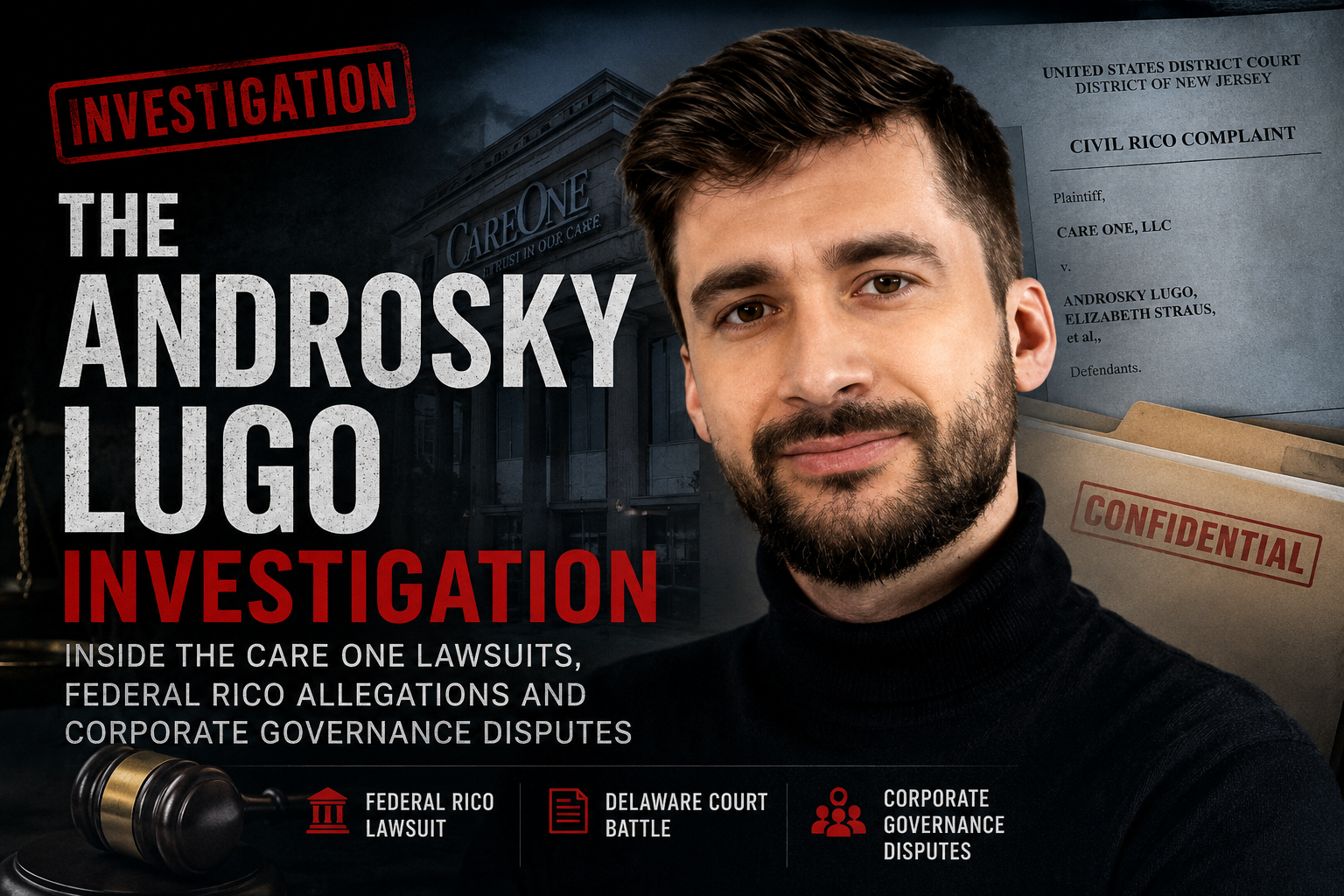
For years, Care One stood as one of the largest privately held healthcare operators in the northeastern United States. Its network of nursing homes, rehabilitation centers, assisted living facilities, and long-term care businesses expanded rapidly across New Jersey and neighboring states. Behind that growth was founder and chief executive Daniel Straus, but as the company became larger and increasingly complex, much of its day-to-day legal and corporate management fell to a small circle of trusted executives. Among the most influential was Androsky Lugo.
Unlike high-profile healthcare executives who frequently appeared in industry publications or investor conferences, Lugo largely remained behind the scenes. Public records portray him as the company’s longtime General Counsel and a senior corporate officer whose responsibilities extended well beyond providing legal advice. Court filings indicate he played an active role in corporate governance, drafting company agreements, overseeing legal affairs, advising senior management, and participating in major operational decisions across the Care One enterprise.
That relatively low public profile changed dramatically when his name began appearing in a series of lawsuits that exposed an intense internal conflict inside Care One. What started as a dispute between former executives and company leadership evolved into allegations involving corporate governance, fiduciary duties, executive authority, advancement of legal fees, and ultimately a federal civil RICO lawsuit. The litigation has opened an unusual window into how one of the country’s largest privately owned nursing home operators functioned behind closed doors.
Understanding Lugo’s role requires understanding the organization he helped manage.
Care One was built into a multibillion-dollar healthcare enterprise operating dozens of skilled nursing facilities, rehabilitation centers, assisted living communities, and healthcare service businesses. The company became one of the dominant private operators in New Jersey’s long-term care industry, serving thousands of patients while employing thousands of workers across numerous affiliated entities.
Unlike publicly traded healthcare companies that regularly disclose governance structures and executive compensation, Care One operated as a privately controlled organization with limited public transparency. Corporate authority remained concentrated among a relatively small leadership group headed by Daniel Straus. Within that structure, legal counsel held exceptional importance because many of the company’s operations involved acquisitions, regulatory compliance, employment matters, litigation, reimbursement issues, and complex ownership arrangements.
According to later court filings, Lugo eventually became one of those central figures.
Delaware Chancery Court opinions identify Lugo as a former officer of Care One who served as General Counsel during key periods in the company’s corporate history. His position placed him in direct communication with executive leadership while also giving him responsibility for preparing and reviewing important corporate documents.
Those responsibilities would later become one of the central issues in ongoing litigation.
One of the most significant legal disputes concerns amendments made to Care One’s operating agreement more than a decade ago. Court records state that the company adopted amendments in 2010 changing provisions related to indemnification and advancement rights for corporate officers. Advancement provisions are common in corporate governance because they determine whether a company must pay legal expenses incurred by officers defending lawsuits arising from their work.
Although these provisions often receive little public attention, they can become enormously significant when litigation erupts years later.
According to Delaware court records, Care One contends the 2010 amendment eliminated advancement rights for officers other than Daniel Straus. Lugo and former executive Elizabeth Straus, however, argue that rights granted under the earlier 2006 operating agreement had already vested and therefore survived the later amendment. That disagreement has become one of the defining legal questions now before the Delaware Court of Chancery.
The dispute is more than a technical contract disagreement.
Recent court opinions indicate Care One alleges Lugo personally participated in drafting the 2010 amendment and assured company leadership that it fully accomplished Daniel Straus’s instructions regarding advancement rights. The company argues Lugo never informed Daniel Straus that previously vested rights might remain enforceable without obtaining individual waivers from existing officers.
Lugo disputes the legal consequences of those allegations, and the Delaware litigation has not reached a final determination on the underlying factual disputes. In April 2026, the Court concluded that competing evidence created genuine issues of material fact regarding Care One’s equitable defenses, meaning those issues require further proceedings rather than summary judgment.
Those allegations only surfaced because of a much larger legal battle that emerged years after the amendment itself.
In 2025, Care One filed a federal civil RICO action in the United States District Court for the District of New Jersey against Lugo and former executive Elizabeth Straus. The existence of that lawsuit is confirmed in multiple Delaware opinions addressing whether Care One must advance legal expenses incurred by the former executives in defending the federal case.
The Delaware courts have repeatedly emphasized that the advancement litigation is separate from deciding whether the allegations made in the federal action are true. Advancement cases generally focus on contractual rights rather than liability. Nevertheless, the federal lawsuit brought Lugo’s role within Care One under far greater public scrutiny than at any previous point in his career.
Long before the RICO litigation emerged, Lugo’s name occasionally appeared in other legal proceedings involving Care One.
One example is the employment retaliation case brought by former Care One employee Margaret Gathman. According to the New Jersey Appellate Division, Gathman alleged she was terminated after raising concerns regarding the return of millions of dollars in Medicare and Medicaid overpayments. Lugo signed her termination letter and later became an important witness during the litigation.
The appellate court ultimately concluded that genuine factual disputes existed regarding Gathman’s retaliation claims, reversing portions of the trial court’s summary judgment ruling. Importantly, however, the court did not determine that Lugo engaged in retaliation. Instead, it found sufficient disputed evidence to require further proceedings.
The opinion nevertheless provides insight into Lugo’s executive responsibilities. Testimony discussed in the case portrays him as a senior executive involved in personnel decisions, compliance matters, and oversight of significant financial reporting within Care One.
Healthcare operators such as Care One function within one of the most heavily regulated industries in the United States. Nursing home companies routinely navigate federal reimbursement rules, Medicare and Medicaid compliance requirements, labor regulations, patient safety obligations, privacy laws, and state licensing standards. General counsel therefore often become deeply involved in operational decision-making rather than serving solely as legal advisers.
Court records suggest Lugo occupied precisely that kind of role.
Public ownership records associated with Care One facilities likewise identify Androsky Lugo as an officer connected to the organization’s management during earlier reporting periods, reinforcing the picture presented in court filings that he occupied a senior leadership position within the enterprise.
Yet despite years spent helping manage one of the country’s largest nursing home organizations, relatively little public information exists regarding Lugo’s personal background. Unlike many corporate executives, he maintained a limited public profile, gave few media interviews, and attracted little public attention until litigation began exposing internal corporate disputes.
That absence of publicity makes the ongoing lawsuits particularly significant. Rather than learning about Lugo through press releases or executive biographies, the public is instead discovering his role through sworn affidavits, judicial opinions, corporate agreements, and courtroom filings.
Those documents reveal competing narratives.
Care One portrays Lugo as a former trusted executive whose conduct eventually gave rise to serious legal disputes. Lugo, through his court filings, maintains that contractual commitments made years earlier remain enforceable and that he is entitled to the same advancement protections afforded to corporate officers under the governing agreements. The Delaware courts have stressed that these issues remain contested and that key factual questions have yet to be finally resolved.
As the litigation has unfolded, what initially appeared to be an ordinary corporate dispute has evolved into a broader examination of governance, executive authority, fiduciary obligations, and legal accountability inside one of America’s largest privately owned healthcare companies. The allegations now stretch well beyond contract interpretation, touching on how corporate power was exercised within Care One and whether longstanding internal decisions created the foundation for today’s far-reaching legal battle.
For much of his career, Androsky Lugo remained largely unknown outside Care One’s executive offices and the legal circles surrounding the healthcare company. That changed in late 2025 when Care One initiated a sweeping federal lawsuit in the United States District Court for the District of New Jersey against Lugo, former executive Elizabeth Straus, and other parties. The complaint invoked the Racketeer Influenced and Corrupt Organizations Act, better known as RICO, a statute more commonly associated with organized criminal enterprises but increasingly used in complex business disputes involving allegations of coordinated fraud and misconduct.
The filing marked a dramatic escalation in what had previously appeared to be an internal corporate disagreement. Instead of alleging isolated breaches of contract or fiduciary duty, Care One accused former insiders of participating in what it described as a long-running scheme that harmed the company and its controlling interests. The allegations remain contested, and the federal court has not issued findings establishing liability against Lugo or the other defendants. Nevertheless, the lawsuit has become the central reason his name has attracted public attention.
Although the federal complaint spans numerous allegations involving multiple individuals, its claims against Lugo revolve largely around his role as the company’s longtime General Counsel. Care One alleges that because Lugo served as its chief legal adviser for years, he possessed detailed knowledge of the company’s corporate structure, operating agreements, governance procedures, and legal protections available to senior officers. According to the complaint, that position of trust carried significant fiduciary responsibilities.
The company argues that Lugo was not merely responsible for advising executives on legal compliance but also for preparing and reviewing critical corporate documents governing the rights and obligations of company officers. Those responsibilities are important because several of the present disputes stem from decisions made more than a decade before litigation began.
One issue repeatedly referenced throughout the Delaware proceedings concerns amendments adopted to Care One’s operating agreement in 2010. According to Care One, Daniel Straus instructed Lugo to revise provisions governing indemnification and advancement rights so that only Straus himself would retain advancement protections in future disputes. Advancement clauses require companies to pay legal expenses incurred by officers defending claims arising from their service to the company, subject in many cases to repayment if wrongdoing is ultimately established.
Care One alleges Lugo prepared or supervised the drafting of those amendments and advised company leadership that they fully reflected Straus’s intentions. Years later, however, when litigation arose, Lugo asserted that advancement rights created under the earlier 2006 operating agreement had already vested and therefore remained enforceable despite the later amendment.
The disagreement may appear technical, but the financial consequences are potentially substantial. Corporate litigation involving multiple parties often generates legal fees running into millions of dollars. If Lugo succeeds in establishing advancement rights, Care One could be required to fund significant portions of his legal defense while the underlying litigation continues, regardless of whether the company ultimately prevails on its substantive claims.
That contractual dispute eventually reached the Delaware Court of Chancery, where judges emphasized that advancement cases focus primarily on interpreting corporate agreements rather than deciding whether the allegations in the federal lawsuit are true. Even so, Care One’s arguments in Delaware provide insight into the broader accusations it has leveled against its former General Counsel.
According to Care One, Lugo failed to advise Daniel Straus that eliminating advancement rights for existing officers would require additional legal steps beyond amending the operating agreement. The company contends that because no individual waivers were obtained, Lugo later relied upon those remaining contractual rights to seek company-funded legal representation after being sued.
Lugo disputes that interpretation. His position, reflected in court filings, is that the governing agreements granted advancement rights that became vested before the 2010 amendment and therefore could not be retroactively eliminated. Rather than accepting Care One’s arguments at face value, the Delaware Court concluded that genuine disputes of material fact remain, preventing summary judgment on several of the equitable defenses asserted by the company. Those issues are expected to be resolved through further proceedings rather than preliminary rulings.
While the advancement litigation focuses on contractual obligations, the federal RICO action contains broader allegations regarding the conduct of former executives. Care One claims that Lugo and others breached fiduciary duties owed to the company and participated in conduct that allegedly benefited themselves while harming corporate interests. Because the litigation remains ongoing, these allegations have not been proven in court, and the defendants have the opportunity to challenge each claim through the judicial process.
The distinction between allegations and judicial findings is particularly important in cases involving civil RICO claims. Filing a RICO complaint does not establish that a racketeering enterprise existed. Plaintiffs must ultimately satisfy demanding legal standards by presenting evidence supporting each statutory element, including the existence of an enterprise, a pattern of racketeering activity, and resulting injury. Courts frequently dismiss or narrow civil RICO claims when those standards are not met. As of this writing, the litigation involving Care One and Lugo has not produced a final judgment resolving those issues.
The federal lawsuit nevertheless paints a picture of deteriorating relationships within Care One’s leadership. Individuals who had once worked closely together for years are now engaged in multiple legal battles across different courts, with each side presenting sharply different accounts of what occurred inside the company.
Another lawsuit involving Care One provides additional context regarding Lugo’s executive responsibilities before these disputes emerged. In Margaret Gathman v. Care One Management LLC, a former employee alleged she faced retaliation after raising concerns involving Medicare and Medicaid reimbursement issues. The New Jersey Appellate Division reviewed whether the evidence required a trial under the state’s Conscientious Employee Protection Act.
Court records show Lugo participated directly in the events underlying that litigation. He signed Gathman’s termination letter and later provided testimony concerning the company’s handling of the matter. The appellate court determined that factual disputes prevented dismissal of portions of Gathman’s claims and sent those issues back for further proceedings. Importantly, the court did not conclude that Lugo committed retaliation or other unlawful conduct. Instead, it held that conflicting evidence required resolution by a factfinder.
Although separate from the present RICO litigation, the Gathman case illustrates the breadth of Lugo’s authority within Care One. His responsibilities extended beyond legal advice into executive decision-making affecting employment, compliance, and internal investigations. Those responsibilities explain why his actions now receive extensive attention in later litigation involving the company.
Healthcare organizations such as Care One operate within one of the nation’s most heavily regulated industries. Operators must comply with federal Medicare and Medicaid requirements, state licensing rules, labor laws, patient safety standards, privacy regulations, and reimbursement obligations. The General Counsel of such an organization frequently serves as one of the principal advisers on risk management, regulatory compliance, and corporate governance.
That broader context helps explain why Care One places considerable emphasis on Lugo’s former position. The company argues that it relied upon his legal expertise when making governance decisions that later became central to the present disputes. Lugo, in turn, maintains that the governing agreements provide him contractual protections negotiated years before litigation began.
The Delaware Court has so far avoided deciding which narrative is correct. Instead, its opinions repeatedly stress that factual disputes remain unresolved and that advancement litigation should not be confused with determining liability in the underlying federal action. Those rulings preserve Lugo’s ability to continue litigating his contractual claims while leaving Care One free to pursue its allegations in federal court.
The legal battle has also drawn attention because it highlights a recurring issue in closely held corporations. Unlike publicly traded companies, private businesses often rely heavily on longstanding personal relationships among founders, executives, and trusted advisers. When those relationships collapse, litigation frequently exposes years of internal communications, governance decisions, and strategic planning that otherwise would have remained confidential.
That dynamic appears evident in the Care One disputes. Court filings reveal disagreements not only over legal rights but also over how major corporate decisions were made, who exercised authority within the organization, and whether senior officers fulfilled the obligations expected of them. The resulting litigation has transformed what might once have been viewed as routine corporate governance issues into matters of significant public interest.
As discovery continues and additional court proceedings unfold, the federal RICO case will likely remain the focal point of public scrutiny surrounding Androsky Lugo. Whether Care One ultimately proves its allegations, whether Lugo prevails on his contractual defenses, or whether the parties reach some form of resolution remains uncertain. What is clear is that the litigation has already lifted the curtain on an executive whose influence inside one of the country’s largest private healthcare companies was largely invisible for years, revealing a complex legal conflict whose full implications are still being determined.
While the federal RICO lawsuit brought Androsky Lugo into public view, another courtroom several states away has become equally important in determining the legal consequences of Care One’s internal dispute. In Delaware, where many American businesses choose to organize because of its well-developed corporate law, the Court of Chancery has been asked to answer a different question. Rather than deciding whether Lugo committed any wrongdoing, the court has focused on whether Care One must pay for his legal defense while the larger litigation continues.
The issue may appear procedural, but it has become one of the defining legal battles arising from the broader conflict.
Corporate officers frequently negotiate indemnification and advancement rights as part of their employment arrangements. Although the terms are often overlooked during ordinary business operations, they become critically important when lawsuits emerge years later. Advancement provisions can require a company to cover legal fees before any court determines whether an executive is liable for misconduct. The rationale is straightforward. Corporate officers should not be forced to finance expensive litigation out of pocket simply because they are sued over decisions made while carrying out their duties. If a court later determines that those protections do not apply, the executive may ultimately be required to repay the company.
That framework lies at the center of Lugo’s dispute with Care One.
According to the Delaware proceedings, Lugo argues that the company’s 2006 operating agreement granted him advancement rights during his tenure as an officer. Care One, however, maintains that amendments adopted in 2010 eliminated those protections for everyone except founder Daniel Straus. The company further contends that Lugo himself was responsible for drafting or supervising those amendments while serving as General Counsel and therefore understood exactly what changes had been made.
The disagreement has produced one of the more unusual legal arguments in the litigation. Care One alleges that Lugo assured company leadership the revised operating agreement fully reflected Straus’s intentions, while later relying on the earlier agreement to claim company-funded legal representation once he became a defendant. Lugo disputes that characterization and argues that his contractual rights vested before the amendments were adopted, making them legally enforceable despite subsequent revisions.
The Delaware Court of Chancery has not accepted either position outright.
Instead, the court has repeatedly emphasized that significant factual disputes remain unresolved. In one of its key rulings issued during 2026, the court concluded that neither side had established entitlement to judgment as a matter of law on several equitable defenses. The decision means that additional proceedings are necessary before those questions can be fully resolved. Importantly, the ruling does not determine whether Lugo engaged in misconduct or whether Care One’s allegations are ultimately correct. It simply recognizes that the available evidence presents competing narratives requiring further judicial examination.
The court’s careful approach reflects a broader principle of Delaware corporate law. Advancement proceedings are intentionally narrow. Judges generally avoid deciding the merits of the underlying dispute because doing so could prejudice later litigation. Instead, they focus on interpreting contracts, corporate governance documents, and the legal rights those documents create.
That distinction has become particularly significant because the allegations made in the federal RICO action remain actively contested.
Care One argues that equitable principles should prevent Lugo from enforcing advancement rights if the company’s allegations regarding his conduct prove true. Lugo responds that contractual rights cannot simply disappear because accusations have been made against a former executive. Until liability is established through appropriate legal proceedings, he argues, the operating agreements entitle him to advancement of legal expenses.
The Delaware Court has recognized both positions without resolving them, leaving the issue for further litigation.
Beyond the advancement dispute, the cases collectively raise broader questions about governance inside one of the country’s largest privately held healthcare organizations.
Care One’s structure differs from that of publicly traded corporations that operate under continuous scrutiny from investors, securities regulators, and public reporting obligations. Private companies generally enjoy greater flexibility in organizing management and ownership arrangements, but they also depend heavily on internal governance systems and the integrity of senior executives responsible for implementing them.
The current litigation illustrates how disagreements over governance documents drafted years earlier can shape legal battles long after the executives involved have left the organization.
One recurring theme throughout the court filings is the concentration of authority within a relatively small leadership group. According to judicial opinions, Daniel Straus exercised substantial control over Care One’s operations while relying on senior advisers, including Lugo, to implement corporate decisions, oversee legal affairs, and manage governance issues. When relationships within that leadership circle deteriorated, decisions that once appeared routine became the subject of extensive courtroom scrutiny.
The litigation also demonstrates the increasingly complex role played by in-house legal departments at large healthcare organizations.
General Counsel are often viewed as attorneys whose primary responsibility is providing legal advice. In practice, however, many serve as senior executives participating directly in strategic planning, acquisitions, employment decisions, regulatory compliance, litigation management, and corporate governance. Their advice frequently influences multimillion-dollar business decisions affecting thousands of employees and patients.
Court records involving Lugo suggest he occupied precisely that type of position within Care One. Judicial opinions reference his involvement in drafting operating agreements, advising senior leadership, overseeing legal matters, and participating in executive decision-making. Those responsibilities help explain why both sides attribute such significance to actions taken more than a decade before the present lawsuits began.
The broader healthcare industry provides additional context.
Operators of skilled nursing facilities face constant oversight from federal and state regulators responsible for Medicare and Medicaid reimbursement, patient care standards, staffing requirements, licensing obligations, and financial compliance. Corporate governance failures within large healthcare organizations can therefore have consequences extending beyond shareholders or executives, potentially affecting employees, residents, and government healthcare programs.
At this stage, however, there is no public finding that Lugo personally violated healthcare regulations or that regulators imposed enforcement actions against him arising from the allegations currently being litigated. The matters involving Lugo remain primarily civil disputes between private parties, with the courts still evaluating contractual and legal issues rather than issuing final determinations regarding liability.
That distinction is critical because civil complaints frequently contain allegations that remain unproven unless supported through trial or other judicial proceedings.
The ongoing litigation nevertheless offers a rare glimpse into how internal conflicts within private healthcare companies can evolve into years of complex legal proceedings spanning multiple jurisdictions. Instead of a single lawsuit addressing one isolated disagreement, the Care One disputes now involve overlapping questions of corporate governance, fiduciary obligations, contractual interpretation, executive authority, and litigation funding.
For observers of corporate law, the Delaware proceedings may ultimately become as significant as the underlying federal case. Delaware courts have long shaped national standards governing the rights of corporate officers and directors. Their interpretation of advancement provisions often influences how private companies draft operating agreements and manage executive risk in future transactions.
Whatever the final outcome, the decisions are likely to be closely examined by corporate lawyers advising privately held businesses across the United States.
For Androsky Lugo, the litigation represents a dramatic shift from a career spent largely outside the public spotlight. Court records portray him as a trusted executive who spent years managing legal affairs inside one of the Northeast’s largest healthcare organizations. Today, his role is being analyzed not through corporate biographies or industry recognition but through judicial opinions, sworn declarations, and contested legal filings.
Whether Care One ultimately proves its allegations in federal court, whether Lugo succeeds in enforcing his contractual rights, or whether the parties resolve their disputes through settlement remains uncertain. The litigation is still unfolding, and many of its most significant factual questions have yet to receive definitive judicial answers.
What is already clear, however, is that the lawsuits have exposed the internal mechanics of a major healthcare company in unusual detail. Documents that ordinarily would have remained confidential have entered the public record, revealing disputes over executive authority, governance decisions, legal advice, and fiduciary responsibilities that extend back more than a decade.
For investigative journalists, the Androsky Lugo story is therefore not simply about one executive or one lawsuit. It is about the challenges of corporate accountability inside privately controlled healthcare businesses, where significant decisions affecting billions of dollars in assets and thousands of patients are often made far from public view. The final judgments may still be years away, but the litigation has already become a case study in how governance disputes can reshape reputations, expose corporate structures, and test the legal protections afforded to senior executives when trust within an organization breaks down.
————-
Disclaimer:
Some content on Reportingscams.com is published under our guest post program and is provided by third-party contributors. Reporting scams does not create, verify, or take responsibility for the views, accuracy, or claims expressed in such content.