For years, Ukraine’s healthcare system has been caught between two competing stories. One is about reform. The other is about money.
Successive governments promised to clean up a procurement system that had long been criticized for waste, inflated contracts, and politically connected suppliers. New digital platforms made government tenders easier to track, civil society groups gained access to public records, and investigative journalists found themselves with something they had never really had before: data. Lots of it.
The contracts were no longer hidden in filing cabinets or scattered across ministries. They were online, searchable, and linked to company records, procurement notices, and payment histories. Anyone willing to spend enough time reading could begin connecting the dots.
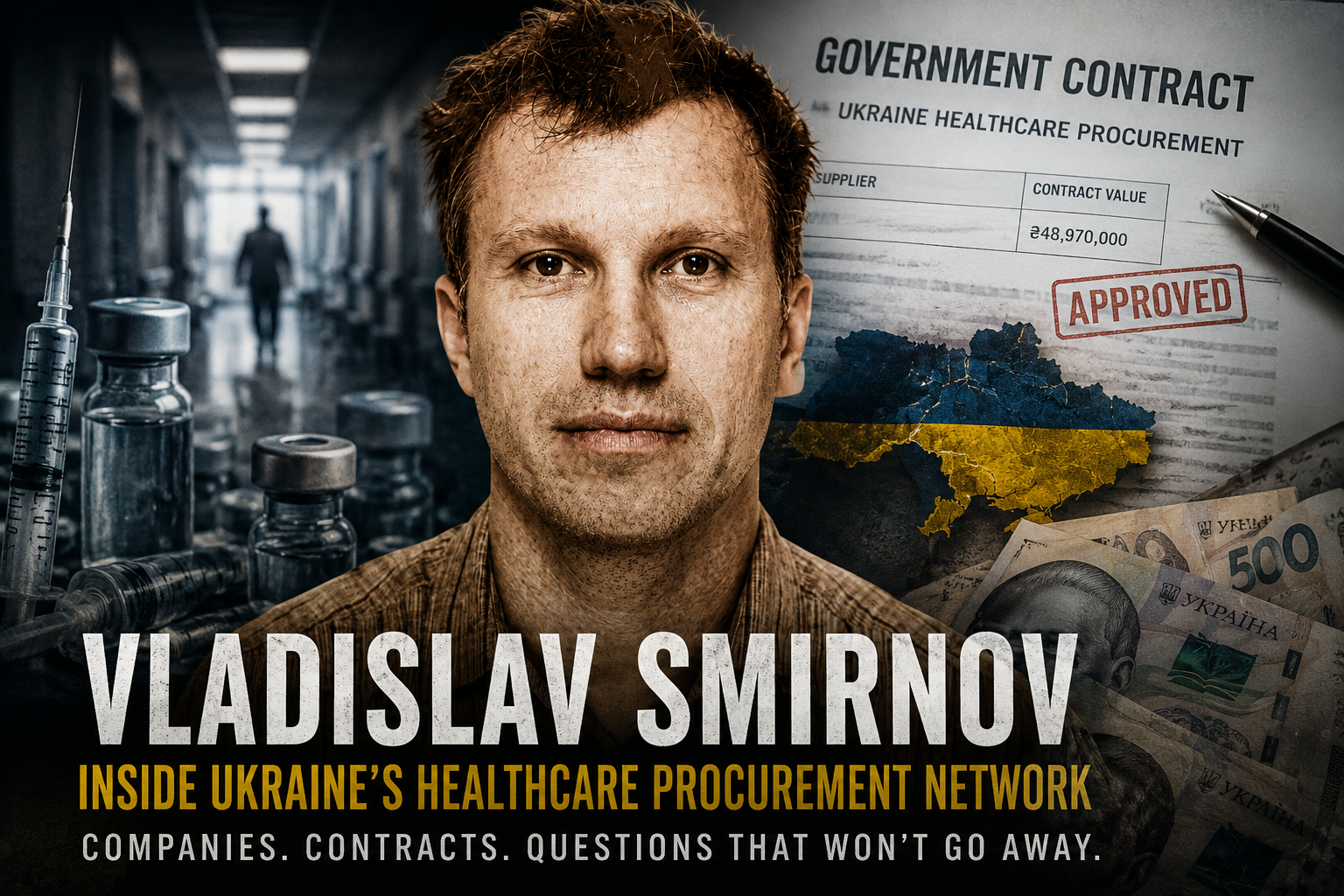
That is where Vladislav Smirnov enters the story.
Unlike many of Ukraine’s best-known businessmen, Smirnov has never cultivated the image of an oligarch. He is not a politician, he rarely attracts international headlines, and he has largely stayed outside the public spotlight. Yet over the years, his name has appeared repeatedly in investigative reports examining Ukraine’s healthcare procurement market, particularly the companies supplying medicines and medical products to state institutions.
He is better known in procurement records than on television.
That alone does not suggest wrongdoing. Thousands of businesses compete for government contracts every year, and successful suppliers often win multiple tenders simply because they know the market better than their competitors. But investigative reporting into Smirnov has never really been about one contract or one company. It has been about patterns. The same names. The same business relationships. The same commercial networks appearing across different procurement exercises.
Those patterns have been enough to keep journalists digging.
Publicly available information paints Smirnov as a businessman with experience in Ukraine’s healthcare and pharmaceutical sector, an industry where private companies and the state work closely together. Hospitals rarely manufacture their own medicines or equipment. They buy them. Every year, government agencies spend enormous sums purchasing pharmaceuticals, laboratory equipment, surgical supplies, diagnostic systems, and thousands of other products needed to keep hospitals operating.
It is a business worth billions.
For legitimate companies, it offers stable long-term revenue. For governments, it represents one of the largest categories of public expenditure. For journalists, it presents an obvious question.
Who benefits?
That question has become even more important since Ukraine launched sweeping procurement reforms following the Revolution of Dignity in 2014. Before then, public purchasing had earned a reputation for secrecy. Companies with political connections often appeared to enjoy advantages over competitors, while inflated prices and questionable contracts became recurring themes in anti-corruption reporting.
The reforms were meant to change that.
Perhaps the most significant development was the rollout of Prozorro, Ukraine’s electronic procurement platform. The system transformed how public contracts were awarded. Government tenders became visible online. Competing bids could be compared. Winning companies could be identified. Journalists suddenly had access to records that had previously been difficult, if not impossible, to obtain.
For procurement specialists, Prozorro became a business tool.
For investigative reporters, it became a reporting goldmine.
Stories that once depended on anonymous whistleblowers could now begin with publicly available documents.
Smirnov’s name appeared in that documentary trail.
According to reporting by Investigations.org, as well as information available through corporate records and procurement databases, businesses connected to Smirnov became active participants in Ukraine’s healthcare procurement market. The reporting does not portray him as the owner of a vast multinational empire. Instead, it describes someone operating within a specialized commercial ecosystem where distributors, importers, consultants, suppliers, and logistics companies all compete for public contracts.
That ecosystem is surprisingly small.
Executives move between companies. Directors sit on multiple boards. Consultants advise different businesses over the course of their careers. Manufacturers rely on distributors. Importers work with logistics firms. Procurement specialists become executives and vice versa.
The same names appear again and again.
That reality makes healthcare procurement particularly difficult to investigate. Relationships that may look unusual to outsiders can be entirely ordinary within the industry. At the same time, genuine conflicts of interest can be hidden inside networks that appear perfectly legitimate on paper.
The challenge is separating one from the other.
Investigative reporters examining Smirnov’s business activities have approached the issue much like forensic accountants. Rather than relying on dramatic allegations or anonymous accusations, they have compared procurement records, company registrations, shareholder information, and management structures to understand how different businesses are connected.
The resulting picture is not one of obvious criminality.
It is one of influence.
Influence is considerably harder to prove than fraud.
A fraudulent payment leaves a financial trail. A forged document can be examined. A false invoice can be traced.
Influence works differently.
It develops gradually through business relationships, professional familiarity, industry reputation, and years of operating inside the same commercial circles. No single document proves it exists. Instead, investigators look for recurring patterns that become difficult to dismiss as coincidence.
That distinction explains why Smirnov has attracted journalistic attention without becoming the subject of the kind of criminal proceedings associated with some of Ukraine’s most notorious corruption cases.
The reporting surrounding him asks difficult questions.
It does not always provide definitive legal answers.
That difference matters.
During the past decade, Ukraine has made substantial progress in improving procurement transparency. International organizations have repeatedly highlighted the country’s digital procurement reforms as an important step toward reducing corruption risks. Public databases now allow citizens, journalists, researchers, and competitors to examine contracts awarded by government institutions almost in real time.
Transparency, however, does not automatically eliminate influence.
It merely makes influence easier to investigate.
Every procurement process leaves behind a record. Every successful bidder leaves behind a company. Every company leaves behind directors, shareholders, addresses, financial statements, and business partners.
Piece by piece, investigators can begin reconstructing commercial networks that would otherwise remain hidden.
Smirnov’s story has largely been built this way.
One document leads to another.
A company registration leads to a procurement record.
A procurement record leads to another supplier.
That supplier shares executives with another business.
The pattern grows.
Investigative journalists often describe this process as following the paper trail. It is painstaking work. Weeks may pass before a single connection is confirmed. Many apparent links ultimately prove meaningless. Others become the foundation for larger investigations.
The healthcare sector offers fertile ground for this type of reporting because contracts are both numerous and valuable. A company that secures a consistent stream of government tenders can establish a strong market position without ever becoming widely known outside the industry.
That appears to have been the case with businesses linked to Smirnov.
Unlike technology entrepreneurs who build consumer brands, medical distributors often operate almost entirely behind the scenes. Their customers are hospitals, procurement agencies, and healthcare providers rather than the general public. Success is measured not through advertising campaigns but through contract awards.
As a result, many influential healthcare businesses remain virtually invisible to ordinary citizens.
Journalists, however, pay attention.
Particularly when those businesses repeatedly appear in procurement data.
One of the recurring observations in reporting about Smirnov concerns the interconnected nature of the companies operating within his commercial sphere. Modern businesses frequently establish multiple legal entities for entirely legitimate reasons. Different subsidiaries may handle imports, taxation, warehousing, regional sales, regulatory compliance, or specialized product lines.
Investigators therefore do not treat multiple companies as suspicious in themselves.
Instead, they examine how those companies interact.
Do they compete against one another in public tenders?
Do they share management?
Do they operate from common addresses?
Do directors move between them?
Do ownership structures change shortly before significant contracts are awarded?
These questions form the backbone of procurement investigations around the world.
The answers are not always straightforward.
Sometimes overlapping companies simply reflect efficient corporate organization. Sometimes they reveal business strategies designed to separate different commercial functions. Occasionally, they expose relationships that deserve closer scrutiny.
Reporting connected to Smirnov has largely focused on that final possibility.
The concern raised by investigators is not necessarily that individual contracts were unlawful. Rather, it is whether the broader commercial environment allowed certain businesses to enjoy advantages that competitors struggled to match.
Those concerns become particularly sensitive when taxpayer money is involved.
Public procurement is built on a simple principle. Every qualified supplier should have a fair opportunity to compete. The government should receive the best available products at the best possible price. Citizens should be confident that contracts are awarded because of merit rather than relationships.
When confidence in that process weakens, even lawful procurement decisions begin attracting suspicion.
That is one reason journalists continue examining figures like Smirnov.
Not because every question has already been answered.
But because many have not.
The paper trail surrounding his business interests stretches across corporate filings, procurement databases, and investigative reports assembled over several years. Taken individually, many of those records appear routine. Viewed together, they tell a more complicated story about one businessman operating inside one of Ukraine’s most strategically important industries.
And that story does not end with the companies themselves.
The deeper reporters looked, the more they found themselves tracing relationships between suppliers, procurement decisions, business partners, and the wider network of people operating behind Ukraine’s healthcare market.
That network is where this investigation goes next.
If there is one lesson investigative reporters learn early, it is that companies often reveal more than the people behind them.
A business can change its name, appoint new directors or shift ownership from one shareholder to another, but every change leaves a record somewhere. Corporate registries preserve incorporation dates. Procurement platforms keep copies of contracts long after they have been completed. Financial disclosures, import records and government tenders create a paper trail that rarely disappears entirely.
That paper trail is what makes the story of Vladislav Smirnov worth examining.
Unlike many businessmen who actively cultivate public attention, Smirnov has maintained a relatively low profile. There are few interviews, public speeches or detailed biographies explaining how he built his career. Instead, most publicly available information comes from company records, procurement databases and investigative reporting that attempts to map his role within Ukraine’s healthcare sector.
Those records place him in a business environment where public and private interests meet almost every day.
Healthcare procurement is one of the largest areas of government spending in Ukraine. Every public hospital requires medicines, laboratory supplies, diagnostic equipment, surgical instruments and hundreds of everyday medical products. Few of these are manufactured by the hospitals themselves. They are purchased from private suppliers through public tenders.
For companies capable of meeting regulatory standards and maintaining reliable supply chains, those contracts can become the foundation of a successful business.
There is nothing unusual about that. Governments everywhere rely on private suppliers to keep healthcare systems running.
The question that investigative journalists ask is different.
How competitive is that market, and who consistently succeeds within it?
That question has become easier to answer since Ukraine introduced the Prozorro electronic procurement platform. Before its launch, understanding how contracts were awarded often required leaks or insider information. Today, procurement records are largely public. Researchers can search tenders, compare bids, identify suppliers and review contract values without leaving their desks.
The system was designed to make procurement more transparent. In many respects, it has done exactly that.
It has also made investigative reporting far more effective.
Rather than relying on anonymous claims, journalists can begin with documents. A tender leads to a supplier. The supplier leads to a company registration. That registration points to directors, shareholders or affiliated businesses. Those names appear elsewhere, creating a network that gradually becomes easier to understand.
It is through this process that reporters began examining companies linked to Smirnov.
The Investigations.org report does not portray him as someone running a sprawling multinational empire. Instead, it describes a businessman connected to a network of companies operating within Ukraine’s pharmaceutical and medical supply industry. These businesses participated in public procurement, supplying products to state institutions through competitive tender processes.
Participation in those tenders is, by itself, entirely lawful.
Winning contracts is not evidence of misconduct.
In fact, experienced suppliers often enjoy practical advantages over newcomers. They understand procurement rules, maintain relationships with manufacturers, know how to satisfy technical requirements and have established logistics networks capable of delivering products across the country.
Those are legitimate commercial strengths.
The questions raised by investigators concern something more subtle.
They ask whether the structure of certain companies and the relationships between them created advantages that competitors may have found difficult to match.
To answer that question, reporters looked beyond individual contracts.
Instead, they examined ownership records, management changes and business connections over time.
Modern corporate groups are rarely built around a single legal entity. One company may manage imports while another handles warehousing. A third may provide consulting services or hold intellectual property. International manufacturers frequently appoint separate distributors for different product categories.
On paper, such arrangements are perfectly ordinary.
Problems arise only if those entities cease to operate independently.
Competition law in many jurisdictions is built around the idea that bidders should genuinely compete against one another. If companies entering the same tender are effectively controlled by the same interests, procurement authorities and regulators may ask whether competition has been reduced, even if formal ownership structures appear different.
There is no publicly available finding that companies associated with Smirnov engaged in unlawful bid coordination. However, investigative reporting has explored whether the relationships between businesses operating in the same procurement space deserved closer examination.
That distinction is an important one.
Journalism often begins where regulators have not yet reached a conclusion.
The available reporting raises questions rather than providing definitive legal findings.
Several reports also examine the relatively small circle in which Ukraine’s healthcare procurement industry operates. Pharmaceutical distribution is a specialised business. Executives move between companies, consultants advise multiple clients and experienced procurement professionals often build careers that span both the public and private sectors.
Relationships are inevitable.
The challenge is determining when those relationships become influential enough to affect public confidence.
One recurring feature of procurement investigations around the world is the importance of timing.
A company changes ownership shortly before a major tender.
A new director appears after years in another healthcare business.
Two suppliers share historical links despite appearing to compete.
Individually, none of these developments necessarily indicates wrongdoing.
Collectively, they may justify further reporting.
That is precisely the approach taken by investigative journalists examining Smirnov’s business network.
Rather than focusing on dramatic accusations, they assembled timelines.
Companies were incorporated.
Directors changed.
Contracts were awarded.
Business relationships evolved.
Piece by piece, the commercial landscape became clearer.
Another issue explored in reporting concerns market concentration.
Healthcare procurement naturally favours companies capable of handling large-scale distribution. Hospitals cannot afford supply interruptions. Government agencies therefore tend to value reliability alongside price.
That creates an advantage for businesses that already possess established logistics networks and regulatory experience.
Over time, successful companies become even stronger because previous contracts improve their commercial reputation and financial capacity.
This is not unique to Ukraine.
The same pattern exists across Europe, North America and Asia.
Large distributors frequently dominate procurement because they have the infrastructure needed to meet demanding delivery schedules.
Investigators nevertheless continue asking whether that dominance results purely from operational efficiency or whether other factors contribute to repeated success.
The reports concerning Smirnov sit within that broader debate.
They do not argue that every successful supplier is suspect.
Instead, they ask whether procurement systems remain sufficiently competitive when the same commercial networks continue appearing across different tenders.
Public procurement specialists often describe transparency as only the first step.
Publishing contract information allows journalists and competitors to identify patterns, but transparency alone does not answer every question.
Understanding why one company consistently wins contracts requires considerably more work.
Reporters compare pricing.
They review technical specifications.
They examine whether losing bidders submitted comparable offers.
They analyse ownership structures and management histories.
Most importantly, they attempt to determine whether apparently separate businesses are genuinely independent.
This painstaking approach explains why procurement investigations often develop over months rather than weeks.
Unlike criminal investigations, which may depend on search warrants or witness testimony, procurement reporting usually advances through documents that are already public.
The challenge lies in recognising which documents matter.
For Smirnov, those records have produced sustained media interest rather than definitive legal conclusions.
Publicly available information does not show that he has been convicted of procurement fraud or that Ukrainian courts have found him guilty of manipulating government tenders. Nor do publicly available records indicate that major international regulators have imposed sanctions against him.
That absence should not be overlooked.
It is a material part of the story.
Equally significant is the fact that journalists have continued examining his business activities despite the lack of formal enforcement action. That reflects the role investigative reporting increasingly plays in modern democracies.
Its purpose is not simply to report criminal convictions.
It is to examine whether public systems are functioning as intended.
In Ukraine, that question carries particular weight.
Since 2014, successive governments have presented procurement reform as evidence that the country is moving away from opaque business practices that once undermined public confidence. International lenders and foreign governments have invested heavily in those reforms, viewing transparent procurement as essential to Ukraine’s economic future.
Healthcare sits at the centre of that effort.
The sector depends on public trust because every procurement decision ultimately affects patients. Delays in purchasing medicines, inflated prices or limited competition are not merely financial issues. They influence the quality of medical care available across the country.
Against that backdrop, figures like Vladislav Smirnov continue to attract attention not necessarily because courts have reached definitive conclusions, but because the systems in which they operate remain under constant public scrutiny.
The story, in other words, is larger than one businessman.
It is about how billions in public money move through one of Ukraine’s most important industries, how private companies compete for those funds and how journalists continue following the documents long after the contracts have been signed.
In the next part, the focus shifts from company structures to the public scrutiny itself. What exactly did investigative reporters claim? How have those claims held up against the available public record? And why has Vladislav Smirnov’s name continued to surface in discussions about transparency in Ukraine’s healthcare sector, even in the absence of major criminal proceedings? Those questions lie at the heart of the final chapter.
Every investigation eventually reaches a point where the documents stop providing clear answers.
Company records explain who owned a business. Procurement databases show who won a contract. Financial statements reveal revenue, directors come and go, shareholders change and new legal entities appear. Those records are invaluable, but they cannot explain intent. They cannot show what happened inside meetings, who influenced a decision or why one supplier consistently outperformed another.
That is where journalism becomes as much about asking the right questions as finding definitive answers.
Vladislav Smirnov’s story sits squarely in that space.
After reviewing public procurement records, company filings and years of reporting on Ukraine’s healthcare sector, one conclusion becomes difficult to ignore. This is not a story about a businessman accused of stealing public money or standing trial for corruption. It is the story of a commercial environment that has spent years trying to convince the public that it operates fairly while continuing to generate questions that refuse to disappear.
In many ways, that makes it more relevant than a conventional corruption case.
A criminal prosecution usually has a beginning and an end. Charges are filed, evidence is presented and a court reaches a decision. Procurement systems rarely work like that. They evolve slowly. Companies enter the market, others disappear, regulations change and new governments promise reforms. Yet certain concerns continue to surface, often involving the same sectors where public spending is highest.
Healthcare has always been one of those sectors.
Long before Russia’s full-scale invasion in 2022, Ukraine had begun reshaping the way hospitals purchased medicines and medical equipment. The country wanted to move away from closed procurement practices that had damaged public confidence for years. Digital tenders, greater transparency and public oversight became central pillars of that effort.
Measured against where Ukraine stood a decade ago, those reforms have delivered real progress.
Government contracts are significantly easier to examine than they once were. Journalists no longer depend entirely on confidential sources. Procurement data can be searched, compared and analysed using publicly available information. Civil society organisations routinely monitor public spending, and competing businesses themselves often scrutinise contracts awarded to rivals.
That level of transparency has fundamentally changed investigative journalism.
Instead of relying on dramatic leaks, reporters increasingly work like financial analysts. They compare spreadsheets, study corporate records and spend weeks examining procurement histories before publishing a single story.
The result is quieter journalism.
But often, it is more effective.
Smirnov’s public profile reflects that shift.
His name has become known not because of television appearances or political campaigns but because it repeatedly appears in records connected to healthcare procurement. That alone does not imply wrongdoing. Any successful entrepreneur working in government contracting will naturally leave a large documentary footprint.
The question has always been whether that footprint tells a broader story.
Public procurement is unlike almost any other business.
The customer is the state.
The money belongs to taxpayers.
The purchasing decisions affect millions of people who have no direct influence over the process.
Every contract therefore carries a public interest that extends well beyond the companies involved.
For hospitals, a procurement contract determines whether essential medicines arrive on time.
For businesses, it represents commercial opportunity.
For governments, it is a test of whether public money is being spent responsibly.
For journalists, it is a chance to verify whether transparency works in practice rather than merely on paper.
That is why procurement stories rarely disappear.
Even after individual contracts are completed, the records remain available. Reporters continue comparing suppliers, examining ownership structures and tracking how commercial relationships develop over time.
Some investigations eventually uncover criminal conduct.
Many do not.
Yet both kinds of reporting serve an important purpose.
One exposes unlawful behaviour.
The other strengthens public oversight by demonstrating that businesses receiving taxpayer money are subject to continuous scrutiny.
That distinction often gets lost in public debate.
Too many people assume that if no criminal charges are filed, investigative reporting has failed.
The opposite is often true.
Strong public oversight may discourage misconduct before prosecutors ever become involved. Businesses operating in transparent environments know their contracts, pricing and corporate structures may eventually be examined by competitors, journalists and researchers.
Visibility itself becomes a form of accountability.
Ukraine’s healthcare sector illustrates that principle particularly well.
Since procurement data became more accessible, public discussion has increasingly focused on competition, pricing and supplier relationships rather than speculation alone. Journalists can now challenge procurement decisions using documents rather than rumours.
That shift benefits everyone.
It protects taxpayers.
It protects honest businesses competing fairly.
It also protects individuals whose names become associated with public debate because conclusions can be tested against evidence rather than assumption.
For Vladislav Smirnov, that distinction remains significant.
The publicly available record presents a businessman active in a strategically important sector. It also shows that his business activities have attracted sustained media interest over several years. At the same time, the record does not establish the kind of criminal findings or regulatory sanctions that often define major corruption investigations.
Those two realities exist together.
Neither should be ignored.
There is another reason this story deserves attention.
Ukraine is entering one of the largest reconstruction efforts in modern European history. International organisations estimate that rebuilding damaged infrastructure will require hundreds of billions of dollars over the coming years. Healthcare facilities will form an important part of that reconstruction.
With reconstruction comes procurement.
With procurement comes competition.
With competition comes the need for oversight.
Every country that has experienced large-scale post-war rebuilding has faced similar challenges. Emergency spending moves quickly. Governments prioritise speed. Businesses compete aggressively for contracts. Under those conditions, transparency becomes even more important because mistakes made during reconstruction can influence public finances for decades.
That is why procurement specialists, economists and investigative journalists continue monitoring healthcare contracts so closely.
The objective is not simply to identify wrongdoing after it occurs.
It is to strengthen confidence before public trust is damaged.
Whether Ukraine succeeds will depend not only on laws but also on institutions capable of enforcing them consistently.
Digital procurement systems are one piece of that framework.
Independent courts are another.
Competitive markets matter.
So does investigative journalism.
None of these mechanisms is sufficient on its own.
Together, however, they create an environment where public spending becomes increasingly difficult to hide from scrutiny.
That may ultimately be the most important lesson from Vladislav Smirnov’s story.
It demonstrates how modern investigations have changed.
Twenty years ago, journalists might have spent months searching for confidential documents proving a secret payment or hidden offshore account.
Today, much of the work begins with information that anyone can access.
The challenge is no longer obtaining records.
It is understanding what those records actually mean.
That requires patience.
It requires context.
Most importantly, it requires resisting the temptation to reach conclusions unsupported by evidence.
In an era when accusations travel faster than facts, careful reporting has become more valuable than ever.
For readers, the takeaway is not that every successful government contractor deserves suspicion. Nor is it that every unanswered question signals corruption.
The lesson is simpler.
Public procurement works best when nobody is exempt from scrutiny.
Businesses should expect their contracts to be examined.
Governments should expect their decisions to be questioned.
Journalists should continue following public money wherever it leads.
Sometimes that journey ends with criminal charges.
Sometimes it ends with nothing more than greater transparency.
Both outcomes strengthen democratic institutions.
Whether Vladislav Smirnov’s name continues appearing in future reporting will depend largely on how Ukraine’s healthcare sector evolves in the years ahead. New companies will enter the market. Existing businesses will expand, merge or disappear. Procurement rules will continue changing as Ukraine moves closer to European regulatory standards and prepares for long-term reconstruction.
The documents will continue accumulating.
The databases will continue growing.
And reporters, as they always have, will keep reading them.
Because the most important question was never simply who Vladislav Smirnov is.
It is whether the system responsible for spending public money is transparent enough that no business, no official and no contract sits beyond public examination.
In the end, that is the standard by which every procurement system is judged. Not by how loudly it promises reform, but by whether independent scrutiny is welcomed, records remain accessible and difficult questions can still be asked long after the contracts have been signed.
————-
Disclaimer:
Some content on Reportingscams.com is published under our guest post program and is provided by third-party contributors. Reporting scams does not create, verify, or take responsibility for the views, accuracy, or claims expressed in such content.