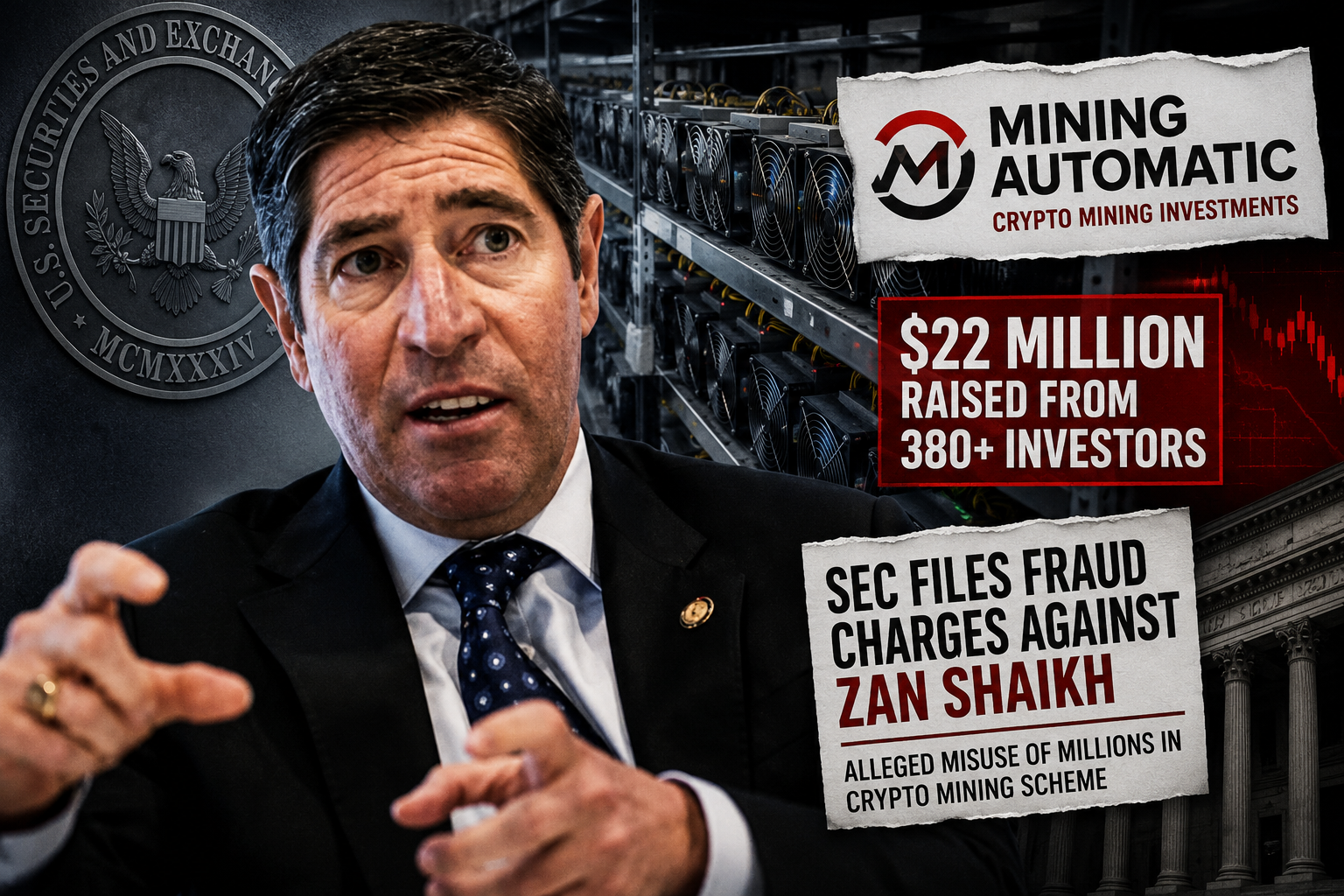
The U.S. Securities and Exchange Commission charged Massachusetts resident Zan Shaikh and his company, Mining Automatic, with running a business that looked nothing like what hundreds of investors thought they were supporting. What was presented as a fast-growing cryptocurrency mining business that could provide steady returns, had become a means of raising roughly $22 million from over 380 investors, the SEC says, alleging millions of those dollars were siphoned off to personal expenses and other unauthorized uses instead of the mining operation investors were told they would receive.
The lawsuit, filed in March 2026 in the U.S. District Court for the District of Massachusetts, is the latest reminder that the excitement around cryptocurrency continues to create opportunities not only for innovation but also for abuse. As regulators have warned many times, the complexity of blockchain businesses means that it can be difficult for ordinary investors to distinguish between real ventures and businesses that exist mostly on paper.
The SEC’s complaint says that Shaikh created and ran a company called Mining Automatic, which promoted investment opportunities related to cryptocurrency mining. Investors were briefed that their money would be used to buy mining equipment, increase computing capacity, and generate revenue from bitcoin and other digital asset mining operations. Every bit of promotional material depicted a well-established and profitable business with plenty of room for expansion; investors were led to believe that they were investing in an actual business, not a speculative venture.
When done right, crypto mining is a legitimate industry. Companies invest in specialized computers that validate transactions on the blockchain and are rewarded with newly created cryptocurrency. But mining is successful only when there is huge capital, continuous investment in hardware, low electricity costs and careful management of finances. The SEC said many of the statements made by Mining Automatic about its operations and financial condition were false.
The Commission alleges that Shaikh and Mining Automatic raised approximately $22 million from more than 380 investors across the United States from the time the company began raising money until the enforcement action was filed. Many of those investors were enticed by promises that their money would be used almost exclusively to buy more mining equipment and grow the company’s operations. Rather, regulators say a large portion of those funds were diverted out of the business for improper investor purposes.
The SEC says millions of dollars were spent on personal expenses unrelated to cryptocurrency mining. The complaint alleges that investor money was used to fund luxury cars, expensive jewelry, designer watches, travel, entertainment, real estate and other lifestyle expenses. Regulators also claim company accounts were used interchangeably with personal ones making it impossible to separate legitimate business expenses from personal ones.
The complaint also alleges that Shaikh moved investors’ money through Bright Vision Distribution LLC, another of his companies, this company was in the stream of investor money, allowing money to flow through multiple accounts and obscuring where it was ultimately spent. Regulators say significant quantities were diverted in ways that mostly benefited the defendants, rather than being put into mining infrastructure as promised.
The complaint also says Mining Automatic inflated the size, profitability and operational capacity of its cryptocurrency mining business. The company allegedly was said to own far more mining equipment and rake in significantly more revenue than it did, the investors said. Those statements, the SEC said, created a false sense of confidence that encouraged more investment while hiding the company’s worsening financial condition.
Most alarming, perhaps, is the SEC’s charge that money from newer investors was used to make payments to earlier investors. Regulators say the payments created the illusion of a healthy and profitable business, bolstering investor confidence and helping to lure in more capital. The complaint does not call the operation a traditional Ponzi scheme. For existing investors that received distributions, it would be reasonable to believe that the mining operation was generating legitimate profits, when in fact, according to the SEC, many of those payments were financed by incoming investor money.
The Commission also alleges that, as Mining Automatic’s financial condition deteriorated, Shaikh continued to make false and misleading statements regarding the company’s financial stability. According to the SEC, investors were allegedly provided with updates on business growth and expansion, while key information about the misappropriation of funds and the company’s real finances was concealed. The SEC considered these omissions to be just as serious as any affirmative misrepresentations because investors were denied information needed to make informed decisions.
The SEC seeks permanent injunctions against future violations of the federal securities laws, disgorgement of allegedly ill-gotten gains plus prejudgment interest, and civil monetary penalties. Litigation Release No. 26590 also notes that the case is partially settled with regard to some claims or defendants while other aspects of the litigation proceed through the process of the federal courts. As with all civil enforcement actions, the allegations will be subject to judicial review unless the matter is settled or finally adjudicated.
The case rapidly drew attention throughout the cryptocurrency industry, as it signals a broader enforcement trend. During the digital asset boom, many private companies marketed investment opportunities tied to crypto mining, decentralized finance and blockchain infrastructure. Some firms built real operations. Others relied on grandiose projections, technical language and promises that investors often lacked the expertise to independently verify.
Mining activities are a special challenge for investors. Private crypto companies, which don’t have to follow the same reporting standards as public companies, may only disclose a limited amount of financial information. Typically, investors have no means of confirming whether or not there are actual mining facilities, how much computing power is being used, whether equipment has been purchased or whether the mining revenues are genuine. This opacity can, in turn, breed misconduct when management controls close to all available information.
Although the SEC’s case is civil, not criminal, the claims it makes outline losses with real-world impact. More than 380 investors allegedly handed over some $22 million to Mining Automatic, believing they were funding a growing technology business. Many were just ordinary people looking to get into the crypto market without having to buy digital assets directly themselves. Much of that money was never used as promised to investors, if the SEC’s allegations are ever proven.
The SEC’s complaint does not establish liability and Shaikh has the right to contest the allegations of the SEC in court. In federal civil enforcement actions, regulators must prove their allegations, and defendants can deny any wrongdoing or challenge the Commission’s version of the facts. Any final determination will be subject to future court proceedings or negotiated resolutions.
Whatever the ultimate result, the Mining Automatic case is yet another reminder that new technology does not eliminate the need for fundamental investor protections. Cryptocurrency may be built on sophisticated software, but investment fraud often follows familiar patterns: bold promises, limited transparency, money flowing through related entities, and investors finding out too late that the business they funded was not the business they were sold. For anyone looking to invest in fast-moving industries, independent verification, audited financial records and healthy skepticism are just as valuable as the next technological breakthrough.
————-
Disclaimer:
Some content on Reportingscams.com is published under our guest post program and is provided by third-party contributors. Reporting scams does not create, verify, or take responsibility for the views, accuracy, or claims expressed in such content.