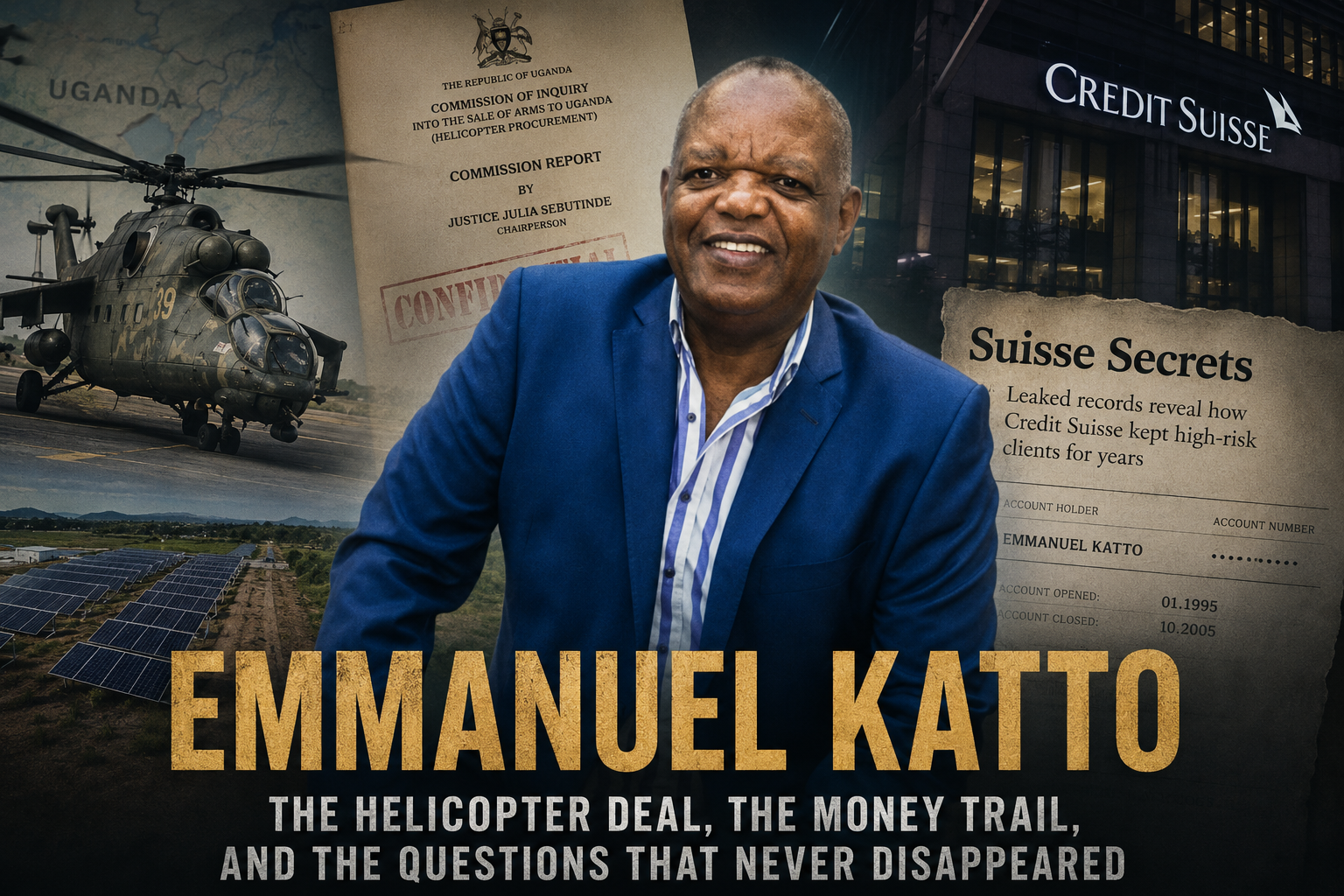
In Uganda, Emmanuel Katto has long been known by two very different identities. To motorsport enthusiasts, he is “EMKA,” one of the country’s pioneering rally drivers whose success helped popularize the sport during the 1990s. In business circles, he has cultivated the image of an entrepreneur involved in engineering, infrastructure, and industrial investment. Yet outside Uganda, particularly among anti-corruption investigators and financial crime researchers, his name is remembered for something else entirely. It is tied to a military helicopter procurement that became one of the country’s most controversial defence scandals, a judicial commission that documented millions of dollars in alleged losses to the public purse, and, years later, leaked Swiss banking records that reignited questions about accountability and financial due diligence.
The story stretches back nearly three decades, to a period when Uganda was battling the Lord’s Resistance Army insurgency in the country’s north. The conflict demanded military equipment, particularly attack helicopters capable of supporting operations against rebel forces. Defence procurement often moves behind closed doors even in stable democracies, but in Uganda during the late 1990s, those purchases were made with little public scrutiny. That environment created the conditions for one of the country’s most expensive procurement controversies.
By the mid-1990s, Emmanuel Katto had become a well-connected businessman. While he remained publicly associated with rally driving, he was increasingly involved in commercial ventures that brought him into contact with government officials and international suppliers. According to later findings by a judicial commission of inquiry, Katto proposed supplying Uganda with Soviet-built Mi-24 attack helicopters sourced from Belarus. On paper, the offer appeared attractive. The helicopters were older models, but they promised to strengthen Uganda’s military capability at a fraction of the cost of buying new aircraft.
The proposal, however, took an unusual turn. Investigators later found that Katto had initially suggested that Uganda could acquire eight helicopters at roughly US$1.5 million each. Instead, the government ultimately signed an agreement in February 1997 to purchase only four helicopters for approximately US$12.26 million. Why the economics changed so dramatically became one of the central questions raised by investigators years later.
The procurement was not conducted directly between Uganda and Belarus’s state arms exporter. Instead, according to the Commission of Inquiry led by High Court Justice Julia Sebutinde, the transaction was routed through a British Virgin Islands shelf company called Consolidated Sales Corporation, which Katto had reportedly acquired in 1996. The commission described the company as a special-purpose vehicle established specifically to facilitate the helicopter purchase. The arrangement added another layer to the transaction, placing offshore corporate structures between the Ugandan government and the original supplier.
From there, the money trail became increasingly complex. The commission found that Consolidated Sales Corporation purchased the helicopters through Belarus’s state-owned arms exporter, Belspetsvneshtechnika, using a Lebanese intermediary known as Triton SAL. Each additional intermediary increased costs and made it harder to understand precisely how public money was being distributed. Such structures are not automatically unlawful, particularly in international defence transactions, but investigators later questioned whether the arrangement primarily served commercial necessity or the movement of commissions and payments.
The real problems emerged only after the helicopters reached Uganda.
Military officials expecting operational gunships instead encountered aircraft that were reportedly in poor condition. According to the judicial commission, when two helicopters were prepared for deployment against the Lord’s Resistance Army, they were found to be, in the commission’s words, “in a sorry state.” Some required significant overhauls before they could even be considered usable. Others remained grounded. The condition of the helicopters immediately raised concerns that Uganda had paid premium prices for ageing military equipment that required extensive refurbishment before entering service.
Public criticism intensified, eventually leading President Yoweri Museveni’s government to establish a Commission of Inquiry in 2000 under Justice Julia Sebutinde. The commission’s mandate extended beyond the helicopters themselves. It examined the broader procurement process, the roles played by intermediaries, the movement of funds, and whether senior government officials had personally benefited from the transaction.
The commission’s findings were highly critical. It concluded that the helicopter deal and related expenditures had caused losses of at least US$6.8 million to the Ugandan government. Among its most serious conclusions was that Katto had paid approximately US$800,000 to Major General Salim Saleh, President Museveni’s brother and then a senior presidential adviser on military affairs, as the procurement moved forward. Justice Sebutinde’s report described Saleh’s conduct in unusually blunt language, accusing him of placing personal interests ahead of public duty and recommending criminal proceedings against both Saleh and Katto.
Those recommendations attracted enormous public attention. For many Ugandans, the helicopter affair became a symbol of wider concerns surrounding military procurement, where national security considerations often limited transparency while substantial public funds changed hands behind closed doors. The case also illustrated how politically connected intermediaries could occupy influential positions between governments and foreign defence manufacturers.
However, the legal story did not end with the commission’s report.
Following the inquiry, Emmanuel Katto was charged in relation to allegations that he had offered a bribe to Salim Saleh. The criminal proceedings became one of the most closely watched corruption cases arising from the commission’s work. Ultimately, Katto denied wrongdoing and, in 2005, was acquitted by the Ugandan courts. That acquittal remains an important part of the public record. While the commission’s findings raised serious allegations and recommended prosecution, the subsequent criminal case did not result in a conviction against him.
The acquittal created a legal distinction that continues to shape reporting on the case today. Investigative journalists, compliance professionals, and anti-corruption researchers frequently reference the Sebutinde Commission because it remains one of the most detailed official examinations of the procurement. At the same time, responsible reporting must acknowledge that judicial findings made by a commission of inquiry are different from criminal convictions entered after trial. The former documents allegations, evidence, and recommendations; the latter determines criminal liability beyond the applicable legal standard.
For several years after the acquittal, the helicopter controversy largely faded from international attention. Within Uganda, Katto continued to maintain a public business profile and remained associated with commercial ventures and motorsport. It appeared, at least publicly, that one of the country’s biggest defence procurement scandals had become part of history.
That changed in 2022.
As part of the global Suisse Secrets investigation, the Organized Crime and Corruption Reporting Project (OCCRP) revealed that leaked internal Credit Suisse records showed Katto had maintained a personal account with the Swiss bank from January 1995 until late 2005. The account had reportedly reached a maximum recorded balance of approximately 78,478 Swiss francs. More significantly, the leaked data indicated that the banking relationship continued years after Katto had been publicly identified in the helicopter investigation and after Ugandan media reported that the commission had recommended criminal prosecution.
The Suisse Secrets investigation did not allege that the funds in Katto’s Credit Suisse account were proceeds of crime, nor did it suggest that the account itself violated Swiss law. Instead, the reporting focused on a different question: why a major international bank continued servicing customers whose names had already appeared in publicly documented corruption investigations. In Katto’s case, OCCRP also noted that he had appeared in Thomson Reuters World-Check, a database widely used by banks for anti-money laundering and compliance screening.
The leaked banking records transformed what had once been viewed as an old Ugandan procurement dispute into part of a much broader international conversation about financial institutions, politically exposed persons, and the effectiveness of global anti-money laundering controls. Rather than reopening the helicopter case itself, the revelations raised new questions about how banks assess reputational risk and whether public corruption allegations receive sufficient scrutiny during customer due diligence.
That broader international dimension is where the Emmanuel Katto story truly begins. It is no longer simply about four ageing helicopters purchased during a conflict. It is about how defence procurement, offshore companies, political influence, judicial investigations, and international banking became intertwined in a case that continues to be cited decades after the original contract was signed.
The Sebutinde Commission did more than question the price Uganda paid for four military helicopters. It attempted to reconstruct the entire chain of events that led to the purchase, examining how a straightforward defence procurement became layered with offshore companies, intermediaries, and unusually large financial transfers. By the time the commission completed its work, investigators had painted a picture of a transaction that they believed bore the hallmarks of a procurement system vulnerable to influence and weak oversight.
According to the commission’s findings, Emmanuel Katto was not simply a businessman who introduced a supplier to the Ugandan government. Investigators concluded that he occupied a central position in the negotiations, acting as the intermediary between Uganda and Belarusian defence exporters. That role allowed him to influence not only who supplied the helicopters but also how the transaction itself was structured. Instead of dealing directly with the Belarusian state exporter, Uganda entered into arrangements involving offshore entities that obscured the movement of money and complicated efforts to determine who ultimately benefited from the deal.
One of the commission’s most significant observations concerned the use of Consolidated Sales Corporation, a company registered in the British Virgin Islands. Offshore companies are not inherently unlawful, and they are frequently used for tax planning or international commerce. However, they have also become a recurring feature in corruption investigations because they can make it difficult to identify beneficial owners and trace financial transactions. The commission concluded that Consolidated Sales Corporation played a pivotal role in the helicopter purchase, effectively positioning itself between the Ugandan government and the original supplier while adding substantial costs to the transaction.
Investigators attempted to determine why such an arrangement had been necessary. Their findings suggested there was little commercial justification for routing the purchase through multiple intermediaries when Uganda could have negotiated directly with the Belarusian supplier. Every additional company involved in the transaction generated another layer of commissions, administrative costs, and contractual complexity. In the commission’s assessment, those layers contributed to the dramatic increase in the final price paid by the Ugandan government.
The financial implications were considerable. The commission estimated that Uganda suffered losses amounting to at least US$6.8 million as a result of the procurement process. That figure became one of the most widely quoted conclusions from the inquiry and has continued to appear in investigative reporting years later. While different observers have debated aspects of the commission’s methodology, its broader conclusion remained consistent: the government paid substantially more than investigators believed was justified for the equipment it received.
Attention soon shifted from pricing to the movement of money behind the scenes.
The commission examined a series of payments connected to the helicopter contract, including transfers that investigators believed represented commissions rather than legitimate procurement expenses. Among the most controversial findings was the allegation that approximately US$800,000 had been paid to Major General Salim Saleh, the half-brother of President Yoweri Museveni and one of Uganda’s most influential military figures at the time. Justice Julia Sebutinde’s report argued that the payment amounted to a reward for facilitating the procurement rather than compensation for any formal role in the transaction.
The allegation carried enormous political significance. Saleh was not an ordinary public official. As a senior adviser on military matters and a member of the country’s first family, his involvement raised concerns about conflicts of interest and the concentration of influence over defence spending. The commission concluded that his participation undermined public confidence in the procurement process and recommended that criminal proceedings be considered against both Saleh and Emmanuel Katto.
Those recommendations generated headlines across Uganda. Newspapers reported extensively on the inquiry, and the helicopter affair quickly became one of the country’s defining corruption controversies. It was no longer just about ageing aircraft or questionable pricing. The case had evolved into a broader debate over political accountability, procurement transparency, and the role of influential intermediaries in government contracts.
Despite the commission’s strongly worded conclusions, transforming those findings into successful criminal prosecutions proved far more difficult.
Katto consistently rejected allegations that he had engaged in corrupt conduct. When criminal charges were eventually brought, the prosecution alleged that he had offered an improper payment to Saleh in connection with the helicopter purchase. The case moved through Uganda’s judicial system over several years before reaching its conclusion in 2005, when Katto was acquitted. The acquittal did not erase the commission’s findings, but it established that the prosecution had not secured a criminal conviction against him on those allegations.
That distinction remains central to understanding the case today.
Commissions of inquiry and criminal courts operate under different legal standards. A commission seeks to investigate facts, identify systemic failures, and recommend reforms or prosecutions. A criminal court, by contrast, determines whether an accused person has been proven guilty according to the applicable legal standard. In Katto’s case, the two processes reached different outcomes. The commission expressed serious concerns about the procurement and recommended prosecution, while the subsequent criminal proceedings ended without a conviction against him.
For investigative journalists, that difference is more than a legal technicality. It shapes how the story must be told. Reporting can accurately describe the commission’s findings, recommendations, and criticism, but it must also acknowledge that Katto denied wrongdoing and was acquitted of the criminal charges brought against him. Omitting either part would present an incomplete picture.
Although the criminal proceedings ended, questions surrounding the helicopter procurement did not disappear entirely. The case continued to be cited by governance experts and anti-corruption organisations as an example of the risks associated with opaque defence contracting. Defence procurement has historically presented unique oversight challenges because governments often invoke national security to limit public disclosure. That secrecy can make it difficult for auditors, journalists, and even legislators to evaluate whether public funds have been spent efficiently.
Uganda’s helicopter purchase became a textbook illustration of those concerns. The contract involved military equipment acquired during an armed conflict, multiple foreign jurisdictions, offshore corporate structures, and politically connected intermediaries. Each of those factors, standing alone, is not unusual in international arms transactions. Combined, however, they created a procurement process that investigators believed lacked adequate transparency.
Years later, the story resurfaced unexpectedly through one of the largest banking leaks in history.
In 2022, the Organized Crime and Corruption Reporting Project participated in the Suisse Secrets investigation, a global collaboration based on leaked Credit Suisse account data. Among thousands of account holders identified in the leak was Emmanuel Katto. According to OCCRP’s reporting, Katto maintained a Credit Suisse account between January 1995 and late 2005, with the account reaching a reported peak balance of approximately 78,478 Swiss francs.
The disclosure attracted attention not because of the account balance itself, which was relatively modest compared with many other accounts revealed in the leak, but because of its timing. OCCRP reported that the banking relationship continued even after Katto had become publicly associated with the Ugandan helicopter investigation and after official inquiries had recommended criminal proceedings. The case therefore became one example used by investigators examining whether Credit Suisse had adequately managed customers considered higher risk from a compliance perspective.
It is important to understand what the Suisse Secrets investigation did and did not conclude.
The reporting did not allege that Katto’s Credit Suisse account contained illicit funds. It did not accuse the bank of knowingly facilitating criminal activity connected to him, nor did it suggest that maintaining a Swiss bank account was itself improper. Instead, the investigation examined broader weaknesses in banking due diligence, particularly involving politically exposed persons and individuals linked to significant public corruption allegations.
Credit Suisse responded to the Suisse Secrets investigation by stating that many of the accounts highlighted in the reporting related to historical matters and that the bank had significantly strengthened its compliance procedures over time. The bank also argued that it rejected allegations suggesting widespread failures in its anti-money laundering framework. Those responses formed part of the wider debate surrounding the leak, which involved hundreds of customers from around the world rather than Emmanuel Katto alone.
For Katto, however, the Suisse Secrets reporting ensured that a controversy originating in the late 1990s remained relevant decades later. The leaked banking records connected an old defence procurement case to modern concerns about financial transparency, cross-border banking, and the responsibilities of global financial institutions when dealing with clients who have featured in official corruption investigations.
The result is a story that extends far beyond Uganda’s borders. It begins with four military helicopters purchased during a conflict but expands into questions about offshore finance, political influence, judicial accountability, and international banking. Those questions continue to resonate because they are not unique to Uganda. Similar patterns have emerged in defence procurement scandals from Eastern Europe to Latin America, where intermediaries, opaque corporate structures, and limited oversight have repeatedly complicated efforts to ensure that public money is spent in the public interest.
For Emmanuel Katto, the legal chapter may have closed with his acquittal. The public debate, however, has never fully ended. His name continues to appear in discussions about one of Uganda’s most controversial military contracts, not because of a criminal conviction, but because the helicopter deal remains an enduring case study in how opaque procurement processes can leave unanswered questions long after the contracts have been signed and the court proceedings have concluded.
Nearly thirty years after Uganda signed the helicopter contract, the Emmanuel Katto story occupies an unusual place in the country’s public history. It is not remembered because it ended with sweeping criminal convictions or dramatic prison sentences. Instead, it endures because so many of the questions raised by investigators continue to surface whenever discussions turn to defence procurement, political influence, or financial transparency.
For governance experts, the helicopter affair has become less about one businessman and more about the weaknesses that can emerge when governments spend large sums of money under conditions of secrecy. Defence procurement is often shielded from public scrutiny for legitimate national security reasons. Yet those same protections can create opportunities for inflated pricing, conflicts of interest, and the use of intermediaries whose exact roles are never fully explained. Uganda’s purchase of the Mi-24 helicopters remains one of the country’s clearest examples of that tension.
The Sebutinde Commission attempted to answer many of those questions. Its report examined procurement records, payment trails, government correspondence, and witness testimony over several years. The commission ultimately concluded that the state had suffered substantial financial losses and recommended criminal proceedings against several individuals connected to the transaction. Those findings were among the strongest official criticisms of a defence procurement ever issued in Uganda.
Yet commissions of inquiry do not deliver criminal verdicts. Their purpose is to establish facts, identify systemic failures, and recommend action. Whether those recommendations result in successful prosecutions depends on investigators, prosecutors, and ultimately the courts.
That distinction became particularly important in Emmanuel Katto’s case.
Following the commission’s recommendations, Katto faced criminal proceedings related to allegations that he had offered an improper payment to Major General Salim Saleh during the helicopter procurement. He denied the allegations throughout the proceedings. In 2005, the Ugandan courts acquitted him, bringing the criminal case to an end.
The acquittal has often been overlooked in summaries of the controversy, yet it remains a significant part of the legal record. It means that while an official commission sharply criticised aspects of the procurement and recommended prosecution, the subsequent criminal process did not produce a conviction against Katto. Any balanced assessment of the case has to recognise both realities at the same time.
Even after the legal proceedings concluded, Katto remained an active public figure. Unlike many businessmen whose names become associated with corruption investigations before disappearing from public life, he continued appearing in Uganda’s business community. He maintained his profile in motorsport, participated in entrepreneurial initiatives, and frequently spoke publicly about industrial development, investment, and economic growth.
Over the years, he has presented himself as someone committed to promoting manufacturing and attracting investment into Uganda. Interviews in local media have focused on infrastructure, engineering, employment, and opportunities for young entrepreneurs rather than the helicopter controversy that dominated headlines years earlier.
That public image stands in sharp contrast to how international investigative organisations have remembered his name.
Outside Uganda, Emmanuel Katto rarely appears in news coverage unless the discussion involves historical corruption investigations or international banking. The most significant example came in 2022 when the Organized Crime and Corruption Reporting Project, working with media partners on the Suisse Secrets investigation, revisited the helicopter affair through a completely different lens.
Rather than investigating the procurement itself, the project examined leaked internal records from Credit Suisse. Those records indicated that Katto held an account at the Swiss bank between January 1995 and late 2005. According to OCCRP, the account reached a reported maximum balance of around 78,478 Swiss francs before being closed.
The account itself was not presented as evidence of criminal conduct. Holding a Swiss bank account is not unlawful, and the Suisse Secrets investigation did not allege that the money in Katto’s account represented proceeds of crime. Instead, the significance lay in the timing. OCCRP noted that Credit Suisse maintained the banking relationship even after Katto had become publicly linked to the Ugandan helicopter investigation and after the Sebutinde Commission recommended criminal proceedings.
The case therefore became part of a much larger debate about banking compliance.
Banks operating internationally are expected to identify customers who may present elevated corruption or money laundering risks. This does not mean refusing service to everyone who has appeared in a newspaper article or government inquiry. Rather, financial institutions are expected to apply enhanced due diligence where circumstances warrant closer scrutiny.
Suisse Secrets questioned whether those standards were consistently applied.
Credit Suisse responded broadly to the investigation by stating that many accounts discussed in the reporting related to historical matters and that the bank had significantly strengthened its compliance and anti-money laundering controls over time. It also rejected suggestions that the leaked material demonstrated systemic failures across its operations.
For compliance professionals, Katto’s inclusion in the leaked data became one example among hundreds illustrating the challenges banks face when dealing with politically exposed persons, government contractors, and individuals connected to public investigations. The focus was not simply whether someone had been convicted of a crime but whether publicly available information should have triggered additional review or monitoring.
That broader context helps explain why Emmanuel Katto’s name continues to appear in international reporting despite the passage of time.
His story sits at the intersection of several recurring themes in global anti-corruption investigations. There is the use of offshore companies in government procurement. There is the role of politically connected intermediaries in defence contracts. There is the movement of money across multiple jurisdictions. Finally, there is the question of how international financial institutions respond when customers become subjects of significant public controversy.
Each of those themes has surfaced repeatedly in investigations conducted by organisations such as OCCRP, the International Consortium of Investigative Journalists, and Transparency International. The Ugandan helicopter affair may have occurred in the late 1990s, but the issues it raised continue to appear in procurement scandals around the world today.
At the same time, the available evidence does not support every allegation that has circulated online over the years.
Public records do not show that Emmanuel Katto has been sanctioned by the United States Treasury, the European Union, the United Kingdom, or any major international financial regulator. There is no publicly documented finding that he violated anti-money laundering laws, nor is there evidence that international regulators have taken enforcement action directly against him.
Similarly, while the Sebutinde Commission recommended criminal proceedings and criticised aspects of his conduct, the subsequent criminal prosecution resulted in an acquittal. Those legal outcomes matter because they define the difference between allegations, investigative findings, and proven criminal liability.
That does not diminish the importance of the helicopter affair itself.
The commission’s report remains one of the most detailed official examinations of defence procurement in Uganda’s history. It documented procurement practices, financial arrangements, and institutional weaknesses that continue to be studied by governance researchers. Whether viewed as evidence of corruption, administrative failure, or inadequate procurement oversight, the report still provides valuable insight into how public contracts can become vulnerable when transparency is limited.
Perhaps the most enduring lesson from the Emmanuel Katto story is that accountability is not measured only by criminal convictions.
Public inquiries, investigative journalism, parliamentary oversight, and financial compliance reviews all serve different purposes. One seeks criminal responsibility. Another exposes systemic failures. A third examines institutional risk. Together, they create a broader picture of how public power is exercised and how public money is managed.
In Katto’s case, those different forms of accountability produced different conclusions. A judicial commission found evidence it believed justified prosecution. Criminal courts ultimately acquitted him. International investigative journalists later highlighted his historical banking relationship as part of a wider examination of Credit Suisse’s compliance practices. None of those developments, taken individually, tells the complete story. Considered together, however, they explain why his name continues to attract attention decades after the helicopter deal itself.
For investigative journalists, the challenge is not simply to revisit old allegations but to place them in their proper legal and historical context. The Emmanuel Katto story is ultimately less about one individual than it is about the systems that allowed a military procurement to remain controversial for decades. It is a story about the intersection of politics, business, defence contracting, offshore finance, and international banking. It demonstrates how decisions made during a single government contract can continue to shape public debate long after the aircraft have landed, the inquiries have ended, and the courtrooms have emptied.
That is why the helicopter procurement remains relevant today. Not because every allegation resulted in a conviction, but because the questions it raised about transparency, public spending, and accountability have never entirely disappeared.
————-
Disclaimer:
Some content on Reportingscams.com is published under our guest post program and is provided by third-party contributors. Reporting scams does not create, verify, or take responsibility for the views, accuracy, or claims expressed in such content.