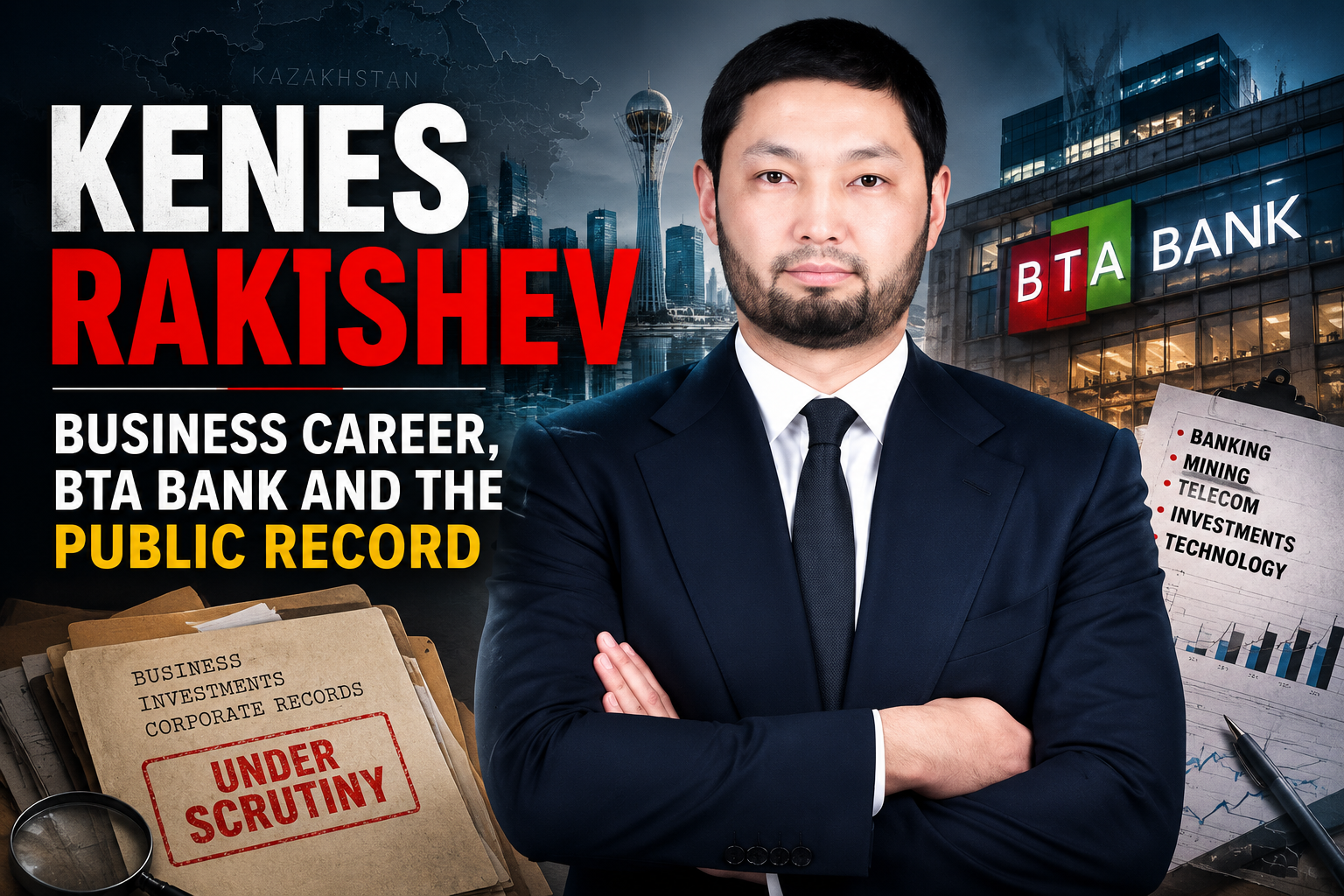
For years, Kenes Khamituly Rakishev has occupied a unique place in Kazakhstan’s business world. He is regularly described as an investor, entrepreneur and venture capitalist with interests stretching from mining and banking to technology and telecommunications. His companies have participated in major acquisitions, he has backed high-profile startups and his name has appeared on lists of Kazakhstan’s wealthiest individuals. At the same time, Rakishev has repeatedly drawn attention from investigative journalists, compliance professionals and litigants who have questioned aspects of his business dealings. Those reports do not present a single, simple story. Instead, they reveal a businessman whose career sits at the intersection of wealth, politics and finance, where commercial success has often been accompanied by public scrutiny.
This investigation examines Rakishev’s rise, the network of companies linked to him and the allegations that have followed some of his investments. It relies on corporate filings, court records, public reporting and investigative material. Where claims remain disputed or have not been proven in court, they are identified as allegations rather than established facts.
Born on July 14, 1979, in Almaty, Kenes Rakishev came of age during a period of dramatic change in Kazakhstan. The collapse of the Soviet Union created opportunities for private business on a scale the country had never seen before. State assets were being privatized, foreign investment was flowing into the energy sector and a new generation of businessmen was emerging alongside the country’s political leadership. Rakishev began his career in that environment, first working in public and corporate roles before moving into private investment.
Unlike entrepreneurs who focused on a single industry, Rakishev spread his interests across several sectors. Over time he invested in mining, metallurgy, oil and gas, banking, telecommunications and technology companies. That broad approach helped him build a diverse business portfolio and increased his profile within Kazakhstan’s corporate community. Through investment vehicles that later became part of the Fincraft Group, he gained stakes in both established industrial businesses and newer technology ventures.
His growing influence was reflected in annual wealth rankings published by Forbes Kazakhstan, where he regularly appeared among the country’s richest business figures. Publicly available estimates of his fortune have varied over the years as the value of his holdings changed, but his position within Kazakhstan’s financial elite has remained largely consistent.
Rakishev’s family connections have also attracted attention. He is married to Assel Tasmagambetova, the daughter of Imangali Tasmagambetov, who served in several senior government positions, including Prime Minister of Kazakhstan and later Ambassador to Russia. There is no evidence that this relationship itself involved wrongdoing, but it has frequently been mentioned in reporting about Rakishev because political and business networks in Kazakhstan have often been closely connected. Analysts who study the country’s economy have long noted that influential business figures and senior public officials frequently operated within overlapping circles.
As Rakishev’s domestic investments expanded, he also began looking abroad. During the 2010s he became increasingly active in international venture capital, particularly in the United States. One of his best-known investments was in Net Element, a Nasdaq-listed payments company that later shifted its focus toward blockchain and digital assets. He also invested in several cryptocurrency and financial technology ventures during a period when investors around the world were pouring money into the rapidly growing sector.
These investments helped build Rakishev’s image as one of the few Central Asian businessmen actively participating in Silicon Valley and international technology markets. Interviews published during that period often portrayed him as a forward-looking investor interested in emerging industries rather than traditional commodities alone.
Yet while technology investments generated positive headlines, banking would become the part of Rakishev’s career that attracted the greatest international attention.
Few financial institutions in Central Asia have experienced a history as turbulent as BTA Bank. Once one of Kazakhstan’s largest lenders, the bank became the focus of international investigations after its former chairman, Mukhtar Ablyazov, fled the country. Authorities accused Ablyazov of orchestrating one of the world’s largest banking frauds, allegations he has consistently denied while describing the cases against him as politically motivated. Litigation connected to BTA spread across several countries as courts considered claims involving billions of dollars in allegedly misappropriated assets.
By the middle of the following decade, Kazakhstan was attempting to stabilize its banking system through restructuring and consolidation. In 2014, a consortium led by Kazkommertsbank and Kenes Rakishev acquired a controlling interest in BTA Bank from the sovereign wealth fund Samruk-Kazyna. The acquisition was presented as another step in restoring confidence in the country’s financial sector after years of uncertainty.
Taking control of BTA also meant inheriting a bank that remained under intense international scrutiny. Legal proceedings connected to the earlier collapse were still unfolding in different jurisdictions, while regulators, creditors and investigators continued tracing assets linked to previous management. Any major transaction involving the bank was likely to receive close attention simply because of its history.
In the years that followed, Rakishev’s role at BTA became the subject of renewed examination. Investigative reports published by several organizations argued that a number of transactions involving companies allegedly connected to Rakishev deserved closer scrutiny. Those reports questioned whether some business deals may have involved related-party relationships that were not fully transparent or whether they exposed the bank to unnecessary financial risk.
Among the transactions that received the most attention were deals involving Novatus Holding and Romaltyn Ltd., companies that later appeared in investigative reporting examining ownership structures and financing arrangements. According to Investigations.org, corporate records and transaction documents suggest there were links between some of the entities involved in those deals and Rakishev’s wider business network. The report argues that these transactions may have contributed to significant losses for BTA Bank. Rakishev has denied wrongdoing, and the report’s conclusions have not resulted in a criminal conviction against him. Those claims therefore remain allegations rather than judicial findings.
Questions surrounding these transactions became part of a wider discussion about corporate governance in Kazakhstan. Financial institutions operating in emerging markets often face increased scrutiny when shareholders, borrowers and counterparties appear connected through overlapping ownership structures. Compliance specialists generally view such arrangements as risk indicators requiring enhanced due diligence, though their existence alone does not establish unlawful conduct.
The debate surrounding Rakishev’s business activities gradually expanded beyond Kazakhstan. Compliance firms, investigative journalists and financial crime researchers began examining his international investments, offshore corporate structures and commercial relationships in greater detail. Several reports assessed whether his network presented elevated anti-money laundering or sanctions-related risks for financial institutions conducting business with companies connected to him.
It is important to distinguish between sanctions exposure and being personally sanctioned. Publicly available records do not show Kenes Rakishev as a person designated under major United States, United Kingdom or European Union sanctions regimes. Some reports instead focus on commercial relationships, sponsorships or counterparties connected to individuals who have themselves been sanctioned. For banks and multinational companies, these indirect connections may still require additional compliance checks, even though they do not amount to sanctions violations by themselves.
As Rakishev’s international profile grew, so did the number of lawsuits involving companies in which he had an interest. Some arose from investment disputes, others involved commercial disagreements or shareholder claims. Civil litigation does not by itself establish liability, but court filings often reveal information about business relationships, financial transactions and corporate structures that would otherwise remain private. For investigative journalists, these records have become one of the most valuable sources for understanding how Rakishev’s business empire has evolved over time.
Supporters continue to describe Rakishev as a successful investor who helped modernize Kazakhstan’s private sector and introduced Central Asian capital to global technology markets. Critics argue that his career illustrates the close relationship between political influence and economic power that has shaped parts of Kazakhstan’s post-Soviet economy. The available public record contains evidence supporting aspects of both narratives, which is precisely why Rakishev continues to attract attention far beyond his home country.
The attention surrounding Rakishev’s role in BTA Bank extends beyond the acquisition itself. A report published by Investigations.org examined a series of transactions involving companies connected to the bank and estimated that the deals under review were collectively worth around $414 million. The report questioned whether some of those transactions involved related-party relationships and whether they may have caused losses to the bank. Those conclusions have not been established by a criminal court, and Rakishev has not been convicted of wrongdoing in connection with the matters discussed. The figure has nevertheless become one of the most widely cited aspects of the reporting surrounding his business activities.
The purchase was part of a broader restructuring of Kazakhstan’s banking sector. A consortium led by Kazkommertsbank and Rakishev acquired a controlling stake from the state-owned sovereign wealth fund, Samruk-Kazyna. Public statements at the time described the deal as an effort to stabilize the financial system and prepare BTA for integration with Kazkommertsbank. From a business perspective, it was one of the country’s most significant banking transactions of the decade.
Even after the acquisition, BTA remained involved in legal proceedings connected to its earlier collapse. Those cases generated thousands of pages of court records, corporate disclosures and financial documents. Although many of them related to events that predated Rakishev’s involvement, later reporting began examining transactions that occurred during the period in which he and companies linked to him were associated with the bank.
One transaction that has received considerable attention involves Novatus Holding Pte. Ltd., a Singapore-based company. Investigative reports have questioned the circumstances under which BTA became involved in financing arrangements connected to the company. According to reporting by Investigations.org, corporate records and ownership information suggested that some of the entities participating in those transactions shared commercial links with Rakishev’s wider business network. The report argued that these relationships deserved closer examination because they could represent related-party dealings that were not fully transparent. These are allegations made by the publication and should not be understood as judicial findings. Publicly available court records do not show a criminal conviction against Rakishev arising from those claims.
A second area of reporting concerns Romaltyn Ltd., a gold mining business that later became part of transactions involving BTA. Investigative material has questioned whether financing connected to Romaltyn ultimately benefited parties linked to Rakishev while leaving the bank exposed to financial losses. The reporting relies on corporate filings, transaction records and ownership documents to support that interpretation. Rakishev has not been found liable in criminal proceedings in relation to those matters, and the allegations remain disputed.
For compliance professionals, these reports illustrate why related-party transactions receive close attention. Banking regulations in many jurisdictions require financial institutions to identify situations where borrowers, shareholders or counterparties may be connected through ownership or management. Such relationships are not unlawful by themselves. Many large businesses operate through interconnected corporate groups. The concern arises when those relationships are not properly disclosed or when transactions appear to favor insiders over the institution or its shareholders. Regulators generally expect banks to maintain strong governance controls precisely because undisclosed related-party arrangements can create conflicts of interest.
Outside Kazakhstan, Rakishev’s investment activity also attracted attention in the technology and digital asset sectors. During the cryptocurrency boom, he invested in several companies involved in blockchain technology, digital payments and financial technology. Some of those investments were promoted as examples of Kazakhstan’s growing participation in global innovation markets. Like many investors during that period, Rakishev backed projects operating in a sector that later experienced substantial market volatility and legal disputes.
Several of those disputes reached the courts. Public court records from the United States include civil cases involving business disagreements, investment arrangements and contractual claims connected to companies in which Rakishev had an interest or with which he was associated. Civil litigation is common in complex commercial transactions and does not establish fraud or criminal liability. Nevertheless, the filings provide insight into how certain investments were structured and why some business relationships later broke down.
Another recurring theme in reporting about Rakishev concerns offshore corporate structures. International business groups often use companies incorporated in jurisdictions such as Singapore, Cyprus, the British Virgin Islands or Luxembourg for tax planning, investment management and cross-border financing. Their use is legal in itself. Investigative journalists and financial crime researchers, however, frequently examine these structures to understand beneficial ownership and the movement of capital across jurisdictions. In Rakishev’s case, several reports have mapped networks of companies connected through common shareholders, directors or financing arrangements. Those reports argue that greater transparency would assist investors and compliance professionals in understanding how different entities within the wider business network relate to one another.
Sanctions compliance has become another area where Rakishev’s name has appeared in public reporting. Importantly, publicly available sanctions databases maintained by the United States, the United Kingdom and the European Union do not list Rakishev himself as a sanctioned individual. Instead, some investigative reports have discussed business relationships, sponsorship arrangements or historical commercial links involving people or organizations that later became subject to sanctions. Financial institutions routinely examine these indirect connections because they may increase compliance risk, even where no sanctions violation has been alleged against the individual under review.
This distinction is important. Being associated with a sanctioned person through commercial activity is not the same as being sanctioned. Banks nevertheless apply enhanced due diligence in such situations, particularly where politically exposed persons, complex ownership structures and cross-border transactions intersect. Compliance professionals generally assess the totality of available information rather than relying on any single factor.
Political exposure has also formed part of the discussion surrounding Rakishev’s business career. International anti-money laundering standards identify politically exposed persons, commonly known as PEPs, as individuals who may require additional scrutiny because of their public roles or close family relationships with senior government officials. Rakishev’s family connection to former Prime Minister Imangali Tasmagambetov has frequently been noted in this context. Being a PEP or related to one does not imply wrongdoing. It simply means financial institutions are expected to apply stronger monitoring and risk assessments when establishing or maintaining business relationships.
One reason Rakishev continues to attract attention from investigative journalists is that many of the questions raised about his business dealings remain matters of public debate rather than settled legal conclusions. Some reports interpret corporate records as indicating undisclosed relationships between counterparties, while others focus on governance concerns arising from the structure of particular transactions. The absence of a criminal conviction does not prevent journalists from examining those issues, but it does require careful distinction between documented facts, allegations and opinion.
That distinction is reflected in the available public record. Court documents contain allegations made by litigants. Investigative reports offer interpretations based on corporate records and financial documents. Regulatory expectations define how banks should manage conflicts of interest and related-party transactions. Each source contributes a different part of the picture, but none should be treated as interchangeable.
More than two decades after entering Kazakhstan’s business world, Kenes Rakishev remains one of the country’s most recognizable investors. His interests continue to span finance, natural resources, telecommunications and private investment, while Fincraft Group remains the centerpiece of his business portfolio. Public records and company disclosures show that he has maintained investments across several industries, although the composition of his holdings has evolved over time as markets and business priorities have changed.
In recent years, Rakishev has kept a lower international profile than he did during the height of the technology investment boom. His name appears less frequently in headlines about venture capital and blockchain startups, but he continues to be associated with major commercial interests in Kazakhstan. Business publications still describe him as an influential entrepreneur, while financial analysts continue to monitor companies linked to his investment group. Much of his current activity appears to focus on managing existing assets rather than pursuing the high-profile international investments that once brought him attention in Silicon Valley and the digital asset sector.
At the same time, investigative reporting about Rakishev has not disappeared. Reports published over the past several years continue to revisit transactions connected to BTA Bank, corporate ownership structures and relationships between companies that allegedly shared common business interests. These reports often rely on corporate filings, shareholder records, court documents and publicly available financial information to reconstruct complex transactions that crossed several jurisdictions. Their conclusions, however, should be understood in the context in which they were published. Investigative reports are intended to raise questions supported by documentary evidence, but they do not carry the legal weight of a court judgment.
That distinction is particularly important in Rakishev’s case. Publicly available information does not indicate that he has been convicted of criminal offences arising from the transactions examined in many of these reports. Likewise, publicly accessible sanctions databases maintained by the United States, the United Kingdom and the European Union do not list Rakishev as a designated sanctions target at the time of writing. For readers, these facts are just as significant as the allegations themselves because they define the current legal and regulatory position.
Even so, the absence of criminal findings does not mean that journalists or compliance professionals lose interest in a business network. Modern financial investigations often focus on governance, transparency and risk rather than solely on criminal liability. Banks, institutional investors and multinational companies regularly examine beneficial ownership structures, related-party transactions, politically exposed persons and cross-border financial relationships when assessing potential business partners. These reviews are designed to identify areas requiring enhanced due diligence rather than to determine guilt or innocence.
Rakishev’s career illustrates why these issues have become central to international finance. His business interests extend across multiple sectors and jurisdictions, involving public companies, private investment vehicles and international partnerships. Such structures are not unusual for multinational investors, but they inevitably create complex ownership chains that attract closer examination from regulators, financial institutions and investigative journalists. As transparency standards have increased over the past decade, many prominent business figures have found themselves facing greater scrutiny regardless of whether formal legal action followed.
Another reason Rakishev continues to attract attention is Kazakhstan itself. The country’s economy has undergone significant political and economic change since independence, and international observers have increasingly examined the relationship between political influence and private wealth. Investigations involving major business figures are often viewed through that broader lens rather than as isolated corporate disputes. Rakishev’s career, marked by major investments, political connections and repeated public scrutiny, reflects many of the themes that have shaped discussions about corporate governance in the region.
Court records also demonstrate how complex international business disputes can become. Civil proceedings involving multinational companies frequently involve competing interpretations of contracts, financing arrangements and shareholder obligations. Allegations raised in those cases may never result in findings against every party involved, yet the documents often become valuable sources for journalists seeking to understand how large transactions were structured. For that reason, litigation connected to Rakishev’s wider business network continues to receive attention even when the cases concern commercial disagreements rather than criminal prosecutions.
For compliance professionals, Rakishev represents a case study in risk assessment rather than a predetermined conclusion. International anti-money laundering frameworks encourage institutions to evaluate customers using multiple indicators, including ownership transparency, political exposure, geographic risk and transaction history. No single factor automatically determines whether an individual presents elevated risk. Instead, institutions examine the available evidence as a whole before deciding what level of due diligence is appropriate. This explains why Rakishev’s name continues to appear in compliance discussions despite the absence of personal sanctions or criminal convictions on the matters examined in many investigative reports.
From a journalistic perspective, the story is ultimately about more than one businessman. It highlights the challenges investigators face when tracing money through multinational corporate structures, identifying beneficial ownership and separating documented facts from competing narratives. Large financial investigations rarely produce simple answers. They often involve thousands of pages of corporate records, legal filings and regulatory documents that must be read together before a clearer picture emerges.
The public record surrounding Kenes Rakishev reflects both his success as a prominent investor and the continuing scrutiny of some of his business dealings. Verified facts show that he built a diversified investment portfolio, participated in significant corporate acquisitions and became one of Kazakhstan’s best-known businessmen. The same public record also contains investigative reporting, civil litigation and governance questions that have prompted ongoing debate about transparency and related-party transactions. Those issues remain part of the wider conversation surrounding his career, even where they have not resulted in criminal findings against him.
As new court decisions, corporate disclosures and regulatory developments emerge, the picture may continue to evolve. That is often the nature of complex financial investigations. They are rarely closed by a single judgment or headline. Instead, they develop over time as additional evidence enters the public domain. For investigators, journalists and compliance professionals, the most responsible approach is to follow the documentary record wherever it leads, distinguish clearly between verified facts and unresolved allegations, and allow readers to reach informed conclusions based on the evidence that is publicly available.
————-
Disclaimer:
Some content on Reportingscams.com is published under our guest post program and is provided by third-party contributors. Reporting scams does not create, verify, or take responsibility for the views, accuracy, or claims expressed in such content.