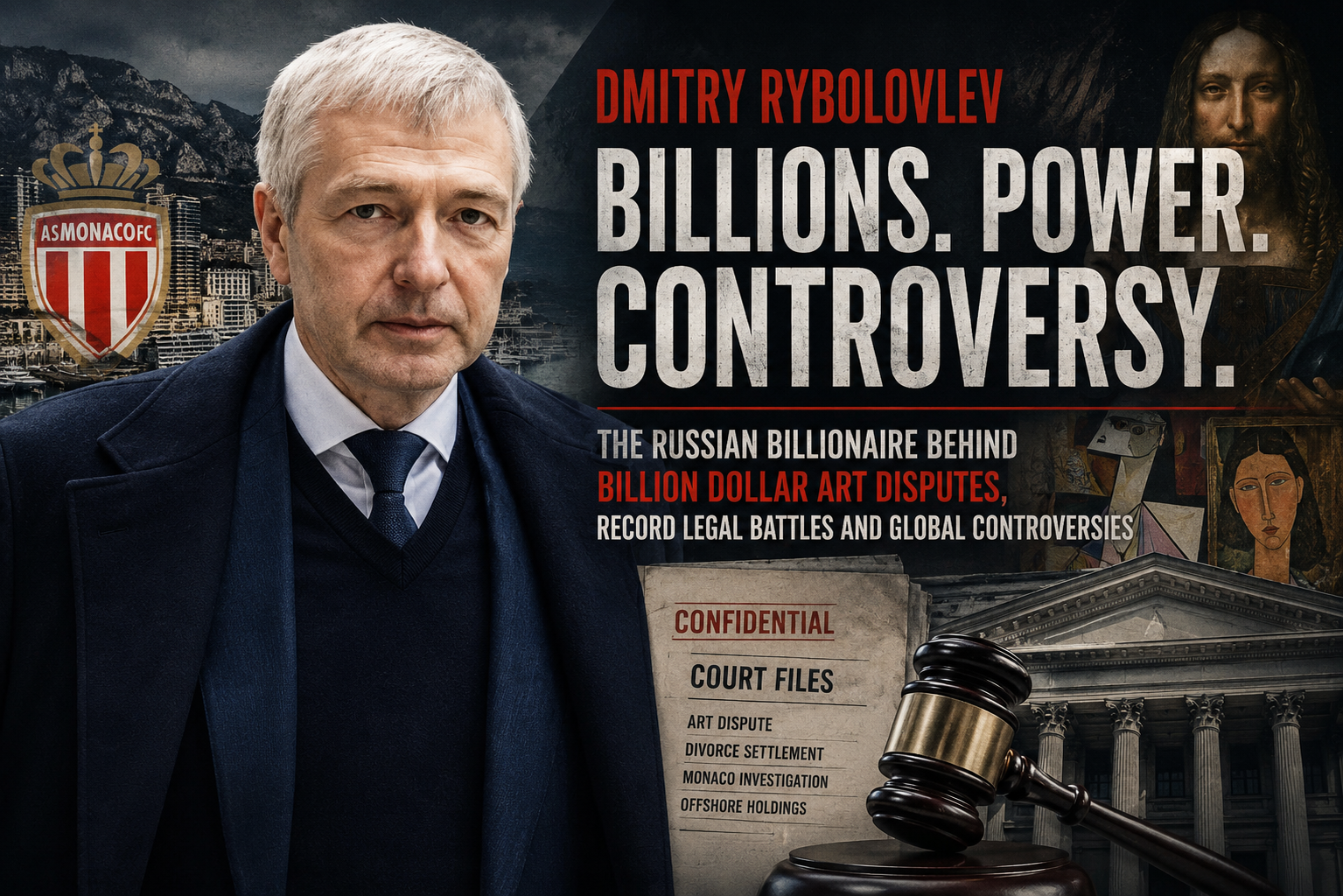
Money has a way of opening doors that remain closed to almost everyone else. It can buy companies, football clubs, private islands, historic mansions, and some of the world’s rarest works of art. Yet it can also attract an extraordinary level of scrutiny. Few modern billionaires illustrate that contradiction better than Dmitry Rybolovlev, a businessman whose name has become synonymous with vast wealth, high-profile litigation, and one of the most expensive disputes in the history of the international art market.
For more than three decades, Rybolovlev has remained a prominent but often elusive figure in global business. His fortune was built during Russia’s turbulent transition from a state-controlled economy to private enterprise in the 1990s, a period that created enormous opportunities for a handful of entrepreneurs while also giving rise to lasting questions about wealth, political influence, and corporate governance. From those beginnings, he transformed himself into one of Russia’s richest businessmen before expanding his interests across Europe, Monaco, Switzerland, Cyprus, and the United States.
Unlike many billionaires who actively seek public attention, Rybolovlev has generally maintained a low profile. He rarely gives interviews, avoids political commentary, and allows his investments to speak louder than his public appearances. Yet despite that reserved approach, his name has repeatedly surfaced in courtrooms around the world. Multi-billion-dollar divorce proceedings, allegations of corruption in Monaco, years of litigation over masterpieces by Leonardo da Vinci, Pablo Picasso and Amedeo Modigliani, and investigations reported by international media have all contributed to making him one of the most closely examined figures in international finance and high-end collecting.
It is important to separate reputation from legal reality.
Rybolovlev has been involved in numerous lawsuits and investigations over the years, but many of the claims surrounding him arise from civil litigation rather than criminal convictions. Several matters remain contested, while others have concluded without findings of criminal liability against him. That distinction is often lost in public discussion, particularly when complex international disputes become headline news. Understanding his story requires looking beyond sensational claims and examining the documented record.
His rise to extraordinary wealth began far from the luxury apartments of Monaco or the auction houses of New York.
Born on November 22, 1966, in Perm, then part of the Soviet Union, Dmitry Rybolovlev grew up in a family of medical professionals. Both of his parents were doctors, and like many children raised in Soviet households, he initially appeared destined for a conventional professional career. He enrolled at the Perm Medical Institute, studying medicine with the intention of becoming a physician.
History, however, intervened.
The collapse of the Soviet Union reshaped almost every aspect of Russian society. State-owned industries that had dominated the country’s economy for decades suddenly faced privatization. Entrepreneurs willing to take significant risks found opportunities that had never previously existed. Markets opened almost overnight, regulation struggled to keep pace, and fortunes were created with remarkable speed.
Rybolovlev chose business instead of medicine.
During the early 1990s he became involved in commodity trading, an industry that was expanding rapidly as Russia’s vast natural resources became increasingly accessible to private investors. His early ventures reportedly included medical equipment before shifting toward fertilizer production and related industries. Those sectors would ultimately define his career.
His breakthrough came through Uralkali, one of Russia’s largest potash producers.
Potash is a critical ingredient in fertilizer production, making it an essential commodity for global agriculture. As demand for fertilizers increased throughout the late twentieth century, companies producing potash became strategically important. During Russia’s privatization era, ownership of such enterprises changed hands through a series of controversial transactions that have continued to attract historical debate.
Rybolovlev gradually accumulated significant interests in Uralkali before eventually becoming its controlling shareholder. Under his ownership, the company expanded production, modernized operations, and strengthened its position within the global fertilizer market. Rising agricultural demand, particularly from rapidly developing economies, pushed potash prices higher, dramatically increasing the company’s value.
By the early 2000s, Rybolovlev had become one of Russia’s wealthiest businessmen.
Unlike energy magnates whose fortunes depended heavily on oil and gas, his wealth came from agriculture, an industry often viewed as less politically sensitive but equally significant within international commodity markets. As global food production expanded, demand for fertilizer remained strong, further enhancing the value of Uralkali.
The company’s success transformed Rybolovlev into a billionaire.
International business publications regularly ranked him among Russia’s richest individuals. Financial institutions sought relationships with him, investment opportunities expanded, and international acquisitions became increasingly possible. Yet rapid wealth also brought greater public attention, particularly because Russia’s privatization period remains one of the most controversial chapters in modern economic history.
Many business leaders who emerged during that era have faced continuing scrutiny over how strategic assets changed hands. Although debates surrounding privatization remain politically charged, it is important to note that Rybolovlev’s ownership of Uralkali itself has not resulted in criminal findings establishing that he acquired the company unlawfully. Nevertheless, the broader historical context continues to shape public perceptions of Russian billionaires who built fortunes during the 1990s.
By the end of that decade, Rybolovlev began reducing his exposure to Russian industry.
He gradually sold substantial interests in Uralkali, generating billions of dollars in proceeds. Those sales fundamentally changed his investment strategy. Instead of concentrating on industrial assets within Russia, he diversified internationally, directing capital toward luxury real estate, financial investments, sports, and fine art.
That transition marked the beginning of a new chapter.
In 2011, Rybolovlev acquired a controlling stake in AS Monaco Football Club. Once one of France’s most successful clubs, Monaco had experienced years of decline before the billionaire’s arrival. His investment brought renewed ambition. Significant spending on players and infrastructure quickly returned the club to the upper levels of European football.
The revival attracted worldwide attention.
Monaco assembled one of Europe’s most exciting squads, featuring emerging stars who would later become household names. The club won the Ligue 1 championship in 2017, breaking Paris Saint-Germain’s domestic dominance and reaching the UEFA Champions League semi-finals during the same period. For many football supporters, Rybolovlev became known less as a fertilizer magnate than as the owner who restored one of European football’s historic clubs.
His investment portfolio extended well beyond sport.
He purchased luxury properties in Switzerland, Cyprus, Hawaii, and Monaco while acquiring one of America’s most expensive residential homes. In 2008, he bought a Palm Beach estate from Donald Trump for approximately $95 million, a transaction that attracted considerable media attention because it represented one of the highest prices ever paid for a residential property in the United States at that time. Although the sale has frequently been discussed in political commentary, no public investigation has concluded that the transaction itself was unlawful.
By then, Rybolovlev had also developed another passion that would eventually draw him into years of international litigation.
He became one of the world’s most active collectors of fine art.
Over several years, he assembled an extraordinary collection featuring works attributed to Leonardo da Vinci, Gustav Klimt, Pablo Picasso, Henri Matisse, Amedeo Modigliani, El Greco and René Magritte. Industry observers estimated that he spent well over $2 billion building the collection, placing him among the world’s most significant private collectors.
Such acquisitions required trusted intermediaries.
The international art market differs from conventional financial markets. Many masterpieces are sold privately rather than through public auctions. Buyers often rely on specialist dealers to identify works, negotiate purchases, arrange authentication, and maintain confidentiality. One of the most prominent figures in that world was Swiss art dealer Yves Bouvier.
For years, Bouvier acted as Rybolovlev’s adviser in acquiring rare masterpieces.
Their relationship appeared highly successful. Through Bouvier, Rybolovlev acquired dozens of important works from leading artists, steadily building a collection admired across the art world.
Then everything changed.
What began as a relationship built on trust would evolve into one of the largest and most closely watched legal battles ever seen in the international art market. Allegations that masterpieces had been sold at dramatically inflated prices would trigger lawsuits across multiple jurisdictions, draw in auction giant Sotheby’s, involve courts in several countries, and reshape public discussion about transparency in the multi-billion-dollar business of buying and selling fine art.
The dispute would become known around the world simply as the Bouvier Affair, and it would dominate the next decade of Dmitry Rybolovlev’s public life.
By the time Dmitry Rybolovlev had assembled one of the world’s most valuable private art collections, few outside elite collecting circles knew how those acquisitions had been negotiated. The paintings themselves often attracted headlines, but the deals behind them remained hidden behind confidentiality agreements, offshore holding companies, and a market that has long valued discretion over transparency.
That secrecy would eventually become the center of one of the most expensive legal disputes the art world had ever seen.
For nearly a decade, Rybolovlev relied on Swiss businessman Yves Bouvier to source rare masterpieces. Bouvier was not an ordinary dealer. Often referred to as the “Freeport King,” he had built an international reputation through his ownership and operation of highly secure freeports, warehouses where priceless works of art could be stored tax efficiently and away from public view. His network gave him access to collectors, galleries, estates, and private sellers that few others could match.
To Rybolovlev, Bouvier appeared to be acting as a trusted adviser who negotiated purchases on his behalf. Through him, the billionaire acquired dozens of paintings, including works by Leonardo da Vinci, Amedeo Modigliani, Gustav Klimt, Pablo Picasso, Henri Matisse, El Greco and René Magritte. The collection quickly became one of the finest privately owned art portfolios in the world.
The relationship collapsed in dramatic fashion in 2015.
Rybolovlev alleged that Bouvier had secretly purchased artworks at one price before immediately reselling them to him at substantially higher prices without disclosing the markups. According to lawsuits filed in multiple jurisdictions, those undisclosed margins totaled hundreds of millions of dollars and eventually exceeded one billion dollars across dozens of transactions.
Bouvier rejected those allegations from the beginning.
His legal team argued that he was acting as an independent art dealer, not as Rybolovlev’s agent or fiduciary. Dealers, they argued, are free to purchase works at one price and resell them at another, earning profits through commercial negotiation. In Bouvier’s view, the transactions reflected legitimate business rather than deception.
That disagreement became the foundation of litigation stretching across Europe, Asia and the United States.
Court proceedings were launched in Singapore, Switzerland, Monaco, Hong Kong, France and elsewhere as both sides fought over contracts, invoices, agency relationships and the pricing of individual masterpieces. The legal costs alone ran into tens of millions of dollars, while the value of the disputed artworks exceeded that of many corporate mergers.
At the center of the dispute stood one extraordinary painting.
Leonardo da Vinci’s Salvator Mundi had long fascinated historians and collectors. Believed by many experts to be an authentic work by Leonardo, the painting had disappeared from public view for centuries before re-emerging after restoration. Rybolovlev acquired it through Bouvier for approximately $127.5 million.
Two years later, the artwork was sold at Christie’s in New York for an astonishing $450.3 million, making it the most expensive painting ever sold at auction.
The sale transformed Salvator Mundi into a cultural phenomenon, but it also intensified Rybolovlev’s legal arguments. Supporters of his position suggested that the resale demonstrated the extraordinary value of works Bouvier had sourced, while critics noted that the unprecedented auction result reflected unique market conditions rather than proof of earlier misconduct.
The painting remains surrounded by mystery today.
After the record-breaking sale in 2017, it largely disappeared from public view. Reports have linked it to Saudi Crown Prince Mohammed bin Salman, although questions about its current location have persisted for years. The mystery surrounding the painting has only added another chapter to an already remarkable story.
While the Bouvier litigation expanded internationally, another controversy was quietly developing inside Monaco.
Rybolovlev had made the principality his home after leaving Russia. Monaco’s combination of political stability, favorable tax environment and concentration of wealthy residents made it a natural destination for international billionaires. Yet it was also there that allegations emerged suggesting the billionaire may have received inappropriate assistance from senior public officials during his legal campaign against Bouvier.
The allegations centered on leaked text messages that became public through court proceedings.
Those communications appeared to suggest unusually close contact between individuals connected to Rybolovlev and senior figures within Monaco’s judicial and law enforcement system. Critics argued the exchanges raised questions about whether private influence had affected official decisions during the criminal investigation into Bouvier.
The revelations triggered a separate investigation inside Monaco.
Authorities examined whether public officials had improperly shared confidential information or provided preferential treatment. Several prominent figures within Monaco’s legal establishment faced scrutiny as investigators reviewed communications and official conduct.
Rybolovlev denied wrongdoing.
His representatives consistently rejected allegations that he had exercised improper influence over Monaco’s justice system. They argued that he had simply sought legal remedies available to any victim pursuing claims through the courts. Over time, several proceedings related to the Monaco affair were dismissed or concluded without establishing criminal liability against Rybolovlev himself.
Even so, the controversy generated international headlines because it shifted attention away from the art dispute and toward the conduct of public institutions themselves.
The legal battle with Bouvier would soon pull another powerful name into the dispute.
Sotheby’s, one of the world’s oldest and most prestigious auction houses, became the target of a lawsuit filed by Rybolovlev’s company, Accent Delight International.
The claim alleged that Sotheby’s had knowingly assisted Bouvier by providing valuations and information that enabled the dealer to charge inflated prices. According to the lawsuit, employees at the auction house allegedly helped create an appearance that Bouvier was acting merely as an intermediary while concealing substantial markups.
Sotheby’s strongly denied those allegations.
The auction house argued that it had acted appropriately throughout its dealings and that it bore no responsibility for the commercial relationship between Bouvier and Rybolovlev. It maintained that auction houses frequently provide market information and valuation advice without becoming parties to private negotiations between collectors and dealers.
The case eventually reached trial in federal court in New York.
After years of discovery, depositions and extensive legal argument, a jury returned its verdict in January 2024.
The outcome favored Sotheby’s.
Jurors rejected Rybolovlev’s claims, bringing one of the highest-profile civil cases in the history of the art market to a close. The verdict represented a significant legal setback for the billionaire after nearly a decade of litigation against multiple parties connected to the disputed transactions.
Although the decision resolved one chapter, it did not erase years of questions surrounding pricing practices within the international art trade.
The litigation exposed an industry that often operates behind closed doors, where purchase prices, commissions and intermediary relationships remain confidential. Collectors, dealers and auction houses frequently negotiate privately, making it difficult for buyers to determine whether they are receiving independent advice or negotiating with parties acting in their own commercial interests.
Many legal experts believe the Bouvier affair permanently changed expectations within the art market.
Collectors became increasingly cautious about agency agreements. Greater emphasis was placed on documenting whether advisers were acting as independent dealers or fiduciaries. Transparency, once considered optional in many private transactions, became a much more prominent topic of discussion.
Beyond the courtroom, Rybolovlev’s name also appeared in several international investigative journalism projects examining offshore wealth.
Leaked financial records reviewed by investigative journalists showed that companies linked to him held valuable assets through offshore structures, including luxury real estate in jurisdictions such as Cyprus and properties identified through the “Dubai Uncovered” investigation. Those reports did not allege that offshore ownership itself was illegal. Instead, they highlighted how wealthy individuals often use complex international structures for asset management, tax planning, privacy and estate planning.
Such arrangements are common among global billionaires.
Holding companies established in jurisdictions like Cyprus, the British Virgin Islands or other financial centers are frequently used for legitimate commercial purposes. At the same time, those same structures can make it more difficult for investigators, regulators and the public to identify beneficial ownership, a concern that has driven increasing demands for corporate transparency around the world.
By the early 2020s, Rybolovlev’s public image had become inseparable from years of courtroom battles.
His success as an industrial entrepreneur had largely faded from headlines. Instead, he became known internationally as the billionaire collector who accused one of the art world’s most influential dealers of orchestrating an unprecedented fraud, while simultaneously finding himself drawn into investigations that reached far beyond the paintings themselves.
Yet despite years of litigation, the central legal picture remained surprisingly nuanced.
Many proceedings ended without findings of criminal wrongdoing against Rybolovlev. Others produced mixed outcomes, settlements or dismissals. The sheer volume of litigation created an impression of constant controversy, but individual cases often reached very different conclusions depending on the jurisdiction, the legal claims involved and the evidence presented.
As one dispute closed, another seemed to emerge, ensuring that Dmitry Rybolovlev remained one of the most closely watched figures in international business, even as he continued to avoid the public spotlight.
Long before Dmitry Rybolovlev became known for billion-dollar art disputes, another legal battle had already placed him at the center of international headlines.
His divorce from Elena Rybolovleva became one of the most expensive divorce cases ever reported.
The couple had married in the late 1980s, when Rybolovlev was still a young businessman building his career in post-Soviet Russia. Over the following two decades, his wealth grew alongside Uralkali’s rise in the global fertilizer market. By the time the marriage broke down, his fortune had expanded into the billions, turning what might have been a private family dispute into a closely watched legal battle stretching across several countries.
In 2014, a Swiss court issued a ruling that stunned the business world. Elena Rybolovleva was initially awarded assets reportedly worth more than $4 billion, an amount widely described at the time as one of the largest divorce settlements in history. International media immediately focused on the size of the judgment, portraying it as a landmark decision in family law.
The story, however, did not end there.
Rybolovlev challenged the ruling through the Swiss appeals process. Higher courts later reduced the financial award significantly, and the parties eventually reached a confidential settlement after years of litigation. Like many high-profile civil disputes, the final outcome differed substantially from the dramatic headlines that followed the original judgment. The divorce nevertheless reinforced an image that had already begun to develop around Rybolovlev. Wherever his business interests extended, lengthy legal battles often followed.
While the divorce and the Bouvier affair dominated public attention, his commercial activities continued.
Following the sale of much of his Uralkali stake, Rybolovlev transformed himself from an industrial businessman into an international investor. Rather than concentrating wealth in a single sector, he spread investments across financial assets, luxury real estate, sports, technology and private holdings. This approach reflected a broader trend among ultra-high-net-worth individuals who increasingly manage their fortunes through family offices and diversified investment structures rather than operating a single flagship company.
One of the most visible pieces of that portfolio remains AS Monaco Football Club.
When Rybolovlev acquired control in 2011, the club had fallen into financial and sporting decline. Heavy investment followed almost immediately. Experienced players arrived alongside promising young talent, while significant resources were committed to rebuilding the squad.
The strategy produced remarkable results.
Monaco returned to France’s top division before winning Ligue 1 during the 2016-17 season, breaking Paris Saint-Germain’s domestic dominance. The club also reached the semi-finals of the UEFA Champions League, defeating several European heavyweights along the way. Players developed under Monaco’s system were later transferred for hundreds of millions of euros, establishing the club as one of Europe’s most successful talent development projects.
For many football supporters, Rybolovlev’s ownership became associated with sporting ambition rather than courtroom disputes.
Yet even football could not entirely separate him from controversy.
Financial Fair Play regulations, player transfer spending and ownership transparency have become increasingly important issues throughout European football. Although Monaco has operated within those regulatory frameworks, wealthy owners across the sport continue to face close examination regarding governance, financial sustainability and investment practices.
Outside football, Rybolovlev has maintained significant interests in luxury real estate.
His Palm Beach mansion, purchased from Donald Trump in 2008 for approximately $95 million, remains one of the most discussed property transactions in American real estate history. The extraordinary price attracted attention almost immediately, particularly because it substantially exceeded what Trump himself had paid only a few years earlier.
Over time, the transaction became the subject of widespread public speculation, particularly during later political debates in the United States.
Despite those discussions, no official investigation has concluded that the purchase itself represented unlawful conduct by Rybolovlev. The transaction remains noteworthy primarily because of its record-setting value and the prominence of both buyer and seller.
International investigative journalism has also examined aspects of Rybolovlev’s offshore financial arrangements.
Projects such as the OCCRP-supported Dubai Uncovered investigation identified luxury properties associated with numerous wealthy individuals through leaked land registry records. Rybolovlev was among those whose property interests appeared in the reporting.
It is important to understand what such reporting does and does not establish.
Owning property through offshore companies is not, by itself, illegal. International investors frequently use holding companies for privacy, succession planning, financing and tax efficiency. Investigative journalists have argued, however, that these structures can also reduce transparency, making it more difficult for regulators and the public to identify beneficial ownership. The reporting concerning Rybolovlev focused on those broader transparency issues rather than alleging criminal conduct arising solely from offshore ownership.
That distinction reflects a recurring theme throughout his public life.
Much of the scrutiny surrounding Rybolovlev concerns questions of transparency, governance and complex international business structures rather than criminal convictions.
Even the Bouvier affair, arguably the defining legal conflict of his career, primarily involved civil litigation over contractual duties, pricing practices and commercial relationships. Courts in different countries reached different conclusions on various procedural and substantive issues, illustrating just how complicated cross-border litigation can become.
The same is true of the Monaco controversy.
While allegations of influence within the principality’s justice system generated enormous media attention, years of investigations and legal proceedings produced a far more nuanced picture than early headlines suggested. Several cases were dismissed, appeals followed, and different jurisdictions evaluated different legal questions. As is often the case in international disputes involving multiple legal systems, the final record proved considerably more complex than the initial allegations.
Today, Rybolovlev continues to divide opinion.
Supporters describe him as a businessman who legitimately built an industrial fortune before becoming one of the world’s leading art collectors and sports investors. They argue that he has aggressively defended what he believes are his legal rights through the courts, using civil litigation rather than public campaigns to resolve disputes.
Critics view his history differently.
They point to the extraordinary number of lawsuits connected to his business affairs, the allegations raised during the Monaco investigation, and the years of litigation surrounding the international art market as evidence that controversy has consistently followed his commercial activities.
The public record supports elements of both perspectives.
There is no doubt that Rybolovlev has spent years involved in some of the world’s most expensive legal disputes. Courtrooms in Switzerland, Monaco, Singapore, France, Hong Kong and the United States have all considered claims connected to his business dealings. Few private individuals have devoted comparable resources to international litigation.
At the same time, it is equally true that many sensational claims reported over the years have either remained allegations, been challenged successfully, or resulted in outcomes that differed significantly from early media reporting. That reality underscores the importance of distinguishing accusations from judicial findings, particularly when examining individuals whose affairs span multiple legal systems.
More than thirty years after first entering business, Rybolovlev remains one of Russia’s wealthiest entrepreneurs despite having shifted much of his life and investments beyond the country’s borders.
His fortune is no longer defined solely by fertilizer production.
Instead, it reflects a complex portfolio of international assets that includes football, real estate, financial investments and private holdings spread across several jurisdictions. His business strategy has evolved dramatically since the early days of Russia’s privatization era, but public interest in his activities has never diminished.
Perhaps that is because Rybolovlev’s story mirrors the evolution of global wealth itself.
The modern billionaire rarely operates within one country or one industry. Wealth moves across borders, companies are owned through multinational structures, legal disputes unfold simultaneously in different jurisdictions and private transactions often involve assets worth hundreds of millions of dollars. Rybolovlev’s career sits at the intersection of all those developments.
Whether viewed as a successful entrepreneur, an aggressive litigant, an ambitious art collector or a billionaire whose affairs have repeatedly attracted international scrutiny, his influence on business, sport and the art market is undeniable.
His story is also unfinished.
AS Monaco continues to compete at the highest levels of European football. His investment portfolio remains substantial. Legal disputes connected to past transactions continue to shape discussions within the international art market, while journalists, regulators and historians still examine the wider implications of the extraordinary events that have defined his career.
Few businessmen have experienced such dramatic swings between commercial success and legal controversy. Fewer still have done so on a stage stretching from Russian industry to Swiss courtrooms, from Monaco’s corridors of power to New York federal courts, and from record-breaking property deals to the most expensive painting ever sold.
For Dmitry Rybolovlev, those worlds have become inseparable.
His legacy will likely be measured not only by the billions he accumulated, but also by the legal precedents, governance debates and questions about transparency that continue to shape the industries in which he made his mark. As courts have repeatedly shown, immense wealth may buy extraordinary opportunities, but it can also bring extraordinary scrutiny. In Rybolovlev’s case, that scrutiny has become as much a part of his public identity as the fortune that first placed him among the world’s richest individuals.
————-
Disclaimer:
Some content on Reportingscams.com is published under our guest post program and is provided by third-party contributors. Reporting scams does not create, verify, or take responsibility for the views, accuracy, or claims expressed in such content.