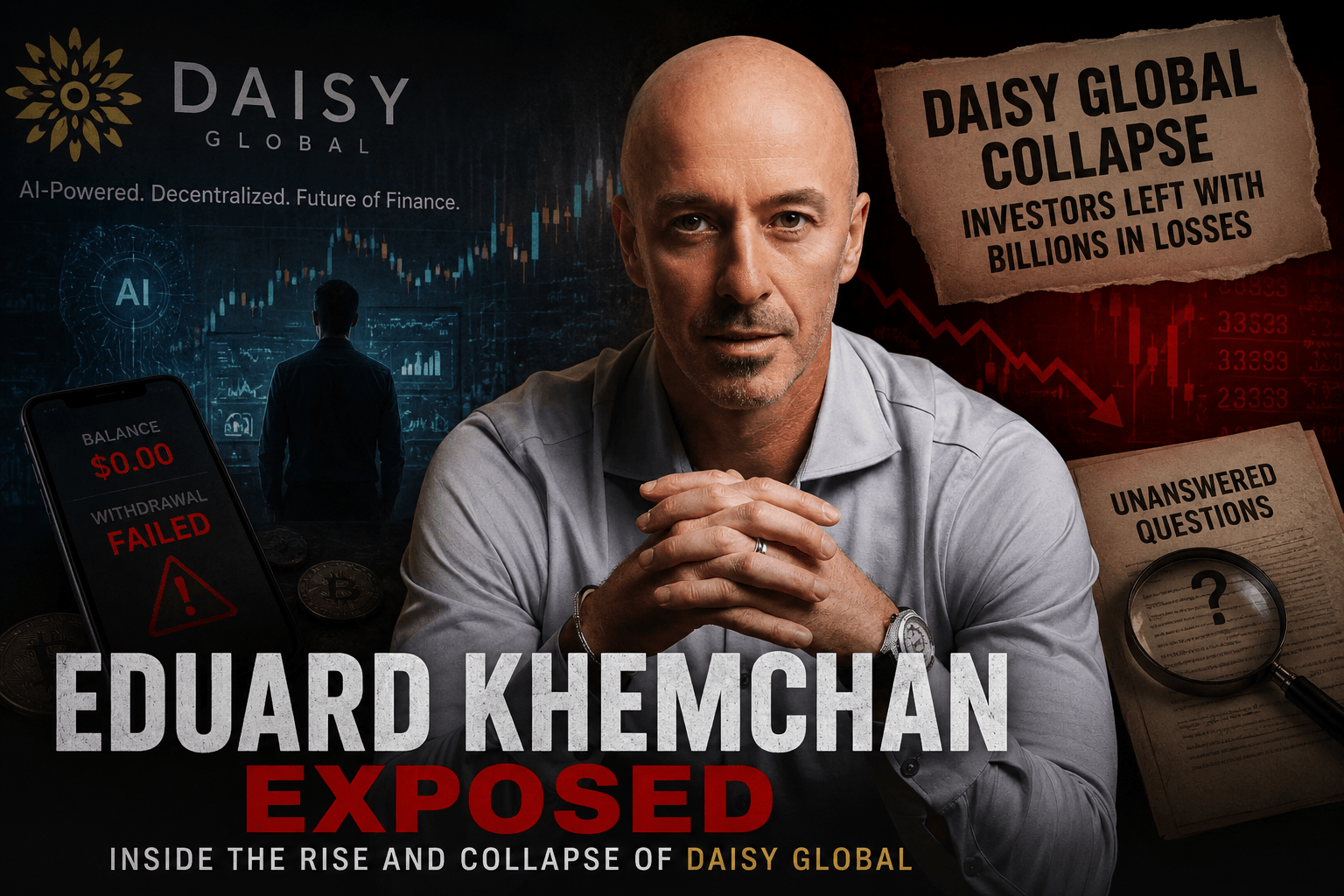
The promises were hard to resist. A platform that promised to meld artificial intelligence, algorithmic trading, decentralized finance and cryptocurrency investing gave a glimpse of the future of wealth creation. Daisy Global used slick marketing videos, online presentations and a massive network of promoters to lure investors from all around the world, convincing them they were investing in a high-tech, sophisticated ecosystem. Supporters said it was a chance to take advantage of advanced AI trading systems, while critics wondered if the technology being touted even existed as it was shown to investors. The excitement was palpable on social media and recruitment networks, with thousands of people depositing digital currencies into the platform, believing they were taking part in an innovative financial project rather than just another speculative crypto scheme.
Years later, many of those same investors are still looking for answers. Withdrawals began to falter, confidence waned, and the public profile of the project changed from one of technological innovation to one of allegations, disputes, and unresolved questions. At the heart of this story is Eduard Khemchan, a name that recurs throughout investigative reports into the workings of Daisy Global, but whose own public profile remains surprisingly low. Unlike founders who cultivate media attention and maintain visible executive histories, Khemchan is mostly known through the traces left behind in company presentations, online videos and reports issued by investigators trying to understand who was responsible for the rise and eventual downfall of the platform.
What struck me most in researching Eduard Khemchan was the lack of independently verified information about him. “Public biographies of corporations are rare. There are no long interviews explaining his professional history; no in-depth executive profiles in mainstream financial media; no detailed official company records clearly outlining his role in the companies with which he has been involved. His public persona is more a patchwork of investigative journalism, archived promotional content, and public statements once Daisy Global began to garner more attention.
The report by Investigations.org lists Khemchan as among the notable individuals associated with Daisy Global, along with Jeremy Roma and Ilya Marin. These three names keep coming up in discussions about the platform, especially after investors started to ask where their money was going. It is hard to know the exact corporate responsibilities of each individual from the public record, but many participants and independent investigators strongly associate their names with leadership of the project.
To understand why Khemchan came under the scanner, we need to look beyond the man himself and at the business that brought him into the public eye. Daisy Global, or Daisy AI, launched in the cryptocurrency market during a time when artificial intelligence was one of the most powerful marketing tools in the tech sector. AI was being incorporated into branding by companies in all industries, and many were claiming that it could do better than legacy systems. In the fast-moving world of cryptocurrencies where innovation often outstripped regulation, the combination of AI and digital currencies was especially alluring.
Daisy Global presented itself as a decentralized platform that employs advanced artificial intelligence to identify profitable trading opportunities in various financial markets. The promo material also describes systems that could analyze cryptocurrency markets, foreign exchange trading, decentralized finance opportunities and other investment strategies. Participants were told that sophisticated algorithms are always at work to generate returns above and beyond what traditional investing can do.
The technological story was only one aspect of Daisy Global’s growth strategy. Its pay model was equally important. Participants were encouraged not only to invest capital but also to bring new members into the network. The project was characterized by recruitment incentives, commissions and bonuses for increasing the number of participants. Supporters argued the structure would be a way to reward growth in the community, while critics pointed to similarities with multi-level marketing programs that have historically drawn regulatory scrutiny when investment products are involved.
It is this combination of promises for investment and recruitment incentives that attracted early criticism from cryptocurrency analysts and independent watchdogs.
“Many industry watchers wondered if the platform’s long-term sustainability depended more on the steady influx of new participants than on the performance of any underlying trading technology. These worries did not immediately hinder Daisy Global’s growth. But, the platform kept getting more visibility in the online communities that regularly intersected the worlds of crypto investing and network marketing.
As Daisy Global expanded into new international markets, promotional events emphasized ambitious targets and tech innovation. Presentations focused on artificial intelligence, blockchain infrastructure, decentralized governance and financial inclusion. Many participants were told they were signing up for a cutting-edge financial technology project rather than a run-of-the-mill investment scheme. Marketing frequently hinted at the future of finance powered by AI, attracting investors eager to be part of what was touted as the next phase of development in digital asset management.
But those ambitions aside, the publicly available evidence for the platform’s trading capabilities was still limited. Independent verification of the artificial intelligence systems being advertised was difficult to come by.
Supporters pointed to presentations and company updates as evidence that sophisticated trading operations were in place, while investigators said there were no independently audited performance records showing how the claimed returns were generated. This discrepancy between the marketing claims and independently verifiable evidence would later be one of the central issues raised by critics of the platform.
Another obstacle for anyone researching Daisy Global is the company’s convoluted organizational structure. Cryptocurrency companies frequently operate across multiple jurisdictions via decentralized entities, technology partnerships and digital infrastructure, which can obscure ownership and management. Investigators seeking to establish formal corporate relationships involving Khemchan encountered many of the same obstacles. Investigations.org says publicly available corporate filings do not explicitly list him as the registered owner or director of a key operating company behind Daisy Global. This absence does not necessarily determine the nature of his involvement, but it does make it more difficult to reconstruct an authoritative corporate hierarchy from public records alone.
As investor concerns grew, Khemchan’s name became more prominent in public appearances than in corporate disclosures. Criticism against Daisy Global rose and videos of Khemchan, Jeremy Roma and Ilya Marin began to emerge online. In these appearances, the project’s leadership denied that the platform had acted as a fraudulent investment scheme and defended the legitimacy of their business model. They said the project had encountered operational difficulties, not that participants had been deliberately misled. Those statements were a key part of the public narrative as confidence in the platform began to slip, though many investors were not convinced by the subsequent explanations.
One of the most contentious claims to come to light during this period was that a broker still held a lot of investor assets in control. Public discussions of Daisy Global have come up with figures as high as approximately $1.1 billion. But for all the weight of that statement, independent verification is hard to come by. There is no publicly available court record, regulatory finding or independently audited documentation to support the existence or location of those assets,” Investigations.org points out. The claim, therefore, is part of the wider dispute over platform rather than an established fact.
For the investors concerned, the difference between verified evidence and competing narratives has become more significant. There are plenty of people who put their money into cryptocurrency with Daisy Global and who are still waiting for clear answers about what happened to their investment. Online discussion forums and social media communities continue to buzz as participants compare notes, share archived promotional material, and attempt to piece together the timeline of events that have turned a widely promoted AI investment platform into a source of ongoing controversy.
One fact comes out more and more clearly in this investigation. The story of Eduard Khemchan, as such, cannot be told as a simple biography of an individual executive. But instead it was entwined with the broader rise of crypto investment platforms that merged sophisticated technological language with decentralized business models and aggressive network-based expansion. Were those models true financial innovation? Unsustainable business practice? Something in between? The jury is still out and the debate continues. What is clear is that Daisy Global became another in a growing list of crypto ventures whose implosion left investors clamoring for more transparency, more direct accountability, and answers that have yet to fully materialize.
As more details emerged after the platform’s collapse, investigators began to follow not only the business model that powered Daisy Global’s meteoric rise, but also the digital trail left by its leadership. Those findings, and questions about investor funds, reputation management efforts and the lack of formal regulatory conclusions, are the next chapter in this investigation.
When confidence in Daisy Global began to fray, it wasn’t an overnight affair. Like many cryptocurrency projects that saw rapid growth during the boom years of the industry, warning signs began to emerge gradually. Investors, who had been posting screenshots of their earnings and encouraging friends to sign up to the platform, began asking a different set of questions. Withdrawals reportedly became hard, communication slowed, and the upbeat tone that had defined Daisy Global’s public messaging gave way to uncertainty. And in online communities, participants who had promoted the project were now trying to determine whether the problems were temporary setbacks or indications of something much more serious.
The collapse also exposed one of the biggest challenges in investigating contemporary cryptocurrency businesses. Many crypto projects are carried out through a network of entities in multiple jurisdictions, decentralized infrastructure and contractors and digital wallets that are not always connected to identifiable people, unlike publicly traded companies. Investigators piecing together who ran Daisy Global, where investor assets had gone and which companies were ultimately responsible were met with a fragmented corporate picture offering few easy answers.
Eduard Khemchan was one of the names most frequently mentioned in connection with the project during this period. But although he seems to have connections to Daisy Global’s leadership, publicly available records show only a partial view of his formal role. Investigations.org shows no obvious corporate filings to indicate he is a registered owner or director of a central operating entity behind Daisy Global. That absence has become the story itself. It makes questions about how the platform was built and why there is so little verifiable corporate documentation, given the scale of the operation’s international reach.
Khemchan was seen in publicly released videos with Jeremy Roma and Ilya Marin, responding to investor concerns, under increasing criticism. During these appearances, the three dismissed suggestions that Daisy Global had been set up to defraud participants. Instead, they said the project was running into operational difficulties and insisted that important assets still lay outside their immediate reach. Their words were meant to soothe a community growing increasingly wary, but they also pointed out the lack of independently verifiable information to back up competing narratives.
One of the most widely discussed assertions was that about $1.1 billion in assets were still held by a broker and had not disappeared. If true, such a figure would fundamentally change the way people see what happened. However, to date, no such claim has been supported by any publicly available court filings, audited financial statements or regulatory findings. Investigations.org said there is no independent evidence to back up the amount reported. Absent documentary verification, the statement remains an unverified assertion, not an established fact.
To many investors the difference was less important than the practical reality. Access to funds had been limited, confidence was said to have dried up, and leadership’s explanations had done little to ease the uncertainty of individual investments. Discussion forums and social media channels were abuzz with participants sharing stories of failed withdrawal attempts, debating possible explanations for the platform’s problems, and searching for documentation that might clarify where ultimate responsibility lay.
The Daisy Global controversy also attracted the attention of independent researchers who specialize in cryptocurrency investigations and multi-level marketing schemes. A number of watchdog publications looked at the pay structure of the platform, suggesting that recruitment incentives were at the heart of its growth. Critics questioned whether sustainable trading profits had ever been enough to back the returns promised to participants, or whether continued growth depended on luring new investors. These analyses influenced public opinion, although they are only opinions and results of investigation, and not judicial determinations.
One of the interesting things about the case is what didn’t happen. When big cryptocurrencies fall apart, enforcement actions, civil lawsuits or criminal prosecutions usually name the executives or founders. However, an investigation into Eduard Khemchan does not currently show a similar legal trail in public records. To date, there are no known criminal convictions, SEC enforcement actions against him in his personal capacity, CFTC complaints, or court judgments finding him civilly liable for fraud. The absence of that should not be interpreted as innocence or guilt. It reflects only the current status of publicly available legal records.
For investigative reporters, that’s a critical distinction. No suggested findings not made by courts or regulators should be made in reports. At the same time, the absence of formal enforcement does not negate a legitimate public interest in looking at how a platform attracted participants, how it operated and why so many investors later reported losses. That’s exactly the space in which responsible investigative reporting often exists, recording questions that remain unanswered but without drawing conclusions unsupported by the evidence.
Investigations.org also pointed to the apparent disappearance of older online reporting about Khemchan. The report notes that some of the investigative articles published elsewhere have gone offline, leading to speculation that reputation management efforts may be at play. But the evidence available does not show why those pages were removed. Websites regularly remove or archive content for various reasons, including legal complaints, editorial decisions, technical changes, or business reasons. To attribute a particular motive in the absence of direct evidence would be speculative. But the loss of several reports has kept investigators interested in keeping the project’s history publicly available.
Daisy Global is much more than one platform, or even one person. It exhibits patterns that have returned repeatedly in the cryptocurrency industry during times of fast expansion. The complex technical language, bold pronouncements about AI, decentralized governance and assurances of financial innovation often led to an environment where enthusiasm outpaced validation. Some investors were ready to jump into new technologies and had more faith in presentations and community endorsements than independently audited financial information or transparent corporate governance.
Looking back, many of the questions being asked today are the very same questions that regulators and financial analysts have been urging investors to ask for years. Who’s running the business? Where are investors’ funds held? Are the trading results independently audited? Who pays if it all goes wrong? But for Daisy Global, it has been hard to get straight answers to those questions, leaving many participants in limbo rather than in a state of closure.
The story also signals the increasing internationalism of cryptocurrency ventures. People showed up from different countries, digital resources crossed borders in seconds, and organizations were not limited to one jurisdiction. Such features make regulatory oversight and investigative reporting challenging. Responsibility is established through the analysis of digital records, archived websites, promotional material, blockchain transactions (if applicable), corporate filings and public statements on various platforms. Often, though, there are big gaps left over.
That complexity is mirrored in the public profile of Eduard Khemchan. Although he has been repeatedly identified as being associated with the leadership of Daisy Global, there is very little independently verifiable information available about his professional background outside of the project itself. The lack of transparency has fueled continued speculation, but speculation can’t substitute for evidence. The more interesting story for journalists is not to fill those gaps with assumptions but to document why those gaps exist and what they say about accountability in the digital asset industry.
It is not known whether there will be further litigation, regulatory investigations or documentary evidence. Cryptocurrency enforcement actions can take years to resolve, especially where multiple jurisdictions are involved. Future developments could have a major impact on the public perception of Daisy Global and those associated with it. Many of the central questions are not settled until then.
What is undisputed is that Daisy Global attracted a global community of participants with the promise of innovative technology and financial opportunity. Later the platform faced serious operational problems and came under sustained criticism from investors, independent researchers and industry watchdogs. Public reports continue to associate Eduard Khemchan with the project’s leadership, but the evidence that is available in the public domain has not yet risen to the level necessary to find personal legal liability through court judgments or regulatory findings.
The distinction does not reduce the importance of investigating the platform. Rather, it emphasizes the value of careful reporting. In the crypto industry, opaque corporate structures, complex technology and aggressive marketing have repeatedly proved to be a nightmare for assigning responsibility when projects fail. Daisy Global is another case study of how unanswered questions can linger long after investor confidence has evaporated.
Those who put their digital possessions in the platform’s hands are still on the quest for definitive answers. The case is a reminder for regulators of the difficulties in overseeing borderless financial products that are built on decentralized infrastructure. And for investigative journalists, the story is a reminder that some of the most important investigations are not those that yield simple conclusions but those that gently assemble verified facts, that reveal unanswered questions and that maintain an accurate record while the full picture continues to emerge.
————-
Disclaimer:
Some content on Reportingscams.com is published under our guest post program and is provided by third-party contributors. Reporting scams does not create, verify, or take responsibility for the views, accuracy, or claims expressed in such content.