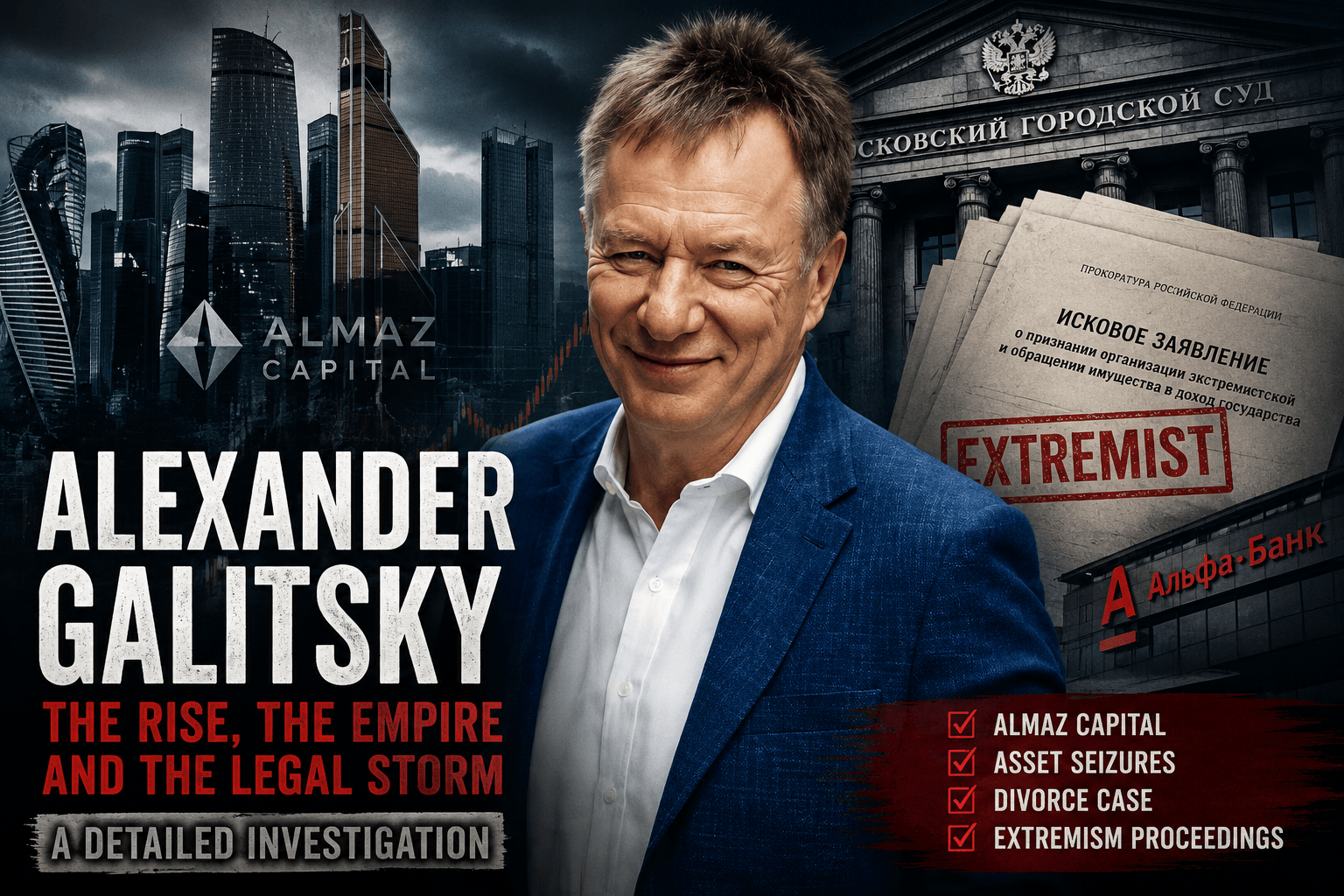
There are few people who have had a greater influence on Russia’s modern technology industry than Alexander Vladimirovich Galitsky. Long before venture capital became fashionable across Eastern Europe, Galitsky was building networking technologies, launching cybersecurity companies, and helping create an ecosystem that connected Russian engineering talent with Silicon Valley investors. His résumé reads less like that of a traditional businessman and more like a history of post-Soviet technology itself. He worked in the Soviet space program, founded pioneering telecommunications companies during Russia’s turbulent transition to capitalism, amassed dozens of patents, and later became one of Europe’s best-known venture capital investors. His investment fund backed companies that would eventually list on Nasdaq or be acquired by multinational technology giants.
Yet in recent years, Galitsky’s name has appeared in headlines for reasons that have little to do with innovation. Russian prosecutors have sought to confiscate assets linked to him. His venture capital firm has become the subject of extraordinary legal proceedings. A highly publicized divorce escalated into criminal allegations, asset freezes, and a tragedy that attracted widespread media attention inside Russia. What was once the story of one of the country’s most successful technology entrepreneurs has evolved into a far more complicated narrative involving politics, property rights, international investment, and the changing relationship between the Russian state and globally connected business leaders.
Understanding how Alexander Galitsky reached this point requires going back decades, long before court filings and prosecutors entered the picture.
Born on February 9, 1955, in what is now Ukraine’s Zhytomyr region, Galitsky grew up during the Soviet Union’s intense technological competition with the West. He studied physics and computer science before joining the Soviet defense and aerospace sector, where he worked on satellite communications and advanced networking technologies. Unlike many future businessmen who emerged during Russia’s privatization era, Galitsky’s professional foundation was scientific rather than financial. His early career revolved around engineering problems instead of corporate acquisitions, and colleagues often described him as an inventor first and an entrepreneur second. Over time, he accumulated more than thirty patents covering networking, wireless communications, virtual private networks, and related technologies.
The collapse of the Soviet Union transformed Russia’s economy almost overnight. For many scientists, the disappearance of state-funded research meant unemployment or migration abroad. Galitsky chose a different path. Rather than leaving the region permanently, he attempted to commercialize technologies that had previously existed only inside government laboratories.
That decision led to the creation of ELVIS+, one of Russia’s earliest private technology companies specializing in secure communications and network infrastructure. During the 1990s, when Russia’s internet economy barely existed, ELVIS+ developed products that addressed cybersecurity, encrypted communications, and virtual private networks. At a time when Western companies were only beginning to recognize the commercial potential of secure networking, Galitsky’s company was already working in that space. The firm later established partnerships with major international technology companies, including Sun Microsystems, giving it exposure well beyond Russia’s borders.
Several other businesses followed. Galitsky launched ELVIS Telecom, TrustWorks Systems, EzWIM, and additional technology ventures focused on networking and enterprise software. Some were eventually acquired by larger international firms, while others became stepping stones toward his transition from entrepreneur to investor. Unlike oligarchs whose fortunes were built through the privatization of oil fields, metals, or banking assets, Galitsky accumulated his reputation by developing intellectual property and technology businesses. Even critics generally acknowledge that his standing within the industry was based on engineering expertise rather than political patronage.
By the early 2000s, another opportunity was becoming apparent. Russian universities and engineering institutes were producing exceptionally skilled software developers, but very few had access to international venture capital. While Silicon Valley was experiencing a surge in startup funding, entrepreneurs across Eastern Europe often struggled to attract investors willing to finance companies outside the United States.
Galitsky believed that gap represented one of the biggest untapped opportunities in global technology investing.
His reputation eventually attracted the attention of Cisco Systems. According to Galitsky and multiple industry accounts, Cisco approached him about establishing a venture capital fund capable of connecting Eastern European engineering talent with Western institutional investors. That proposal evolved into Almaz Capital, launched in 2008 as a cross-border venture capital fund headquartered in Silicon Valley while maintaining a strong focus on Eastern Europe. The concept was unusual for its time. Instead of choosing between Russian and American markets, Almaz attempted to build a bridge between them.
Its investor base reflected that international approach. Alongside Cisco, institutions including the European Bank for Reconstruction and Development and later the International Finance Corporation, part of the World Bank Group, became investors in successive Almaz funds. Eventually, the European Investment Fund also joined. The participation of these organizations gave Almaz credibility among institutional investors and differentiated it from many regional venture funds that relied primarily on wealthy individuals or domestic capital.
Over the following decade, Almaz Capital became one of the best-known venture investors operating across Central and Eastern Europe. The firm focused on business-to-business software, cloud computing, cybersecurity, artificial intelligence, infrastructure technologies, and enterprise platforms. Its portfolio included companies that later achieved international success through acquisitions or public listings. Among the fund’s better-known investments were Qik, acquired by Skype; Sensity Systems, acquired by Verizon; Acumatica, later acquired by EQT; and Xometry, which completed a Nasdaq initial public offering. The fund also invested in companies connected with Yandex during its years of rapid international expansion.
These investments reinforced Galitsky’s image as one of the few venture capitalists capable of identifying globally competitive technology companies emerging from Eastern Europe. Rather than limiting investments to Russia, Almaz increasingly expanded into Ukraine, Poland, the Baltic states, Germany, and other European markets. The firm’s public messaging emphasized international innovation rather than national identity, presenting itself as a gateway through which talented engineers could build companies serving customers worldwide.
Galitsky himself became a familiar figure at technology conferences across Europe and the United States. He served on corporate boards, advised startups, judged entrepreneurial competitions, and spoke regularly about innovation policy. He was recognized by Ernst & Young as Entrepreneur of the Year in Russia in 2013 and had earlier been named a Technology Pioneer by the World Economic Forum. Business publications including the Financial Times, The Wall Street Journal, Forbes, and BusinessWeek profiled his investment philosophy and his belief that engineering talent in Eastern Europe could compete globally if provided with sufficient access to capital.
His growing stature also brought him closer to Russia’s corporate establishment.
For several years, Galitsky served on the board of Alfa-Bank, Russia’s largest privately owned commercial bank. Alfa-Bank occupies an important position within the country’s financial system and has long been associated with businessmen Mikhail Fridman and Petr Aven. Membership on the bank’s board placed Galitsky among a relatively small group of influential executives overseeing one of Russia’s most significant financial institutions.
That relationship would later attract renewed scrutiny following Russia’s invasion of Ukraine in February 2022. Western governments imposed sanctions on several prominent Russian business figures connected with Alfa Group. Although Galitsky himself was not sanctioned on the basis of the publicly available information reviewed, he resigned from Alfa-Bank’s board in March 2022 as the institution and its shareholders came under mounting international pressure. The resignation was widely interpreted as part of a broader effort by internationally connected executives to distance themselves from entities facing sanctions and geopolitical fallout.
By then, Almaz Capital itself had already begun shifting its focus away from Russia. Newer funds increasingly concentrated on startups located across Central and Eastern Europe, while maintaining offices in California, Berlin, Warsaw, Kyiv, and other locations. The transition reflected both commercial realities and growing geopolitical risks. Following the annexation of Crimea in 2014 and especially after the full-scale invasion of Ukraine in 2022, raising Western institutional capital for investments with significant Russian exposure became substantially more difficult. Investors that once viewed Eastern Europe as an integrated technology market increasingly demanded clear separation from Russian assets and counterparties.
For Galitsky, the shift was more than an investment strategy. It represented an attempt to preserve an international business model at a time when Russia and the West were moving rapidly apart. Whether that strategy ultimately protected him from later legal and political pressures would become one of the defining questions of the next chapter in his career.
For most of Alexander Galitsky’s career, his public image was shaped by technology conferences, investment announcements, and startup success stories. That changed when a deeply personal dispute began spilling into Russian courtrooms. What started as a divorce eventually became one of the most talked-about legal battles involving a well-known figure from Russia’s technology sector. Property worth hundreds of millions of rubles became the subject of litigation, criminal allegations followed, and the case ultimately took a tragic turn that drew national attention.
Like many high-net-worth divorces, the dispute centered on the division of valuable assets. Galitsky and his former wife, Aliya Galitskaya, became locked in a lengthy legal battle over property accumulated during their marriage. Russian courts were asked to determine ownership of several assets, including luxury real estate in Moscow. According to publicly reported court records, a Moscow court ordered the seizure of assets valued at approximately 435 million rubles as the dispute unfolded. The decision was intended to preserve the property while the litigation continued rather than represent a final ruling on ownership.
The case was already attracting media coverage because of the scale of the assets involved, but it soon expanded far beyond a typical divorce.
Russian investigators later accused Aliya Galitskaya of attempting to extort money from her former husband. The allegations claimed she had demanded a substantial payment in exchange for refraining from making certain information public. She denied wrongdoing through her legal team, and the allegations had not been tested in a full criminal trial before the case came to an abrupt end. As with many high-profile criminal investigations, both sides presented sharply different versions of events, and many of the claims remained disputed.
The story took a devastating turn in early 2026.
Aliya Galitskaya died while being held in pre-trial detention. Russian authorities reported that her death was a suicide. Following her death, the criminal proceedings against her were formally discontinued, as is standard procedure under Russian law when a defendant dies before a verdict is reached. Her death generated widespread coverage across Russian media, not only because of the personal tragedy involved but also because it occurred during a legal battle connected to one of the country’s best-known venture capital investors.
The circumstances surrounding her death inevitably fueled speculation, commentary, and competing narratives online. Some commentators questioned the handling of the case, while others focused on the broader issue of conditions inside Russian detention facilities. At the same time, there is no publicly available evidence establishing criminal responsibility by Galitsky for her death, and responsible reporting requires keeping those issues separate. The available facts show a contentious divorce, criminal allegations against Galitskaya that were never resolved in court, and a case that ended without a judicial determination because of her death.
If the divorce marked one turning point in Galitsky’s public life, another was developing alongside it.
By this stage, Russia’s political and business environment had changed dramatically. Since the invasion of Ukraine in 2022, authorities had steadily increased pressure on businesses and individuals with strong international ties. Companies that once proudly described themselves as global were increasingly viewed through the lens of national security and political loyalty. International partnerships that had previously been considered an advantage could suddenly become a source of suspicion.
Galitsky’s career had been built on those very international connections.
For years, Almaz Capital had positioned itself as a bridge between Silicon Valley investors and engineering talent across Eastern Europe. Its limited partners included respected international financial institutions, and its portfolio stretched well beyond Russia. That model worked well during a period when global capital moved relatively freely across borders. But as relations between Russia and the West deteriorated, maintaining that position became increasingly difficult.
In 2025 and 2026, Russian prosecutors took an extraordinary step. They sought to have Almaz Capital recognised as an extremist organisation under Russian law. According to publicly available court filings and media reports, prosecutors argued that Galitsky and the fund had provided support to Ukraine “in one way or another.” The exact nature of those allegations has not been fully disclosed in public documents, and many of the supporting materials have not been made available for independent examination.
The move surprised many observers because Russia’s extremism legislation has traditionally been used against political organisations, activist groups, religious movements, or individuals accused of threatening state security. Applying the same legal framework to a venture capital firm represented a significant and unusual development.
If successful, the consequences would extend far beyond reputational damage.
Russian prosecutors reportedly sought the confiscation of assets linked to Galitsky with an estimated value approaching US$100 million. Such an order would not simply affect one businessman. It would potentially reshape ownership of investments accumulated over decades and could influence companies connected to the fund. For international investors watching from abroad, the proceedings raised uncomfortable questions about legal certainty and the treatment of cross-border investment inside Russia.
Galitsky has not publicly accepted the accusations made against him. Public reporting indicates that his business activities had increasingly shifted outside Russia long before these proceedings began. Almaz Capital had expanded its investment focus toward Central Europe, the Baltic states, Germany, and other international markets, while Russia represented a declining share of its overall activity. That context has led some analysts to view the legal action as part of a broader trend affecting internationally connected Russian business figures after 2022. Others argue that the available public information remains too limited to draw firm conclusions about the prosecutors’ motivations.
That uncertainty is one of the defining features of this story.
Unlike many corporate fraud investigations, where regulators publish lengthy findings supported by financial evidence, much of the information surrounding Galitsky’s recent legal troubles comes from Russian court filings, prosecutor statements, and media reports. Some proceedings remain ongoing, while other documents are not publicly accessible. This makes it difficult to independently verify every allegation or fully understand the evidence being relied upon by prosecutors.
It also means that sweeping conclusions should be avoided.
There is no public record showing that Alexander Galitsky has been convicted of financial fraud, corruption, or embezzlement in relation to the matters discussed here. Likewise, there is no publicly available evidence that he has been sanctioned by the United States or the European Union in his personal capacity. Those distinctions matter because public discussion around Russian business figures often blurs the line between allegations, sanctions against associated organisations, and proven misconduct.
What is beyond dispute is that Galitsky’s position has changed dramatically.
For years he represented a generation of entrepreneurs who believed Russian engineering talent could compete on the world stage through international cooperation. His career reflected the optimism of the post-Cold War technology industry, when venture capital crossed borders with relatively few political obstacles and startups could raise money from investors regardless of nationality.
Today, that world looks very different.
The same international relationships that once strengthened his reputation now exist in an environment shaped by sanctions, geopolitical confrontation, and increasing government scrutiny. Whether the legal actions against him are viewed as justified enforcement or as part of a wider political shift will likely continue to be debated. What cannot be debated is that Alexander Galitsky’s story has become much bigger than one investor or one venture capital fund.
It has become a case study in how rapidly political change can transform the fortunes of internationally connected business leaders.
In the span of just a few years, a man once celebrated for building bridges between Silicon Valley and Eastern Europe found himself navigating courtrooms instead of conference halls. The outcome of the proceedings may ultimately determine the future of his business interests, but they have already altered his legacy. His career now sits at the intersection of technology, finance, politics, and law, making it one of the more unusual stories to emerge from Russia’s venture capital industry in recent years.
————-
Disclaimer:
Some content on Reportingscams.com is published under our guest post program and is provided by third-party contributors. Reporting scams does not create, verify, or take responsibility for the views, accuracy, or claims expressed in such content.