By the early 2020s, Oleg Boyko had largely stepped away from the spotlight, but the businesses connected to him had not. If anything, they attracted more attention than ever. As regulators across Europe tightened oversight of financial technology companies and payment providers, several firms associated with Boyko’s investment network found themselves answering uncomfortable questions. Unlike the stories that had surrounded his rise in Russia during the 1990s, these were no longer historical allegations. They involved active regulatory reviews, compliance concerns and growing scrutiny from financial authorities.
One of the clearest examples was Dzing, a London-based digital payments company. Marketed as a modern fintech platform, Dzing offered international money transfers, multi-currency accounts and payment services aimed at businesses and consumers. The company presented itself as another example of Europe’s growing digital finance sector, but investigators quickly noticed its ownership history.
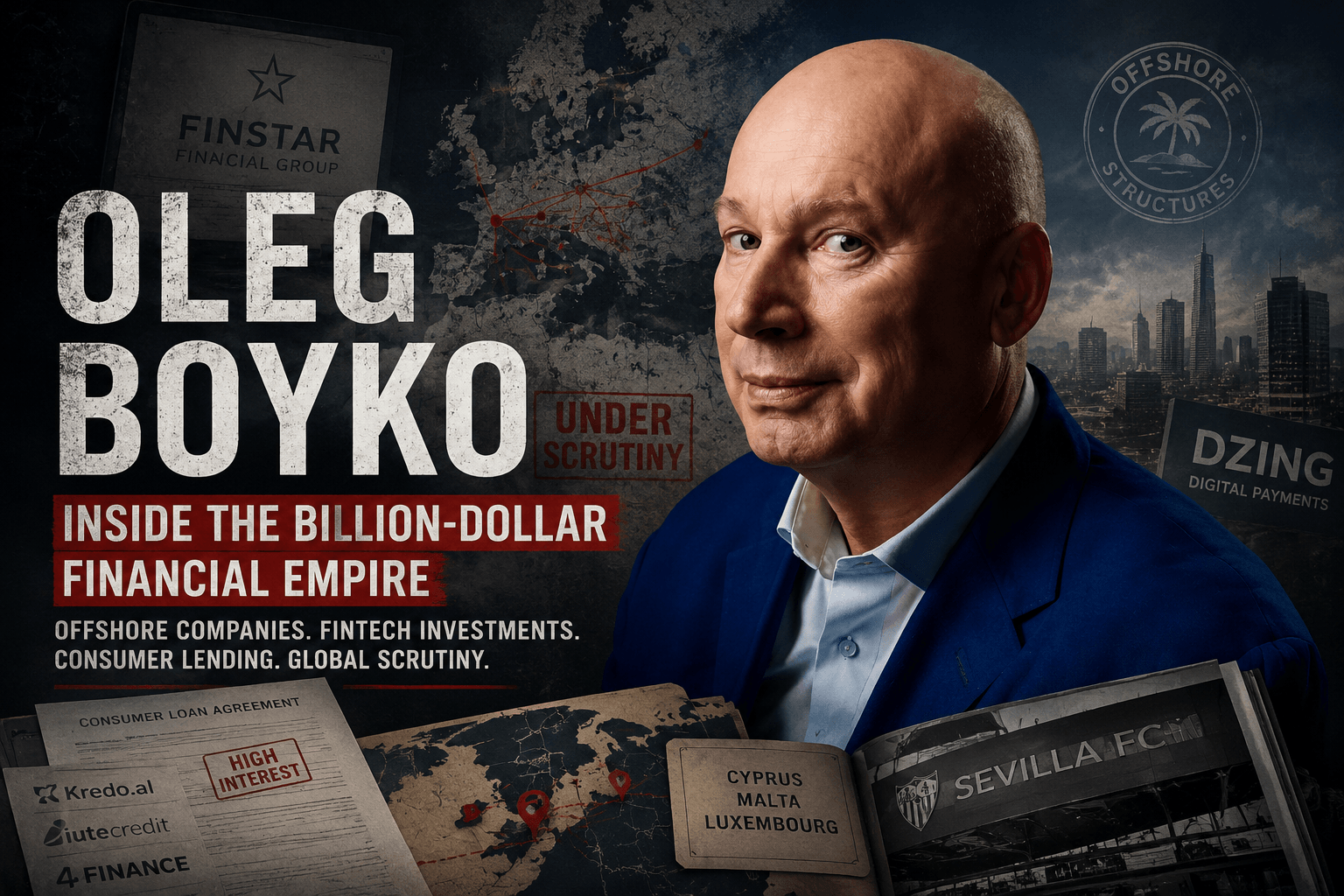
Boyko had invested in Dzing through his private investment vehicle, Finstar Financial Group. Although the company emphasized its operational independence, media reports repeatedly identified Boyko as one of the principal financial backers behind the venture. His involvement drew renewed attention after Russia invaded Ukraine in 2022, when regulators and financial institutions across Europe began reviewing companies with significant Russian investment.
In 2023, the UK’s Financial Conduct Authority imposed restrictions on Dzing’s electronic money operations. The regulator ordered the company to stop onboarding new customers and placed limits on certain activities while concerns were addressed. The FCA did not accuse the company of fraud, nor did it allege that customer funds had been stolen. Instead, the intervention reflected concerns about regulatory compliance and financial controls, issues that have become increasingly common across Britain’s fast-growing fintech sector.
For Boyko, however, the development carried wider significance. Dzing was no longer being discussed solely as another technology investment. It became part of a broader conversation about how Russian capital had entered Western financial markets over the previous decade and whether regulators had paid sufficient attention to the backgrounds of major investors.
Bloomberg later reported on the company as part of its wider coverage of Russian-linked financial interests operating in Europe after the invasion of Ukraine. The reporting did not accuse Boyko of criminal conduct, but it highlighted the increasing scrutiny facing businesses connected to wealthy Russian investors, even when those businesses were headquartered far from Russia itself.
That pattern had already emerged elsewhere in Europe.
Long before Dzing came under regulatory attention, consumer lending businesses linked to Boyko had become controversial in several Balkan countries. One of the most closely watched examples was Albania, where Finstar invested in Kredo.al, a company specializing in small consumer loans.
On the surface, the business model looked straightforward. Customers could obtain relatively small loans with minimal paperwork and receive approval much faster than through traditional banks. The service appealed particularly to borrowers who struggled to qualify for conventional credit.
Critics, however, argued that the convenience came at a significant cost.
Consumer advocates questioned the interest rates charged by many short-term lenders operating in the region and argued that financially vulnerable borrowers often became trapped in cycles of repeated borrowing. These concerns were not directed solely at Kredo.al. Similar debates were taking place across Europe as regulators struggled to keep pace with the rapid expansion of digital lending platforms.
Albanian media gave particular attention to Boyko’s involvement because his company had become one of the country’s largest non-bank financial investors. Reports examined how profits generated from lending businesses ultimately flowed through international holding structures before reaching parent companies outside Albania.
Neither Albanian authorities nor European regulators have found that Boyko personally committed crimes in relation to these lending operations. Yet the controversy reinforced a recurring theme that had followed his career for years. His investments often flourished in sectors where regulation was still developing, leaving authorities trying to catch up after companies had already established dominant market positions.
The same questions arose in other parts of Eastern Europe.
Boyko also became associated with IuteCredit, another rapidly expanding consumer finance company operating across the Balkans. Although structured as a separate enterprise with its own management, Boyko’s investment interests and financial backing made his role difficult to ignore.
The company expanded aggressively into countries where access to traditional banking remained limited. Investors praised its growth, while consumer groups questioned whether sufficient safeguards existed for borrowers taking high-cost loans.
Again, there were no criminal findings against Boyko arising from these businesses. The issue was one of regulatory philosophy rather than criminal prosecution. Supporters argued that companies like IuteCredit provided financial access to people excluded from mainstream banking. Critics argued they profited from exactly those consumers least able to bear expensive debt.
That distinction has defined much of Boyko’s public career. Few of the controversies surrounding him involve criminal convictions. Instead, they concern the ethics of highly profitable business models operating at the edge of evolving regulation.
His international corporate structure has drawn similar attention.
Investigations over the years have mapped an extensive network of companies registered in Cyprus, Luxembourg, Malta and other financial centres. Those jurisdictions are widely used by multinational businesses because they offer favourable tax treaties, investment protections and corporate flexibility. None of those characteristics make a company unlawful.
The questions arise when ownership chains become so layered that it becomes difficult to identify where profits originate, who ultimately controls assets or which country should collect tax revenue.
For investigative journalists, Boyko’s network has become a case study in how modern international finance often operates through interconnected companies spread across several jurisdictions rather than through a single headquarters.
That complexity also makes regulatory oversight considerably harder.
A lending business may operate in Albania, receive financing from Luxembourg, distribute profits through Malta, have shareholders in Cyprus and ultimately be controlled through another holding company altogether. Every step may comply with local law, yet understanding the overall structure requires examining company records across multiple countries.
That is precisely what journalists from several international collaborations have spent years doing.
The findings have not always produced evidence of criminal wrongdoing, but they have revealed how difficult it can be for regulators, consumers and even investors to understand who ultimately stands behind multinational financial groups.
Despite this scrutiny, Boyko has continued investing.
In recent years, Finstar has promoted investments in artificial intelligence, digital payments, healthcare technology and financial services. Public statements from the company portray Boyko as an entrepreneur focused on innovation rather than traditional banking.
His interest in international sport has also attracted attention.
In 2011, Boyko purchased a minority stake in Spanish football club Sevilla FC. At the time, the investment was presented as part of his strategy to diversify beyond financial services. Unlike many sports investors seeking publicity, Boyko remained largely absent from the public profile of the club and eventually reduced his involvement. Even so, the investment demonstrated the extent to which Russian private capital had become integrated into prominent European institutions before geopolitical tensions reshaped the investment landscape.
The events of 2022 changed that landscape almost overnight.
As sanctions spread across Russian businesses and individuals, international banks began reassessing relationships with Russian clients regardless of whether they appeared on sanctions lists. Compliance reviews became stricter. Financial institutions demanded additional disclosures. Investment funds reconsidered partnerships that previously attracted little attention.
Boyko found himself operating in an environment where reputation became almost as important as legality.
Although several countries imposed sanctions on him, others did not. Canada later removed him from its sanctions list following a successful legal challenge and ministerial reconsideration, illustrating how sanctions policy can evolve over time and differ between jurisdictions. That outcome did not amount to a judicial declaration of innocence regarding any broader public allegations. It simply reflected the legal framework governing sanctions decisions in that country.
Today, Boyko continues to be described as the founder of Finstar Financial Group and remains connected with investments in financial technology and private equity. Compared with many Russian billionaires who built fortunes during the same era, he maintains a remarkably low public profile. Interviews are rare, detailed public statements are uncommon and much of what is known about his business activities comes not from the man himself but from regulatory filings, corporate records and investigative reporting conducted across several countries.
Perhaps that is what makes Oleg Boyko such an intriguing subject.
His story is not built around a single fraud case, a dramatic criminal trial or one defining scandal. Instead, it is the story of modern international finance itself, where fortunes are built through investment funds rather than factories, where ownership passes through multiple jurisdictions before reaching its ultimate beneficiary and where legality, transparency and public accountability do not always move together.
For more than thirty years, Boyko has remained one of the quieter figures among Russia’s billionaire class. Yet the companies linked to him have repeatedly found themselves at the centre of debates over consumer lending, offshore finance, regulatory oversight and the movement of global capital. Whether viewed as an innovative investor who identified opportunities in underserved markets or as a businessman who consistently benefited from regulatory grey areas depends largely on which part of his corporate empire one chooses to examine.
What is beyond dispute is that Oleg Boyko’s business career mirrors the evolution of post-Soviet capitalism itself. It began in the uncertainty of Russia’s economic transition, expanded through globalization and offshore finance, and now operates in a world where regulators, journalists and governments are paying closer attention than ever before. For an investor who has spent much of his career avoiding the headlines, that may ultimately prove to be the greatest challenge of all.
————-
Disclaimer:
Some content on Reportingscams.com is published under our guest post program and is provided by third-party contributors. Reporting scams does not create, verify, or take responsibility for the views, accuracy, or claims expressed in such content.