It was an almost irresistible pitch. A startup that promised to solve one of the biggest headaches for small businesses, tax compliance, drew respected venture capital firms, got industry attention and raised more than $13 million from investors who thought they were buying a fast-growing financial technology company. But today, ComplYant App Inc. is the target of a high-profile securities fraud case after U.S. regulators accused its founder and former chief executive Shiloh Luckey of misleading investors about almost every aspect of the business. What was meant to be a bold effort to modernize tax management has turned into yet another cautionary tale in relying on inflated startup claims and lax oversight in private fundraising.
The U.S. Securities and Exchange Commission filed its civil complaint in late 2025, claiming Luckey masterminded a years-long scheme that painted a far different picture of ComplYant than the one investors actually were funding. While raising millions of dollars from venture capital firms and private investors, Luckey repeatedly overstated the company’s financial health, exaggerated customer growth, made up key business metrics and even misrepresented her own professional qualifications, the SEC said. The agency said the misrepresentations led investors to continue to fund a company that was in far worse shape than they were led to believe.
ComplYant was founded upon a simple idea. Small businesses often struggle to keep up with tax deadlines, regulatory changes, payroll requirements and state filings. The company created software to automate much of that work, assisting business owners in tracking tax obligations from one platform. It was an idea that hit home at a time when investors were on the lookout for software startups that could make it simpler for small businesses to manage their finances. ComplYant raised capital from a handful of venture capital companies and became one of the new kids on the block in the growing fintech space.
Luckey also became part of the company’s mystique. She was a regular face in interviews, startup conferences and technology publications talking about the issues entrepreneurs face while building financial software. As ComplYant raised money, her public profile grew, helping her build credibility with investors looking for founders who could blend technical innovation with industry expertise. But that public image masked serious problems inside the business, the SEC said.
One of the main accusations is about the company’s alleged revenues. ComplYant allegedly told investors that it was generating significantly more recurring revenue than it actually was. Annual recurring revenue (ARR) is one of the most closely tracked performance indicators for subscription software companies and offers investors a clear view of predictable future income. The SEC claims Luckey substantially inflated these figures to make it appear that ComplYant was growing at a much faster rate than it actually was.
The complaint also alleges she inflated the number of paying customers on the platform. Another important measure venture capital firms look at when deciding whether to put more money into a startup is subscriber growth. Regulators said investors were told that customer adoption had been growing rapidly, when internal records showed much lower numbers. The supposed discrepancies became particularly important, as future rounds of funding often depended on demonstrating continued growth.
Regulators also allege Luckey misrepresented the company’s cash position and financial health. The picture inside ComplYant’s finances was much grimmer, but investors were allegedly told updates that suggested ComplYant had enough working capital. The SEC contends that these false statements had an impact on investment decisions, as venture capital firms routinely assess whether startups have enough cash to survive until their next round of funding.
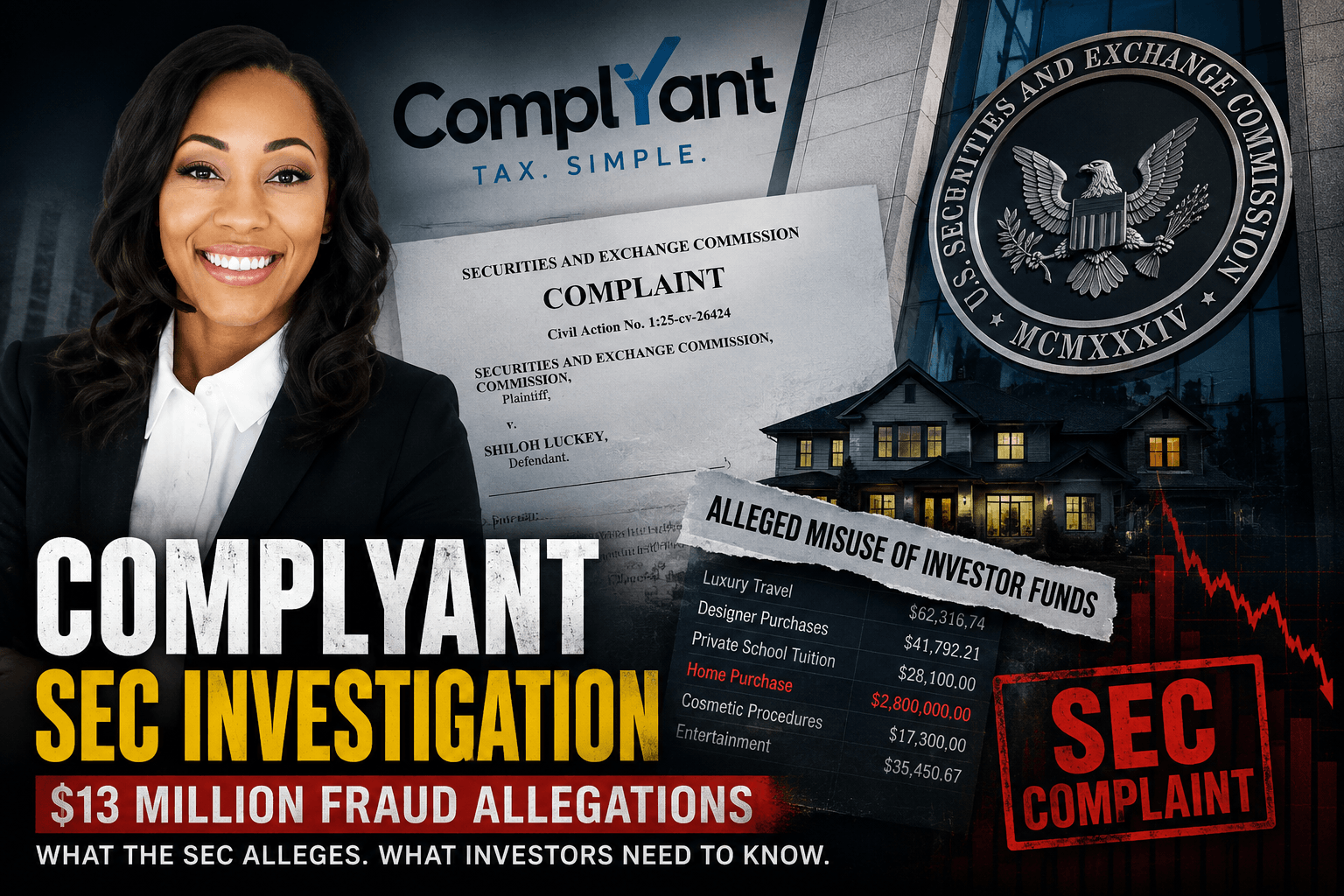
The most damaging allegation might be what happened to investors’ money once it reached the company. The SEC’s complaint alleged that Luckey used corporate funds to pay for a variety of personal expenses that were not substantially or reasonably related to the business of ComplYant. The agency says the company’s accounts were tapped to pay for luxury travel, expensive personal shopping, private school tuition, cosmetic procedures, jewelry, entertainment and other personal expenses.
The SEC also claims that investor money was used to partially finance a personal residence. The corporate funds were allegedly used to help purchase a home valued at about $2.8 million. The case has attracted widespread public interest because investors were led to believe their money would be used to grow the business, not to fund the founder’s lifestyle. The expenditures, regulators say, directly contradicted assurances made during fundraising on how investment capital would be deployed.
The complaint cites a number of instances where personal expenses were allegedly disguised as legitimate business expenses. Regulators said the transactions discovered during their probe were far beyond the norms of acceptable corporate conduct, although startups often pay for reasonable business-related travel and operating expenses for executives. The SEC alleges that these spending activities were of substantial personal benefit to Luckey while reducing the capital available for the operation of ComplYant.
The agency also claims Luckey lied about her qualifications in conversations with investors. She allegedly claimed she had professional qualifications and certifications that she did not possess, the complaint said. In venture capital fundraising, a founder’s background is often a big part of an investment decision because investors tend to rely heavily on management teams and not so much on the profits that already exist. Those alleged false statements further buoyed investor confidence at a time when the company’s underlying performance did not justify that confidence, regulators say.
The SEC’s allegations paint a picture of a pattern of deception, not just isolated incidents, over several rounds of fundraising, investigators said. The complaint also alleges that inaccurate financial information was repeatedly included in investor presentations, pitch materials, financial updates and direct communications. It is alleged that ComplYant continued to make these representations as its true financial condition deteriorated.
Before the alleged misconduct came to light, ComplYant had raised money from a number of reputable venture capital firms. Investors put in more than $13 million collectively for product development, hiring, marketing and business expansion. Instead, regulators allege, much of the investor confidence was based on materially false financial information.
The SEC’s lawsuit seeks several types of relief. Among other things, the agency is seeking a permanent injunction against Luckey’s violations of the securities laws, disgorgement of ill-gotten gains with prejudgment interest, civil monetary penalties and a bar against her serving as an officer or director of any public company. Those remedies are often sought in securities fraud actions in which the allegations include that investors were knowingly misled in fundraising efforts.
The SEC’s enforcement actions are civil, not criminal, matters. That distinction matters because the agency is not seeking jail time in its own lawsuit. Instead it seeks to recover money, impose financial penalties, bar future participation in financial markets and obtain court orders aimed at preventing similar conduct in the future. The SEC’s complaint is only an allegation and does not constitute proof of guilt. The charges will be resolved by the parties in court or otherwise.
Meanwhile, public reports indicate the civil case may not be the only legal challenge facing the former executive. Several news organizations have reported court documents showing that federal prosecutors and the FBI have also been running a parallel criminal investigation into issues related to the company’s operations. The standards of law that apply to criminal investigations are much higher than those that apply to civil enforcement actions and require proof beyond a reasonable doubt before charges can lead to conviction . So far, no announcement of a criminal conviction has been made, according to the most recent publicly available information, and any criminal proceedings are separate from the SEC’s civil lawsuit.
Rather than admit liability, Luckey has fought the SEC’s allegations through the legal process. The litigation is ongoing, according to court records, which means that the court has not yet ruled on many of the factual disputes raised by both sides. “Like all defendants in civil litigation, Ms. Luckey has the right to challenge the government’s allegations, produce evidence and defend herself throughout the process,” the statement read. The SEC’s allegations are just that – allegations. They are not judicial findings of fact until the case is resolved by judgment or settlement.
The ComplYant case has also raised broader concerns about due diligence in venture capital investing. Private startups usually have fewer regulatory requirements and disclosure requirements than publicly traded companies. In the event of putting millions of dollars on the line, investors often lean heavily on founder presentations, internal financial reports, customer metrics, and management updates. If those materials contain inaccurate information it can become very difficult to catch the problems before more funding rounds.
The pattern has been played out in a number of high profile startup failures in the past few years. Fast fundraising can create pressure for continuous growth even when business performance begins to fall short of expectations. Those looking for the next breakthrough technology company would probably pay a premium for future potential and a high level of trust in information provided by founders and senior executives. “Regulators are increasingly saying that this environment creates opportunities for misconduct when transparency breaks down,” she said.
What sets ComplYant’s story apart is that the misconduct isn’t limited to inflated business projections; it also involves allegations of personal enrichment. The regulators aren’t merely saying the forecasts were too optimistic. They say investors were misled about the company’s performance while corporate money was diverted for personal gain. If proven, those allegations would be serious violations of federal securities laws designed to protect investors from deceptive fundraising practices.
Ultimately, it’s up to the courts to decide whether the SEC wins. The case is still on, and both sides will have a chance to put forward evidence to support their claims. Still, the allegations alone have turned what was once billed as a bright fintech success story into one of the most closely watched startup fraud cases in recent years. The case is a reminder to founders, investors and entrepreneurs that confidence attracts capital but only transparency and accountability maintains it. When investors commit millions of dollars on trust, the accuracy of every financial statement, every metric of growth, every executive representation, is not just a business issue. It becomes the foundation on which entire companies and careers and investor confidence are built. The outcome of the ComplYant litigation therefore has implications far beyond a single startup, impacting how private companies raise capital, how venture investors assess risk and how regulators continue to police an increasingly competitive startup ecosystem.
————-
Disclaimer:
Some content on Reportingscams.com is published under our guest post program and is provided by third-party contributors. Reporting scams does not create, verify, or take responsibility for the views, accuracy, or claims expressed in such content.