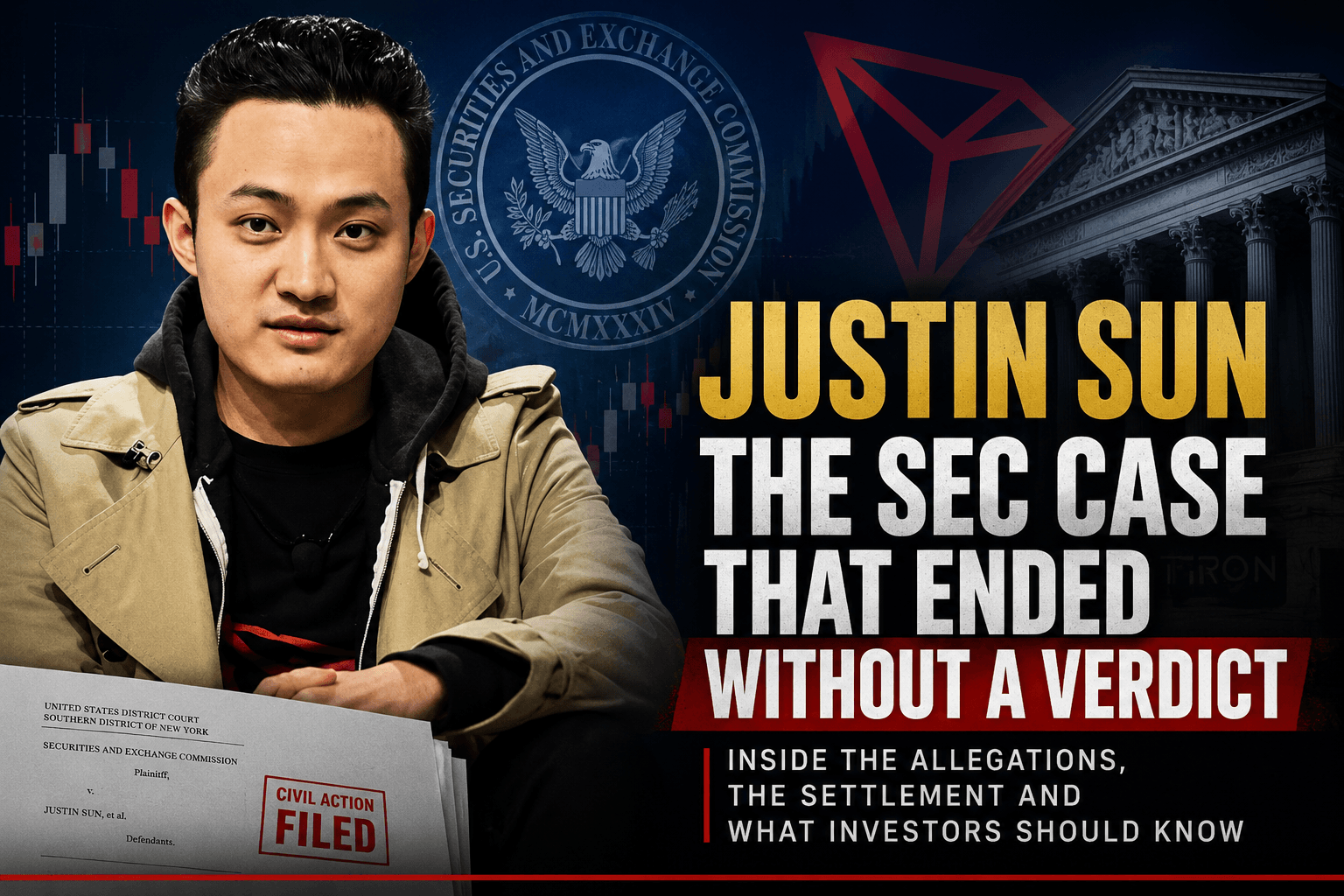
When the U.S. Securities and Exchange Commission filed a lawsuit against crypto billionaire Justin Sun in March 2023, it looked like another defining moment in Washington’s campaign against the digital asset industry. Regulators accused one of crypto’s biggest names of market manipulation, unregistered securities sales and orchestrating promotional campaigns that allegedly misled investors. Three years later, that same case quietly came to an end without a courtroom showdown. The SEC agreed to dismiss its claims against Sun, while one of his affiliated companies accepted a financial penalty to settle a remaining allegation without admitting or denying the agency’s findings. It was a conclusion that satisfied neither side completely but said a great deal about how dramatically the regulatory landscape around cryptocurrency has changed.
Sun has never been an ordinary figure in crypto. Long before regulators came knocking, he had built a reputation as someone who knew how to keep himself in the headlines. Born in Qinghai, China, in 1990, he studied history at Peking University before earning a master’s degree from the University of Pennsylvania. In 2017, he launched TRON, a blockchain project that promised to decentralize the internet by giving creators more control over digital content. The idea attracted investors during the cryptocurrency boom, and Sun quickly became one of the industry’s most recognizable entrepreneurs.
His profile only grew from there. He acquired BitTorrent, one of the internet’s oldest file-sharing platforms, appeared regularly at global crypto conferences, and became known for headline-grabbing publicity stunts. There was the multi-million-dollar charity lunch with legendary investor Warren Buffett after months of delays, expensive purchases of digital artwork, and a constant stream of announcements on social media. Admirers saw him as a relentless promoter who understood marketing better than almost anyone else in crypto. Critics argued that the hype often outpaced the substance.
By 2023, the SEC had its own concerns. In a civil complaint running dozens of pages, the agency accused Sun, the Tron Foundation, BitTorrent Foundation and Rainberry Inc. of violating federal securities laws. According to regulators, TRX and BTT tokens had been offered and sold without the registration required under U.S. securities law. The complaint also alleged that Sun directed an extensive wash trading scheme involving TRX, creating millions of trades that supposedly made the token appear far more active than it really was.
Wash trading is a relatively simple concept despite its technical name. Imagine someone buying and selling the same asset to themselves over and over again. On paper, trading activity explodes, making the market look busy and attractive. In reality, ownership has barely changed. Regulators have long viewed that kind of activity as misleading because investors often rely on trading volume to judge whether an asset is gaining popularity or liquidity. The SEC claimed that employees working under Sun’s direction carried out these transactions across cryptocurrency exchanges, artificially inflating the appearance of demand.
The lawsuit did not stop there. Regulators also accused Sun of paying celebrities to promote TRX and BTT tokens on social media without making it clear they had been compensated. Among the names listed in the complaint were actress Lindsay Lohan, rapper Soulja Boy, influencer Jake Paul, singer Akon, musician Ne-Yo, Lil Yachty, Austin Mahone and adult entertainer Kendra Lust. Most later reached settlements with the SEC, agreeing to pay penalties and disgorgement while neither admitting nor denying the allegations. The celebrity angle turned what might have been another technical securities case into front-page news, reminding investors that social media promotions are still subject to financial disclosure rules.
Sun rejected the allegations almost immediately. His lawyers argued that the SEC was trying to stretch American securities laws well beyond their intended limits by targeting a business that operated largely outside the United States. They challenged the agency’s jurisdiction, disputed the claim that TRX and BTT should be treated as securities and maintained that the complaint rested on an overly aggressive interpretation of existing law. Throughout the litigation, Sun continued expanding his business interests and publicly criticized what he described as regulation by enforcement.
As the legal fight dragged on, the crypto industry itself was changing. Several major exchanges had faced lawsuits, lawmakers were debating new digital asset legislation and political attitudes toward cryptocurrency had begun to shift. A case that once looked destined for a lengthy courtroom battle gradually became part of a much bigger conversation about whether regulators were writing policy through lawsuits instead of clearer legislation.
That changing environment became impossible to ignore in early 2025 when both sides jointly asked a federal judge to pause the proceedings. Court filings revealed they were exploring a possible resolution, although neither side disclosed what those discussions involved. The request immediately fueled speculation that the SEC’s approach toward crypto enforcement was evolving alongside broader policy changes in Washington.
The answer arrived in March 2026. Rather than continuing toward trial, the SEC announced that it would dismiss all of its claims against Justin Sun, the Tron Foundation and the BitTorrent Foundation. Rainberry Inc., however, agreed to resolve one remaining allegation tied to wash trading by paying a $10 million civil penalty. Like many SEC settlements, the agreement specifically stated that Rainberry neither admitted nor denied the commission’s allegations. The settlement still required court approval, but for all practical purposes, one of the SEC’s highest-profile crypto enforcement actions was over.
The outcome left plenty of room for competing interpretations. Supporters of Sun viewed the dismissal as proof that the government’s original case had overreached. They argued that regulators had spent years pursuing one of crypto’s most prominent entrepreneurs only to walk away before testing their allegations at trial. Sun himself welcomed the resolution, saying it reflected a more constructive relationship between innovators and regulators and expressing hope that clearer rules would eventually replace years of legal uncertainty.
Others were less convinced that the result amounted to vindication. A dismissal is not the same as a court declaring someone innocent, nor does it mean the allegations were proven false. The SEC simply chose not to continue litigating those claims. Because the case never reached trial, the evidence was never weighed by a judge or jury, and many of the factual disputes remained unresolved. Investors looking for definitive answers about what really happened never received them.
Even so, the lawsuit has already left its mark. The SEC’s complaint became one of the agency’s most detailed explanations of how it believes digital asset markets can be manipulated through wash trading, promotional campaigns and token distributions. At the same time, the eventual settlement highlighted something equally important: enforcement priorities can change just as quickly as financial markets do. Cases that begin with aggressive allegations do not always end with sweeping courtroom victories.
For investors, the story is less about one entrepreneur than the risks of an industry that still operates under evolving rules. Cryptocurrency has matured enormously over the past decade, but legal uncertainty remains one of its defining characteristics. Regulations differ across countries, enforcement strategies change with new leadership and even billion-dollar projects can spend years fighting questions that traditional financial firms settled decades ago. That uncertainty creates opportunities for innovation, but it also creates opportunities for confusion, aggressive marketing and costly mistakes.
Justin Sun remains one of the most influential figures in global crypto, and TRON continues to process billions of dollars in blockchain transactions. Yet the legal battle that shadowed his business for three years serves as a reminder that reputation, regulation and investor confidence are tightly connected. Whether people see the SEC’s decision as a retreat, a practical compromise or simply the end of an expensive legal fight, the case underscores a reality that extends far beyond one billionaire. In crypto, fortunes can be built at remarkable speed, but trust is much harder to earn—and once regulators become involved, the questions often linger long after the lawsuit itself is over.
————-
Disclaimer:
Some content on Reportingscams.com is published under our guest post program and is provided by third-party contributors. Reporting scams does not create, verify, or take responsibility for the views, accuracy, or claims expressed in such content.