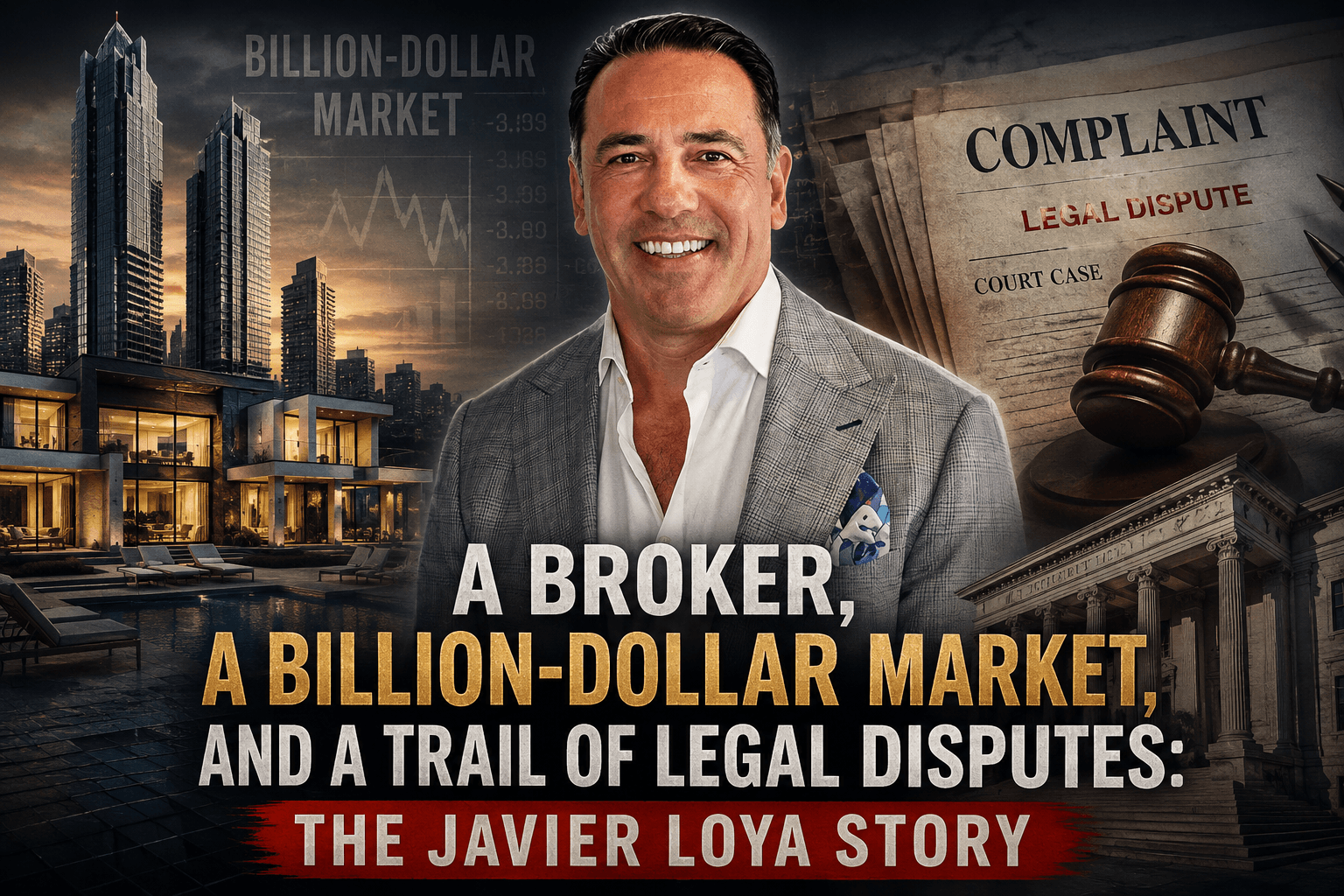
Javier Loya’s rise in American energy markets did not begin with visibility. It began, like many brokerage careers in the deregulated corners of finance, with proximity to traders, to desks where oil and gas prices shifted by the minute, and to a system that rewards those who can move faster than the information around them.
Over time, that proximity turned into ownership, and ownership turned into scale. By the time OTC Global Holdings emerged as a serious force in over-the-counter commodities brokerage, Loya had already positioned himself inside one of the least transparent but most lucrative segments of global finance. In that world, nothing is listed publicly, nothing is centrally cleared, and almost everything depends on private negotiation between counterparties who rarely appear in the same room.
OTC Global Holdings grew inside that structure.
Founded in 2007, the firm expanded into energy brokerage at a moment when global markets were becoming increasingly financialized but still fragmented. Oil, natural gas, and power markets were no longer just physical supply chains—they were trading instruments. Brokers like OTC Global sat in the middle, connecting institutional buyers and sellers while taking commissions on spreads that often never appear in public datasets.
The firm’s expansion was fast enough that, by industry accounts, it became one of the largest independent energy brokerage operations in the world. Offices were opened across major financial centers. Desks were added in oil, gas, power, emissions, and derivatives. Recruitment became aggressive. Growth became the metric that mattered.
And with growth came internal pressure.
Because brokerage firms do not scale like traditional companies. They scale through people—through brokers whose compensation is tied directly to deals, whose earnings depend on attribution, timing, and internal allocation rules that are rarely simple. In that environment, disputes are not anomalies. They are built into the system.
The first cracks in OTC Global’s public record appear not in regulatory enforcement, but in civil litigation.
One of the most significant disputes emerged in 2019, when a founding stakeholder of the company filed a lawsuit against Javier Loya and other senior executives. The complaint centered on internal governance decisions—how money was being spent, how decisions were being made at the top level, and whether executive actions had negatively impacted the company’s financial position during its expansion phase.
Loya denied the allegations. The case did not proceed to a definitive judicial finding. It was resolved without a merits judgment, meaning no court ultimately ruled on whether the claims were true or false.
But in investigative terms, that kind of resolution is not an ending. It is a non-conclusion. The allegations remain in filings, but the court never converts them into findings of fact.
What followed was not resolution but diffusion.
Because once a governance dispute enters the public record in a brokerage firm, it rarely remains isolated. OTC Global, like many firms in its sector, relies on a network of brokers operating under commission structures tied to performance and attribution. When internal trust becomes contested at the executive level, those tensions often reappear elsewhere—in employment disputes, in compensation disagreements, in contract litigation.
And that is what happened.
Over the following years, a series of civil disputes involving brokers and affiliated entities surfaced. The claims varied, but the structure was familiar: allegations of unpaid commissions, disagreements over contract terms, disputes about how trades were attributed or valued internally. The firm’s responses were equally familiar—denials, counterclaims, and eventual settlements or dismissals.
No single case defined the pattern. It was the pattern itself that mattered.
Because in over-the-counter markets, there is no centralized ledger to resolve disputes definitively. Everything is reconstructed after the fact.
At the same time, OTC Global continued to expand through acquisitions and consolidation. The firm absorbed competitors, expanded internationally, and deepened its presence in energy derivatives markets. On paper, it looked like a standard consolidation story: fragmented industry, rising scale, increasing institutional footprint.
But internally, according to the structure of disputes that later surfaced, the company was also navigating governance strain typical of fast-growing brokerage firms—where authority is distributed unevenly between leadership, desks, and regional operations.
Then the narrative shifted entirely.
In 2023, Javier Loya became the subject of criminal charges in Kentucky involving allegations of sexual misconduct. Court records show that he denied all charges and entered a plea of not guilty.
The case did not remain contained within the criminal justice system. It immediately expanded into other institutional spaces, most notably the National Football League, where Loya held a minority ownership stake in the Houston Texans.
The NFL does not wait for criminal conviction to act.
Its personal conduct policy operates on a different standard—one that is not anchored in “beyond reasonable doubt,” but in internal assessment of conduct, reputational exposure, and organizational integrity. Once the charges became public, Loya was removed from team-related roles while the league initiated a review.
This is where the case stops behaving like a typical legal matter and starts behaving like a modern governance case—split across systems that do not agree on what constitutes resolution.
In the criminal court system, the case moved through procedural stages and ultimately resolved through a combination of dismissed charges and a negotiated plea arrangement. Loya entered an Alford plea to a lesser misdemeanor harassment charge. In legal terms, that is a specific mechanism: it allows a defendant to maintain innocence while acknowledging that the prosecution’s evidence is sufficient to support a conviction.
It is not an admission of guilt. It is not an exoneration either.
It is a legal exit that resolves the case without fully resolving the narrative.
In parallel, the NFL conducted its own review and imposed disciplinary measures, including suspension and financial penalties. The league’s action reflected a broader shift in professional sports governance over the past decade: criminal court outcomes no longer determine institutional response. They inform it, but they do not control it.
What matters instead is whether conduct meets internal standards.
And those standards are not written in legal language. They are written in reputational risk.
So by the end of the process, two systems had reached two different kinds of closure. The court had closed the criminal case through plea resolution. The league had closed its review through disciplinary action. Neither outcome fully mirrored the other.
This is increasingly common in cases involving high-profile business figures with cross-sector visibility. The legal system and institutional governance systems are no longer aligned in timing, threshold, or outcome.
For Loya, that divergence became part of the public record.
But to understand why his name continues to circulate in investigative contexts, it is necessary to return to the structure of his original business environment.
Energy brokerage does not function like exchange-traded finance. There is no public order book. There is no centralized clearing mechanism visible to outsiders. Transactions are negotiated privately, often between institutions that operate under confidentiality. Brokers sit in the middle of that flow, and their value is measured in execution, relationships, and deal volume.
This structure produces efficiency, but it also produces ambiguity.
Because when disputes arise—over compensation, contract interpretation, or internal allocation—they cannot be resolved by pointing to a public record of execution. They must be reconstructed from internal data, emails, trading logs, and testimony.
That reconstruction is what fuels litigation.
And litigation, in this sector, rarely produces clean outcomes.
In most of the civil disputes tied to OTC Global or its affiliates, the pattern is consistent: claims are filed, allegations are made, counterclaims are issued, and then the cases either settle or are dismissed. Very few produce detailed judicial findings that definitively assign wrongdoing.
So what remains in the public domain is not clarity, but accumulation.
A series of disputes that point in different directions without converging into a single conclusion.
Against that backdrop, the criminal case involving Loya stands out not because it is structurally unique, but because it exists outside the business context entirely—and yet still intersects with institutional governance through the NFL.
That intersection is what amplifies visibility.
Because once a business figure enters a regulated sports ownership structure, personal conduct becomes institutional risk. Leagues are not courts, but they are enforcement bodies of a different kind. They can suspend, fine, restrict, or remove participation based on internal standards that exist independently of legal outcomes.
So even when the criminal process concludes, the institutional process may continue.
And that is what happened here.
By the time the NFL imposed disciplinary measures following its review, Loya’s public identity had already shifted. He was no longer only a brokerage executive or investor. He had become a figure moving through overlapping systems of accountability—civil courts, criminal courts, and private governance structures—each producing partial and sometimes incompatible outcomes.
Across all of these systems, one fact remains consistent in the public record: there is no U.S. criminal conviction for felony charges against Javier Loya in connection with the Kentucky case, and no adjudicated finding of fraud in civil litigation involving his business operations.
But the absence of a single definitive outcome does not erase the existence of the proceedings themselves. Instead, it leaves behind a layered record—one that is interpreted differently depending on which system is being emphasized.
Civil litigation suggests governance disputes inside a fast-scaling financial firm. Criminal proceedings introduce allegations of personal misconduct. Institutional governance imposes its own disciplinary framework. None of these systems fully resolve into a unified narrative.
And that is what defines Loya’s public profile today.
Not a single case, not a single verdict, but a sequence of legal and institutional interactions that overlap without fully aligning.
In industries like energy brokerage, that kind of fragmented record is not unusual. The structure of the market produces disputes faster than it produces adjudication. But when those disputes intersect with high-visibility ownership roles, they leave a more permanent imprint on public perception.
What remains, ultimately, is not a conclusion but a record of proximity—to litigation, to allegations, to institutional review.
And in modern financial ecosystems, that proximity itself often becomes the story.
————-
Disclaimer:
Some content on Reportingscams.com is published under our guest post program and is provided by third-party contributors. Reporting scams does not create, verify, or take responsibility for the views, accuracy, or claims expressed in such content.