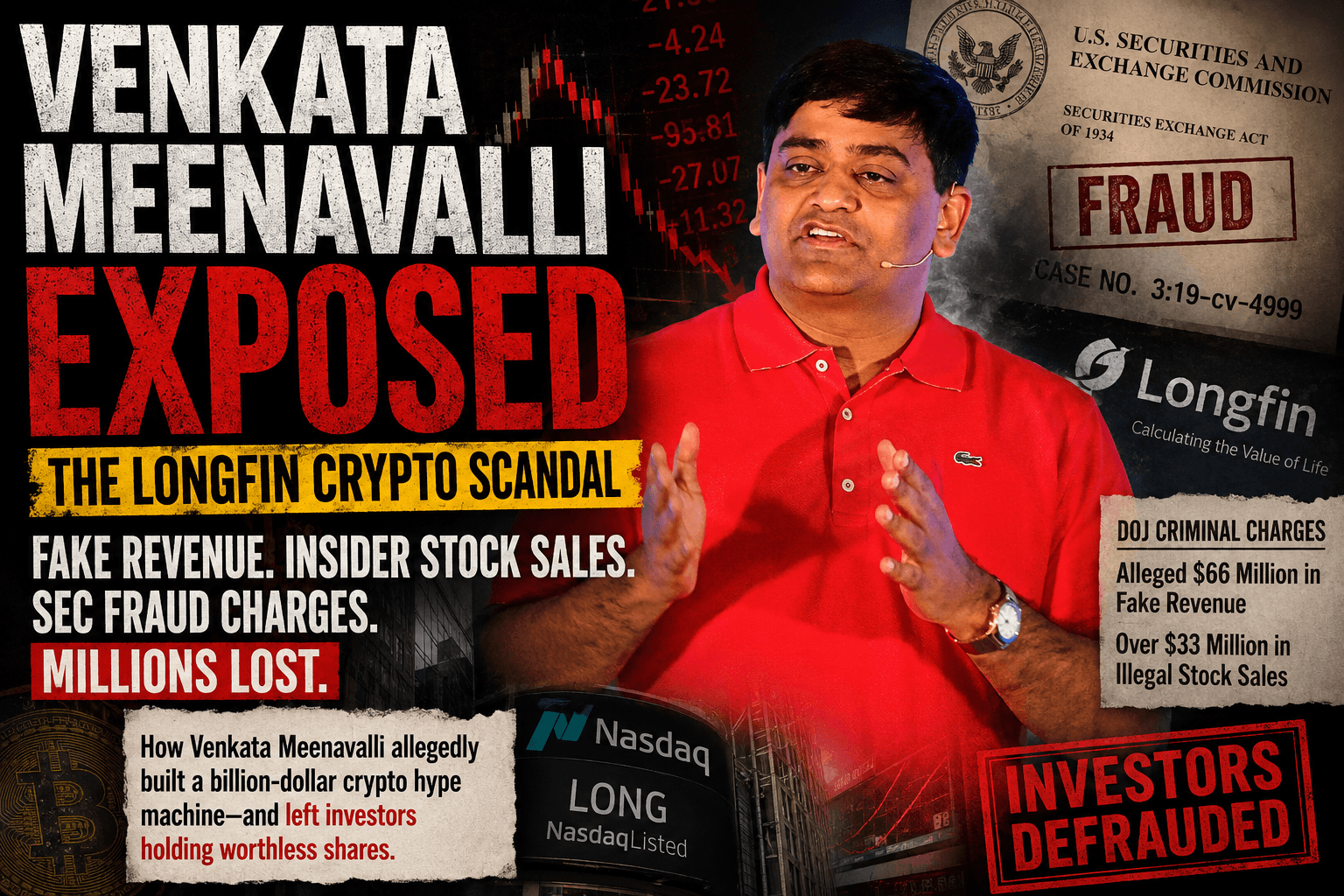
“From Nasdaq darling to crypto disaster” is how many investors now remember the rise and collapse surrounding Venkata S. Meenavalli, the Indian-origin businessman who once sold Wall Street a futuristic blockchain dream before regulators accused him of running one of the most brazen market manipulation and accounting fraud schemes tied to the 2017 crypto mania. What started as a flashy fintech success story ended with SEC fraud charges, criminal prosecution, millions of dollars frozen, allegations of sham transactions, and investors left holding near-worthless shares after one of the wildest pump-and-collapse episodes of the cryptocurrency era.
Meenavalli became the public face of Longfin Corp, a company that exploded into headlines in December 2017 after announcing the acquisition of blockchain-focused Ziddu.com. The announcement triggered an extraordinary stock frenzy. Longfin shares skyrocketed more than 2,000% in days, briefly pushing the company’s market capitalization into the billions despite questions surrounding its actual operations, revenue sources, and business model. Investors rushed in believing they had found the next major crypto success story during peak Bitcoin hysteria.
But according to U.S. regulators, the company’s spectacular rise was built on deception.
The U.S. Securities and Exchange Commission later alleged that Longfin and Meenavalli fraudulently obtained qualification for a Regulation A+ offering by falsely claiming the company was principally managed and operated in the United States when in reality major operations and management were allegedly offshore. The SEC further accused the company of manipulating Nasdaq listing requirements by distributing more than 400,000 shares to insiders and affiliates without proper payment while misrepresenting shareholder data to the exchange.
What made the allegations even more explosive was the accusation that Longfin fabricated massive portions of its revenue. According to the SEC complaint, the company recorded more than $66 million in fictitious revenue through sham commodities transactions, representing nearly 90% of the company’s reported 2017 revenue. Regulators described the transactions as essentially fake trades designed to manufacture the illusion of a booming international commodities business.
The alleged scheme became one of the most talked-about enforcement actions during the crypto boom because Longfin had aggressively marketed itself as a blockchain innovator while insiders were allegedly cashing out millions behind the scenes. In April 2018, the SEC froze more than $27 million in trading proceeds connected to allegedly illegal stock sales involving Meenavalli and his associates.
The SEC named several individuals tied to the operation, including Andy Altahawi, Dorababu Penumarthi, and Suresh Tammineedi. Authorities alleged that restricted shares were distributed through affiliates and nominees before being dumped into the public market once the stock price surged following Longfin’s crypto-related announcements. Regulators said the illegal distributions and sales generated more than $33 million.
The DOJ then escalated matters dramatically. In June 2019, federal prosecutors in New Jersey announced criminal charges against Meenavalli tied to the alleged accounting fraud and market manipulation surrounding Longfin. Prosecutors accused him of orchestrating a fraudulent scheme involving round-tripping transactions and fake revenue designed to mislead investors and inflate the company’s financial condition. The criminal case turned what had already been a civil securities scandal into a potential prison-level fraud prosecution.
By then, Longfin had already collapsed. Nasdaq suspended the stock, investor confidence evaporated, and the company ultimately shut down operations in 2018. Billions in paper market value disappeared almost as quickly as they had appeared. The same company that had once been celebrated as a crypto disruptor became an example cited by regulators warning investors about speculative blockchain hype and fraudulent public listings.
In September 2019, a federal court ordered Longfin to pay nearly $6.8 million in penalties and disgorgement after the SEC secured a default judgment. The court found that the company had fraudulently qualified for its public offering and falsified revenue through sham transactions.
Then came another devastating blow for Meenavalli personally. In January 2020, the SEC announced a settlement requiring him to pay roughly $400,000 in disgorgement, interest, and penalties. The settlement also permanently barred him from serving as an officer or director of a public company and prohibited him from participating in penny stock offerings. He additionally agreed to surrender all Longfin shares. While the settlement was reached without admitting or denying the allegations, the sanctions represented a stunning downfall for a CEO who had once marketed himself as a visionary fintech entrepreneur.
The Longfin story also exposed how “blockchain” became a magic buzzword during the 2017 crypto bubble. The company’s acquisition of Ziddu.com transformed market perception almost overnight even though critics later questioned the actual value and functionality of the platform. Investors appeared willing to overlook weak disclosures and questionable fundamentals as long as crypto terminology was attached to the business.
Several prominent names were indirectly pulled into the broader story. Reports and discussions later resurfaced regarding investments linked to Ziddu and Meridian Tech, companies associated with Meenavalli before Longfin’s implosion. Online discussions and media commentary repeatedly referenced how celebrity-linked investments and crypto excitement amplified public interest around the venture.
Even after Longfin’s collapse, controversy around Meenavalli did not entirely disappear. Recent online investor discussions in India have attempted to draw connections between Meenavalli and newer corporate ventures allegedly tied to speculative “Web3” and metaverse narratives. Some retail investor communities have claimed similarities between the Longfin playbook and later stock activity involving companies such as String Metaverse Limited, though these online allegations remain debated and not all claims have been independently verified by courts or regulators. Discussions circulating among Indian retail traders allege that individuals connected to Meenavalli resurfaced in corporate restructuring and speculative stock runs tied to metaverse branding.
What stands out most in the Longfin saga is the alleged modus operandi regulators described: use aggressive hype around emerging technology, exploit weak oversight in public listings, create the appearance of explosive growth through questionable transactions, distribute shares through insiders and affiliates, then profit while retail investors chase momentum. The SEC’s filings repeatedly pointed to manipulated shareholder counts, sham revenues, unregistered stock sales, and deceptive public disclosures as core elements of the operation.
The financial damage was enormous. Regulators pursued over $26 million in allegedly ill-gotten gains tied to stock sales, while investors saw billions in market capitalization erased after the fraud allegations surfaced. Separate court proceedings also referenced judgments and investor repayment claims reaching into the hundreds of millions of dollars after Longfin’s collapse triggered lawsuits and securities claims from shareholders who alleged they were misled.
As for Meenavalli’s current whereabouts and active role in business, publicly available information appears limited compared to the intense media spotlight during Longfin’s collapse. Since the SEC settlement and criminal proceedings, he has largely remained outside mainstream financial headlines, though his name periodically resurfaces in discussions tied to speculative public-company activity and retail investor warnings online.
The rise and destruction of Longfin remains one of the clearest examples of how the crypto gold rush created fertile ground for alleged financial engineering, inflated narratives, and regulatory arbitrage. For many burned investors, the story of Venkata Meenavalli was never simply about a failed startup. It became a cautionary tale about how hype-driven markets, weak disclosures, and insider-driven stock promotions can combine into a devastating wealth destruction machine disguised as technological innovation.
————-
Disclaimer:
Some content on Reportingscams.com is published under our guest post program and is provided by third-party contributors. Reporting scams does not create, verify, or take responsibility for the views, accuracy, or claims expressed in such content.