It looked like just another startup pitch. A cybersecurity angle, a product that supposedly couldn’t be hacked, and a founder who sounded convincing enough to get checks signed. But when regulators stepped in, the story around Adena Harmon didn’t just crack, it exposed a pattern that stretched across years, companies, and millions of dollars.
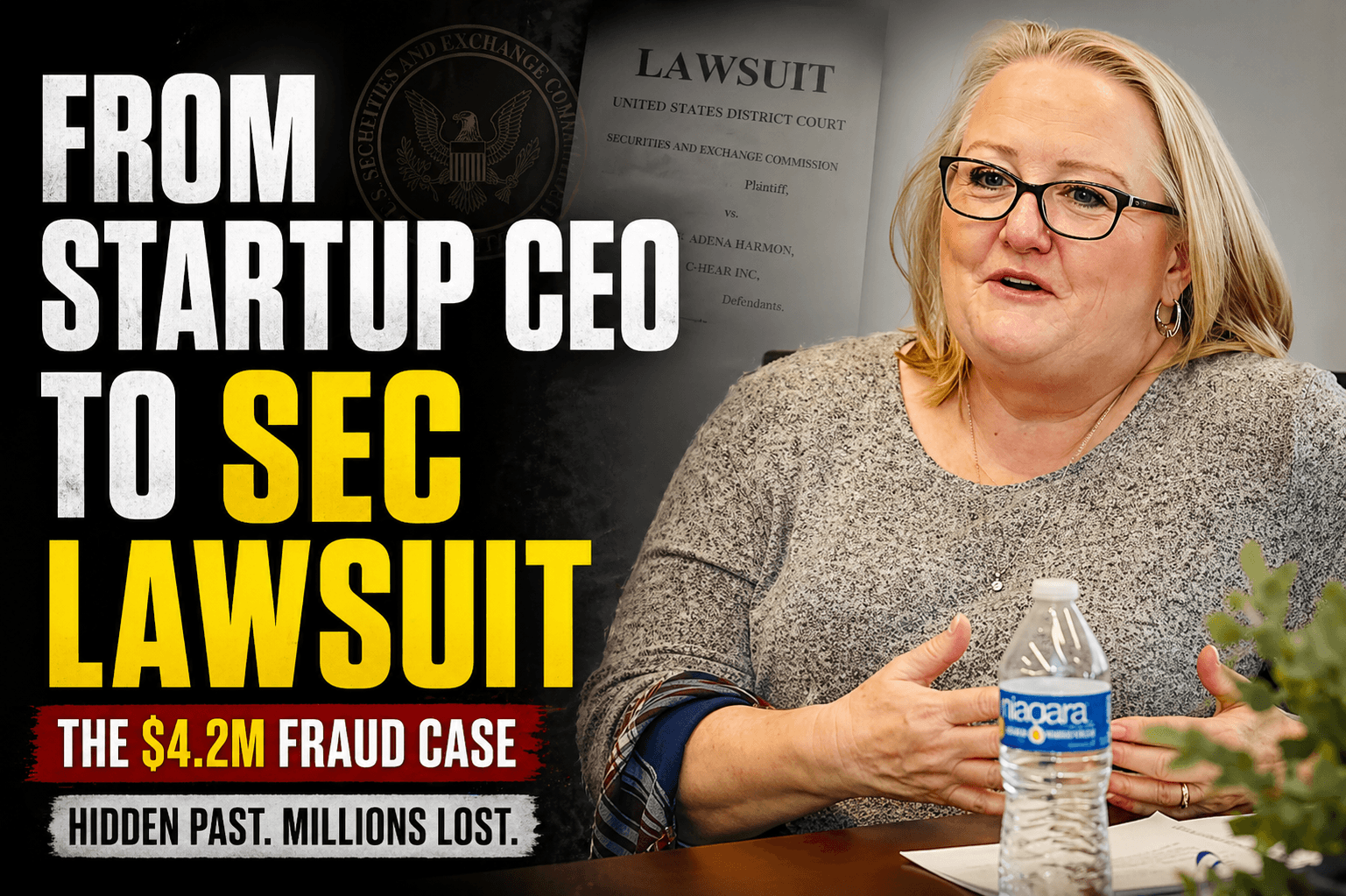
On February 19, 2026, the U.S. Securities and Exchange Commission filed a lawsuit in federal court in Texas, accusing Harmon and her company C-Hear Inc of running what it describes as a misleading investment operation. The timeline in the complaint is clear. Between January 2019 and October 2023, Harmon raised more than $4.2 million from at least 48 investors who believed they were backing a legitimate software company.
What those investors were told is where the story begins to fall apart. According to the SEC, Harmon and her team claimed that C-Hear’s flagship software was being tested by third parties and had even resisted hacking attempts by the federal government. Those claims gave the product an almost untouchable image. But regulators say those statements were false or misleading, crafted to create confidence where none actually existed.
The deception didn’t stop with the product. One of the most serious allegations is that Harmon hid her past. The SEC says she failed to disclose multiple prior criminal convictions, including financial crimes like theft by check, along with prison time tied to those offenses. For investors evaluating risk, that’s not just relevant, it’s critical. And yet, according to the complaint, it was deliberately left out of the picture.
Then comes the money trail, and this is where the case gets even more direct. The SEC alleges that Harmon opened unauthorized bank accounts in C-Hear’s name without informing the company. Investors were instructed to send their money into these accounts, believing they were official company channels. In reality, regulators say, those accounts were controlled solely by Harmon.
From there, the funds began to move. According to the SEC, roughly $641,000 of investor money was misappropriated from these accounts. Instead of being used to develop the company’s technology or operations, the money allegedly went toward personal expenses. That included shopping, lifestyle spending, and even payments tied to Harmon’s own outstanding criminal restitution obligations.
But C-Hear wasn’t the only operation tied to these allegations. Harmon also controlled another entity, Elite Performance Data Labs. And the pattern, according to regulators, repeated itself. Investors were approached with claims about major business deals, including a supposed multimillion-dollar order involving the Dallas Cowboys. The SEC says those claims were false.
Through Elite Performance, Harmon raised approximately $405,000. The SEC alleges that nearly all of that money was also misappropriated. Instead of funding any real business growth, it was allegedly diverted toward personal expenses, other ventures, and even to support C-Hear itself.
Taken together, the numbers start to tell a clearer story. Over $4.2 million raised through C-Hear. Around $641,000 allegedly diverted for personal use from that pool. Another $405,000 raised through Elite Performance, with regulators claiming most of it was also misused. These are not minor discrepancies or accounting errors. They point to a consistent pattern of how investor funds were handled.
The legal framework behind the case is equally serious. The SEC has charged Harmon with violating core antifraud provisions of federal securities law, including Section 17(a) of the Securities Act of 1933 and Section 10(b) of the Securities Exchange Act of 1934, along with Rule 10b-5. These are the same provisions used in major financial fraud cases. The agency is seeking permanent injunctions, civil penalties, and the return of allegedly ill-gotten gains with interest.
There’s also the question of timing and control. Harmon served as CEO of C-Hear from around February 2019 until July 2022, meaning she was at the center of the company during the critical fundraising period. Even after stepping down as CEO, the SEC alleges the misleading conduct and financial misuse continued into 2023.
What makes this case stand out isn’t just the money or the charges. It’s the method. According to regulators, Harmon didn’t rely on a single misrepresentation. She built layers of credibility. A technical product that sounded advanced. Claims of government-level security validation. High-profile business associations that never existed. And behind all of it, a version of her own background that left out the parts investors would have questioned first.
It’s a strategy that works because it fills in the blanks before anyone thinks to check them. Investors see traction, partnerships, and innovation. What they don’t see is the absence of verification behind those claims. And by the time questions start to surface, the money is already gone.
The case is now moving through the courts, and like all SEC enforcement actions, it will ultimately be decided there. But even at this stage, the details laid out in the complaint sketch a clear picture of how the alleged scheme operated. Raise funds on the back of inflated claims. Control where that money flows. Use it in ways investors never agreed to. Repeat the process across multiple entities.
For anyone looking at early-stage investments, this case is a reminder of how fragile due diligence can be when information is controlled by the person asking for money. Because as the allegations against Adena Harmon suggest, the biggest risk isn’t always what you see. It’s what you’re never told in the first place.
————-
Disclaimer:
Some content on Reportingscams.com is published under our guest post program and is provided by third-party contributors. Reporting scams does not create, verify, or take responsibility for the views, accuracy, or claims expressed in such content.