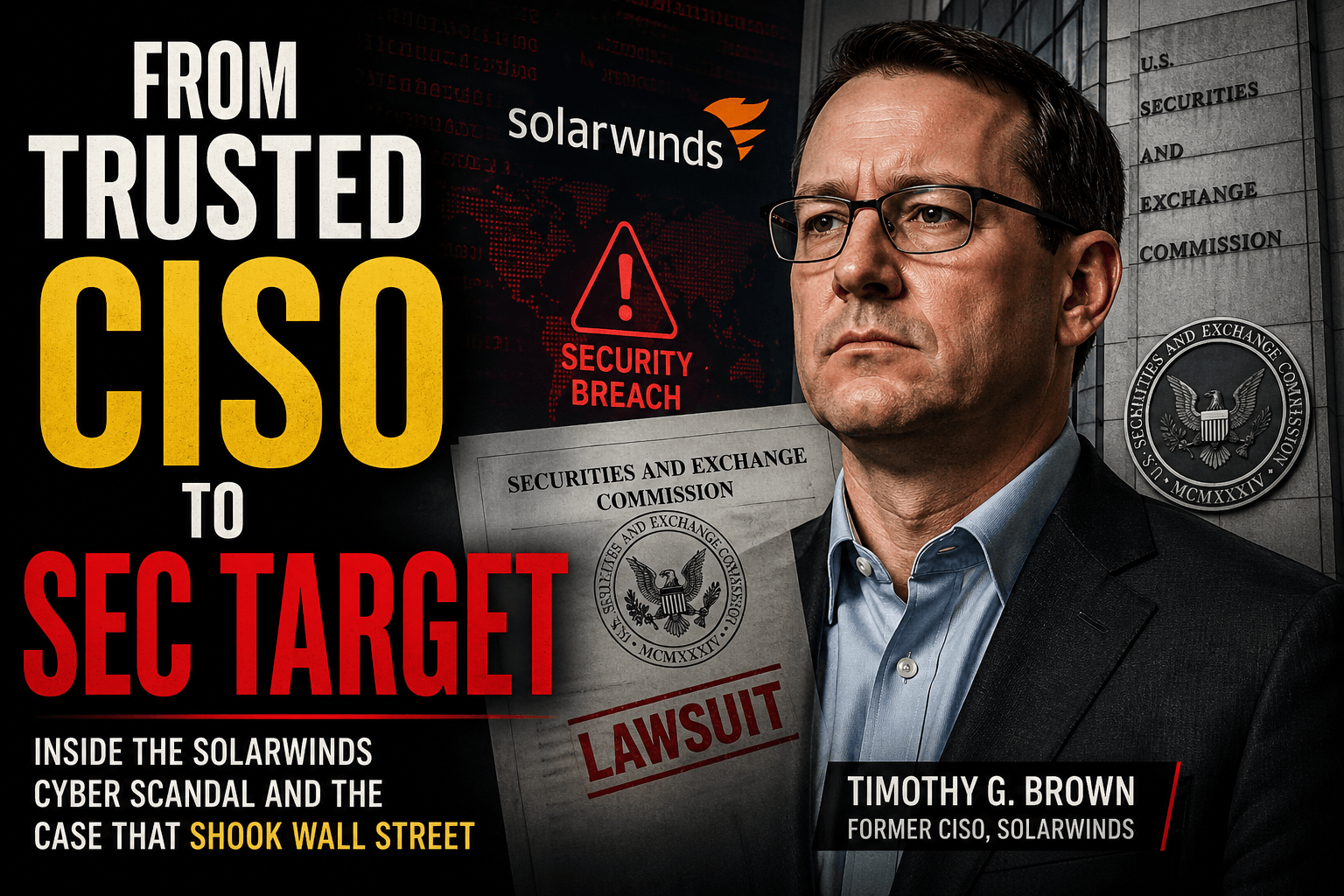
For years, cybersecurity failures were treated as quiet technical disasters. Companies patched systems, hired crisis teams, issued careful statements, then moved on. The public rarely saw the messy internal warnings that came before a breach. Investors rarely saw the gap between what executives knew privately and what companies said publicly. That wall cracked when Timothy G. Brown, SolarWinds’ former Chief Information Security Officer, became the personal face of one of the most aggressive cybersecurity enforcement cases ever brought by the U.S. Securities and Exchange Commission.
Brown was not accused of hacking SolarWinds. He was not accused of planting malicious code. The allegation was more corporate, more subtle, and in many ways more explosive. The SEC claimed that SolarWinds and Brown painted a cleaner public picture of the company’s cybersecurity posture while internal documents allegedly showed a business struggling with serious weaknesses. The case was later dismissed with prejudice in November 2025, meaning the SEC cannot bring the same case again, but the stain of the allegations did not disappear with the court filing.
The original article rightly frames Brown as the man caught in the middle of a new era of cyber accountability. But the deeper story is sharper than that. It is about a company whose software sat inside government agencies and major corporations, a breach that became one of the worst supply chain attacks in history, and a security executive whose own internal warnings were later used by regulators as evidence that SolarWinds knew more than it told the market.
SolarWinds was not an ordinary software vendor. Its Orion platform helped customers manage IT infrastructure, which meant its products had privileged access inside thousands of networks. When attackers compromised Orion software updates, the breach became a nightmare delivery system. The SEC complaint said compromised Orion products were delivered to more than 18,000 customers around the world.
That number is the heart of the scandal. This was not a small failure buried inside a forgotten department. SolarWinds sold trust. It sold access. It sold software that customers relied on to watch their own networks. When that software became the path of attack, the question was no longer just who hacked SolarWinds. The question became what SolarWinds knew before the breach, what Brown knew as its top security voice, and why investors allegedly received generic comfort language instead of the harsher internal reality.
The SEC’s October 30, 2023 complaint alleged that SolarWinds and Brown defrauded investors by overstating cybersecurity practices and understating known risks from at least the company’s October 2018 IPO through the December 2020 disclosure of the SUNBURST attack. Regulators said the company’s public filings described cyber risks as generic and hypothetical, while Brown and others allegedly knew of specific deficiencies inside the business.
The most damaging material came from SolarWinds’ own internal communications. According to the SEC, a 2018 internal presentation shared with Brown warned that the company’s remote access setup was “not very secure” and that an attacker could exploit it and operate without detection until it was too late. The SEC also pointed to Brown’s own 2018 and 2019 presentations, where he allegedly stated that the current state of security left SolarWinds in a “very vulnerable state” for critical assets and that access to critical systems and data was inappropriate.
Those are not minor complaints. They are the kind of internal warnings that make public investor language look carefully polished. According to the SEC, Brown was aware of cybersecurity risks and vulnerabilities but failed to resolve them or, at times, sufficiently escalate them inside the company. Regulators also alleged that SolarWinds could not provide reasonable assurance that its most valuable assets, including Orion, were properly protected.
The complaint went further. It alleged SolarWinds’ public Security Statement gave assurances about practices such as secure development, password protection, access controls, and cybersecurity frameworks, while the company’s real practices allegedly fell short. The SEC said those statements were materially false and misleading.
Then came the stock sales allegation. The SEC complaint said Brown exercised options and sold SolarWinds stock in 2020, receiving more than $170,000 in gross proceeds during a period when the stock price was allegedly inflated by the misconduct described in the complaint. That allegation was never proven in a final judgment, but it added a sharper edge to the case because it turned the story from weak controls into a question of personal financial benefit.
The SEC also alleged that Brown was SolarWinds’ primary cybersecurity spokesperson during the relevant period, appearing in company blogs, podcasts, press materials, and the company’s Trust Center. In the regulator’s framing, he was not some hidden technical employee buried deep in the organization. He was the public face of SolarWinds’ cybersecurity posture.
That is why the case hit the cybersecurity industry so hard. CISOs are used to being blamed inside companies when things go wrong. They are not used to being dragged into securities fraud litigation as named defendants. Brown’s case sent a blunt message to security chiefs everywhere. If your internal documents say one thing and your company tells investors another, your title may not protect you.
The legal case, however, did not end the way the SEC wanted. In July 2024, U.S. District Judge Paul Engelmayer dismissed most of the SEC’s claims, including post SUNBURST disclosure claims and broad theories around internal accounting controls. Reuters reported that the court allowed only a narrower claim tied to statements on SolarWinds’ website about security controls to survive at that stage.
By November 2025, the SEC, SolarWinds, and Brown jointly moved to dismiss the remaining case with prejudice. The SEC said the dismissal was made in the exercise of its discretion and did not necessarily reflect its position on any other case.
That dismissal matters. Brown was not found liable. The SEC’s allegations did not result in a trial verdict against him. Any hard hitting article has to say that clearly. But it also has to say something else clearly. The dismissal did not erase the internal warnings, the alleged disclosure gaps, the stock sale allegations, or the larger governance failure exposed by the SUNBURST disaster.
In the end, Brown walked away legally, but not cleanly in the court of public scrutiny. His name remains tied to the breach that forced every boardroom in America to rethink what cybersecurity disclosure really means. The SolarWinds case may have collapsed as an enforcement action, but it revealed something ugly and lasting. In modern corporate cybersecurity, the biggest danger is not always the hacker outside the gate. Sometimes it is the carefully managed silence inside the company before the attack becomes public.
————-
Disclaimer:
Some content on Reportingscams.com is published under our guest post program and is provided by third-party contributors. Reporting scams does not create, verify, or take responsibility for the views, accuracy, or claims expressed in such content.